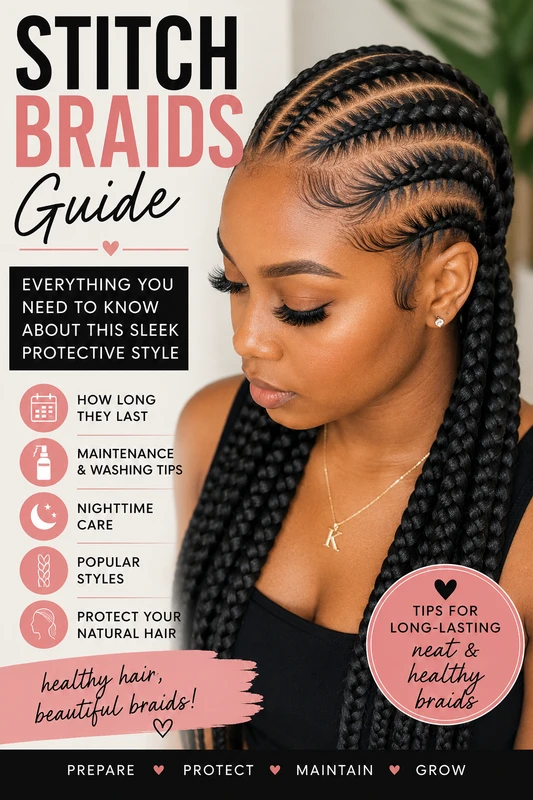
Stitch braids have become one of the most popular braided hairstyles for anyone who loves clean parts, sleek lines, and a polished protective style. Whether you prefer simple straight-back stitch braids, intricate designs, long feed-in braids, or a braided ponytail, stitch braids can create a striking look while keeping your natural hair tucked away.
For Black women in particular, stitch braids offer seemingly endless possibilities. You can wear them long or short, thick or thin, simple or detailed. They can be dressed up for special occasions or kept simple enough for an everyday hairstyle.
But getting beautiful stitch braids is only part of the process.
Preparing your natural hair correctly, avoiding excessive tension, caring for your scalp, moisturizing your hair, protecting your braids at night, and knowing when to remove the style are all important if you want your natural hair to remain healthy.
In this complete stitch braids guide, we'll cover everything you need to know about stitch braids, including how they're created, how long they last, how to prepare your hair, maintenance tips, nighttime care, washing, frizz prevention, popular styles, and how to protect your natural hair underneath.
What Are Stitch Braids?
Stitch braids are a type of cornrow hairstyle characterized by small, clean horizontal sections that create a distinctive "stitched" appearance along each braid.
Instead of simply braiding the hair backward like traditional cornrows, the stylist carefully separates small sections of hair as the braid progresses.
These sections create the signature lines that make the hairstyle look as though the hair has literally been stitched together.
Stitch braids are commonly combined with the feed-in braiding technique.
Small pieces of braiding hair are gradually incorporated into the natural hair to create longer and sometimes thicker braids.
The result is a sleek hairstyle with extremely defined parts and structured braids.
Why Are Stitch Braids So Popular?
One reason stitch braids have become so popular is their appearance.
The extremely precise sections give the hairstyle a clean, professional finish that stands out from traditional cornrows.
Stitch braids are also incredibly versatile.
They can be styled as:
- Straight-back braids
- Feed-in braids
- Ponytails
- Buns
- Side-swept braids
- Heart-shaped designs
- Zigzag patterns
- Crisscross designs
- Small stitch braids
- Jumbo stitch braids
- Half-up hairstyles
- Braided updos
A skilled braider can use the stitch technique to create dozens of different patterns.
Are Stitch Braids a Protective Hairstyle?
Stitch braids can function as a protective hairstyle when they're installed and maintained properly.
Protective hairstyles are designed to reduce daily manipulation of your natural hair.
Once your stitch braids are installed, you generally don't need to comb, brush, straighten, or restyle your natural hair every morning.
Reducing manipulation can be particularly helpful for people who experience frequent breakage.
However, simply calling a hairstyle "protective" doesn't automatically mean that it will protect your hair.
Extremely tight braids can place unnecessary stress on the scalp and hairline.
Poor maintenance can also result in excessive dryness, tangling, buildup, or breakage.
The installation technique and your maintenance routine matter tremendously.
Stitch Braids vs. Regular Cornrows
Stitch braids and traditional cornrows are similar because both involve braiding hair close to the scalp.
The biggest difference is the sectioning technique.
Traditional cornrows generally have a smoother appearance along the braid.
Stitch braids have intentionally created horizontal lines running across the sections of hair.
These lines produce the signature stitch pattern.
Stitch braids also frequently use braiding gel and feed-in extensions to create an especially sleek appearance.
Traditional cornrows can be created with or without extensions.
Stitch Braids vs. Feed-In Braids
The terms stitch braids and feed-in braids are sometimes used interchangeably, but they technically describe different techniques.
Feed-in braiding refers to gradually adding extension hair into a braid.
The technique allows the braid to start smaller near the scalp and gradually become thicker.
Stitch braiding describes the distinctive sectioning technique used while creating the braid.
Many stitch braid hairstyles use both techniques simultaneously.
For example, your stylist might create the stitch pattern with your natural hair while gradually feeding extension hair into each braid.
How Long Do Stitch Braids Last?
Stitch braids commonly last around two to six weeks, depending on your hair type, installation, lifestyle, braid size, and maintenance routine.
Some people may be able to keep their braids looking neat longer than others.
Smaller braids can sometimes maintain their appearance longer, while larger stitch braids may begin looking grown out sooner.
Your hair growth also plays a role.
As your natural hair grows, you'll begin noticing new growth around the roots.
Sweating, swimming, frequent workouts, and exposure to humidity can also cause the hairstyle to become frizzy faster.
Don't keep stitch braids installed simply because they still look acceptable.
If your scalp becomes uncomfortable or your hair begins matting underneath the style, it may be time for removal.
How Long Does It Take to Get Stitch Braids?
Installation time varies significantly depending on the style.
A relatively simple six-braid straight-back style may take only a few hours.
A more complicated hairstyle with numerous small braids and intricate patterns can take considerably longer.
Factors affecting installation time include:
- Number of braids
- Braid length
- Braid thickness
- Hair density
- Natural hair length
- Pattern complexity
- Stylist experience
- Amount of extension hair
Ask your braider for an estimated appointment time before arriving.
How to Prepare Your Natural Hair for Stitch Braids
Healthy stitch braids begin before you sit in the stylist's chair.
Preparing your hair properly can make the installation easier and help protect your natural hair while it's braided.
1. Remove Your Previous Hairstyle
If you've been wearing another protective hairstyle, carefully remove it before your appointment.
Avoid rushing through the takedown process.
Hair can become tangled around shed strands, particularly after wearing braids for several weeks.
2. Detangle Your Hair
Thoroughly detangle your natural hair before washing.
Work in sections and begin near the ends.
Gradually move toward the roots instead of pulling a comb from the scalp directly through the ends.
3. Shampoo Your Hair
Your scalp should be clean before installing stitch braids.
Braiding over a dirty scalp can trap oils, sweat, dead skin cells, and styling-product residue underneath the hairstyle.
Use shampoo to thoroughly cleanse your scalp and hair.
4. Condition Your Hair
Follow shampooing with a moisturizing conditioner.
Your hair will spend the next several weeks tucked inside the braids, so starting with properly conditioned hair is helpful.
5. Deep Condition When Necessary
If your natural hair feels particularly dry, consider deep conditioning before your braid appointment.
Follow the product's directions instead of assuming leaving a treatment on longer will automatically provide better results.
6. Stretch Your Hair
Many braiders prefer working with stretched natural hair.
Blow-drying can make sectioning easier and help the stylist create the extremely clean parts associated with stitch braids.
If using heat, consider applying an appropriate heat protectant and avoiding unnecessarily high temperatures.
Should You Trim Your Hair Before Getting Stitch Braids?
If your ends are severely split, tangled, or damaged, getting a trim before installing braids may be beneficial.
Healthy ends are generally easier to detangle and manage.
However, you don't necessarily need a haircut every time you install stitch braids.
Maintain a trimming schedule appropriate for your hair's condition and routine.
What Hair Is Used for Stitch Braids?
Many stitch braid hairstyles use synthetic braiding hair designed for feed-in styles.
The amount you'll need depends on the number, thickness, and length of the braids.
Waist-length braids will naturally require more extension hair than shoulder-length braids.
If you're visiting a professional braider, ask which type of hair they recommend before purchasing anything.
Some stylists provide braiding hair as part of their service.
Do Stitch Braids Hurt?
Properly installed stitch braids shouldn't cause severe pain.
You may feel some tension during the braiding process, but intense pulling, throbbing, burning, headaches, or persistent scalp pain shouldn't simply be ignored.
Tell your stylist immediately if the braids feel excessively tight.
This is especially important around your temples, edges, and nape.
Repeatedly wearing extremely tight hairstyles can place stress on the hair follicles.
A beautiful hairstyle isn't worth sacrificing the health of your hairline.
How Tight Should Stitch Braids Be?
Braids should feel secure without feeling painfully tight.
You should be able to move your head comfortably after your appointment.
Watch for warning signs such as:
- Persistent pain
- Headaches
- Redness
- Small bumps
- Extreme scalp tenderness
- Pulling around the edges
- Difficulty sleeping because of tension
Don't assume severe discomfort is simply part of getting your hair braided.
How to Maintain Stitch Braids
Once your braids are installed, proper maintenance can help preserve their appearance while keeping your scalp and natural hair comfortable.
Keep Your Scalp Clean
Your scalp continues producing natural oils and shedding skin cells while you're wearing braids.
You may also accumulate sweat and styling products.
Cleaning your scalp periodically can prevent excessive buildup.
Moisturize When Needed
Your natural hair can still become dry underneath braids.
Use a lightweight moisturizing product as needed, concentrating on your natural hair rather than saturating the synthetic extensions.
Avoid applying excessive amounts of heavy products.
More product doesn't necessarily mean more moisture.
Pay Attention to Your Scalp
Your scalp can tell you a lot about how the hairstyle is working for you.
Persistent itching, soreness, flaking, bumps, or unusual irritation deserves attention.
Don't repeatedly scratch your scalp with fingernails or sharp objects.
How Often Should You Moisturize Stitch Braids?
There's no universal schedule that works for everyone.
Some people may need lightweight moisture every few days, while others need it less frequently.
Consider factors such as:
- Hair porosity
- Climate
- Hair texture
- Activity level
- Products used
- How quickly your hair becomes dry
The goal isn't to keep the braids soaking wet.
You're trying to maintain comfortable, hydrated natural hair without creating excessive buildup.
Should You Oil Your Scalp With Stitch Braids?
Scalp oil isn't automatically necessary for everyone.
If you enjoy using oil and your scalp responds well to it, apply a small amount.
Avoid pouring large quantities of oil over your scalp.
Excessive oil can combine with sweat, dead skin, and product residue and contribute to buildup.
A lightweight application is usually easier to manage.
Can You Wash Stitch Braids?
Yes.
Stitch braids can be washed, particularly if your scalp becomes sweaty or develops noticeable buildup.
The key is washing gently.
Aggressive scrubbing can cause frizz and disturb the clean stitch pattern.
Diluting shampoo with water can make it easier to distribute between the braids.
Focus primarily on cleansing your scalp.
Gently massage using your fingertips rather than scratching with your nails.
Rinse thoroughly.
How Often Should You Wash Stitch Braids?
Your ideal washing frequency depends on your scalp and lifestyle.
Someone who exercises frequently and sweats heavily may need to cleanse their scalp more often than someone with a less active lifestyle.
Instead of following an arbitrary schedule, monitor your scalp.
Signs you may need cleansing include:
- Excessive buildup
- Sweat accumulation
- Unpleasant scalp odor
- Greasy roots
- Visible flakes
- Persistent itching associated with buildup
Washing too aggressively can make the style frizzy, so use gentle techniques.
How to Dry Stitch Braids
Thorough drying is extremely important after washing braids.
Braids can hold water longer than loose hair.
After rinsing, gently squeeze excess water from the braids with a clean towel.
Avoid aggressively rubbing them.
Allow enough time for the braids and your natural hair underneath to dry completely.
Avoid going to sleep with soaking-wet braids.
How to Sleep With Stitch Braids
Your nighttime routine can significantly affect how long your stitch braids stay neat.
Before bed, gently gather longer braids so they're not being pulled underneath your body while you sleep.
Cover the scalp and braided roots with a satin or silk scarf.
A bonnet can help contain longer braids.
You can also sleep on a satin or silk pillowcase for additional protection.
Reducing friction at night can help minimize frizz around the roots.
How to Keep Stitch Braids From Getting Frizzy
Some frizz is inevitable.
Natural hair grows, moves, and responds to humidity.
However, you can reduce premature frizz by:
- Covering your braids at night
- Avoiding excessive touching
- Washing gently
- Minimizing unnecessary manipulation
- Keeping the braids protected during showers
- Avoiding aggressive towel drying
- Using lightweight products
- Protecting the style during workouts
Remember that perfectly smooth braids aren't the only sign of healthy hair.
A little frizz is normal.
Stitch Braids and Exercise
You can absolutely exercise while wearing stitch braids.
In fact, braids can be convenient for active lifestyles because your hair remains contained during workouts.
Sweat, however, can accumulate on the scalp.
After a heavy workout, allow your scalp to dry rather than immediately covering damp hair with a scarf.
People who exercise frequently may also need to cleanse their scalps more often.
Can You Swim With Stitch Braids?
Yes, but swimming requires additional care.
Before swimming, thoroughly wetting your hair with clean water can reduce how much pool or salt water it immediately absorbs.
After swimming, rinse the braids thoroughly.
If you've been swimming in chlorinated water, make sure you're not repeatedly allowing chlorine residue to remain on your hair.
Dry your braids completely afterward.
Best Stitch Braid Hairstyles
One of the biggest advantages of stitch braids is versatility.
Here are several popular variations.
1. Straight-Back Stitch Braids
This is one of the cleanest and most classic versions.
The braids travel directly from the front of the scalp toward the back.
2. Six Stitch Braids
Six large stitch braids create a bold hairstyle without requiring dozens of individual braids.
3. Eight Stitch Braids
Eight braids provide slightly more detail while maintaining the classic straight-back look.
4. Small Stitch Braids
Smaller braids create additional detail and allow for more intricate patterns.
They generally require more installation time.
5. Jumbo Stitch Braids
Jumbo braids make a dramatic statement and can often be installed faster than numerous small braids.
6. Stitch Braids With Curly Ends
Leaving the ends curly adds texture and movement to the hairstyle.
7. Stitch Braids Ponytail
Braids can be directed upward toward the crown and gathered into a high ponytail.
This creates a dramatic updo suitable for everyday wear or special occasions.
8. Stitch Braids Into a Bun
Instead of leaving the braids hanging, they can be wrapped into a braided bun.
9. Side-Swept Stitch Braids
Rather than braiding everything directly backward, the braids can follow a diagonal or side-swept pattern.
10. Heart Stitch Braids
Heart-shaped braid patterns have become popular for people who want something more creative.
11. Zigzag Stitch Braids
Zigzag parts create additional visual interest between the braids.
12. Stitch Braids With Beads
Adding beads to the ends can transform a simple braid style into something more decorative.
Stitch Braids for Short Natural Hair
You don't necessarily need extremely long natural hair to get stitch braids.
A skilled braider may be able to incorporate shorter hair into feed-in braids.
However, the hair needs enough length for the stylist to grip without applying excessive tension.
If your hair is extremely short, ask your stylist whether your current length is appropriate.
Trying to force very short strands into tight braids can place unnecessary tension on the scalp.
Stitch Braids for Thick Hair
Thick natural hair works beautifully with stitch braids.
The main consideration is ensuring that sections are properly detangled and stretched before installation.
People with very dense hair may also need additional appointment time.
Stitch Braids for Fine Hair
People with fine or lower-density hair should be particularly cautious about braid weight and tension.
Extremely large extensions can place unnecessary stress on delicate strands.
Consider choosing a lightweight style and discussing your hair density with your braider beforehand.
Stitch Braids for Kids
Stitch braids can also be adapted for children.
For kids, comfort should be the priority.
Avoid extremely tight installations, overly heavy extension hair, or unnecessarily long styling sessions.
Simpler stitch patterns can create an adorable hairstyle without placing excessive tension on a child's scalp.
How to Protect Your Edges With Stitch Braids
Your edges are among the most delicate areas of your hair.
Tell your stylist if you're concerned about tension around your hairline.
The smallest hairs around the temples don't always need to be forced into the braid.
At home, avoid constantly pulling the braids into extremely tight ponytails or buns.
The initial braid installation creates tension, and repeatedly restyling the braids tightly can add even more.
Should You Use Edge Control Every Day?
Probably not.
Constantly applying thick layers of edge control can contribute to buildup around your hairline.
Frequent brushing and manipulation can also place stress on delicate edges.
Instead of trying to make your hairstyle look freshly installed every day, allow your hairline to relax.
A slightly less polished hairline can be much better than continuously manipulating fragile strands.
Common Stitch Braid Mistakes
Even a beautiful protective hairstyle can become problematic when maintained incorrectly.
Installing Braids Too Tightly
This is one of the biggest mistakes.
Pain isn't proof that your hairstyle will last longer.
Ignoring Your Scalp
Don't completely forget about your scalp simply because your hair is braided.
Using Too Much Product
Heavy layers of oil, gel, mousse, and moisturizing products can create substantial buildup.
Leaving Braids in Too Long
Trying to stretch the hairstyle for months can lead to excessive new growth, matting, tangling, and buildup.
Sleeping Without Protection
Constant friction against cotton bedding can make your roots frizzy faster.
Constantly Restyling
Frequently pulling your braids into tight buns and ponytails can add additional tension.
Signs It's Time to Remove Your Stitch Braids
Your braids don't need to look completely destroyed before you remove them.
Consider taking them down if you notice:
- Significant new growth
- Excessive buildup
- Persistent scalp discomfort
- Matting near the roots
- Excessive tangling
- Braids becoming extremely loose
- Difficulty cleaning your scalp
- Significant frizz
- Your natural hair beginning to knot together
Healthy hair should take priority over extending the life of the hairstyle.
How to Take Down Stitch Braids Safely
The takedown process deserves just as much attention as installation.
Don't rush.
First, determine where your natural hair ends before cutting any extensions.
If you're uncertain, avoid cutting close to your natural hair.
Carefully unravel each braid.
Once the braids are removed, your hair may contain a surprising amount of shed hair.
This is normal to an extent because strands that would normally fall away during daily grooming have been trapped inside the braids.
Detangling After Stitch Braids
Don't immediately jump into the shower with completely tangled hair after removing your braids.
First separate the hair into manageable sections.
Use your fingers to loosen major tangles and remove shed strands.
Apply a product that provides slip if necessary.
Then gently detangle from the ends upward.
Being patient during this stage can help prevent unnecessary breakage.
Washing Your Hair After Stitch Braids
Once you've removed and detangled the hairstyle, thoroughly cleanse your scalp and hair.
You may need a clarifying shampoo if there's substantial buildup, depending on your usual products and hair needs.
Follow cleansing with conditioner.
Many people also enjoy using a deep conditioner after removing a long-term protective style.
Should You Reinstall Stitch Braids Immediately?
You technically can, but giving your scalp and hair a break may be beneficial, particularly if the previous installation involved substantial tension.
Wear your natural hair loose or in a low-manipulation style for a period before installing another long-term protective hairstyle.
This also gives you an opportunity to examine your scalp and hairline.
How to Make Stitch Braids Last Longer
If you want to extend the neat appearance of your hairstyle without compromising hair health, focus on prevention.
Protect your hair while sleeping.
Avoid unnecessary touching.
Keep your scalp clean without aggressively scrubbing the braids.
Don't overload your hair with products.
Protect the hairstyle while showering.
Avoid constantly restyling the braids.
And most importantly, start with a high-quality installation.
A properly installed hairstyle is much easier to maintain.
Are Stitch Braids Good for Hair Growth?
Stitch braids don't magically make hair grow faster.
Your hair continues growing from the scalp whether it's braided or loose.
The potential benefit comes from length retention.
Because your hair is tucked away, you may experience less daily manipulation.
If this helps reduce breakage, you may retain more of the length your hair naturally grows.
That's different from making the follicles produce hair faster.
Your overall hair-growth potential is influenced by many factors, including genetics, nutrition, health, scalp condition, hair practices, and breakage.
Can Stitch Braids Damage Your Hair?
They can if they're installed or maintained incorrectly.
Potential problems can result from:
- Excessive tension
- Heavy extension hair
- Keeping braids installed too long
- Neglecting scalp hygiene
- Rough removal
- Excessive manipulation
- Constantly pulling braids into tight hairstyles
The technique itself isn't automatically damaging.
How the hairstyle is installed and maintained matters.
How Much Do Stitch Braids Cost?
Prices vary widely based on location, stylist experience, number of braids, complexity, length, and whether extension hair is included.
Simple straight-back styles generally cost less than elaborate patterns with numerous braids.
Before booking, ask whether the quoted price includes:
- Braiding hair
- Shampooing
- Blow-drying
- Additional length
- Design fees
- Accessories
This can prevent unexpected costs at your appointment.
Frequently Asked Questions About Stitch Braids
How long do stitch braids last?
Many people wear stitch braids for approximately two to six weeks, although longevity varies based on installation, hair growth, activity level, and maintenance.
Can stitch braids get wet?
Yes. Getting the braids wet isn't automatically harmful, but they should be dried thoroughly afterward.
Can I shower with stitch braids?
Yes. Consider wearing a shower cap when you're not intentionally washing the braids to reduce unnecessary exposure to moisture.
Can I wash stitch braids?
Yes. Focus on gently cleansing the scalp and rinsing thoroughly.
Can I sleep with stitch braids uncovered?
You can, but covering your braids with satin or silk may help reduce friction and frizz.
Are stitch braids good for natural hair?
They can be a useful low-manipulation protective style when installed without excessive tension and maintained properly.
Can stitch braids cause hair loss?
Any hairstyle that repeatedly creates excessive tension can potentially contribute to hair loss or breakage. Avoid painful installations and pay particular attention to the hairline.
Why are my stitch braids itching?
Itching can have several causes, including sweat, buildup, dryness, irritation, or sensitivity to products or extension hair. Persistent or severe irritation should be addressed rather than ignored.
How do I stop stitch braids from frizzing?
Protect the hairstyle at night, minimize manipulation, wash gently, and avoid repeatedly touching the roots.
Can you put stitch braids in a ponytail?
Yes. Stitch braids can be designed specifically as a ponytail or longer braids can sometimes be gathered after installation. Avoid pulling them excessively tight.
What is the difference between stitch braids and cornrows?
Stitch braids use intentional horizontal sections to create the distinctive stitched pattern. Traditional cornrows generally don't include these highly defined sections.
Are stitch braids suitable for thin hair?
They can be, but people with fine or low-density hair should be especially careful about tension and extension weight.
Final Thoughts: Are Stitch Braids Worth It?
Stitch braids combine precision, creativity, and convenience in one beautiful hairstyle.
The clean sections and defined braid patterns make them instantly recognizable, while the enormous variety of designs allows you to customize the hairstyle to match your personality.
More importantly, stitch braids can provide your natural hair with a break from constant styling and manipulation.
But healthy protective styling requires more than simply installing braids and forgetting about your hair.
Prepare your natural hair before installation. Choose a braider who prioritizes healthy tension. Keep your scalp clean. Moisturize according to your hair's needs. Protect your braids while sleeping. Avoid excessively tight restyling. And remove the hairstyle before severe matting and buildup develop.
When you treat the hair underneath the style as the priority, you can enjoy beautiful stitch braids without losing sight of your long-term healthy hair goals.