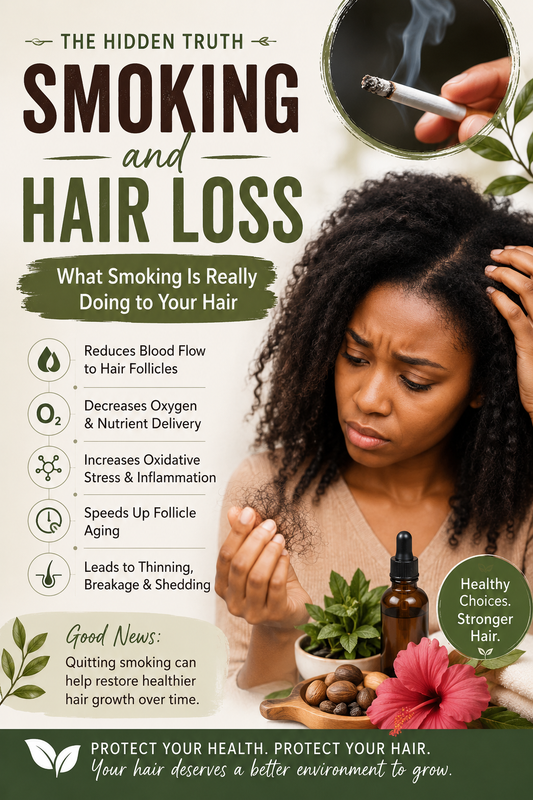
Millions of people know that smoking damages the lungs and heart, but far fewer realize it can quietly damage their hair. If you've noticed your hair becoming thinner, weaker, drier, or slower to grow, smoking could be playing a much bigger role than you think.
Hair follicles are living organs that require oxygen, nutrients, healthy blood flow, balanced hormones, and a clean environment to produce thick, healthy strands. Smoking interferes with every one of these essential processes.
Whether you wear your hair natural, curly, relaxed, braided, locked, or chemically treated, smoking places extra stress on your scalp and follicles.
The good news is that many of smoking's harmful effects begin improving after quitting. Combined with a healthy scalp care routine, proper hydration, balanced nutrition, and natural botanical hair care products, many people can support stronger, healthier hair over time.
This guide explains exactly how smoking affects hair growth, what science says, and how to protect your hair naturally.
Does Smoking Really Cause Hair Loss?
The answer is yes—but not always directly.
Smoking rarely causes hair to suddenly fall out overnight. Instead, it creates conditions inside the body that make hair growth increasingly difficult.
Smoking contributes to:
- Reduced blood circulation
- Lower oxygen delivery
- Increased inflammation
- Higher oxidative stress
- Premature follicle aging
- Hormonal disruption
- Poor collagen production
- Nutrient deficiencies
- Increased scalp dryness
Over months and years, these changes weaken the hair growth cycle.
Understanding How Hair Grows
Every strand grows through four stages:
Anagen (Growth Phase)
Hair actively grows for 2–7 years.
Catagen (Transition Phase)
Growth slows for several weeks.
Telogen (Resting Phase)
Hair rests before shedding.
Exogen (Shedding Phase)
Old hair falls out so new hair can grow.
Smoking shortens the anagen phase while increasing the number of follicles entering telogen early.
The result:
- More shedding
- Less growth
- Thinner hair
- Reduced density
Hidden Truth #1: Smoking Reduces Blood Flow to Hair Follicles
Healthy follicles depend on tiny blood vessels.
Nicotine causes blood vessels to narrow.
This process, called vasoconstriction, limits circulation throughout the body—including the scalp.
Poor circulation means follicles receive:
- Less oxygen
- Less protein
- Less iron
- Less zinc
- Fewer vitamins
- Less moisture
Over time, weakened follicles produce thinner hairs.
Hidden Truth #2: Less Oxygen Means Slower Hair Growth
Every growing follicle requires oxygen.
Cigarette smoke contains carbon monoxide.
Carbon monoxide replaces oxygen in red blood cells.
Less oxygen reaches:
- Hair roots
- Scalp tissue
- Skin cells
- Blood vessels
Without enough oxygen, follicles struggle to stay in the growth phase.
Hidden Truth #3: Smoking Creates Massive Oxidative Stress
Smoking releases thousands of harmful chemicals.
Many become free radicals.
Free radicals damage:
- DNA
- Cell membranes
- Proteins
- Hair follicle cells
This process is called oxidative stress.
Oxidative stress accelerates aging throughout the body—including your scalp.
Hidden Truth #4: Smoking Ages Hair Follicles Faster
Hair follicles naturally age.
Smoking speeds that process dramatically.
Older follicles produce:
- Smaller hairs
- Finer strands
- Shorter growth cycles
- Less pigment
This explains why smokers often experience:
- Earlier thinning
- Earlier graying
- Reduced hair density
Hidden Truth #5: Smoking Increases Inflammation
Healthy follicles prefer a calm scalp.
Smoking increases inflammatory chemicals throughout the body.
Chronic inflammation may:
- Damage follicles
- Slow healing
- Increase shedding
- Irrate the scalp
Inflammation also contributes to several types of hair loss.
Hidden Truth #6: Smoking Damages Collagen
Collagen supports:
- Hair follicles
- Skin
- Blood vessels
- Connective tissue
Smoking breaks down collagen faster than the body can replace it.
Poor collagen equals weaker scalp support.
Hidden Truth #7: Smoking May Affect Hormones
Smoking influences hormones involved in hair growth.
Hormonal disruption may affect:
- Testosterone
- Estrogen
- Cortisol
These changes may worsen hereditary hair thinning in some people.
Hidden Truth #8: Smoking Increases Scalp Dryness
Many smokers notice:
- Dry scalp
- Tight scalp
- Flaking
- Irritation
Reduced circulation and dehydration make it harder for the scalp to maintain moisture.
Hidden Truth #9: Smoking Can Increase Dandruff
Smoking weakens the skin barrier.
This makes the scalp more vulnerable to irritation.
A dry, unhealthy scalp creates conditions where flakes and itchiness may become worse.
Hidden Truth #10: Smoking May Speed Up Gray Hair
Studies consistently associate smoking with premature graying.
Oxidative stress damages pigment-producing cells called melanocytes.
Less pigment means:
- Earlier gray hair
- Faster color loss
Smoking and Male Pattern Hair Loss
Men with a genetic tendency toward male pattern baldness may experience faster progression if they smoke.
Smoking can:
- Increase follicle inflammation
- Reduce circulation
- Increase oxidative stress
These factors may accelerate existing hair loss.
Smoking and Female Hair Loss
Women who smoke may notice:
- Wider parts
- Reduced density
- Increased shedding
- Slower regrowth
Hormonal changes combined with poor circulation make recovery more difficult.
Smoking and Natural Hair
Natural curls depend on moisture and strength.
Smoking promotes dryness and brittleness.
You may notice:
- More breakage
- Split ends
- Frizz
- Reduced elasticity
Smoking and Protective Styles
Braids, twists, wigs, and sew-ins protect hair—but follicles still need healthy circulation.
Smoking weakens follicles underneath protective styles.
Healthy scalp care remains essential.
Smoking and Locs
Locs can become:
- Dry
- Brittle
- Lightweight
- Thinner at the roots
Healthy scalp circulation remains one of the most important factors for maintaining strong locs.
Smoking and Edge Thinning
Edges contain delicate follicles.
Reduced circulation often affects these fragile areas first.
Smoking may contribute to:
- Thinning temples
- Weak baby hairs
- Slow edge regrowth
Smoking and Hair Breakage
Not every lost strand comes from the root.
Smoking also weakens hair fibers.
This leads to:
- Breakage
- Split ends
- Rough texture
- Poor elasticity
Smoking and Nutrient Deficiencies
Smoking reduces levels of several nutrients important for healthy hair, including:
- Vitamin C
- Vitamin E
- Folate
- Zinc
- Selenium
Lower nutrient levels make hair recovery more difficult.
Signs Smoking May Be Affecting Your Hair
Common warning signs include:
- Hair shedding more than usual
- Hair feels thinner
- Slow growth
- Dry scalp
- Brittle strands
- Weak edges
- Increased breakage
- Dull appearance
- Early gray hairs
Can Hair Recover After Quitting Smoking?
In many cases, yes.
Hair follicles often respond positively once circulation and oxygen delivery improve.
Recovery depends on:
- Age
- Genetics
- Overall health
- Length of smoking history
- Nutrition
- Stress levels
- Existing hair conditions
Patience is important because hair grows slowly.
How Long Does Recovery Take?
Although everyone is different:
First Few Weeks
- Improved circulation begins
- Oxygen levels improve
2–4 Months
- Reduced inflammation
- Healthier scalp environment
6–12 Months
- Stronger hair growth may become noticeable
- Less shedding
- Improved density in some individuals
Natural Ways to Support Hair After Quitting
Stay Hydrated
Water supports circulation and scalp hydration.
Aim for consistent hydration every day.
Eat More Protein
Hair is primarily made of protein.
Choose foods like:
- Eggs
- Fish
- Beans
- Lean poultry
- Greek yogurt
Increase Fruits and Vegetables
Antioxidants help combat oxidative stress.
Colorful produce supplies vitamins that support healthy hair.
Massage the Scalp
Gentle scalp massage may encourage blood flow and relaxation.
Massage for a few minutes several times a week.
Exercise Regularly
Exercise naturally improves circulation throughout the body, including the scalp.
Prioritize Sleep
Hair repair occurs during rest.
Aim for 7–9 hours of quality sleep each night.
Reduce Stress
Stress itself can contribute to shedding.
Helpful habits include:
- Walking
- Meditation
- Deep breathing
- Prayer
- Journaling
Use Gentle Hair Care
Avoid excessive heat, harsh chemicals, and tight hairstyles that increase breakage.
Choose moisturizing products formulated with nourishing botanical ingredients that support a healthy scalp environment.
Myths About Smoking and Hair Loss
Myth: Only Heavy Smokers Lose Hair
Even light smoking exposes follicles to harmful chemicals.
Myth: Vaping Is Completely Safe for Hair
While vaping eliminates some substances found in cigarette smoke, nicotine itself can still constrict blood vessels and may negatively affect circulation.
Myth: Hair Loss Stops Immediately After Quitting
Hair recovery is gradual because follicles need time to complete their natural growth cycles.
Myth: Smoking Only Causes Gray Hair
Smoking affects much more than pigment.
It can influence circulation, inflammation, collagen, moisture, and follicle health.
Frequently Asked Questions
Can secondhand smoke affect hair?
Long-term exposure may contribute to increased oxidative stress and poor overall health, although direct smoking has a much stronger effect.
Does smoking cigars affect hair?
Yes. Any tobacco product that delivers nicotine and harmful combustion chemicals may negatively affect hair health.
Can quitting smoking make hair thicker?
If smoking contributed to thinning, quitting may improve the environment for healthier hair growth over time. Results vary by individual.
Is smoking linked to alopecia?
Smoking may worsen certain types of hair loss by increasing inflammation and oxidative stress, but it is usually not the sole cause.
Does smoking slow hair growth?
Yes. Reduced circulation and oxygen delivery can slow the growth process.
Final Thoughts
Smoking affects much more than your lungs—it can quietly damage the health of your scalp and hair follicles. Reduced blood flow, oxidative stress, inflammation, collagen breakdown, dehydration, and nutrient depletion all work together to create an environment where hair struggles to thrive.
If you've been experiencing increased shedding, slower growth, dry strands, or thinning edges, smoking may be one of several contributing factors. Quitting smoking, staying hydrated, eating a nutrient-rich diet, managing stress, and following a consistent, gentle hair care routine can help support healthier hair over time.
Healthy hair begins with a healthy body. By protecting your overall wellness and caring for your scalp with quality botanical products, you give your hair the best possible opportunity to grow stronger, fuller, and more resilient—naturally.