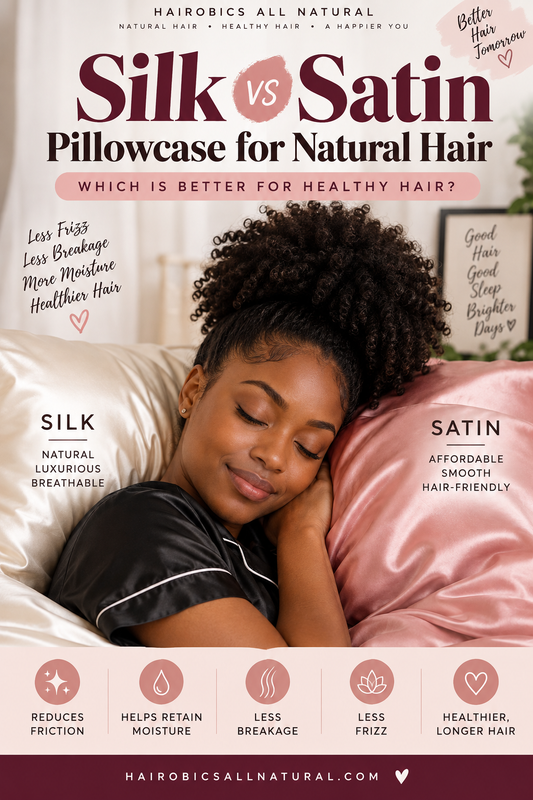
If you have natural hair, what you sleep on can be almost as important as the products you put in your hair. You can follow a moisturizing routine, deep condition regularly, protect your ends, and carefully detangle your hair, but sleeping on the wrong pillowcase night after night may still contribute to dryness, tangles, frizz, and breakage.
This is why silk and satin pillowcases have become so popular for natural hair.
Unlike traditional cotton pillowcases, silk and satin provide smoother surfaces that allow your hair to move more freely while you sleep. This can be especially beneficial for Black hair, curly hair, coily hair, locs, braids, twists, and other textured hairstyles that may be more vulnerable to friction and moisture loss.
But there is an important question:
Is silk or satin better for natural hair?
Although the two materials are often discussed as if they are identical, silk and satin are not actually the same thing. They can differ significantly in material, construction, price, durability, maintenance, and overall sleeping experience.
The good news is that both can be excellent options for protecting natural hair at night.
In this complete guide, we'll compare silk vs satin pillowcases for natural hair, explain the advantages and disadvantages of each, and help you decide which option deserves a place in your nighttime hair-care routine.
What Is a Silk Pillowcase?
Silk is a natural protein fiber traditionally produced by silkworms.
For centuries, silk has been valued for its exceptionally smooth texture, lightweight feel, and luxurious appearance.
When woven into fabric, high-quality silk creates a soft surface with relatively little friction. This is one of the main reasons silk pillowcases have become popular among people trying to protect their hair while sleeping.
Instead of your curls, coils, or strands constantly rubbing against a rough surface, they can slide more easily across silk.
For natural hair, reducing unnecessary friction can be extremely valuable.
Hair experiences movement throughout the night. Even if you think you sleep relatively still, your head may move against your pillow dozens of times.
If your hair is rubbing against a rough or absorbent surface for seven or eight hours every night, that repeated friction can contribute to tangling, frizz, and mechanical damage over time.
A silk pillowcase provides a smoother sleeping surface.
What Is a Satin Pillowcase?
Satin is often confused with silk, but they aren't necessarily the same thing.
Silk is a fiber, while satin refers primarily to a type of weave.
Satin fabric can be produced using several different fibers.
Many affordable satin pillowcases are made from synthetic materials such as polyester. Other satin fabrics may be made from nylon, rayon, silk, or blends.
The satin weaving technique creates a smooth, glossy surface with relatively low friction.
This means you don't necessarily need a pure silk pillowcase to get many of the nighttime hair-protection benefits associated with smooth bedding.
A good-quality satin pillowcase can provide a slippery surface that allows natural hair to glide more easily while you sleep.
For many people, satin offers one of the most affordable ways to upgrade their nighttime natural hair routine.
Silk vs Satin Pillowcase for Natural Hair: Quick Comparison
Both materials can be beneficial, but they aren't identical.
Silk Pillowcase
Advantages:
- Extremely smooth
- Natural fiber
- Luxurious feel
- Gentle against curls and coils
- Helps reduce friction
- Can help protect hairstyles
- Generally breathable
- Comfortable for many sleepers
Disadvantages:
- Usually more expensive
- May require delicate washing
- Can be easier to damage
- Quality varies considerably
Satin Pillowcase
Advantages:
- Smooth sleeping surface
- Helps reduce hair friction
- Usually inexpensive
- Widely available
- Often easy to wash
- Can be durable
- Excellent option for natural hair
- Great for people on a budget
Disadvantages:
- Many satin pillowcases are synthetic
- Some can feel warmer
- Quality varies significantly
- Cheap satin may snag or become rough over time
For protecting natural hair, either can work very well.
The biggest differences generally come down to fiber, quality, price, breathability, durability, and personal preference.
Why Your Pillowcase Matters for Natural Hair
Natural hair often requires special attention to moisture retention and mechanical damage.
Curly and coily strands have bends and curves throughout the hair shaft. These structures can make it harder for natural scalp oils to travel evenly from the roots to the ends.
As a result, the ends of natural hair may become dry relatively easily.
Your ends are also the oldest part of your hair.
If your hair is several years old, the ends have experienced years of washing, styling, detangling, environmental exposure, and friction.
Protecting those ends becomes particularly important when you're trying to retain length.
Your nighttime routine represents a major portion of your hair-care schedule.
If you sleep approximately eight hours per night, you're spending around one-third of your life sleeping.
That's a lot of time for your hair to interact with your pillow.
Changing the surface your hair rests against can therefore be a simple but meaningful addition to your natural hair routine.
1. Silk and Satin Can Reduce Friction
One of the biggest benefits of both silk and satin pillowcases is reduced friction.
Imagine rubbing a delicate strand of hair repeatedly against a rough piece of fabric.
Eventually, that friction may contribute to:
- Frizz
- Tangling
- Knots
- Split ends
- Roughness
- Hairstyle disruption
- Mechanical breakage
Natural hair can be particularly vulnerable when it is already dry or damaged.
Silk and satin provide smoother surfaces.
Instead of strands repeatedly catching against the fabric, the hair can move more freely as you change sleeping positions.
Less friction doesn't mean your hair becomes immune to breakage.
But reducing unnecessary friction is one practical way to make your nighttime routine gentler.
2. Silk and Satin May Help Natural Hair Retain Moisture
Moisture retention is one of the most important parts of natural hair care.
Cotton is an absorbent fiber.
While this property makes cotton useful for towels, it isn't necessarily ideal when you're trying to preserve the moisture and oils in your hair overnight.
A smooth silk or satin pillowcase generally provides a less absorbent-feeling sleeping surface than traditional cotton bedding.
That can be useful after applying:
- Leave-in conditioner
- Hair oil
- Moisturizing cream
- Hair butter
- Scalp treatments
- Lightweight hair moisturizers
The goal isn't to keep your hair wet overnight.
Instead, you're trying to prevent unnecessary dryness while maintaining a healthy moisture balance.
If you frequently wake up with hair that feels much drier than it did before bed, your pillowcase may be one factor worth considering.
3. They Can Help Reduce Morning Frizz
You go to sleep with beautifully defined curls.
You wake up looking like you fought your pillow all night.
Sound familiar?
Morning frizz can occur for many reasons, including humidity, styling products, moisture levels, and movement during sleep.
Friction can also play a role.
When curls constantly rub against fabric, individual strands may separate from their curl pattern.
A smoother pillowcase allows your curls to move with less resistance.
You may still need to refresh your hair in the morning, but your hairstyle can potentially require less manipulation.
And less manipulation can be beneficial when you're trying to prevent unnecessary breakage.
4. Silk and Satin Can Help Preserve Hairstyles
A silk or satin pillowcase isn't only useful for loose natural hair.
It can also be helpful when wearing protective or low-manipulation styles such as:
- Two-strand twists
- Mini twists
- Braids
- Box braids
- Knotless braids
- Cornrows
- Bantu knots
- Locs
- Wash-and-gos
- Twist-outs
- Braid-outs
- Roller sets
- Puffs
Sleeping on a smoother surface may help reduce friction against the hairstyle.
For example, braids constantly rubbing against rough bedding may develop frizz more quickly.
Twist-outs can lose definition.
Locs may attract lint from certain fabrics.
A smoother pillowcase creates another layer of nighttime protection.
5. Silk and Satin Can Help Protect Your Edges
Your edges deserve special attention.
Hair around the hairline can be finer and more vulnerable to mechanical stress than other areas of the scalp.
Most people immediately think about tight hairstyles when discussing edge damage.
That's certainly important, but nighttime friction shouldn't be ignored.
Depending on your sleeping position, the sides and front of your hair may repeatedly rub against your pillow.
A smoother surface can help minimize unnecessary friction around these delicate areas.
Of course, switching pillowcases cannot repair severe hair loss or address an underlying medical issue.
But reducing friction is a reasonable preventive hair-care practice.
6. They Can Help Reduce Single-Strand Knots
Single-strand knots are a common frustration for people with tightly curled or coily hair.
Sometimes called fairy knots, these tiny knots occur when a strand curls around itself and forms a knot.
You can't prevent every single-strand knot.
The natural structure of curly and coily hair makes them difficult to eliminate completely.
However, reducing tangling and friction may help minimize the conditions that encourage excessive knotting.
Combining a satin or silk pillowcase with stretched hairstyles, regular detangling, moisturization, and trimmed ends can create a more effective strategy for controlling knots.
Is Silk Better Than Satin for Natural Hair?
Not necessarily.
Silk is often marketed as the premium choice, and high-quality silk certainly has advantages.
However, a good satin pillowcase can provide many of the same practical hair-protection benefits at a much lower price.
For most people, the main objective is reducing friction.
Both silk and satin can accomplish that.
Your decision should therefore depend on factors such as:
- Budget
- Fabric quality
- Breathability
- Durability
- Washing requirements
- Personal comfort
- Hair type
- Sleeping temperature
If you love luxury bedding and don't mind paying more, silk may be worth the investment.
If your primary goal is simply protecting your natural hair without spending much money, satin is an excellent choice.
Silk Pillowcase Benefits for Natural Hair
Let's examine silk more closely.
Exceptionally Smooth Texture
High-quality silk feels incredibly smooth against the skin and hair.
This allows strands to move more freely during sleep.
For people experiencing frequent tangling or morning frizz, this smoothness can make silk particularly appealing.
Natural Fiber
One of the biggest distinctions between silk and many satin pillowcases is fiber composition.
Silk is naturally derived.
Many satin pillowcases are made from polyester.
Some people simply prefer sleeping on natural fibers.
Breathability
High-quality silk can provide good breathability.
This may be particularly valuable for people who sleep hot.
However, the actual sleeping experience also depends on fabric thickness, weave, bedding, room temperature, and individual preferences.
Luxurious Feel
There is no denying that silk has a premium feel.
A high-quality silk pillowcase can transform your bed into a much more luxurious sleeping environment.
That isn't necessarily a hair benefit, but comfort matters.
If you enjoy using your pillowcase, you're more likely to use it consistently.
Satin Pillowcase Benefits for Natural Hair
Satin has some major advantages of its own.
Affordable
This is probably satin's biggest advantage.
You can often purchase several satin pillowcases for the price of one high-quality silk pillowcase.
That makes satin accessible for almost every natural hair budget.
Easy to Replace
Pillowcases need regular washing.
Over time, fabric can wear down.
Because satin pillowcases are inexpensive, replacing worn ones isn't usually a major expense.
Convenient for Travel
A satin pillowcase is extremely easy to pack.
If you're staying at a hotel, vacation rental, or someone's home, bringing your own pillowcase allows you to maintain your nighttime hair routine.
Fold one into your suitcase and you have an instant hair-friendly sleeping surface wherever you go.
Excellent for Children
Parents caring for children's natural hair may also appreciate satin pillowcases.
Children may not keep bonnets on throughout the night.
A satin pillowcase provides backup protection even if the bonnet ends up somewhere across the room by morning.
Silk vs Satin for 4C Hair
For 4C hair, both silk and satin are excellent choices.
4C hair has tightly coiled strands that can experience shrinkage, tangling, dryness, and breakage.
Reducing friction at night can therefore be especially useful.
A nighttime 4C hair routine might include:
- Lightly moisturizing the hair if necessary.
- Sealing the ends with an appropriate oil or butter when desired.
- Dividing the hair into loose twists or braids.
- Covering the hair with a satin or silk bonnet.
- Sleeping on a silk or satin pillowcase.
Using both a bonnet and smooth pillowcase provides backup protection.
If your bonnet comes off while you sleep, your hair isn't immediately rubbing against cotton bedding.
Silk vs Satin for Type 3 Curly Hair
Type 3 curls can also benefit from a smoother pillowcase.
People with curly hair often struggle with preserving curl definition overnight.
A silk or satin surface may help reduce friction that can disrupt curls.
Try combining your pillowcase with the pineapple method.
Gather your curls loosely toward the top of your head using a soft scrunchie.
Avoid pulling the hair tightly.
Sleep on your satin or silk pillowcase and gently release the hair in the morning.
You may find that fewer curls need refreshing.
Silk vs Satin for Locs
Locs can also benefit from nighttime protection.
Constant friction against cotton bedding can contribute to fuzziness and may expose locs to lint from bedding.
Silk or satin pillowcases provide smoother alternatives.
People with longer locs may particularly appreciate the reduced friction because their hair covers a larger portion of the pillow.
You can also combine your pillowcase with a satin bonnet, scarf, or loc cap.
Silk vs Satin for Braids
Both materials work well with braids.
Braids can become frizzy as the natural hair begins escaping from the style.
Some frizz is unavoidable.
However, rough nighttime friction may accelerate the process.
Sleeping on satin or silk can help your braids move more freely against the pillow.
For additional protection, tie the braids down with a satin scarf or bonnet before bed.
Silk vs Satin Pillowcase for Hair Growth
This is where we need to separate marketing from reality.
A silk or satin pillowcase does not directly make your hair follicles grow faster.
Hair growth occurs at the follicle.
Your pillowcase cannot magically increase your biological hair-growth rate.
However, pillowcases can potentially play an indirect role in your length-retention strategy.
Here's why.
Imagine your hair grows steadily at the roots, but the ends continuously break.
You may feel as though your hair isn't growing because you're losing length almost as quickly as you're gaining it.
Reducing friction may help decrease unnecessary mechanical stress.
Less breakage can mean better length retention.
Better length retention allows you to actually see more of the growth your scalp is already producing.
Therefore, satin and silk pillowcases should be considered hair-protection tools rather than hair-growth treatments.
Satin Pillowcase vs Bonnet: Which Is Better?
Why choose?
You can use both.
A bonnet keeps the hair contained and protected.
A satin pillowcase protects the hair if the bonnet moves or falls off.
Using both creates a simple nighttime protection system.
This is particularly helpful for restless sleepers.
If you constantly wake up without your bonnet, a satin pillowcase is almost essential.
You can also look for bonnets with adjustable or wider bands to improve comfort and fit.
Can You Sleep on Satin Without a Bonnet?
Absolutely.
A satin pillowcase can be used by itself.
This is especially convenient for people who dislike wearing bonnets.
However, whether that's enough depends on your hairstyle.
Long natural hair, braids, or locs may still benefit from being loosely contained at night.
For shorter natural hairstyles, simply sleeping on satin may provide sufficient friction reduction.
Experiment and see what works best for your hair.
What About Cotton Pillowcases?
Cotton isn't inherently "bad."
It's comfortable, breathable, washable, affordable, and widely available.
The issue is that traditional cotton pillowcases generally create more friction and absorb more moisture than smooth silk or satin surfaces.
That difference may matter if you have:
- Very dry hair
- High-friction hairstyles
- Fragile ends
- Frequent tangles
- Significant morning frizz
- Breakage
- Delicate edges
You don't necessarily have to replace all your bedding.
Simply replacing your main pillowcase with silk or satin can be enough.
How to Choose a Silk Pillowcase for Natural Hair
If you're purchasing silk, don't automatically choose the first product labeled "silk."
Look at the actual fiber composition.
Some products use words such as "silky," which describe texture rather than material.
If you specifically want genuine silk, verify the label.
Mulberry silk is one of the most common types used in premium pillowcases.
You'll also encounter the term momme, which is a measurement related to silk fabric weight.
Higher isn't automatically better for every person, but pillowcases often balance durability and softness in the mid-range momme levels.
The construction and quality of the fabric matter just as much as the marketing language.
How to Choose a Satin Pillowcase for Natural Hair
Satin shopping can be simpler.
Look for a pillowcase that feels:
- Smooth
- Soft
- Consistent
- Free from rough seams
- Free from snagging
- Comfortable against your skin
You don't necessarily need the most expensive option.
The entire point is to create a smooth sleeping surface.
If the fabric feels rough or catches your fingers when you run your hand across it, consider another pillowcase.
How Often Should You Wash a Silk or Satin Pillowcase?
Regular washing is important.
Your pillowcase collects:
- Hair products
- Natural oils
- Sweat
- Skin oils
- Dust
- Dead skin cells
- Environmental debris
A reasonable starting point is washing your pillowcase about once a week, although you may prefer more frequent washing depending on your scalp, skin, sweating, and product use.
Always follow the manufacturer's care instructions.
Silk often requires gentler washing than synthetic satin.
Some silk pillowcases may need cold water, delicate detergent, gentle cycles, hand washing, or air drying.
Polyester satin is often easier to maintain.
Should You Apply Hair Oil Before Sleeping on Silk or Satin?
You can, but moderation matters.
More oil doesn't automatically mean healthier hair.
Applying excessive oil may create buildup on both your hair and pillowcase.
Instead, use the amount your hair actually needs.
Focus especially on areas that tend to become dry, such as your ends.
If your scalp already produces enough oil or becomes greasy easily, you may not need additional scalp oil every night.
Your nighttime routine should be customized to your hair.
Best Nighttime Routine for Natural Hair
Your pillowcase works best as part of a complete nighttime routine.
Step 1: Check Your Hair
Before automatically applying products, feel your hair.
Does it actually feel dry?
If your hair still feels moisturized, you may not need to add anything.
Step 2: Moisturize When Necessary
If your hair feels dry, apply a small amount of your preferred moisturizer or leave-in product.
Focus on areas that need attention rather than saturating your entire head.
Step 3: Pay Attention to Your Ends
Your ends are your oldest hair.
Treat them gently.
Apply a small amount of appropriate product when necessary and avoid excessive manipulation.
Step 4: Put Hair Into a Low-Manipulation Style
Depending on your length and texture, you might use:
- Loose twists
- Loose braids
- Pineapple
- Bantu knots
- Loose bun
Avoid creating excessive tension.
Step 5: Add a Bonnet or Scarf
Cover your hair with satin or silk if you prefer additional protection.
Step 6: Sleep on Your Silk or Satin Pillowcase
Now you have backup protection underneath your head.
Even if your bonnet slips off, your hair still has a smooth surface.
Common Silk and Satin Pillowcase Mistakes
Even something as simple as changing pillowcases can be done incorrectly.
Mistake #1: Thinking Satin Automatically Means Silk
Remember:
Silk = fiber.
Satin = weave.
A satin pillowcase may contain silk, polyester, nylon, or another material.
Check the label.
Mistake #2: Never Washing Your Pillowcase
Hair products accumulate.
Wash your pillowcase regularly.
Mistake #3: Expecting a Pillowcase to Fix Hair Loss
A pillowcase can reduce friction.
It cannot diagnose or treat medical hair-loss conditions.
Sudden, severe, patchy, or unexplained hair loss should be evaluated by an appropriate healthcare professional.
Mistake #4: Ignoring Your Hair Routine
You can't compensate for excessive heat, constant tension, aggressive detangling, and severe dryness simply by purchasing a silk pillowcase.
Think of your pillowcase as one part of your overall routine.
Mistake #5: Buying Based Only on Price
Expensive doesn't automatically mean better.
Read the fiber composition and care instructions.
How Silk and Satin Fit Into a Length-Retention Routine
Growing longer natural hair isn't only about stimulating growth.
It's also about keeping the hair you grow.
A good length-retention routine generally focuses on several areas:
Moisture management: Keep hair adequately conditioned without constantly soaking it.
Gentle detangling: Work through knots carefully instead of ripping through them.
Low manipulation: Avoid unnecessarily styling and restyling the hair every day.
Healthy scalp habits: Keep your scalp reasonably clean and address persistent scalp concerns appropriately.
Protective nighttime routine: Reduce friction while sleeping.
Heat management: Avoid excessive heat exposure.
Tension control: Avoid hairstyles that consistently pull on the scalp.
Regular trims when needed: Remove severely split or damaged ends before problems travel farther up the strand.
Your pillowcase supports the nighttime portion of this strategy.
Is a Silk Pillowcase Worth the Money?
For some people, absolutely.
If you enjoy silk, prefer natural fibers, sleep hot, or simply want a luxurious bedding experience, a quality silk pillowcase can be a worthwhile investment.
But don't feel pressured into believing you need an expensive silk pillowcase to have healthy natural hair.
You don't.
A smooth, good-quality satin pillowcase can be extremely effective for reducing nighttime friction.
Spend according to your budget.
Your consistency matters more than luxury branding.
Which Is Better for Natural Hair: Silk or Satin?
For most natural-hair routines, there isn't one universal winner.
Choose silk if you:
- Prefer natural fibers
- Want a luxurious feel
- Value breathability
- Don't mind delicate care
- Have room in your budget
Choose satin if you:
- Want an affordable option
- Need multiple pillowcases
- Prefer easy maintenance
- Travel frequently
- Want an inexpensive backup to your bonnet
For pure value, satin is difficult to beat.
For premium comfort, silk has the advantage.
For reducing friction on natural hair, both can be excellent.
Frequently Asked Questions About Silk vs Satin Pillowcases
Is silk or satin better for Black hair?
Both are good options for Black hair because they provide smoother sleeping surfaces than traditional cotton pillowcases. Silk may offer a more luxurious, natural-fiber experience, while satin is typically more affordable.
Is satin good for 4C hair?
Yes. Satin can be an excellent sleeping surface for 4C hair because its smooth texture helps reduce friction while you sleep.
Does satin help natural hair grow?
Satin does not directly increase the biological rate of hair growth. However, reducing friction and breakage can support length retention, which may help you maintain more of the hair you grow.
Should natural hair sleep on silk or satin?
Either can work. The best choice depends on your budget, comfort preferences, and maintenance requirements.
Is silk better than cotton for natural hair?
Silk generally provides a smoother, lower-friction surface than standard cotton. For people struggling with nighttime tangling, dryness, or frizz, this can make silk a useful alternative.
Can satin prevent hair breakage?
No pillowcase can guarantee that your hair won't break. Breakage has many potential causes. However, satin can help reduce one source of mechanical stress: friction between your hair and bedding.
Can I use satin if I have locs?
Yes. Satin pillowcases can work extremely well for locs and may help reduce friction and exposure to lint-producing bedding.
Should kids with natural hair sleep on satin?
A satin pillowcase can be a convenient addition to a child's nighttime hair routine, particularly if they have trouble keeping a bonnet or scarf on throughout the night.
Do men with natural hair need satin pillowcases?
They can benefit from them too. Satin pillowcases aren't gender-specific. Men with waves, curls, coils, braids, twists, or locs can all benefit from reducing nighttime friction.
Can I sleep directly on satin without covering my hair?
Yes. A satin pillowcase can be used alone, although a bonnet or scarf may provide additional protection for longer hair or certain hairstyles.
Final Verdict: Silk vs Satin Pillowcase for Natural Hair
When it comes to silk vs satin pillowcases for natural hair, you don't necessarily need to choose the most expensive option.
Both materials can help create a smoother nighttime environment for your curls, coils, braids, twists, or locs.
Silk offers a luxurious natural fiber, excellent smoothness, and a premium sleeping experience.
Satin offers many of the practical hair-protection benefits people are looking for at a fraction of the price.
For someone building an affordable natural hair routine, a quality satin pillowcase is usually more than enough.
If you want premium bedding and prefer natural fibers, a quality silk pillowcase can be a worthwhile upgrade.
Whichever you choose, remember that your pillowcase is only one piece of the healthy-hair puzzle.
Pair nighttime protection with gentle detangling, appropriate moisturization, scalp care, low-manipulation styling, and consistent healthy hair habits.
The goal isn't simply to grow hair.
It's to protect your strands long enough to retain that growth.
And something as simple as changing what you sleep on every night can be one more step toward healthier-looking, stronger, longer natural hair.