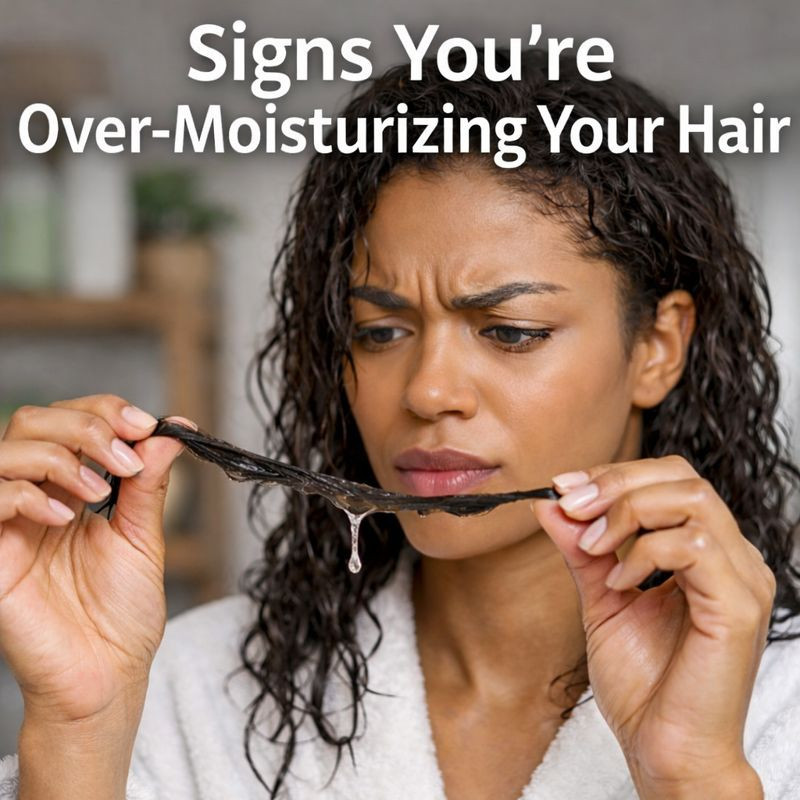
Most people assume dry, brittle hair means one thing: you need more moisture.
So you add more leave-in.
Then more cream.
Then oil.
Then a deep conditioner… again.
But what if the real problem isn’t lack of moisture — it’s too much of it?
Over-moisturizing hair is one of the most misunderstood causes of breakage, limp strands, chronic frizz, and hair that “won’t grow” no matter what you do. And the tricky part? The symptoms often look exactly like dryness.
This article breaks down the clear signs you’re over-moisturizing your hair, why it happens, how it quietly sabotages length retention, and how to restore balance so your hair can actually thrive.
What Over-Moisturized Hair Really Means
Hair needs balance, not just moisture.
Healthy hair exists in a sweet spot between:
-
Moisture (water + humectants)
-
Strength (protein + structural integrity)
When hair gets too much moisture without enough structure, the cuticle swells, the cortex weakens, and strands lose their ability to hold shape or resist tension.
Think of it like an over-soaked sponge:
-
Soft
-
Mushy
-
Weak
-
Easy to tear
That’s what happens to hair that’s constantly wet, coated in creamy products, or layered with humectants without reinforcement.
Why Over-Moisturizing Is More Common Than You Think
Over-moisturizing used to be rare.
Now it’s everywhere — because modern hair routines often include:
-
Daily leave-in application
-
Weekly deep conditioning
-
Heavy creams layered with oils
-
Constant water exposure (wash-and-go routines, co-washing, misting hair daily)
If you’ve ever heard:
“Hair loves moisture — you can never have too much”
That myth has caused more breakage than flat irons ever did.
15 Clear Signs You’re Over-Moisturizing Your Hair
1. Your Hair Feels Soft… But Weak
This is the most common red flag.
Over-moisturized hair:
-
Feels silky or mushy when wet
-
Has no resistance when you stretch it
-
Snaps easily when manipulated
Healthy hair should feel soft with structure, not floppy.
If your hair collapses under the slightest tension, moisture overload is likely.
2. Your Hair Stretches Too Much Before Breaking
Do the stretch test.
Gently pull a wet strand:
-
If it stretches a little and returns → balanced
-
If it stretches excessively and snaps → over-moisturized
Too much elasticity is just as bad as none at all.
3. Chronic Frizz No Matter What You Apply
You add more product.
The frizz gets worse.
Over-moisturized hair struggles to:
-
Seal the cuticle
-
Hold definition
-
Maintain shape
So humidity penetrates easily, causing constant puffiness and fuzz.
4. Hair Won’t Hold Styles
Twists unravel.
Wash-and-go definition disappears in hours.
Braids look fuzzy immediately.
This happens because over-moisturized hair:
-
Lacks internal strength
-
Can’t “remember” shape
-
Loses tension quickly
5. Your Hair Feels Gummy When Wet
This is a major warning sign.
If wet hair feels:
-
Sticky
-
Gummy
-
Slimy
You’re likely dealing with moisture overload, often from heavy conditioners or humectants used too frequently.
6. Breakage Increases Even Though Hair Feels “Moisturized”
This one confuses people.
They think:
“My hair can’t be dry — it feels soft”
But softness without strength equals silent breakage, especially at:
-
Ends
-
Crown
-
Hairline
7. Your Hair Takes Forever to Dry
Over-moisturized hair absorbs water easily but can’t release it efficiently.
If your hair:
-
Stays damp for hours
-
Feels heavy when wet
-
Never feels fully dry
Your cuticle may be overly swollen.
8. Products Just Sit on Your Hair
Instead of absorbing, products:
-
Sit on top
-
Leave residue
-
Cause buildup fast
That’s because the cuticle is already oversaturated and can’t take in anything else.
9. You Need to Moisturize Constantly or Hair Feels “Off”
Ironically, over-moisturized hair can feel dry between applications.
Why?
Because the hair shaft is weakened and can’t retain moisture properly.
So you keep adding more… and the cycle continues.
10. Your Hair Loses Volume and Body
Moisture-heavy hair routines weigh strands down.
Signs include:
-
Flat roots
-
Limp curls
-
Hair that won’t fluff or expand
Especially common in fine or low-density hair.
11. Hair Feels Worse After Deep Conditioning
If deep conditioning makes your hair:
-
Softer but weaker
-
Frizzier
-
More tangled
You may already be moisture overloaded.
12. Tangling Increases
Over-moisturized hair tangles because:
-
The cuticle stays raised
-
Strands cling together
-
Elasticity is excessive
This leads to breakage during detangling — even with gentle tools.
13. Your Hairline and Edges Break Easily
Edges are delicate.
When over-moisturized, they:
-
Stretch too much
-
Snap under tension
-
Thin out quietly
Especially common with daily leave-in use.
14. Hair Feels “Too Soft” to Be Healthy
If you’ve ever thought:
“My hair feels almost too soft”
Trust that instinct.
Healthy hair has subtle firmness, not marshmallow softness.
15. Nothing Seems to Fix the Problem
You switch products.
You deep condition more.
You moisturize more often.
Nothing helps — because the issue isn’t dryness.
It’s imbalance.
Why Over-Moisturizing Stops Hair Growth (Even If You’re Retaining Length)
Hair growth happens at the scalp.
But length retention happens along the strand.
Over-moisturized hair:
-
Breaks before it can retain length
-
Frays at the ends
-
Thins over time
So it looks like your hair “isn’t growing” — when it’s actually breaking faster than it grows.
Common Habits That Cause Moisture Overload
• Daily leave-in application
• Co-washing multiple times per week
• Deep conditioning every wash
• Layering creams + butters + oils
• Constant misting with water
• Avoiding protein entirely
Moisture isn’t the enemy — excess is.
How to Fix Over-Moisturized Hair (Step-by-Step)
1. Pause Heavy Moisture Products
For 1–2 weeks:
-
Stop deep conditioners
-
Reduce leave-in frequency
-
Skip heavy creams
Let your hair reset.
2. Clarify Gently
Use a clarifying or chelating shampoo once to:
-
Remove buildup
-
Reset cuticle behavior
-
Improve absorption
This step alone can dramatically change how hair feels.
3. Reintroduce Light Protein
Protein restores structure.
Look for:
-
Hydrolyzed proteins
-
Amino acids
-
Rice, silk, or wheat protein
Protein doesn’t have to mean hard or brittle — balance is the goal.
4. Moisturize Less Often, Not More
Most hair doesn’t need daily moisture.
Instead:
-
Moisturize 2–3 times per week
-
Focus on sealing properly
-
Let hair rest between applications
5. Use Water Strategically
Water is powerful.
Too much exposure:
-
Swells the cuticle
-
Weakens strands
Limit unnecessary wetting and misting.
6. Pay Attention to How Hair Responds — Not Trends
Your hair will tell you:
-
When it’s balanced
-
When it’s overloaded
-
When it needs strength
Stop chasing softness. Start chasing resilience.
What Balanced Hair Actually Feels Like
Healthy, balanced hair:
-
Feels soft but springy
-
Has slight resistance
-
Holds styles
-
Detangles easily
-
Retains length
That’s the goal — not endless moisture.
Final Thoughts: Moisture Is a Tool, Not a Lifestyle
Moisture is essential.
But constant moisture without structure is destructive.
If your hair feels:
-
Soft but weak
-
Moisturized but breaking
-
Conditioned but lifeless
You’re not failing your hair — you’re just overdoing one side of the equation.
Balance restores growth.
Balance restores strength.
Balance restores confidence.
And once you get it right, your hair finally starts acting the way you always thought it should.