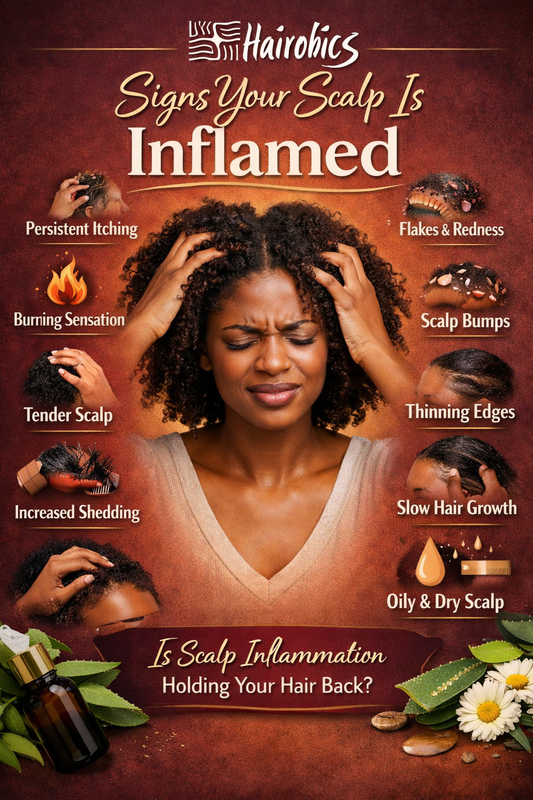
If your hair feels different lately — thinner, shedding more, drier, itchier, or just “off” — your scalp may be trying to tell you something.
Scalp inflammation is one of the most overlooked causes of stalled hair growth, excessive shedding, thinning edges, and chronic dryness — especially in natural hair, textured hair, locs, braids, and curly hair routines.
For the Hairobics community focused on long-term hair health, understanding scalp inflammation is not optional — it’s foundational.
Let’s break down:
-
What scalp inflammation really is
-
The early warning signs
-
How it affects Black hair specifically
-
What causes it
-
How to calm it naturally
-
And how to build a long-term inflammation-proof hair routine
What Does “Scalp Inflammation” Actually Mean?
Inflammation is your body’s protective response to stress, irritation, infection, or injury.
When it happens on your scalp, it can:
-
Disrupt hair follicles
-
Shorten growth cycles
-
Trigger excessive shedding
-
Slow regrowth
-
Cause tenderness and itching
-
Lead to thinning over time
Your scalp is living skin — and when that skin is inflamed, your hair struggles.
Healthy hair always starts with a calm, balanced scalp.
1. Persistent Itching That Doesn’t Go Away
Occasional itch? Normal.
Constant itch that keeps returning — even after washing? That’s inflammation.
Inflammation increases histamine levels in the skin, which creates that persistent “need to scratch” feeling.
If you notice:
-
Itching 24–48 hours after washing
-
Itching under braids or locs
-
Itching around edges or nape
-
Itching that feels deeper than surface dryness
Your scalp may be inflamed — not just dry.
2. Burning or Tingling Sensation
Inflamed scalps often feel:
-
Warm
-
Sensitive
-
Tingly
-
Slightly painful when touched
This is your nervous system reacting to irritation.
Burning sensations are especially common after:
-
Tight protective styles
-
Harsh shampoos
-
Chemical processing
-
Excessive product buildup
If your scalp feels “hot,” that’s a red flag.
3. Tenderness When Styling
Does it hurt when:
-
You part your hair?
-
You pull it into a ponytail?
-
You install braids?
-
You massage your scalp?
Tenderness signals inflammation at the follicle level.
Hair follicles sit inside the scalp. When the surrounding tissue is inflamed, even light tension feels painful.
Over time, this can weaken follicles and contribute to traction-related thinning.
4. Increased Shedding
Inflammation can prematurely push hair out of the growth phase.
If you notice:
-
More hair in the shower
-
More strands on your pillow
-
Increased shedding after stressful events
-
Thinner ponytails
Your scalp may be reacting to internal or external stress.
Chronic inflammation can shorten the anagen (growth) phase — meaning your hair doesn’t grow as long as it should.
5. Flakes That Keep Coming Back
Not all flakes are dandruff.
Inflamed scalp flakes often:
-
Return quickly after washing
-
Feel oily and sticky
-
Appear yellowish or thick
-
Come with redness underneath
This can be linked to seborrheic dermatitis, fungal overgrowth, or product overload — all inflammation-related conditions.
If flakes persist despite moisturizing, the issue may not be dryness — it may be imbalance.
6. Redness or Darkened Patches
Part your hair under good lighting.
Look for:
-
Pink or red tones
-
Shiny irritated patches
-
Discoloration
-
Swelling
In deeper skin tones, inflammation may show up as:
-
Darkened areas
-
Purplish undertones
-
Shiny thickened skin
These visual cues are often ignored — but they matter.
7. Scalp Pimples or Bumps
Folliculitis (inflamed hair follicles) appears as:
-
Small bumps
-
Tender spots
-
Pus-filled pimples
-
Painful raised areas
These are signs bacteria or yeast are thriving in an irritated scalp environment.
Heavy oils layered without cleansing can contribute.
8. Slower Growth or Growth Plateaus
If your hair hasn’t grown past a certain length in years, inflammation could be shortening your growth cycle.
Chronic inflammation:
-
Restricts blood flow
-
Reduces nutrient delivery
-
Damages follicle structure
-
Disrupts the scalp microbiome
Healthy follicles need oxygen and circulation. Inflamed tissue limits both.
9. Edges Thinning Even Without Tension
Edge thinning isn’t always traction alopecia.
If you:
-
Don’t wear tight styles
-
Avoid heavy tension
-
Still see thinning
Your follicles may be inflamed and miniaturizing.
Inflammation around edges is common due to:
-
Sweat
-
Product buildup
-
Stress
-
Hormonal shifts
10. Oily Yet Dry Scalp
This confusing combo is a huge inflammation clue.
When the scalp barrier is disrupted, it:
-
Produces excess oil
-
Still feels dry
-
Gets flaky
-
Feels tight
The body overcompensates.
That imbalance = inflammation.
What Causes Scalp Inflammation?
For natural and textured hair, the most common triggers include:
1. Tight Protective Styles
Braids, sew-ins, ponytails, and loc retwists can strain follicles.
2. Product Buildup
Layering oils without clarifying traps debris and yeast.
3. Harsh Shampoos
Sulfates and stripping cleansers disrupt the barrier.
4. Stress
Cortisol increases inflammatory markers in the body.
5. Hormonal Changes
Pregnancy, postpartum, birth control shifts, aging.
6. Diet & Gut Health
Inflammatory diets affect skin — including scalp skin.
7. Poor Circulation
Sedentary lifestyle, tight headwear, chronic tension.
How Scalp Inflammation Impacts Black Hair Specifically
Textured hair is more prone to dryness. Because natural oils struggle to travel down curls, many people:
-
Apply heavy oils frequently
-
Stretch wash days
-
Avoid cleansing
Over time, buildup accumulates.
Buildup + sweat + heat + friction = inflammation risk.
Protective styles can also trap inflammation beneath the surface if not maintained properly.
This is why scalp-focused care is essential — not optional.
How To Calm an Inflamed Scalp Naturally
1. Clarify Gently (But Regularly)
Use a mild clarifying shampoo every 2–4 weeks.
This removes:
-
Dead skin
-
Excess oil
-
Product residue
-
Microbial buildup
Avoid over-stripping.
2. Reduce Tension
Loosen styles.
Space out installs.
Let your scalp breathe between protective styles.
3. Support the Scalp Microbiome
Use lightweight, scalp-friendly oils that:
-
Calm irritation
-
Balance oil production
-
Support circulation
Avoid layering thick oils daily without cleansing.
4. Massage for Circulation
Scalp massage increases:
-
Blood flow
-
Oxygen delivery
-
Nutrient absorption
Even 5 minutes daily helps.
5. Lower Internal Inflammation
Support your scalp from within:
-
Hydrate consistently
-
Eat anti-inflammatory foods
-
Manage stress
-
Prioritize sleep
Hair health mirrors overall health.
When To See a Professional
Seek a dermatologist if you notice:
-
Severe redness
-
Oozing lesions
-
Sudden bald patches
-
Painful swelling
-
Persistent scaling
Conditions like psoriasis, seborrheic dermatitis, or autoimmune disorders may require medical treatment.
Building an Inflammation-Proof Hair Routine
For long-term scalp peace:
Weekly:
-
Cleanse scalp properly
-
Massage gently
-
Avoid excessive manipulation
Monthly:
-
Clarify
-
Evaluate scalp condition
-
Trim split ends
Quarterly:
-
Reassess product buildup
-
Rotate products if needed
Healthy scalp habits = sustainable growth.
The Long-Term Consequences of Ignoring Inflammation
Chronic inflammation can lead to:
-
Miniaturized follicles
-
Permanent thinning
-
Scarring alopecia
-
Stunted growth cycles
Early intervention protects future density.
The Bottom Line
If your hair feels different, your scalp might be inflamed.
Look for:
-
Persistent itch
-
Burning sensation
-
Tenderness
-
Shedding
-
Flakes
-
Redness
-
Slower growth
Hair health begins beneath the strands.
A calm scalp grows stronger hair.
For the Hairobics community focused on building long, healthy, resilient natural hair — scalp care is not optional. It’s the foundation.
If you treat the scalp with intention, consistency, and balance, your hair will respond.
Because growth isn’t just about products.
It’s about creating an environment where your follicles feel safe enough to thrive.