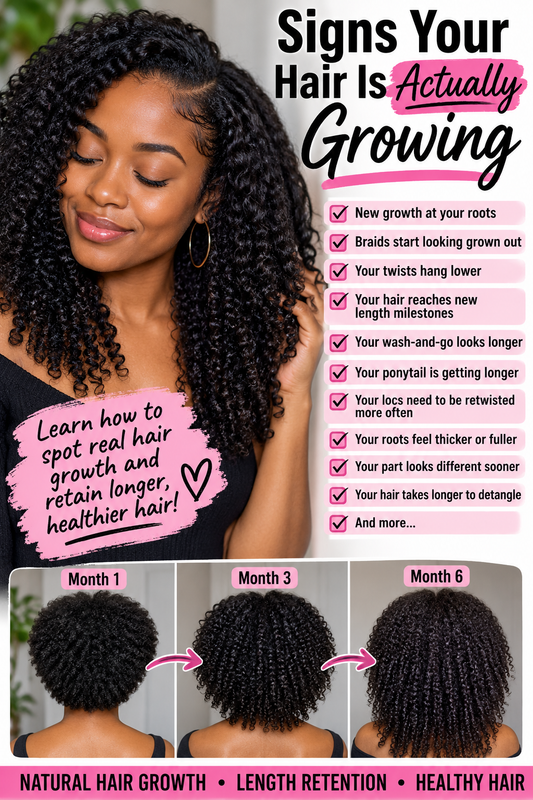
Hair growth can be surprisingly difficult to notice.
You may follow a consistent wash-day routine, moisturize regularly, protect your ends, massage your scalp, avoid excessive heat, and still look in the mirror wondering:
“Is my hair actually growing?”
For people with Black hair, natural hair, curly hair, coils, locs, braids, twists, or other textured hair types, growth can be especially difficult to see. Shrinkage can hide several inches of length, protective styles can keep new growth out of sight, and breakage can make it seem as though your hair has stopped growing altogether.
The good news is that your hair may be making more progress than you realize.
Hair growth does not always show up as dramatically longer hair from one week to the next. Sometimes the first signs are subtle: your roots become fuller, your wash-and-go hangs slightly differently, your twists reach farther down your neck, your part becomes harder to keep neat, or your protective style starts looking grown out sooner than expected.
Understanding these signs can help you determine whether your routine is working and distinguish between hair growth and length retention.
In this complete guide, we'll explore the most common signs your hair is actually growing, how quickly hair normally grows, why growth may be difficult to notice, how to accurately measure your progress, and how to retain more of the length you grow.
What Does Hair Growth Actually Mean?
Before looking for signs of progress, it is important to understand what hair growth means.
Your hair grows from follicles located beneath the surface of your scalp. New hair forms at the root and gradually pushes the existing strand outward.
That means products applied to your ends cannot literally make the ends grow. Growth happens at the scalp.
However, caring for your existing hair is extremely important because the length you see depends on two things:
Hair growth
This is the new hair being produced from your follicles.
Length retention
This is how much of that new length remains on your head instead of breaking off.
For example, your hair could grow steadily while your ends break at nearly the same rate.
You might conclude:
“My hair isn't growing.”
In reality, your scalp may be producing new growth perfectly well. You simply aren't retaining enough of it to see a major difference in overall length.
That's why healthy hair care should focus on both supporting a healthy scalp environment and protecting the hair you already have.
15 Signs Your Hair Is Actually Growing
1. You Can See New Growth at Your Roots
One of the clearest signs of hair growth is visible new growth near your scalp.
This is especially easy to notice when your hair is:
- Braided
- Twisted
- Loc'd
- Relaxed
- Colored
- Straightened
- Cornrowed
- Wearing another long-term protective style
For example, freshly installed braids usually begin very close to the scalp. After several weeks, you may notice that the base of each braid sits farther away from your scalp.
That space represents new growth.
Similarly, people with relaxed hair may notice their natural texture appearing at the roots several weeks after a relaxer.
If your hair is colored, your natural hair color appearing at the roots can also provide a visible marker.
This is one of the easiest ways to confirm that your follicles are actively producing new hair.
2. Your Braids Start Looking Grown Out
Have you ever installed beautiful, neat braids only to notice a few weeks later that the roots look fuzzy or loose?
That isn't necessarily a bad thing.
It can actually be a very obvious sign of hair growth.
As your natural hair grows from your scalp, the starting point of the braid moves farther away from your scalp.
You may notice:
- More space between your scalp and braid
- Fuzziness around the roots
- Looser-looking parts
- New curls forming near the scalp
- Braids moving more freely
- Less scalp visibility
While frizz can also come from moisture, manipulation, or normal wear, increasing distance between the scalp and the base of the braid is a useful indicator of new growth.
Instead of becoming frustrated because your protective style doesn't look freshly installed anymore, remember that some of that change may be evidence of progress.
3. Your Twists Hang Lower
Two-strand twists are one of the easiest hairstyles for monitoring natural hair length.
Take pictures when your twists are freshly installed.
Then compare them several months later.
You may notice that your twists:
- Reach your shoulders
- Touch your collar
- Hang farther down your forehead
- Reach your eyebrows
- Cover more of your ears
- Rest lower on your neck
- Touch your upper back
Even half an inch can change how twists hang.
Because natural hair shrinks differently depending on humidity, products, technique, and moisture levels, twist length isn't a perfect measurement. But consistent photographs taken under similar conditions can make changes much easier to recognize.
4. Your Hair Reaches New Length Milestones
Length milestones are one of the most exciting signs of progress.
Common milestones include:
- Eyebrow length
- Nose length
- Lip length
- Chin length
- Ear length
- Neck length
- Shoulder length
- Collarbone length
- Armpit length
- Bra-strap length
- Mid-back length
- Waist length
Instead of checking your hair every day, select one or two reference points.
For example:
“My longest layer currently reaches the top of my shoulders.”
Take a photograph and check again in approximately eight to twelve weeks.
Using physical landmarks makes growth easier to recognize than simply looking at your hair in the mirror.
5. Your Wash-and-Go Looks Longer
Shrinkage can make natural hair growth difficult to recognize.
You may gain length without immediately seeing dramatically longer hair.
Over time, however, your wash-and-go may begin hanging differently.
Perhaps your curls previously sat above your ears but now reach the middle of them.
Maybe your curls used to stop around your jaw but now touch your shoulders.
Your overall hairstyle may also become larger.
Growth doesn't only show up vertically.
With highly textured hair, additional length can increase:
- Volume
- Width
- Density
- Shape
- Hang time
Your afro becoming noticeably larger can therefore be another sign of progress.
6. Your Shrinkage Is Hiding More Length
Shrinkage is one of the biggest reasons people with natural hair underestimate their growth.
Curly and coily strands bend, spiral, and contract.
Because of this, your hair's visible length may be dramatically shorter than its stretched length.
Imagine a strand that appears four inches long when tightly coiled but stretches significantly farther when gently extended.
As that strand grows, the curl pattern continues contracting.
You may therefore gain considerable stretched length while seeing only a modest difference in your everyday hairstyle.
This is why stretched length checks can sometimes be more useful than comparing unstretched hair.
Shrinkage is not evidence that your hair isn't growing.
In many cases, it's simply part of having curly or coily hair.
7. Your Ponytail Is Getting Longer
A ponytail can provide another easy reference point.
Pay attention to where the ends fall.
Does your ponytail now:
- Touch the back of your neck?
- Brush your shoulders?
- Reach below your collar?
- Feel heavier?
- Look fuller?
You may also notice that shorter sections that previously couldn't reach your ponytail holder can now be gathered into the style.
That can be an excellent sign of increasing length.
Photographing your ponytail from the side and back every couple of months can make these differences easier to see.
8. You Need to Retwist Your Locs More Often
People with locs have one of the clearest indicators of new growth.
As hair grows from the scalp, the roots become looser.
You may notice:
- Puffy roots
- More loose hair around the loc
- Less visible parts
- Longer roots before the loc begins
- Locs hanging farther down
- Increased overall loc length
If your roots consistently grow out between retwists, that's evidence that new hair is being produced.
Don't feel that every bit of new growth must immediately be retwisted.
Excessive manipulation or overly tight maintenance can place unnecessary tension on the roots.
9. Your Roots Feel Thicker or Fuller
Sometimes growth can be felt before it is easily seen.
Run your fingers gently through your roots.
You may notice more volume near the scalp, especially after wearing a protective style.
New growth can make the root area feel:
- Fuller
- Puffier
- Denser
- Less flat
- More textured
This is particularly noticeable for people transitioning from chemically treated hair to natural hair.
As more natural hair grows in, the difference between the new growth and older processed hair becomes increasingly noticeable.
10. Your Part Looks Different Sooner
A freshly styled scalp may have extremely neat, defined parts.
As new growth develops, those parts can become less obvious.
Hair near the roots begins filling the visible space.
This is common with:
- Box braids
- Knotless braids
- Cornrows
- Locs
- Mini twists
- Flat twists
If your scalp was clearly visible immediately after styling but the parts become less defined several weeks later, growth may be one reason.
11. Your Hair Takes Longer to Detangle
This isn't everyone's favorite sign, but longer hair can sometimes require more time to detangle.
More length means there is simply more hair strand to manage.
As your hair becomes longer, you might notice that:
- Detangling takes longer
- Sectioning becomes more important
- You need additional clips
- Your sections feel larger
- Your ends tangle more easily
- Wash day takes slightly longer
This doesn't mean extreme tangling is healthy.
Excessive knots can indicate dryness, damaged ends, or a need to adjust your routine.
But gradually increasing maintenance time can simply be part of having longer hair.
12. You Need More Product Than Before
Suddenly finishing your conditioner faster?
Your hair may simply be longer.
As the total surface area of your hair increases, you may need slightly more:
- Conditioner
- Leave-in conditioner
- Moisturizer
- Styling cream
- Gel
- Oil
You shouldn't automatically increase the amount of every product you use, because overapplication can cause buildup.
However, if your old amount no longer distributes through your entire head as easily, increased length could be one explanation.
13. Styles That Used to Be Difficult Are Becoming Easier
Growth can open the door to new hairstyles.
Perhaps you previously couldn't create a high puff because the back of your hair wouldn't reach.
Now it does.
Maybe your hair wasn't long enough for a comfortable bun.
Now you can create one.
Other milestones can include:
- Easier ponytails
- Larger puffs
- Longer twists
- Fuller buns
- Easier French braids
- Better grip for cornrows
- More styling versatility
These functional changes can be better indicators of progress than staring at your hair every morning.
14. Your Ends Reach Your Clothes
This milestone tends to be very noticeable.
Your hair may suddenly begin touching:
- Shirt collars
- Jacket collars
- Shoulders
- Upper back
- Bra straps
You might even feel strands brushing against your skin and initially think something is touching you.
Reaching clothing landmarks can provide convenient length checkpoints because they are relatively consistent.
Take occasional back-facing photographs to document these milestones.
15. Your Progress Photos Show a Difference
This may be the most reliable visual method.
Your brain becomes accustomed to seeing your hair every day.
Small daily changes are extremely difficult to recognize.
Pictures eliminate some of that problem.
Take photographs every four to eight weeks under similar conditions.
Try to keep the following consistent:
- Hairstyle
- Camera angle
- Hair moisture level
- Lighting
- Clothing
- Head position
Then compare photographs taken several months apart.
You may be shocked by the difference.
How Fast Does Hair Normally Grow?
Hair doesn't grow at exactly the same speed for everyone.
Growth can be influenced by genetics, age, nutrition, hormones, overall health, hair cycle, and other biological factors.
A commonly cited average is approximately half an inch per month, although individual growth rates vary.
At that approximate pace, someone might grow around:
6 inches of hair per year.
However, growing six inches doesn't automatically mean your hair will look six inches longer by the end of the year.
Why?
Because retention matters.
Suppose you grow six inches but lose three inches through:
- Breakage
- Split ends
- Excessive trimming
- Mechanical damage
- Heat damage
- Tangling
Your visible length gain may only be around three inches.
This is why focusing exclusively on making hair “grow faster” can distract from an equally important goal:
Keeping the hair you grow.
Why Does It Feel Like My Hair Isn't Growing?
If your hair appears to remain at the same length for months or years, there are several possible explanations.
Breakage Is Canceling Out Your Growth
This is one of the most important possibilities.
Your roots may be growing while your ends continuously break.
Imagine filling a bucket with water while a hole at the bottom allows water to escape.
Water is entering the bucket, but the level barely changes.
Hair can behave similarly.
If your hair grows approximately half an inch but breaks roughly the same amount, your overall length may remain relatively unchanged.
Look for signs of breakage such as:
- Short pieces of hair
- Uneven ends
- Excessive snapping
- Split ends
- Thinning ends
- Difficulty retaining length
Improving length retention may make a significant difference.
Hair Growth vs. Breakage: How to Tell the Difference
One of the easiest ways to distinguish growth from poor retention is to examine both your roots and ends.
If you're seeing obvious new growth at your roots but your overall length doesn't change much, your hair is likely growing but struggling to retain length.
Pay special attention to your ends.
The ends are the oldest portion of your hair and have usually experienced the most:
- Washing
- Styling
- Combing
- Brushing
- Sun exposure
- Friction
- Heat
- Manipulation
Protecting your ends is therefore a major part of growing visibly longer hair.
Signs Your Hair May Be Breaking
Hair shedding and breakage are not the same thing.
A naturally shed hair generally comes from the root as part of the hair's normal cycle.
Broken hair snaps somewhere along the strand.
Possible signs of excessive breakage include:
- Many short hairs after detangling
- Hair snapping when manipulated
- Increasingly thin ends
- Uneven sections
- Numerous single-strand knots
- Split ends
- Difficulty maintaining length
- Rough-feeling ends
If breakage becomes significant or is accompanied by unusual thinning, bald patches, scalp symptoms, or sudden changes in shedding, consider speaking with a dermatologist or other qualified healthcare professional.
How to Measure Hair Growth Accurately
If you're serious about tracking your progress, don't rely solely on memory.
Create a simple hair-growth tracking system.
Method 1: Monthly Photos
Take pictures every four weeks.
Photograph your:
- Front
- Left side
- Right side
- Back
Use approximately the same hairstyle each time.
Avoid comparing stretched hair one month with a shrunken wash-and-go the next because the comparison won't tell you much.
Method 2: Measure Specific Sections
Choose several sections, such as:
- Front
- Crown
- Left side
- Right side
- Back
Gently stretch one small section and measure from near the scalp toward the end.
Record the measurement.
Repeat after several months.
Avoid repeatedly pulling or manipulating your hair simply to check growth.
Method 3: Use Your Body as a Length Chart
Body landmarks can make tracking easy.
For example:
January: Chin length
April: Neck length
August: Shoulder length
For longer hair:
January: Shoulder length
June: Collarbone length
December: Approaching armpit length
Photographs can help confirm these milestones.
Why You Shouldn't Measure Your Hair Every Day
Daily length checking can make it seem as though nothing is happening.
Hair growth is gradual.
Even if your hair is growing normally, the difference between Monday and Tuesday will be virtually impossible to see.
Constantly stretching strands can also increase unnecessary manipulation.
A better schedule is generally:
Every 4–8 weeks.
For major progress comparisons, three-month, six-month, and twelve-month photos can be particularly useful.
How Shrinkage Can Make Growing Hair Look Short
Shrinkage deserves special attention for natural hair.
Imagine that your hair gains an inch of stretched length.
If your curls contract strongly when wet or humid, you may not see that entire inch in your everyday hairstyle.
Your hair might instead appear:
- Fuller
- Rounder
- Denser
- More voluminous
This is why someone can have surprisingly long natural hair even though their afro or wash-and-go appears relatively short.
Gently stretching a section can reveal hidden length.
You do not need to eliminate shrinkage to prove that your hair is growing.
Does New Growth Mean Your Hair Is Healthy?
Not necessarily.
Growth tells you that follicles are producing hair.
Hair condition tells you how well the strands are being maintained.
Someone can experience new growth while also having:
- Dryness
- Split ends
- Breakage
- Heat damage
- Chemical damage
- Excessive tangling
That's why the ultimate goal shouldn't simply be growing hair.
It should be:
Growing hair while retaining as much healthy length as reasonably possible.
How to Retain More Hair Growth
Once you know your hair is growing, the next step is protecting that progress.
1. Keep Your Hair Moisturized
Textured hair often benefits from a consistent moisture routine.
Because the bends and curves of curly and coily strands can make it harder for natural scalp oils to travel down the hair shaft, the ends may become dry.
A routine may include:
- Cleansing
- Conditioning
- Applying a leave-in or moisturizer when appropriate
- Sealing or styling as needed
The exact routine should depend on your hair.
Avoid assuming that more product always means more moisture.
Product buildup can create its own problems.
2. Pay Special Attention to Your Ends
Your ends need protection because they're the oldest part of your hair.
Consider:
- Detangling gently
- Reducing excessive friction
- Avoiding unnecessary brushing
- Protecting hair at night
- Keeping ends conditioned
- Trimming damaged ends when needed
Healthy-looking ends can make your entire head of hair appear fuller and longer.
3. Detangle Gently
Aggressive detangling can destroy months of length retention.
Instead of ripping through knots, work patiently.
Depending on your hair and preferences, you might use:
- Fingers
- A wide-tooth comb
- A detangling brush suited to your hair
Work in sections and use adequate slip.
Start near the ends and gradually work upward when appropriate.
The goal is to remove shed hair and tangles without unnecessarily snapping healthy strands.
4. Protect Your Hair While Sleeping
Hours of nightly friction can add up.
Consider sleeping with:
- A satin bonnet
- A satin scarf
- A satin pillowcase
These options may help reduce friction compared with rougher surfaces.
If you have long locs, braids, twists, or natural hair, make sure your nighttime method isn't pulling tightly on your edges or roots.
5. Be Careful With Tight Hairstyles
Protective styling should actually protect your hair.
Braids, twists, cornrows, buns, wigs, and other styles can help reduce daily manipulation, but excessive tension can work against your goals.
Warning signs that a hairstyle may be too tight include:
- Pain
- Headaches
- Persistent scalp tenderness
- Bumps
- Extreme pulling
- Excessive tension around edges
A hairstyle does not need to hurt to look neat.
6. Limit Excessive Heat
Heat isn't automatically forbidden, but repeated high-temperature styling can weaken hair and increase damage risk.
If you use heat:
- Use appropriate heat protection
- Avoid unnecessarily high temperatures
- Limit repeated passes
- Handle hair gently
Your goal is to enjoy styling flexibility without repeatedly compromising the strands you're trying to retain.
7. Maintain a Clean Scalp
A healthy hair-care routine includes scalp care.
Wash frequently enough to remove:
- Sweat
- Excess oil
- Product buildup
- Dirt
- Flakes
There isn't one universal wash schedule for everyone.
Some people prefer weekly cleansing, while others adjust based on hairstyle, scalp condition, exercise, product use, and individual needs.
Pay attention to how your scalp responds.
Signs Your Natural Hair Is Growing
For natural hair specifically, look for:
- Larger afro
- Longer stretched sections
- Wash-and-go hanging lower
- Bigger puff
- Longer twists
- Easier ponytails
- More root volume
- New length milestones
- Protective styles growing away from the scalp
- Progress visible in photos
Don't judge growth solely by how long your curls look immediately after washing.
Shrinkage can hide substantial progress.
Signs Your Locs Are Growing
Loc growth can be easier to document because mature locs don't shrink in exactly the same way loose curls do.
Common signs include:
- More loose root growth
- Locs reaching new landmarks
- Increased distance between retwists
- Locs touching your shoulders
- Locs brushing your back
- Ponytails hanging lower
- Increased loc weight or movement
Photograph your locs from the back every few months.
Long-term comparisons can be extremely motivating.
Signs Your Hair Is Growing While Wearing Braids
Braids provide a built-in growth marker.
Watch the roots.
As your natural hair grows, you'll generally notice more distance between your scalp and the braided portion.
You might also see:
- Fuzzy roots
- Looser parts
- New curls around the roots
- Braids hanging slightly lower
Remember, however, that keeping braids installed for excessive periods solely because you see new growth isn't necessarily beneficial.
Your natural hair still needs appropriate cleansing, maintenance, and gentle handling.
Signs Black Men's Hair Is Growing
The same biology applies to men's hair, but growth may be easier to recognize through hairstyle changes.
Possible signs include:
- Waves becoming longer between haircuts
- Afro becoming larger
- Twists hanging lower
- Locs becoming longer
- Hair needing more frequent shape-ups
- Increased curl definition as strands gain length
- More styling options
- Hair becoming easier to braid or twist
If you get regular haircuts, photographs taken immediately before each haircut can help track growth.
Signs Your Child's Hair Is Growing
Parents may have difficulty recognizing children's hair growth because textured children's hair can shrink considerably.
Look for gradual changes such as:
- Longer ponytails
- Larger puffs
- Longer braids
- Twists reaching lower
- Hair becoming easier to gather
- Increased styling options
- Stretched strands reaching new landmarks
Children's hair should be handled gently.
Avoid excessive tension or trying to force rapid growth.
Comfort and healthy hair-care habits are more important than reaching a specific length quickly.
Can Hair Grow Without You Noticing?
Absolutely.
This happens all the time.
You see yourself in the mirror daily, making gradual changes difficult to recognize.
It's similar to watching a plant grow.
You might see the plant every morning and think it looks exactly the same.
Then you compare a picture from six months ago and realize it has doubled in size.
Hair growth can feel similar.
This is why progress photos are so valuable.
Why Your Hair May Look Shorter Some Days
Don't panic if your hair appears shorter today than it did last week.
Your actual strand length hasn't necessarily decreased.
Natural hair can look different depending on:
- Humidity
- Water
- Styling products
- Curl definition
- Stretching
- Weather
- Hairstyle
- Sleeping position
One wash-and-go may hang beautifully.
Another may shrink dramatically.
That doesn't mean you suddenly lost an inch of hair.
Compare your hair under similar conditions.
How Long Should You Wait Before Judging Your Hair Routine?
Give your routine enough time to evaluate meaningful changes.
You probably won't be able to accurately judge length retention after one or two weeks.
Consider documenting progress over:
- 30 days
- 90 days
- 6 months
- 12 months
A three-to-six-month comparison can reveal changes that are nearly impossible to recognize day by day.
What If My Hair Really Isn't Growing?
If you've carefully monitored your hair for several months and see little or no evidence of growth, first consider whether breakage is masking your progress.
Look at your:
- Ends
- Detangling habits
- Heat use
- Protective styles
- Moisture routine
- Nighttime routine
- Styling tension
However, unexplained changes in hair growth or density can sometimes have causes that go beyond your hair-care routine.
If you experience sudden or unusual hair loss, bald patches, significant thinning, scalp inflammation, pain, sores, or other concerning symptoms, consider seeing a dermatologist or qualified healthcare professional.
Hair products and styling routines cannot diagnose or treat every cause of hair loss.
Frequently Asked Questions About Hair Growth
How do I know if my hair is actually growing?
Look for new growth at your roots, increasing stretched length, longer twists or braids, new body-length milestones, larger puffs, longer ponytails, and differences in progress photographs.
Why is my hair growing at the roots but not getting longer?
Breakage may be preventing you from retaining the new length.
If new hair appears at your roots but your overall length remains unchanged, focus on protecting your ends and reducing damage.
Does frizz mean my hair is growing?
Not necessarily.
Frizz can result from humidity, moisture, manipulation, normal wear, or new growth.
However, increasing space between the scalp and a protective style can indicate growth.
Do itchy roots mean hair is growing?
No.
An itchy scalp is not reliable proof of hair growth.
Itching can have many causes, including dryness, irritation, product buildup, or scalp conditions.
Do not use itching as a growth measurement.
Does having a tender scalp mean hair is growing?
No.
Hair growth shouldn't require scalp pain.
Persistent tenderness, inflammation, or pain deserves attention, especially if you're wearing a tight hairstyle.
Can hair grow faster in protective styles?
Protective styles don't magically change your genetic growth rate.
Their main benefit is potentially reducing daily manipulation and helping you retain more length when they're installed and maintained properly.
That retention can make it appear that your hair suddenly grows faster.
How often should I do a length check?
Every four to eight weeks is usually more useful than checking constantly.
Three-month comparisons can show even clearer changes.
Does trimming make hair grow faster?
Trimming your ends does not directly speed up growth at the scalp.
However, removing damaged or split ends can improve the appearance and manageability of your hair and prevent certain types of damage from progressing farther up the strand.
Is shrinkage a sign my hair isn't growing?
No.
Shrinkage is common with curly and coily hair.
Your stretched length can increase significantly while your unstretched hairstyle continues to look relatively short.
Can I grow long hair if my hair grows slowly?
Potentially, yes.
Length depends not only on growth rate but also on retention.
Someone with an average or relatively slow growth rate who retains most of their length can eventually have longer hair than someone who grows quickly but experiences frequent breakage.
A Simple Hair Growth Tracking Routine
If you want to know whether your hair is growing, create a simple system.
Day 1
Take four photographs:
- Front
- Back
- Left
- Right
Then choose three sections of hair and record their stretched lengths.
Write down the date.
After 30 Days
Take another set of photographs.
Don't obsess over tiny differences.
After 90 Days
Repeat your measurements and photographs under similar conditions.
This is where changes may become much easier to recognize.
After 6 Months
Compare your first pictures with your newest ones.
Look at:
- Overall length
- Thickness
- Ends
- Hairline
- Ponytail length
- Twist length
- Styling versatility
After 12 Months
Compare your entire year.
A twelve-month comparison can tell you far more about your routine than checking your hair every morning.
Focus on Length Retention, Not Just Faster Growth
The hair-care industry frequently focuses on “fast growth.”
But growing longer natural hair isn't simply a race to make follicles produce hair as quickly as possible.
For many people, the bigger opportunity is improving retention.
Think about it this way:
Growth + retention = visible length progress.
Your hair may already be growing.
The question is whether you're keeping that growth.
That means protecting your hair from unnecessary:
- Breakage
- Heat damage
- Tension
- Friction
- Rough detangling
- Excessive manipulation
Small improvements repeated consistently can have a major impact over the course of a year.
Create a Routine You Can Maintain
You don't necessarily need an extremely complicated hair routine to see progress.
Consistency matters.
A practical routine might include:
Weekly or as needed
Cleanse your scalp and hair based on your individual needs.
After cleansing
Condition and detangle gently.
Throughout the week
Monitor moisture and refresh your hair when necessary.
At night
Reduce friction with a satin scarf, bonnet, or pillowcase.
During styling
Avoid excessive tension and manipulation.
Every few months
Evaluate your ends and overall hair condition.
Your exact schedule may differ.
The best routine is one that works for your scalp, hair type, lifestyle, and styling habits.
Stop Comparing Your Hair Growth to Everyone Else
Social media can create unrealistic expectations.
You might see someone post:
“Look how much my hair grew in six months!”
Their results don't determine what your hair should do.
People have different:
- Genetics
- Hair densities
- Curl patterns
- Growth cycles
- Hair histories
- Styling habits
- Levels of shrinkage
- Starting lengths
Two people can follow similar routines and still have different results.
Compare your hair to your previous hair—not someone else's.
Celebrate Small Hair Growth Milestones
Hair journeys become much more enjoyable when you recognize smaller wins.
Maybe your hair isn't waist length yet.
But perhaps:
- Your puff is bigger.
- Your twists finally touch your shoulders.
- Your ponytail is longer.
- Your braids show obvious new growth.
- Your locs reach your collar.
- Your hair breaks less during detangling.
- You retained more length than last year.
Those are meaningful improvements.
Long hair is generally the result of many small milestones accumulated over time.
Final Thoughts: Your Hair May Be Growing More Than You Think
If you've been wondering how to tell if your hair is growing, don't rely only on what you see in the mirror every morning.
Look for the evidence.
New growth around your roots, longer twists, grown-out braids, a bigger puff, longer ponytail, new length milestones, fuller roots, increased styling versatility, and progress photographs can all help reveal changes.
For natural, curly, coily, and Black hair, remember that shrinkage can hide significant length.
And if your roots are growing while your overall length seems unchanged, don't automatically assume your hair has stopped growing.
You may need to focus more on length retention.
Protect your ends.
Detangle gently.
Keep your hair appropriately moisturized.
Reduce unnecessary tension and manipulation.
Protect your hair at night.
Maintain a healthy scalp.
Most importantly, give your hair time.
Instead of asking every week, “Why isn't my hair growing?”, document your progress over several months.
You may discover that your hair has been growing all along—you simply couldn't see the progress happening day by day.