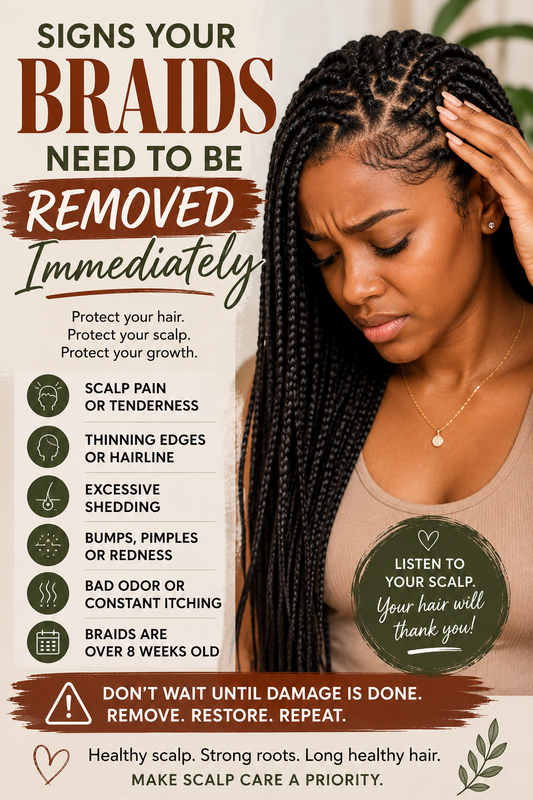
Braids are one of the most popular protective hairstyles because they reduce daily manipulation, help retain length, and offer weeks of convenience. Whether you're wearing box braids, knotless braids, cornrows, twists, or feed-in braids, protective styles can be excellent for maintaining healthy natural hair.
However, even the best protective style has an expiration date.
Keeping braids installed for too long—or ignoring warning signs from your scalp and hair—can lead to breakage, thinning edges, scalp infections, traction alopecia, and excessive shedding. Many people assume that leaving braids in longer equals better protection, but the opposite is often true.
Your hair is constantly communicating with you. Learning how to recognize the early warning signs can save months—or even years—of hair recovery.
In this guide, you'll learn:
- Signs your braids need to come out immediately
- What happens if you ignore the warning signs
- How long braids should actually stay installed
- How to remove braids safely
- Tips for maintaining healthier braids next time
Why Wearing Braids Too Long Can Damage Your Hair
Protective styles protect your hair—but only when they're maintained properly.
Your natural hair continues to:
- Shed every day
- Produce scalp oils
- Collect dirt and sweat
- Experience friction
- Grow new roots
Eventually, your braids become heavier, looser, and harder on your scalp than they were on day one.
Instead of protecting your hair, old braids begin creating stress.
1. Your Scalp Constantly Hurts
Pain is never normal.
If your scalp still hurts days after installation—or suddenly becomes painful weeks later—your braids may be damaging your hair follicles.
Signs include:
- Burning sensation
- Tender scalp
- Headaches
- Pain when touching braids
- Difficulty sleeping
Persistent pain usually means there's excessive tension or inflammation.
Remove the braids before permanent damage occurs.
2. Your Edges Are Becoming Thin
Your edges are usually the first area affected by overly tight or aging braids.
Watch for:
- Smaller baby hairs
- Gaps around the hairline
- Receding temples
- Hair pulling away from the braid
Ignoring thinning edges can eventually lead to traction alopecia.
The earlier you remove the braids, the better your chances of full recovery.
3. You Notice White Bulbs on Pulled-Out Hair
It's normal to shed hair naturally.
However, if entire strands with white bulbs attached are being pulled out because of braid tension, your follicles are under stress.
Large amounts of pulled hair are never a good sign.
4. Your Braids Feel Extremely Heavy
As your hair grows, your natural roots support more and more weight.
Over time:
- Shed hair gets trapped
- Product buildup increases
- Braids absorb moisture
- Extensions become heavier
Heavy braids continuously pull on your roots.
If your braids suddenly feel much heavier than when installed, it's time to remove them.
5. Your Scalp Itches Constantly
Occasional itching is normal.
Constant itching is not.
Persistent itching may indicate:
- Product buildup
- Dry scalp
- Sweat accumulation
- Irritation
- Allergic reaction
- Fungal overgrowth
If moisturizing and cleansing your scalp don't help, remove the braids.
6. There's a Bad Odor Coming from Your Braids
Healthy hair shouldn't smell unpleasant.
Bad odors usually come from:
- Sweat
- Mildew
- Trapped moisture
- Product buildup
- Bacteria
If washing doesn't eliminate the smell, remove the braids immediately.
7. Your Scalp Has Bumps or Pimples
Scalp bumps often signal inflammation.
Possible causes include:
- Tight braids
- Infection
- Ingrown hairs
- Folliculitis
- Product irritation
Painful bumps should never be ignored.
8. You See Excessive Frizz at the Roots
Some frizz is normal after several weeks.
However, excessive root frizz often means:
- Hair has grown significantly
- Braids are no longer supporting your hair
- The style has reached the end of its lifespan
Loose roots increase tangling and breakage during takedown.
9. The Braids Keep Sliding Down
When braids start slipping:
- Your new growth isn't secured
- The braid is heavier than the root
- Hair can tangle around the loose section
Sliding braids increase unnecessary stress on individual strands.
10. Your Scalp Looks Red
Healthy scalp color should remain consistent.
Redness often signals:
- Inflammation
- Irritation
- Excessive pulling
- Infection
Don't wait for redness to become sores.
11. You Notice Hair Wrapped Around the Base of the Braid
This is trapped shedding.
Everyone sheds 50–100 hairs daily.
Over several weeks, those hairs accumulate around each braid.
Too much trapped shedding can cause:
- Severe tangles
- Matting
- Breakage during removal
12. Your Braids Are More Than 8 Weeks Old
Even if they still look good, your natural hair may not be.
Most stylists recommend:
- Knotless braids: 4–8 weeks
- Box braids: 6–8 weeks
- Cornrows: 2–6 weeks
- Feed-in braids: 2–4 weeks
- Crochet styles: 4–8 weeks
Longer wear increases the risk of damage.
13. You Have Excessive Product Buildup
If your scalp looks:
- White
- Waxy
- Flaky
- Greasy
Your braids likely need to come out.
Buildup blocks proper scalp cleansing and may contribute to irritation.
14. Your Hairline Feels Tight Every Day
Healthy braids shouldn't constantly tug.
Ongoing tightness means your follicles never get a chance to relax.
Months of continuous tension can permanently weaken your hairline.
15. Your Braids Are Tangling at the Roots
Root tangling makes braid removal much harder.
This happens because:
- Shed hairs become intertwined
- Hair growth twists around itself
- Dirt acts like glue
Waiting longer only increases tangles.
16. You Notice Hair Breaking Off
Broken pieces around your shoulders or sink are warning signs.
Breakage usually comes from:
- Dry hair
- Friction
- Tension
- Old braids
- Lack of moisture
Don't wait until significant length is lost.
17. Your Scalp Is Extremely Dry
Protective styles shouldn't leave your scalp painfully dry.
If you notice:
- Tight skin
- Flakes
- Cracking
- Constant dryness
Your scalp needs attention.
Sometimes removal is the healthiest solution.
18. You See Bald Spots Developing
This is one of the most serious warning signs.
Small bald areas may indicate:
- Traction alopecia
- Broken follicles
- Excessive pulling
Remove the braids immediately.
If bald spots continue to enlarge or do not improve, consult a dermatologist.
19. Your Braids Feel Loose Near the Scalp
Loose braids no longer protect your natural hair effectively.
Instead, they allow:
- Tangling
- Friction
- Knotting
- Breakage
The style has reached its limit.
20. Your Hair Has Grown More Than Two Inches
Significant new growth changes how the braid distributes weight.
Long roots become more vulnerable because the extensions are hanging farther away from your scalp.
The longer the new growth becomes, the more tension each strand experiences.
What Happens If You Ignore These Warning Signs?
Keeping damaged braids installed can lead to:
- Severe breakage
- Hair thinning
- Permanent edge loss
- Scalp infections
- Excessive shedding
- Tangles
- Matting
- Painful braid removal
- Hair loss
- Slow recovery
Many people spend months trying to repair damage that could have been prevented simply by removing their braids sooner.
How Long Should Braids Stay In?
General guidelines include:
| Style | Recommended Wear Time |
|---|---|
| Knotless Braids | 4–8 weeks |
| Box Braids | 6–8 weeks |
| Cornrows | 2–6 weeks |
| Feed-In Braids | 2–4 weeks |
| Twists | 4–8 weeks |
| Crochet Braids | 4–8 weeks |
If your hair shows warning signs earlier, remove the style before reaching the maximum timeframe.
How to Remove Braids Safely
Proper takedown is just as important as proper installation.
Step 1: Trim Carefully
Only cut below where your natural hair ends.
Step 2: Add Moisture
Use a lightweight oil or leave-in conditioner to soften the braid.
Step 3: Detangle Slowly
Work one braid at a time.
Step 4: Remove Shed Hair
Finger-detangle before using a wide-tooth comb.
Step 5: Cleanse Thoroughly
Wash your scalp to remove buildup and trapped debris.
Step 6: Deep Condition
Restore moisture with a rich conditioning treatment.
Step 7: Let Your Hair Rest
Give your scalp a short break before installing another protective style.
How to Keep Future Braids Healthier
Healthy braids begin with healthy habits.
Follow these tips:
- Don't braid too tightly.
- Moisturize your scalp several times each week.
- Sleep with a satin bonnet or satin pillowcase.
- Clean your scalp regularly with a gentle cleanser.
- Avoid excessive product buildup.
- Protect your edges.
- Limit heavy extension hair.
- Don't ignore pain.
- Stay hydrated.
- Remove braids on time.
Support Your Hair and Scalp While Wearing Braids
Protective styles work best when your scalp stays clean, hydrated, and nourished. Using natural, lightweight products can help soothe dryness, reduce itchiness, and keep your scalp feeling comfortable without leaving behind heavy buildup.
The Hairobics Hair & Scalp Booster is formulated with natural ingredients to help moisturize the scalp, support healthier-looking hair, and maintain a balanced environment while wearing protective styles. Applying a small amount directly to your scalp several times a week can help keep your roots feeling refreshed between wash days.
Consistent scalp care, along with timely braid removal, gives your natural hair the best chance to stay strong and healthy.
Frequently Asked Questions
Is it okay to keep braids in for three months?
For most people, three months is too long. Extended wear increases the risk of buildup, tangling, breakage, and scalp irritation.
Does itching always mean I need to remove my braids?
Not always. Mild itching can happen from dryness or new growth. However, persistent itching that doesn't improve with cleansing or moisturizing may be a sign it's time to take the braids out.
Will removing my braids cause hair loss?
It's normal to see shed hairs that accumulated while your hair was braided. Excessive breakage or bald patches, however, are not normal and should be addressed.
Can braids cause permanent hair loss?
Yes. Braids that are too tight or worn for too long can contribute to traction alopecia, which may become permanent if ignored.
How soon can I reinstall braids?
Giving your hair and scalp a short break after removing braids allows you to cleanse, deep condition, detangle, and restore moisture before installing another protective style.
Final Thoughts
Braids are one of the best protective styles for natural hair when they're installed, maintained, and removed at the right time. Paying attention to warning signs such as persistent pain, thinning edges, severe itching, scalp redness, excessive buildup, slipping braids, or heavy new growth can help you avoid unnecessary damage.
Removing your braids promptly when these signs appear protects your scalp, preserves your hairline, and supports long-term hair health. By combining proper braid care, regular scalp maintenance, and timely takedown, you can continue enjoying protective styles while keeping your natural hair strong, healthy, and thriving.