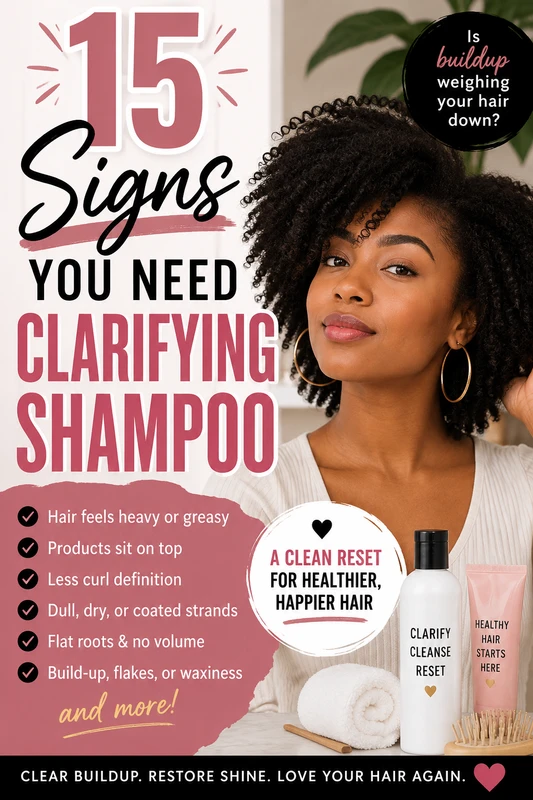
Hair can sometimes feel dirty, heavy, greasy, dry, or simply “off” even after you have just washed it. Your curls may suddenly stop popping. Your favorite leave-in conditioner may seem like it is sitting on top of your strands instead of absorbing. Your scalp might feel coated, and your hair may lack the softness and movement it normally has.
When this happens, your regular shampoo may not be the problem—or at least not the entire solution.
You may need a clarifying shampoo.
Clarifying shampoos are designed to provide a deeper cleanse than many everyday shampoos. They can help remove accumulated oils, styling products, silicones, waxes, gels, butters, minerals, and other substances that gradually collect on the hair and scalp.
For people with natural hair, curly hair, locs, braids, waves, or frequently styled Black hair, knowing when to clarify can be especially useful because many popular hair routines rely on multiple moisturizing and styling products.
But clarifying too frequently can also leave some hair feeling dry.
The key is recognizing the signs that your hair actually needs clarification.
In this guide, we'll cover 15 signs you need clarifying shampoo, what causes buildup, how often you should clarify, how to clarify natural hair without excessive dryness, and what to do after using a clarifying shampoo.
What Is Clarifying Shampoo?
Clarifying shampoo is a shampoo formulated to provide a more thorough cleansing experience than a typical gentle or moisturizing shampoo.
Regular shampoos are often designed to balance cleansing with softness and moisture. Clarifying shampoos generally place more emphasis on removing substances that have accumulated on the hair.
Depending on the formula, a clarifying shampoo may help remove:
- Excess sebum
- Hair oils
- Styling creams
- Hair gels
- Edge controls
- Pomades
- Hair sprays
- Waxes
- Butters
- Silicones
- Dry shampoo residue
- Sweat and dirt
- Chlorine residue
- Some mineral deposits
- Layers of conditioning and styling products
Think of your normal shampoo as routine cleaning and clarifying shampoo as an occasional deeper reset.
You don't necessarily need that deeper cleanse every wash day.
However, when product buildup becomes significant, continuing to pile more products onto the hair may make the problem worse.
That's why learning to recognize buildup is so important.
15 Signs You Need Clarifying Shampoo
1. Your Hair Still Feels Dirty After Washing
One of the clearest signs that you may need a clarifying shampoo is hair that doesn't feel completely clean after shampooing.
You wash your hair.
You rinse thoroughly.
Maybe you even shampoo twice.
Yet once your hair dries, your roots or strands still feel coated.
This can happen when your normal shampoo isn't removing all of the accumulated product, oil, and residue from previous wash days.
This is especially common if your routine regularly includes heavier products such as:
- Hair butter
- Styling gel
- Edge control
- Pomade
- Thick creams
- Oils
- Silicone-containing products
Each individual application may not seem excessive. However, repeated applications can gradually create layers.
Eventually, a gentle shampoo may have difficulty removing everything in one wash.
An occasional clarifying wash can help give your hair a cleaner starting point.
2. Your Hair Feels Heavy or Weighed Down
Healthy hair doesn't necessarily need to feel extremely light, but there is usually some natural movement and flexibility.
Product buildup can change that.
You may notice that your hair feels unusually heavy even though you haven't changed the length or density of your hair.
Your curls may hang differently.
Your roots may appear flatter.
Your hairstyle may lose volume much faster than usual.
This can occur because layers of product are coating your strands.
People with fine natural or curly hair may notice this particularly quickly because it takes less product to weigh down finer strands.
Before adding another volumizing product, consider whether your hair simply needs a more thorough cleanse.
3. Your Curls Aren't as Defined as They Used to Be
Have your curls suddenly stopped curling the way they normally do?
Buildup could be one possible explanation.
When the hair is heavily coated, water and styling products may interact differently with the strand. Your curls can begin looking:
- Limp
- Puffy
- Stringy
- Undefined
- Flat
- Inconsistent
You may even assume your curl pattern has changed.
Sometimes the solution isn't another curl cream.
It is removing what is already on your hair.
Try clarifying and then following with a moisturizing conditioning routine. Once excessive residue has been removed, you may notice that your natural curl pattern is easier to style again.
4. Your Hair Feels Greasy Soon After Washing
Hair becoming greasy shortly after wash day doesn't always mean your scalp suddenly started producing dramatically more oil.
Sometimes residue was never completely removed during your previous wash.
Imagine washing a plate but leaving a thin layer of grease behind. Adding more food doesn't make the original grease disappear.
Hair can experience something similar.
If oils, conditioners, creams, or styling products remain on the strands, freshly washed hair can quickly begin feeling oily again.
You may notice:
- Greasy roots
- Oily strands
- Flat hair
- Reduced volume
- A waxy texture
A clarifying shampoo can sometimes help restore that cleaner feeling.
5. Your Hair Feels Waxy or Coated
Run your fingers down a section of clean, dry hair.
Does it feel like there is a film around it?
This coated or waxy sensation is one of the classic signs of product buildup.
It may be especially noticeable after repeatedly using products containing waxes, heavy oils, butters, styling polymers, or certain silicones.
The hair itself hasn't necessarily changed.
You're feeling what has accumulated around it.
A deeper cleansing wash may help remove some of that coating and allow you to feel the actual texture of your hair more clearly.
6. Your Hair Looks Dull
Shine is influenced by many things, including hair texture, condition, lighting, styling, and the way the cuticle reflects light.
However, buildup can also make hair appear dull.
Layers of styling products, minerals, oil, and dirt can interfere with the way light reflects from your strands.
You might notice that your hair looks:
- Cloudy
- Dull
- Dusty
- Lifeless
- Less vibrant
This can be particularly noticeable on darker hair because healthy-looking shine can create a beautiful contrast.
Adding more oil isn't always the answer.
If the dullness comes from buildup, applying additional oil can simply create another layer.
Clarifying first may be more useful.
7. Your Products Seem to Sit on Top of Your Hair
You apply your favorite moisturizer, but instead of disappearing into your hair, you can still see it.
Maybe you notice a white coating.
Maybe droplets of product remain on your strands.
Or perhaps your hair simply feels covered rather than moisturized.
While several factors can influence how products behave on your hair, buildup is one possibility.
If strands are already heavily coated with old styling products and oils, adding more product can create additional layers.
This is why continually adding moisturizer doesn't always fix hair that feels dry.
Sometimes your hair needs to be cleansed before you add anything else.
8. Your Hair Feels Both Greasy and Dry
It sounds contradictory, but hair can feel oily on the surface while still feeling rough or dry.
This is a frustrating situation for many people with natural hair.
You touch your hair and feel oil.
Yet your strands don't feel soft.
So you add more moisturizer.
Then you seal with more oil.
A few days later, your hair feels even heavier—but somehow still dry.
At this point, you may be dealing with buildup.
Rather than continuing the cycle of:
Dry hair → add product → still dry → add more product
consider:
Clarify → condition → moisturize appropriately → monitor results.
Sometimes resetting the hair makes it easier to determine what your strands actually need.
9. Your Scalp Feels Coated
Buildup isn't limited to your hair.
It can accumulate on the scalp as well.
This may happen when products are frequently applied directly to the scalp, particularly:
- Oils
- Grease
- Pomades
- Edge control
- Dry shampoo
- Styling creams
Sweat and natural sebum can mix with those products.
You may notice a film or residue when you scratch or rub your scalp.
Regular scalp cleansing is important, especially when you're frequently using styling products.
If your normal shampoo isn't adequately removing the residue, occasional clarification may be helpful.
Persistent scalp irritation, sores, significant flaking, pain, or other unusual symptoms should be evaluated by a qualified healthcare professional rather than assumed to be ordinary product buildup.
10. Your Hair Doesn't Respond to Deep Conditioner Like It Used To
Remember when deep conditioning used to leave your hair incredibly soft?
Now you follow the exact same routine, but your hair doesn't feel nearly as good afterward.
Your conditioner may not have suddenly stopped working.
Your hair may simply need a thorough cleanse.
When strands are heavily coated with styling residue, the results you get from conditioning can change.
This is why occasionally clarifying before deep conditioning can be an effective combination.
The clarifying shampoo removes accumulated residue, while the conditioner helps restore softness and manageability afterward.
11. Your Wash-and-Go Doesn't Last
If your wash-and-go suddenly isn't behaving normally, look at what is happening before blaming your styling technique.
Perhaps your curls are:
- Falling flat
- Flaking
- Losing definition quickly
- Feeling sticky
- Looking dull
- Clumping poorly
Old product residue can interact with newly applied styling products.
For example, you're not necessarily applying gel to completely clean hair.
You could be applying gel over remnants of last week's gel, leave-in, oil, and curl cream.
After enough cycles, your results can become unpredictable.
Clarifying provides a clean foundation for your next style.
12. You're Experiencing More Product Flaking
Those annoying little white flakes on your hair aren't always dandruff.
Sometimes they're styling products.
Different products don't always layer well together. Additionally, old product residue can mix with newly applied gel, cream, or leave-in conditioner.
Once everything dries, you may notice white flakes throughout your hair.
Before replacing every product in your routine, thoroughly cleanse your hair and try your styling combination again on clean strands.
You may discover that buildup—not the individual product—was contributing to the problem.
13. Your Roots Are Flat
Flat roots can have several causes, but product buildup is an easy one to overlook.
This is particularly common for people who frequently refresh hairstyles without completely washing their hair.
For example:
Day 1: Leave-in + curl cream + gel
Day 2: Water + curl refresher
Day 3: Oil
Day 4: More gel
Day 5: Curl refresher
Day 6: Edge control
After several days, the roots may be carrying a substantial amount of product.
Your hair can begin losing volume simply because of the extra weight.
A clarifying wash can help reset your roots before your next style.
14. You Swim Frequently
Frequent swimmers may benefit from specialized cleansing because pool water can leave chlorine and mineral residue on hair.
Over time, this can contribute to hair that feels:
- Rough
- Dry
- Coated
- Tangled
- Difficult to manage
However, not every clarifying shampoo is specifically designed to remove mineral or chlorine deposits.
If swimming is the main concern, look for a shampoo formulated for swimmers or a chelating shampoo designed to address mineral accumulation.
Wet your hair with clean water before entering a chlorinated pool when possible and cleanse and condition appropriately afterward.
15. It's Been Months Since You Deep-Cleansed Your Hair
You don't need to clarify according to an arbitrary calendar if your hair doesn't need it.
But think about your routine.
Over the last several months, how much have you applied?
Perhaps you've used:
- Gel
- Oil
- Leave-in conditioner
- Curl cream
- Edge control
- Heat protectant
- Hair spray
- Dry shampoo
- Hair butter
- Scalp oil
Even if you shampoo regularly, some routines can leave more persistent residue than others.
If your hair has several of the signs mentioned throughout this article and you haven't clarified in a long time, a clarifying wash may be worth trying.
What Causes Hair Buildup?
Product buildup usually doesn't happen because of one application.
It's typically gradual.
You apply leave-in conditioner after washing.
A few days later, you refresh your hair.
Then you apply oil.
Then gel.
Then another moisturizer.
Eventually you wash, but your gentle shampoo removes only part of what has accumulated.
Then the cycle begins again.
Potential contributors to buildup include:
Heavy Butters
Shea butter and other rich butters can be excellent ingredients in the right routine, but applying large quantities repeatedly can leave some hair feeling coated.
Oils
Oils are popular in natural hair routines, but more isn't always better.
Repeatedly applying oil without adequate cleansing can contribute to heavy-feeling strands.
Styling Gels
Wash-and-go enthusiasts may apply significant amounts of gel.
If that gel isn't thoroughly removed between styles, residue can accumulate.
Edge Control
Edge-control products are often thick and designed to provide strong hold.
Regularly layering edge control around the hairline can create noticeable buildup.
Silicones
Some silicones rinse or cleanse away more easily than others.
Depending on your routine and shampoo, certain silicone-containing products may contribute to residue over time.
Dry Shampoo
Dry shampoo can be useful between washes, but it doesn't replace cleansing the scalp.
Frequent application can leave residue behind.
Hard Water
Hard water contains dissolved minerals such as calcium and magnesium.
Mineral accumulation is technically different from ordinary styling-product buildup and may respond better to a chelating shampoo than a standard clarifying shampoo.
Clarifying Shampoo vs. Regular Shampoo
The biggest difference is generally cleansing intensity and purpose.
A regular shampoo is designed for routine washing.
A clarifying shampoo is intended for occasional deeper cleansing.
For someone washing weekly, for example, a moisturizing or gentle cleansing shampoo might be used most wash days, while a clarifying shampoo is used periodically when needed.
You don't necessarily need to choose one forever.
They can serve different purposes within the same hair-care routine.
Clarifying Shampoo vs. Chelating Shampoo
These terms are sometimes used interchangeably, but they aren't necessarily the same.
A clarifying shampoo primarily focuses on removing oils, styling products, and general buildup.
A chelating shampoo contains ingredients intended to bind to certain minerals and help remove mineral deposits.
Chelating shampoos may be particularly useful for people who:
- Live in hard-water areas
- Swim frequently
- Notice mineral residue
- Have persistent buildup despite regular clarification
Some shampoos perform both functions, so read the product description and ingredient information.
How Often Should You Use Clarifying Shampoo?
There is no perfect schedule for everyone.
How frequently you should clarify depends on your:
- Hair type
- Styling routine
- Product usage
- Scalp oil production
- Wash frequency
- Water quality
- Swimming habits
Some people may clarify approximately once every 2–4 weeks.
Others may only need clarification every month or two.
Someone using heavy styling products frequently might need it more often than someone with a minimalist routine.
Instead of automatically clarifying every week, pay attention to your hair.
Ask yourself:
Does my hair actually show signs of buildup?
If the answer is no, there may be no reason to aggressively cleanse it.
Can You Clarify Natural Hair?
Yes.
Natural hair can be clarified.
The misconception that natural hair should never be deeply cleansed often comes from understandable concerns about dryness.
Textured hair can be prone to dryness, so using harsh cleansing products excessively may not be ideal.
But that doesn't mean buildup should remain indefinitely.
Natural hair can accumulate:
- Butters
- Oils
- Gels
- Creams
- Edge controls
- Conditioners
- Styling products
Occasional clarification can therefore be a useful part of a balanced natural hair routine.
The goal is clean hair without unnecessary over-cleansing.
How to Clarify Natural Hair Without Drying It Out
If your natural hair tends to feel dry after shampooing, technique matters.
Step 1: Thoroughly Wet Your Hair
Allow water to completely saturate your hair before applying shampoo.
If your hair is extremely dense, work in sections so water reaches the scalp and inner portions of your hair.
Step 2: Apply Clarifying Shampoo
Concentrate primarily on the scalp and areas with obvious buildup.
Allow the lather to travel through the lengths while rinsing rather than aggressively scrubbing the ends.
Follow the directions for your specific shampoo.
Step 3: Massage the Scalp
Use your fingertips—not your nails—to gently massage the scalp.
This helps loosen dirt, oil, sweat, and product residue.
Step 4: Rinse Thoroughly
Take your time.
Incomplete rinsing defeats the purpose of trying to remove buildup.
Step 5: Repeat Only If Necessary
Some people may need a second shampoo if buildup is especially heavy.
However, more shampoo isn't automatically better.
If your hair already feels thoroughly clean, another round may be unnecessary.
Step 6: Condition
After clarifying, follow with an appropriate conditioner.
If your hair tends to become dry easily, you may prefer a moisturizing deep conditioner.
Step 7: Moisturize and Style
Once your hair is clean and conditioned, apply your normal moisturizing and styling products.
This time, consider using only as much product as necessary.
Your freshly clarified hair doesn't need to immediately become overloaded again.
Should You Deep Condition After Clarifying?
For many people with natural, curly, or dry hair, conditioning after clarifying is a good idea.
Clarifying shampoos prioritize cleansing, which can leave some hair feeling less conditioned than it does after using a moisturizing shampoo.
Deep conditioning afterward can help improve:
- Softness
- Slip
- Manageability
- Detangling
- Flexibility
Follow the instructions on your chosen conditioner rather than leaving it on dramatically longer than recommended.
Can Clarifying Shampoo Help Dry Hair?
Clarifying shampoo isn't a moisturizer.
However, it can indirectly help in situations where excessive buildup is interfering with your routine.
For example, suppose your hair feels dry.
You add moisturizer.
It still feels dry.
So you add oil.
It still doesn't feel soft.
You add more leave-in.
Now your hair is greasy, heavy, and dry-feeling simultaneously.
Clarifying can remove the accumulated layers and allow you to restart your routine.
The next step should usually focus on conditioning and appropriate moisture rather than repeatedly clarifying.
Can You Clarify Locs?
Locs can accumulate product residue too.
In fact, avoiding excessive product buildup can be particularly important for loc maintenance because thick products may become difficult to remove from the interior of mature locs.
People with locs should be cautious with excessive:
- Wax
- Heavy creams
- Thick butters
- Pomades
- Heavy gels
A residue-conscious cleansing routine can help keep locs feeling clean.
However, clarification frequency will depend on your locs, products, activity level, and scalp.
Always rinse extremely thoroughly because shampoo residue itself can become another source of buildup.
Can You Clarify Hair While Wearing Braids?
Cleaning your scalp while wearing braids can be beneficial, particularly when braids are worn for several weeks.
However, aggressive clarifying while hair is braided can be difficult because thoroughly rinsing shampoo from braided hair may take more effort.
A diluted cleansing approach may sometimes be easier for the scalp while the protective style is installed.
A more complete clarifying session can then be performed after taking the braids down, followed by conditioning and careful detangling.
What Does Hair Feel Like After Clarifying?
Properly clarified hair may feel noticeably different.
You might notice:
- Cleaner roots
- Less greasy residue
- Lighter-feeling strands
- More volume
- Less waxiness
- Better curl definition
- Improved styling results
However, clarified hair shouldn't feel painfully stripped or extremely rough.
If every clarifying wash leaves your hair excessively dry, tangled, or brittle-feeling, you may be clarifying too often or using a formula that isn't a good match for your hair.
Can You Clarify Too Much?
Yes.
More cleansing isn't always healthier.
Overusing a strong clarifying shampoo can remove too much natural oil and leave certain hair types feeling dry.
Signs you may be clarifying too frequently include:
- Persistent dryness
- Rough-feeling strands
- Excessive tangling
- Hair that feels stripped
- Scalp tightness or discomfort
If you're clarifying every few days simply because you want your hair to feel “extra clean,” consider reducing the frequency.
Clarification should solve buildup—not create a new problem.
How to Prevent Product Buildup
You don't necessarily have to eliminate your favorite products.
Instead, focus on using them intentionally.
Use Less Product
More product doesn't automatically mean more moisture or better styling.
Start with a small amount and add more only when necessary.
Avoid Constant Layering
Refreshing hair doesn't always require repeating your entire wash-day routine.
If your hair already contains leave-in, cream, gel, and oil, adding all four again the next morning can quickly create buildup.
Cleanse Regularly
Stretching wash day for extremely long periods while continuously adding products gives residue more time to accumulate.
Your ideal wash schedule depends on your hair and lifestyle, but regular cleansing matters.
Pay Attention to Your Scalp
Your scalp is skin.
Sweat, oil, dirt, and styling products accumulate there too.
Keep it clean rather than focusing exclusively on the hair strands.
Watch Heavy Products
Butters, pomades, edge controls, waxes, and heavy oils can be useful, but they don't always need to be applied daily.
Clarify When Necessary
Don't wait until your hair feels completely coated.
Once you begin noticing several buildup symptoms, consider a deeper cleanse.
A Simple Clarifying Routine for Natural Hair
A straightforward routine might look like this:
1. Saturate hair with warm water.
2. Apply clarifying shampoo primarily to the scalp.
3. Massage gently with fingertips.
4. Allow lather to move through the lengths.
5. Rinse extremely well.
6. Shampoo again only if necessary.
7. Apply a moisturizing conditioner or deep conditioner.
8. Detangle carefully.
9. Rinse and apply leave-in conditioner if desired.
10. Style using a reasonable amount of product.
Keep the routine simple.
The purpose of clarifying is to reset your hair, not immediately cover it with another thick layer of products.
Frequently Asked Questions About Clarifying Shampoo
How do I know if my hair needs clarifying?
Common signs include hair that feels coated, waxy, unusually greasy, heavy, dull, or dirty even after washing. You may also experience flat roots, reduced curl definition, styling-product flaking, or products that seem to sit on the hair.
How often should Black hair be clarified?
There isn't one schedule that applies to all Black hair. Some people may clarify every few weeks, while others need it less frequently. Your product usage, wash schedule, hairstyle, scalp, and water quality all matter.
Does clarifying shampoo remove product buildup?
That is one of its primary purposes. Clarifying shampoo can help remove accumulated styling products, excess oils, and residue that routine cleansing may leave behind.
Should I clarify if my hair feels greasy?
Possibly. If your hair remains greasy or coated even after normal shampooing, buildup could be contributing. However, persistent excessive scalp oiliness or scalp symptoms can have other causes.
Should I clarify before deep conditioning?
Clarifying followed by conditioning can work well when buildup is preventing your hair from responding normally to your routine.
Does clarifying shampoo remove hard-water buildup?
Some clarifying shampoos may remove certain residues, but a chelating shampoo is specifically formulated to target mineral deposits. If hard water is your primary issue, look for a product designed for mineral removal.
Will clarifying shampoo make my curls come back?
If buildup is weighing down your curls and reducing definition, removing that buildup may help your curls behave more normally. Clarifying cannot change your natural curl pattern or reverse every form of hair damage.
Is clarifying shampoo good for low-porosity hair?
Low-porosity hair can still experience product buildup, especially when heavier products are frequently layered. Occasional clarification may be helpful when buildup symptoms appear.
Can I use clarifying shampoo every week?
Some people may tolerate frequent clarification, but many people with dry or textured hair don't need a strong clarifying shampoo every week. Choose frequency based on your hair's condition, product usage, and the strength of the shampoo.
What should I put on my hair after clarifying?
Condition first. After rinsing your conditioner, follow with your normal moisturizing and styling routine. Avoid using unnecessarily large quantities of product immediately after clarifying.
The Bottom Line: Listen to Your Hair
One of the most important parts of building a successful hair-care routine is learning to recognize what your hair is telling you.
When your hair feels dry, the answer isn't always more moisturizer.
When it feels dull, the answer isn't always more oil.
When your curls lose definition, the answer isn't always stronger gel.
Sometimes your hair simply needs to be cleaned more thoroughly.
If your hair feels heavy, greasy, waxy, coated, dull, flat, or dirty even after washing, product buildup may be interfering with your normal routine.
An occasional clarifying shampoo can help remove accumulated residue and provide a cleaner foundation for conditioning, moisturizing, and styling.
For natural and curly hair, balance is especially important. You want to cleanse thoroughly enough to prevent excessive buildup without repeatedly stripping your hair of the oils and conditioning it needs.
Pay attention to how your hair responds.
Clarify when there are genuine signs of buildup, condition afterward, use styling products intentionally, and give your hair a chance to show you what it actually needs.
Sometimes the best thing you can add to your hair routine is actually removing what has been building up all along.