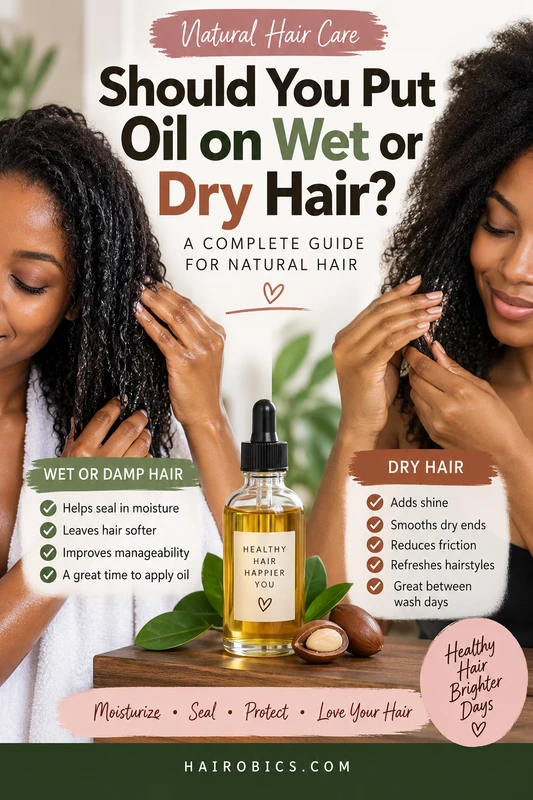
If you use oils as part of your natural hair routine, you may have wondered: Should you put oil on wet or dry hair?
It sounds like a simple question, but when you apply oil can make a noticeable difference in how your hair feels, looks, and retains moisture. Applying oil to wet or damp hair can help seal in water and leave the hair feeling softer for longer. Applying oil to dry hair can be useful for adding shine, reducing friction, refreshing dry-feeling ends, and protecting hair between wash days.
So which method is better?
For many people with natural, curly, coily, or textured hair, applying a small amount of oil to damp hair is usually the better choice when the goal is moisture retention. Water provides the moisture, while oil can help slow down how quickly that moisture is lost.
However, that doesn't mean you should never put oil on dry hair. Dry-hair oiling has its own benefits, especially when used strategically.
In this guide, we'll explain the difference between putting oil on wet, damp, and dry hair, when each method makes sense, how porosity affects your routine, common oiling mistakes, and how to determine what works best for your natural hair.
Should You Put Oil on Wet or Dry Hair?
The short answer is:
Apply oil to damp hair when your main goal is sealing in moisture. Apply a small amount to dry hair when your goal is shine, lubrication, reducing friction, or refreshing your ends.
One of the most important things to understand is that oil and water do different jobs.
Water hydrates hair.
Oil does not replace water.
When natural hair feels dry, adding more and more oil isn't always the solution. If the hair doesn't have enough moisture in it first, coating it with oil may leave it feeling greasy while it continues to feel dry underneath.
That's why many natural hair routines combine water or a water-based leave-in conditioner with an oil or butter.
A basic routine might look like:
Water → Leave-In Conditioner → Oil → Styling Product
The exact order can vary depending on your hair type, porosity, products, and styling goals.
The key is understanding that oil is generally most useful as a supporting product rather than your hair's primary source of hydration.
What Happens When You Put Oil on Wet Hair?
When you apply oil after washing your hair, your strands already contain water.
A light coating of oil can help reduce the rate at which that moisture leaves the hair.
Think about it as layering your products.
First comes moisture.
Then comes something that helps retain that moisture.
For natural hair that becomes dry quickly after washing, this can be particularly useful.
Applying oil while the hair is damp may help your hair:
- Feel softer
- Stay moisturized longer
- Feel smoother
- Become easier to manipulate
- Experience less friction during styling
- Maintain flexibility
- Look shinier
- Feel less rough at the ends
You don't necessarily need to apply oil while your hair is dripping wet.
In fact, many people find that damp hair works better than soaking-wet hair.
After washing your hair, gently remove excess water with a microfiber towel or soft cotton T-shirt. Apply your leave-in conditioner and then distribute a small amount of oil through your hair.
Pay particular attention to your ends.
Because the ends are the oldest part of your hair, they often require more protection than newer growth near your scalp.
What Happens When You Put Oil on Dry Hair?
Putting oil on dry hair isn't automatically bad.
It simply serves a different purpose.
When your hair is completely dry, applying oil can provide lubrication and shine. It may also help reduce friction when you're manipulating your hair.
For example, imagine that you're wearing a twist-out.
Your hairstyle still looks good three days later, but your ends feel slightly rough.
You might rub one or two drops of oil between your palms and gently smooth the oil over your ends.
This can help improve the way your hair feels without completely rewetting your hairstyle.
Dry-hair oiling can be useful for:
- Adding shine
- Smoothing dry-feeling ends
- Reducing friction
- Separating twists or braids
- Refreshing hairstyles
- Protecting ends
- Softening hair before manipulation
- Reducing the rough feeling associated with dryness
However, there is an important distinction.
Putting oil on dry hair is not the same as moisturizing dry hair.
If your hair is truly dehydrated, you will usually need water or a water-based moisturizing product.
Adding several layers of oil without introducing moisture can create buildup while leaving your hair feeling dry.
Damp Hair May Be the Sweet Spot
If you have natural hair, you don't necessarily have to choose between soaking-wet hair and completely dry hair.
There is another option:
Damp hair.
For many people, this is the ideal time to apply oil.
Your hair contains water, but it isn't dripping wet. That makes it easier to distribute leave-in conditioners, oils, creams, and styling products.
A simple routine might be:
- Wash and condition your hair.
- Gently remove excess water.
- Divide your hair into sections.
- Apply your leave-in conditioner.
- Apply a small amount of oil.
- Concentrate on your ends.
- Apply your styling product if necessary.
- Twist, braid, stretch, or style your hair.
This approach can work especially well for thick natural hair because sectioning helps ensure that your products reach more than just the outer layer of your hairstyle.
Does Oil Actually Moisturize Hair?
This is one of the biggest misconceptions in natural hair care.
People often describe oils as "moisturizing oils."
But technically, water is what hydrates hair.
Oil can help support moisture retention, lubrication, softness, shine, and manageability depending on the oil and how it's used.
Imagine your hair feels extremely dry.
You apply a large amount of oil.
Your hair becomes shiny.
But several hours later, it still feels hard or rough.
Why?
Because shine and moisture aren't the same thing.
Oil may change how the surface of the hair feels without supplying the water that dry hair needs.
This is why it's important to distinguish between:
Dry-looking hair
and
Dehydrated hair.
Natural hair doesn't have to look extremely shiny to be healthy. Curly and coily textures reflect light differently from straight hair, so healthy natural hair may naturally appear less glossy.
Focus on how your hair behaves.
Does it feel flexible?
Is it manageable?
Does it break easily?
Does it feel rough?
Does it stay soft after wash day?
Those observations can tell you more about your routine than shine alone.
Why Natural Hair Can Benefit From Oils
Natural hair tends to require special attention when it comes to moisture retention.
Your scalp naturally produces sebum. With straighter hair, those natural oils can travel down the hair shaft relatively easily.
With tightly curled or coiled hair, the bends and curves of the strand can make it more difficult for sebum to travel all the way down to the ends.
As a result, the ends may feel dry even when the scalp doesn't.
Strategically using oils can therefore be helpful for many natural hair routines.
Oil may help provide:
Lubrication
Lubricated strands can slide past one another more easily, which may help reduce unnecessary friction during manipulation.
Shine
A small amount of oil can give natural hair a polished appearance.
Improved Manageability
Some people find that oils make their hair feel easier to twist, braid, separate, or style.
Protection for the Ends
Applying a light amount of oil to the ends can reduce friction between your hair and clothing.
Moisture Retention
When used after water or a water-based moisturizer, oil can help support moisture retention.
The important word is after.
If moisture retention is your goal, make sure moisture is present first.
Should You Oil Your Hair Immediately After Washing?
For many people, yes.
After washing and conditioning is one of the best times to apply your moisturizing products because the hair has just been exposed to water.
You don't have to wait until your hair completely dries.
Try applying your products while your hair is damp.
For example:
Step 1: Cleanse
Use a shampoo appropriate for your scalp and hair.
Step 2: Condition
Apply conditioner and detangle carefully.
Step 3: Rinse
Rinse according to your product's directions.
Step 4: Remove Excess Water
Your hair should remain damp.
Step 5: Apply Leave-In Conditioner
Work in sections for more even distribution.
Step 6: Apply Oil
Use a relatively small amount.
Step 7: Style
Twist, braid, stretch, define, or otherwise style your hair.
This creates a simple foundation for your wash-day routine.
Should You Put Oil on Your Hair Before Washing?
You can.
This technique is commonly called pre-pooing or a pre-shampoo treatment.
Oil is applied before shampooing rather than after.
The purpose isn't necessarily to moisturize your hair.
Instead, some people use pre-shampoo oils to reduce friction and help their hair feel less stripped during cleansing.
Coconut oil is commonly discussed for this purpose because of its interaction with the hair fiber.
A pre-shampoo routine might involve applying a modest amount of oil to your hair before washing and allowing it to sit for a period before shampooing.
However, pre-pooing isn't mandatory.
If your current shampoo and conditioner leave your hair soft and manageable, you may not need another step.
Natural hair routines don't need to contain ten different products to work.
Wet Hair vs. Damp Hair vs. Dry Hair
Let's make the differences simple.
Wet Hair
Hair is saturated with water.
This can work well when you're applying products designed specifically for soaking-wet hair, especially certain curl-defining products.
However, some oils may be more difficult to distribute evenly when your hair is dripping.
Damp Hair
Hair contains plenty of water but isn't dripping.
This is often an excellent stage for applying leave-in conditioner followed by oil.
For many natural hair routines, damp hair provides a good balance between hydration and product distribution.
Dry Hair
There is little surface moisture remaining.
Oil can still be useful for shine, lubrication, reducing friction, and refreshing ends.
However, if your hair needs hydration, consider lightly misting it with water or applying a water-based leave-in before oil.
Should You Put Oil on Wet or Dry Hair for Hair Growth?
This requires an important clarification.
Applying oil to wet versus dry hair does not automatically determine how fast your hair grows.
Hair growth occurs from follicles beneath the scalp.
The length you eventually see is influenced by several factors, including genetics, age, nutrition, general health, hair-care practices, and how well you retain the hair you've already grown.
For people trying to grow longer natural hair, length retention is extremely important.
Imagine your hair grows steadily, but your ends continuously break.
Your roots are producing new hair, but your visible length may barely change.
This can make you believe your hair "isn't growing."
Reducing unnecessary breakage can therefore make a major difference in achieving longer-looking hair.
A good routine should focus on:
- Keeping hair appropriately moisturized
- Gentle detangling
- Protecting your ends
- Avoiding excessive heat
- Limiting unnecessary manipulation
- Maintaining a clean scalp
- Conditioning regularly
- Protecting hair while sleeping
- Trimming damaged ends when necessary
Oil can support that routine, but it isn't a magic growth solution.
Should You Apply Oil to Your Scalp?
You don't necessarily need to oil your scalp just because you have natural hair.
Your scalp already produces its own oil.
Some people enjoy applying scalp oils because they like the feel, fragrance, or scalp-massage experience.
Others find that frequent scalp oiling leads to buildup, itching, or greasiness.
Pay attention to how your scalp responds.
If you use scalp oil, apply a small amount rather than soaking your scalp.
Part your hair into sections and use the product sparingly.
A gentle scalp massage can also be incorporated into your routine.
However, avoid assuming that more oil automatically means faster hair growth.
If you're experiencing persistent itching, scaling, sores, significant dandruff, inflammation, or unusual hair loss, consider speaking with a dermatologist rather than continually adding more oils.
What Is the Best Oil to Use on Damp Natural Hair?
There isn't one oil that's perfect for everyone.
Different oils have different characteristics, and your hair may respond better to some than others.
Popular options include:
Jojoba Oil
Jojoba oil is lightweight and popular in natural hair routines.
It can be especially useful for people who don't want their hair to feel heavily coated.
Grapeseed Oil
Grapeseed oil is another relatively lightweight option.
It can work well for people who want shine and lubrication without using a heavy oil.
Avocado Oil
Avocado oil is popular for dry-feeling natural hair and can be incorporated into wash-day or styling routines.
Sweet Almond Oil
Sweet almond oil is often used to provide softness and shine.
Coconut Oil
Coconut oil has unique properties and is capable of penetrating the hair fiber to some degree.
However, individual experiences vary.
Some people love coconut oil.
Others report that their hair feels stiff or dry after using it.
If your hair consistently feels worse after using coconut oil, you don't have to force it into your routine.
Castor Oil
Castor oil is significantly thicker than many other oils.
A small amount may work well for people with thick, coarse hair, particularly when used on the ends.
However, it can be too heavy for fine or low-density hair.
Should Low-Porosity Hair Be Oiled Wet or Dry?
Low-porosity hair has a relatively resistant cuticle structure, which can make product absorption more challenging.
People with low-porosity hair often experience buildup when they use too many heavy products.
For this reason, lightweight products applied to damp hair may work better than repeatedly layering thick oils onto dry hair.
You might try:
- Wetting or washing your hair.
- Applying a lightweight leave-in.
- Using a small amount of lightweight oil.
- Styling normally.
Potential lightweight oils include jojoba and grapeseed oil.
The key is moderation.
If your hair looks oily but feels dry, you may be using too much oil or too many products.
Clarifying periodically can also be useful when buildup becomes noticeable.
Should High-Porosity Hair Be Oiled Wet or Dry?
High-porosity hair tends to absorb moisture quickly but may also lose moisture relatively quickly.
Applying products to damp hair can therefore be especially useful.
You might use:
Water → Leave-in conditioner → Oil or cream
Some people with high-porosity hair prefer slightly heavier products because their hair tolerates them well.
But porosity isn't the only factor.
Density, strand thickness, styling method, climate, and personal preference all matter.
Two people with high-porosity hair can require completely different routines.
The LOC Method
One popular natural hair moisturizing method is called the LOC method.
LOC stands for:
L — Liquid
O — Oil
C — Cream
You start with water or a water-based leave-in.
Next, apply oil.
Finally, apply a cream.
The idea is to layer products to help retain moisture.
For someone whose hair dries out quickly, the LOC method may be worth testing.
However, it can feel too heavy for some hair types.
The LCO Method
Another option is the LCO method.
That stands for:
L — Liquid
C — Cream
O — Oil
Instead of putting oil before your cream, you put it on last.
Some people find that this order leaves their hair softer for longer.
Others prefer LOC.
There is no universal winner.
Try each method separately for a few wash days and observe how your hair responds.
Ask yourself:
How long does my hair stay soft?
Does my hair feel coated?
Does it become greasy?
How much buildup do I experience?
How does my hair feel three days after wash day?
Your own results should guide your routine.
How Much Oil Should You Use?
This is where many natural hair routines go wrong.
More oil doesn't necessarily mean more moisture.
Using excessive oil can:
- Make hair greasy
- Weigh down curls
- Attract lint and debris
- Contribute to buildup
- Make hair difficult to style
- Cause you to shampoo more aggressively
- Reduce volume
Start small.
You can always add another drop or two.
It is much harder to remove excessive oil without washing your hair.
Fine hair generally requires less oil than thick or coarse hair.
Hair density matters as well.
Someone with extremely dense waist-length natural hair will probably use more product than someone with a short, low-density TWA.
Adjust accordingly.
Should You Oil Your Ends?
If you're trying to retain length, your ends deserve special attention.
The ends of your hair are the oldest section.
They have been exposed to:
- Washing
- Styling
- Detangling
- Clothing
- Pillows
- Weather
- Heat
- Manipulation
for longer than your roots.
That's why ends often become dry, thin, or damaged first.
After moisturizing your hair, smooth a small amount of oil over your ends.
You can also protect your ends with hairstyles that minimize friction and manipulation.
Should You Oil Your Hair Every Day?
Usually, you don't need to apply large amounts of oil every day.
Your hair may not need it.
If your hair stays soft and manageable for several days, leave it alone.
Constantly layering products can create buildup.
Instead, monitor your hair.
If your ends begin feeling rough, you might refresh them with a light water-based moisturizer followed by a tiny amount of oil.
The goal isn't to follow a rigid schedule.
The goal is to respond to what your hair needs.
Why Does My Hair Still Feel Dry After Oiling?
This is an extremely common problem.
You apply oil.
Your hair looks shiny.
But it still feels dry.
Several things could be happening.
You Applied Oil to Dehydrated Hair
Your hair may have needed water first.
Try applying water or a water-based leave-in before your oil.
You're Using Too Much Oil
Heavy product buildup can interfere with how your hair feels and behaves.
Clarifying may help.
You're Using the Wrong Products
Some products simply don't work well together or for your particular hair.
Your Hair Needs Conditioning
A regular conditioning routine may improve softness and manageability.
You Have Damaged Ends
Severely weathered or split ends cannot always be solved with more moisturizer or oil.
A trim may be necessary.
Can You Put Oil on Dry Hair Overnight?
You can apply a small amount of oil to dry hair before bed, particularly if you're using it to lubricate your ends.
But you don't need to saturate your hair every night.
A better nighttime routine for many people is simply protecting their hair from friction.
Try:
- A satin bonnet
- A satin scarf
- A satin pillowcase
- Loose twists
- Loose braids
- A pineapple, when appropriate for your hairstyle
Reducing nighttime friction can be extremely helpful for length retention.
Common Mistakes When Oiling Natural Hair
Oil can be useful, but improper use can create unnecessary problems.
Mistake #1: Using Oil Instead of Moisture
If your hair needs hydration, start with water or a water-based product.
Mistake #2: Using Too Much
Your hair doesn't need to look drenched in oil.
Mistake #3: Ignoring Buildup
Oils, creams, gels, and butters accumulate over time.
Cleanse your hair appropriately.
Mistake #4: Oiling an Irritated Scalp Repeatedly
If your scalp is persistently itchy, inflamed, flaky, painful, or irritated, adding more oil may not address the underlying issue.
Mistake #5: Expecting Oil to Repair Split Ends
Oil may temporarily make damaged ends look smoother, but it cannot permanently fuse split hair back together.
Mistake #6: Expecting Oil Alone to Grow Your Hair
Healthy hair growth and length retention require a complete approach.
A Simple Moisture Routine for Natural Hair
You don't need an extremely complicated routine.
Here's an easy starting point.
Wash Day
Cleanse your scalp and hair.
Follow with conditioner.
Detangle gently.
While Hair Is Damp
Apply your favorite leave-in conditioner.
Work in sections.
Seal
Apply a small amount of oil, concentrating on your ends.
Style
Twist, braid, define, stretch, or style your hair.
Protect at Night
Use satin or silk to reduce friction.
Refresh When Necessary
If your hair becomes dry several days later, lightly mist it with water or use a water-based moisturizer before adding additional oil.
This approach helps prevent the cycle of continually applying oil to hair that actually needs moisture.
Wet or Dry Hair for Protective Styles?
If you're preparing your hair for braids, twists, or another long-term protective style, you generally want your hair properly moisturized beforehand.
After washing and conditioning, apply your leave-in and oil while the hair is damp.
Then allow the hair to dry or stretch it according to the needs of the style.
Starting a protective style with extremely dry hair isn't ideal.
Remember that a protective hairstyle doesn't automatically keep hair moisturized.
Your hair still needs appropriate care while it's braided or twisted.
What About Locs?
Locs require a slightly different approach.
Heavy oils, creams, waxes, and butters can accumulate inside locs, so lightweight products are often preferred.
If your locs feel dry, start with hydration rather than coating them with thick oil.
A lightweight moisturizing spray can be useful, followed by a very small amount of oil if your hair responds well to it.
Avoid saturating locs with heavy oil.
Keeping the scalp clean is also important.
What About Men's Natural Hair?
The same general principles apply.
Whether you wear waves, an afro, twists, braids, or locs, oil shouldn't automatically replace water-based moisture.
For an afro, you might lightly moisturize your hair and then apply a small amount of oil.
For waves, avoid using so much oil that the hair and scalp become excessively greasy.
For locs, lightweight hydration is especially important.
Your routine should match your hairstyle rather than simply following a trend.
How to Know Whether Wet or Dry Oiling Works Better for You
Instead of guessing, conduct a simple experiment.
For one wash day, moisturize your hair and apply oil while your hair is damp.
Observe your hair for the next several days.
Write down:
- Softness
- Shine
- Frizz
- Manageability
- Buildup
- How quickly dryness returns
On another wash cycle, use less oil and compare the results.
You can also compare different oils.
Natural hair care becomes much easier when you stop changing five variables simultaneously.
Change one thing at a time.
That way, you can identify what's actually improving your hair.
Signs You May Be Using Too Much Oil
Your hair may be receiving too much oil if:
- It constantly looks greasy.
- Your curls feel weighed down.
- Your hair attracts lint easily.
- Your scalp develops heavy buildup.
- Your hair feels coated.
- Water seems to sit on top of layers of product.
- You feel the need to shampoo aggressively every wash day.
If these problems sound familiar, simplify your routine.
Use less product and consider clarifying your hair.
Sometimes the solution to dry natural hair isn't adding another product.
It's removing excess buildup and starting fresh.
How Often Should You Clarify?
There is no single schedule that works for everyone.
How frequently you need to clarify depends on:
- How many products you use
- How heavy those products are
- How often you style
- Your scalp's oil production
- Your wash schedule
- Your water quality
- Your lifestyle
Someone who uses oils, gels, edge control, butters, and styling creams every week may need to clarify more frequently than someone who uses only shampoo, conditioner, and a lightweight leave-in.
Watch your hair.
If products stop working the way they normally do and your hair feels heavily coated, buildup may be part of the problem.
Frequently Asked Questions
Is it better to put oil on wet or dry hair?
If your goal is moisture retention, applying a small amount of oil to damp hair after a water-based product is often the better approach. Oil can also be used sparingly on dry hair for shine, lubrication, and refreshing the ends.
Does putting oil on wet hair make it more moisturized?
The water is providing the hydration. Oil can help support moisture retention by reducing moisture loss.
Can I put oil directly on dry natural hair?
Yes. A small amount can provide shine and lubrication. However, if the hair is dehydrated, use water or a water-based moisturizer first.
Should I apply oil before or after leave-in conditioner?
Many people apply leave-in first and oil afterward. This helps ensure that water-based moisture reaches the hair before the oil.
Can oil make natural hair dry?
Using excessive oil or continually applying oil without sufficient water-based moisture may leave the hair feeling coated yet dry.
Should I oil my scalp or my hair?
That depends on your needs. Some people enjoy light scalp oiling, while others experience buildup. Oil can also be applied primarily to the hair and ends.
Is oil necessary for natural hair?
No. Some people have successful routines with minimal oil. Your hair's response matters more than following a specific trend.
Which oil is best for natural hair?
Popular options include jojoba, grapeseed, avocado, coconut, sweet almond, and castor oil. The best option depends on your strand thickness, porosity, density, styling routine, and personal preference.
Should I apply oil every night?
Usually not. Applying too much oil can lead to buildup. Refresh your hair only when necessary.
Does oil make hair grow faster?
Oil alone isn't a guaranteed way to increase the biological rate of hair growth. A healthy scalp and hair-care routine can support length retention by reducing unnecessary breakage.
Final Thoughts: Should You Put Oil on Wet or Dry Hair?
So, should you put oil on wet or dry hair?
For moisture retention, damp hair is generally the best starting point.
Wash or lightly moisturize your hair, apply a water-based leave-in if needed, and then use a small amount of oil to help seal in that moisture.
But oiling dry hair isn't wrong.
Dry-hair oiling can be useful when you want to add shine, reduce friction, soften your ends, or refresh a hairstyle without completely rewetting it.
The most important lesson is understanding the difference between moisture and oil.
Water hydrates your hair.
Oil can help support moisture retention and lubrication.
If your natural hair constantly feels dry despite using plenty of oil, adding even more oil may not solve the problem. Your hair may need more water-based moisture, better conditioning, less buildup, gentler handling, or a combination of those changes.
Pay attention to how your hair responds instead of following a routine simply because it's popular.
For many people with natural hair, a simple formula works well:
Hydrate → Moisturize → Seal → Protect.
Once you understand what each step does, it becomes much easier to build a natural hair routine that leaves your hair soft, manageable, and easier to maintain.