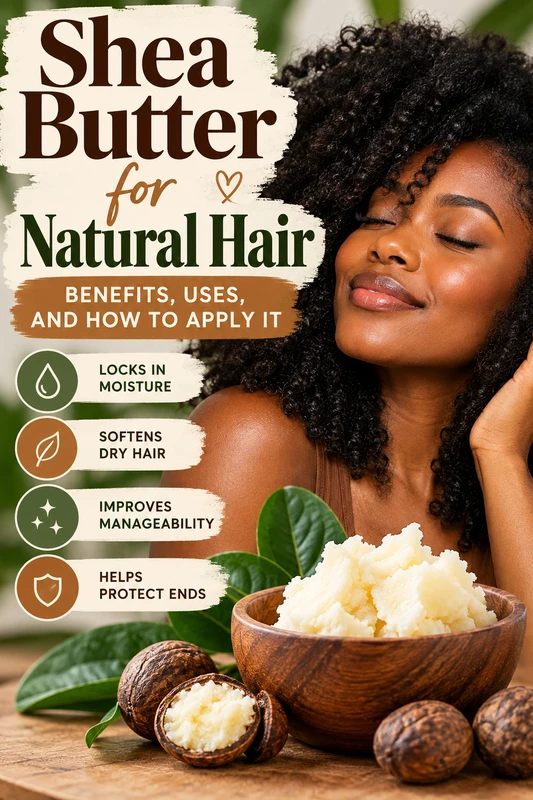
Shea butter has been used in beauty and personal-care routines for generations, and it remains one of the most recognizable ingredients in products made for natural hair. From thick creams and styling butters to leave-in conditioners and pomades, shea butter frequently appears in formulas designed to help dry, textured hair feel softer, smoother, and easier to manage.
For people with natural hair, maintaining moisture can be an ongoing challenge. Curls, coils, kinks, and tightly textured strands can become dry because natural scalp oils may have difficulty traveling all the way down the hair shaft. Add heat styling, protective styles, weather changes, manipulation, and everyday friction, and the ends of the hair can feel particularly dry.
This is where shea butter can be useful.
Shea butter doesn't hydrate hair in the same way that water does. Instead, it works especially well as a rich conditioning and sealing ingredient. When used correctly, it can help reduce moisture loss, soften dry strands, improve manageability, and provide lubrication that may reduce unnecessary friction during styling.
But shea butter isn't automatically perfect for every head of hair. How much you use—and when you apply it—can make the difference between soft, moisturized-feeling hair and hair that feels greasy, coated, or weighed down.
In this guide, we'll explore the benefits of shea butter for natural hair, how to use it correctly, whether it helps with hair growth, and how to determine if it belongs in your natural hair routine.
What Is Shea Butter?
Shea butter is a plant-derived fat traditionally produced from the kernels of the shea tree, which grows primarily in parts of Africa.
At room temperature, unrefined shea butter is generally solid or semi-solid. When warmed between the palms, it begins to soften and melt, making it easy to spread across the skin or hair.
Shea butter naturally contains fatty acids, which contribute to its rich, emollient texture. This is one reason it works particularly well in products formulated for dry or coarse hair.
You'll find shea butter in many types of natural hair products, including:
- Hair butters
- Leave-in conditioners
- Deep conditioners
- Styling creams
- Curl creams
- Pomades
- Edge products
- Hair masks
- Scalp products
- Protective-style products
Some people also purchase raw or unrefined shea butter and use it directly on their hair.
Is Shea Butter Good for Natural Hair?
For many people, yes.
Shea butter can be especially helpful for natural hair that is dry, coarse, thick, or prone to losing moisture quickly.
Its primary strength is its ability to coat and soften the hair.
This coating effect can be beneficial because textured hair often experiences friction between individual strands. The more strands rub against one another, clothing, pillows, combs, or brushes, the greater the possibility of tangling and mechanical damage.
An emollient ingredient such as shea butter can help strands feel smoother and more lubricated.
However, shea butter should not be confused with water.
If your hair is dehydrated, simply covering completely dry hair with a thick layer of shea butter may make the outside feel coated without addressing the underlying need for moisture.
For many routines, shea butter works best after water or a water-based moisturizing product has been applied.
Think of water as the hydration step and shea butter as one possible conditioning and sealing step.
1. Shea Butter Can Help Natural Hair Feel Softer
One of the most noticeable benefits of shea butter is softness.
Natural hair can sometimes feel rough even when it looks healthy. Texture itself isn't a problem, but excessive dryness and friction can make strands harder to manage.
Shea butter's rich texture helps lubricate the surface of the hair.
When applied in an appropriate amount, it can make curls and coils feel smoother and more flexible.
This can be particularly helpful for coarse natural hair, which may tolerate heavier products better than very fine hair.
Soft hair can also be easier to manipulate during styling.
Instead of fighting with stiff, dry strands, you'll often find that adequately moisturized and conditioned hair is easier to section, twist, braid, and detangle.
2. Shea Butter Helps Seal in Moisture
One of the biggest misconceptions about oils and butters is that they "moisturize" hair by themselves.
Water is the primary source of hydration in a hair-care routine.
Shea butter is better viewed as an emollient and sealing ingredient.
After you've applied water or a water-based leave-in conditioner, a small amount of shea butter can create a richer coating on the strands.
That coating can help slow the loss of moisture.
This is particularly valuable for people whose hair seems to become dry shortly after wash day.
A basic routine might look like this:
Water → Leave-in conditioner → Shea butter or styling product
You don't necessarily need all three steps every time. Your hair's porosity, density, thickness, climate, hairstyle, and product formulation all affect what works best.
The goal isn't to pile products onto the hair.
It's to find the smallest amount of product that keeps your hair soft and manageable.
3. Shea Butter May Be Helpful for High-Porosity Hair
High-porosity hair tends to absorb water relatively quickly but may also lose moisture quickly.
Because shea butter is rich and occlusive compared with lightweight sprays, some people with high-porosity natural hair find it useful for maintaining a softer feel after moisturizing.
For example, you might mist your hair with water or apply a leave-in conditioner and then smooth a small amount of shea butter over each section.
Pay particular attention to your ends.
Your ends are the oldest part of your hair and have experienced the most washing, styling, detangling, environmental exposure, and friction.
That makes them an important area to protect.
4. Shea Butter Can Help Protect Dry Ends
If you're trying to retain length, protecting your ends matters.
Hair grows from the scalp, but keeping that length requires limiting unnecessary breakage along the strands and especially at the ends.
Your ends can rub against:
- Clothing
- Bedding
- Car seats
- Scarves
- Towels
- Furniture
- Other strands of hair
Over time, repeated friction and manipulation can contribute to weathering of the hair fiber.
Applying a small amount of shea butter or a shea-butter-containing product to moisturized ends can add lubrication and help them feel smoother.
You don't need a huge amount.
With heavy products, more isn't always better.
5. Shea Butter Can Improve Manageability
Natural hair that is extremely dry can be difficult to style.
The strands may catch against each other, knots may form easily, and simply separating sections can become frustrating.
Shea butter can provide "slip," depending on the formulation and the other ingredients in the product.
More slip generally means less resistance when manipulating the hair.
However, don't rely on pure shea butter as your primary detangler if it doesn't provide enough slip for your hair.
A water-based conditioner or detangling product is often better suited to the actual detangling process.
Shea butter can then be used afterward to help maintain softness.
6. Shea Butter Is Excellent for Twists
Two-strand twists are one of the easiest natural hairstyles to pair with a rich butter.
A good twisting product needs to accomplish several things:
- Make the hair manageable
- Provide some lubrication
- Help strands stay together
- Keep hair from feeling excessively dry
- Provide enough hold for the desired style
A shea-butter-based styling cream can work particularly well for medium, thick, or coarse natural hair.
Start on clean, damp hair.
Apply your leave-in conditioner if needed, followed by a small amount of styling butter.
Work the product through the section before twisting.
Once the hair dries, the twists should feel soft rather than greasy.
If they're extremely oily, you probably used more product than necessary.
7. Shea Butter Can Be Used for Twist-Outs
A twist-out requires a balance between moisture, definition, hold, and volume.
Shea butter can help produce soft, moisturized-feeling results, particularly when it is incorporated into a formulated styling product.
After washing your hair:
- Divide damp hair into sections.
- Apply a water-based leave-in if needed.
- Apply a small amount of shea-butter styling product.
- Detangle gently.
- Create two-strand twists.
- Allow the hair to dry completely.
- Coat your fingertips lightly before unraveling.
- Separate carefully.
Avoid using too much butter.
Excessive product can reduce volume and make a twist-out look oily.
8. Shea Butter Works Well With Braids
Shea butter can also be incorporated into routines for braids and other protective styles.
Before installing braids, make sure the hair is clean, conditioned, moisturized, and properly detangled.
A small amount of shea butter can be applied to the strands, especially the ends, before braiding.
But protective styles shouldn't be overloaded with thick products throughout the entire time they're installed.
Heavy layers of butter combined with other styling products, sweat, dust, and scalp oils can contribute to buildup.
If you're wearing braids for several weeks, a lightweight moisturizing spray may be easier to use regularly than repeatedly coating the hair with raw shea butter.
9. Shea Butter for Low-Porosity Hair
Can low-porosity hair use shea butter?
Yes, but product amount becomes especially important.
Low-porosity hair can sometimes be more prone to feeling coated when heavy products are layered onto the strands.
If your hair is low porosity, raw shea butter may feel too heavy.
That doesn't mean you must avoid shea butter entirely.
Instead, consider using a formulated product where shea butter is combined with lighter ingredients.
Apply a very small amount and evaluate the results.
If your hair feels soft, flexible, and moisturized, the product may work well for you.
If it feels waxy, greasy, limp, or coated, reduce the amount or switch to something lighter.
Your hair's actual response is more useful than following a porosity rule too rigidly.
10. Shea Butter for High-Porosity Hair
High-porosity hair may respond well to richer products.
Because high-porosity strands can lose moisture relatively quickly, a heavier cream or butter may help maintain softness between wash days.
After washing and conditioning, apply your leave-in to damp hair.
Follow with a modest amount of shea butter or a shea-butter styling cream.
Concentrate on the mid-lengths and ends rather than automatically applying a large amount directly to your scalp.
If your hair remains soft for several days without feeling greasy, you've probably found an appropriate amount.
11. Shea Butter for Type 4 Hair
Shea butter is popular among people with Type 4 natural hair because tightly coiled textures often benefit from products that provide softness, lubrication, and manageability.
Type 4 hair includes a wide range of textures, densities, strand thicknesses, and porosity levels.
That means there is no universal product routine for everyone with Type 4 hair.
Still, shea butter may be useful for:
Twists, braid-outs, protective styling, sealing moisturized ends, reducing a rough feel, stretching styles, and maintaining softness between wash days.
If your Type 4 hair is fine, however, use less product.
Fine strands can become weighed down faster than coarse strands.
12. Shea Butter for Coarse Natural Hair
Coarse hair refers to the diameter of the individual hair strands.
Coarse strands are thicker than fine strands.
People with coarse natural hair often find that lightweight sprays alone don't provide the feel they want.
A rich shea-butter cream may provide longer-lasting softness.
Try applying a water-based leave-in first and following it with a small amount of butter.
Don't assume coarse hair needs huge quantities of product.
Start small and increase only if necessary.
13. Shea Butter for Fine Natural Hair
Fine natural hair can use shea butter, but moderation is important.
Fine strands can be overwhelmed by thick butters.
Too much shea butter may leave fine hair:
- Flat
- Greasy
- Sticky
- Heavy
- Difficult to style
- Lacking volume
Instead of using raw shea butter, consider a lightweight product containing a smaller proportion of shea butter.
Apply it primarily to your ends if those are the driest areas.
14. Can Shea Butter Grow Your Hair?
Shea butter is often marketed alongside hair-growth products, which can create confusion.
Shea butter itself shouldn't be treated as a proven hair-growth medication.
Hair growth occurs from follicles in the scalp and is influenced by factors including genetics, age, nutrition, hormones, health, and hair-care practices.
Where shea butter may indirectly support your length goals is through hair retention.
If a product helps your hair stay conditioned, manageable, and lubricated, it may make it easier to reduce unnecessary breakage.
Less breakage can help you retain more of the length your hair naturally grows.
This distinction is important:
Hair growth = new hair produced at the scalp.
Length retention = keeping more of that hair from breaking off.
You need both to achieve longer-looking hair over time.
15. Shea Butter and Hair Breakage
No single butter can guarantee that your hair won't break.
However, dryness, excessive manipulation, rough detangling, tight hairstyles, chemical damage, and heat damage can all contribute to breakage.
Shea butter may help improve lubrication and softness, making the hair easier to handle.
That can be beneficial during styling.
But technique matters just as much as product choice.
You can use the best hair butter available and still experience breakage if you're aggressively combing through knots.
Work in sections.
Detangle from the ends upward.
Use your fingers to separate major tangles before bringing in a comb or brush.
And don't force a tool through a knot.
16. Shea Butter vs Oil for Natural Hair
Shea butter and hair oils can serve similar purposes, but they aren't identical.
Many oils are liquid at room temperature and spread easily across the hair.
Shea butter is thicker and usually provides a heavier coating.
If your hair becomes weighed down easily, you may prefer a lightweight oil.
If your hair is extremely dry, thick, or coarse and seems to absorb lighter products quickly, you may prefer a butter.
You can also use products containing both oils and shea butter.
There's no requirement to choose only one.
17. Shea Butter vs Coconut Oil
Coconut oil is very different from shea butter.
Coconut oil can penetrate the hair shaft to some degree because of its molecular characteristics, while shea butter is typically valued more for its conditioning, emollient qualities.
Some people love coconut oil.
Others report that their hair feels stiff or hard after using it.
If coconut oil doesn't work well for your natural hair, shea butter may provide a different experience.
Again, your individual results matter.
18. Shea Butter vs Jojoba Oil
Jojoba oil is much lighter than shea butter.
Someone with fine or easily weighed-down hair might prefer jojoba oil.
Someone with coarse, very dry hair may prefer the richer feel of shea butter.
You can also combine them.
For example, some hair formulations use lighter oils to improve the spreadability of thicker butters.
19. Shea Butter vs Castor Oil
Castor oil and shea butter are both relatively heavy ingredients.
Castor oil is a thick liquid oil, while shea butter has a solid or semi-solid consistency at normal room temperatures.
Using both together can create an extremely rich combination.
That may work well for certain coarse or very dry hair types, but it can be too heavy for others.
If your hair becomes greasy easily, don't assume layering heavy oil over heavy butter will improve moisture.
More product does not necessarily mean more hydration.
20. Raw Shea Butter vs Refined Shea Butter
Raw or unrefined shea butter has undergone less processing and may retain its characteristic color and natural scent.
Refined shea butter undergoes additional processing that can change its color, smell, or other characteristics.
For hair care, both can be incorporated into effective formulations.
The overall formula matters.
A professionally formulated product containing refined shea butter can perform better for your hair than applying a chunk of raw shea butter directly.
Judge products by how your hair responds rather than assuming "raw" automatically means superior.
21. How to Apply Shea Butter to Natural Hair
The easiest way to use shea butter is on slightly damp or moisturized hair.
Try this method:
Step 1: Start with clean hair.
Wash your hair according to your normal schedule.
Step 2: Condition thoroughly.
Conditioning helps improve softness and manageability.
Step 3: Work in sections.
Four to eight sections can make product application easier.
Step 4: Apply your water-based moisturizer or leave-in.
Distribute it evenly.
Step 5: Use a small amount of shea butter.
Rub it between your palms until it softens.
Step 6: Smooth it over the hair.
Focus especially on the mid-lengths and ends.
Step 7: Style.
Twist, braid, bun, or style your hair as desired.
22. How Much Shea Butter Should You Use?
There isn't one exact measurement for everyone.
Someone with waist-length, extremely dense natural hair will need more product than someone with a short tapered cut.
Start with less than you think you need.
You can always add more.
Pay attention to how your hair feels once it dries.
Ideally, it should feel soft and flexible.
If touching your hair leaves significant grease on your hands, you've probably used too much.
23. Should You Put Shea Butter on Wet or Dry Hair?
For moisture retention, applying shea butter to damp or previously moisturized hair usually makes more sense than putting it onto extremely dry hair.
Remember: shea butter isn't water.
If your hair desperately needs hydration, applying more butter isn't necessarily the answer.
First introduce moisture through water or a water-based product.
Then use shea butter if your hair benefits from the added richness.
24. Can You Use Shea Butter Every Day?
You can, but most people don't need to apply a heavy butter every single day.
Repeated application without cleansing can cause buildup.
If your hair is already soft and moisturized, leave it alone.
Natural hair doesn't need to feel covered in product at all times.
Refresh only when needed.
You may find that a light mist or moisturizing spray is enough between wash days.
Save the heavier butter for times when the hair actually needs additional softness or sealing.
25. Shea Butter for Protective Styles
Protective styles can reduce daily manipulation, but the hair underneath still needs care.
Shea butter can be useful during the preparation stage for:
- Box braids
- Knotless braids
- Cornrows
- Mini twists
- Flat twists
- Crochet styles
- Wigs
Moisturize your hair before installation.
Apply enough product to keep it conditioned without creating a thick layer of residue.
While wearing the style, use lighter products as necessary.
Remember that a protective hairstyle should actually protect your hair.
If a style is excessively tight or painful, the problem isn't something shea butter can fix.
26. Shea Butter for Wash Day
Wash day is an excellent time to evaluate whether your hair needs richer products.
After shampooing and conditioning, feel your strands.
Do they feel soft?
Do your ends feel rough?
Does your hair dry extremely quickly?
Does it become dry within a day or two?
If so, experiment with applying a modest amount of a shea-butter product after your leave-in.
Then monitor your hair for several days.
The goal is to see whether your hair stays softer longer—not simply to use another product because it's popular.
27. Shea Butter and Product Buildup
Shea butter's richness is also its biggest potential disadvantage.
Heavy products can accumulate on the hair when repeatedly applied.
Signs you may be using too much product include:
- Hair feels coated after washing
- Curls look dull
- Hair feels greasy but still seems dry
- Water seems to sit on top of the hair
- Styles lack volume
- Hair feels sticky or waxy
- Products seem to stop working
If buildup becomes an issue, your hair may need a thorough shampoo.
A clarifying shampoo can occasionally be useful when your normal cleanser isn't removing accumulated styling products adequately.
How often you clarify depends on your routine.
Someone using heavy butters and gels frequently may need to clarify more often than someone using only lightweight products.
28. Can Shea Butter Make Natural Hair Dry?
Shea butter doesn't necessarily "dry out" hair, but it can create a situation where hair feels coated while still lacking adequate water.
Imagine applying thick butter repeatedly to already-dry hair without properly cleansing or rehydrating it.
The surface may feel greasy, but the hair itself may still feel stiff.
If this happens, don't immediately add more butter.
Wash the hair, condition it, restore moisture, and reconsider how much product you're using.
29. Shea Butter for Natural Hair in Winter
Winter weather can be challenging for natural hair.
Cold outdoor air combined with heated indoor environments may leave hair feeling dry.
This is when some people prefer richer creams and butters.
You might use a heavier shea-butter styling product during winter than you would during summer.
Also protect your hair from friction.
If you wear wool hats, consider using a satin-lined hat or placing a satin scarf between your hair and rough fabric.
30. Shea Butter for Natural Hair in Summer
You may need less shea butter during warm, humid months.
Heavy products combined with sweat can make the scalp and hair feel greasy faster.
If your winter routine feels too heavy during summer, reduce the amount of butter rather than abandoning your entire routine.
Natural hair routines can—and often should—change with the seasons.
31. Shea Butter for Kids' Natural Hair
Children with natural hair can also benefit from simple, gentle hair-care routines.
The priority should be keeping the hair clean, conditioned, manageable, and styled without excessive tension.
A small amount of a suitable shea-butter product may help keep children's hair soft during twists or braids.
Avoid overcomplicating the routine.
Kids don't need ten products layered onto their hair.
A cleanser, conditioner, moisturizer, and appropriate styling product may be enough.
32. Shea Butter for Men's Natural Hair
Shea butter isn't only for long natural hairstyles.
Men with afros, twists, curls, braids, or locs may also use products containing shea butter.
For a short afro, use very little.
Warm the product between your palms and distribute it evenly.
Too much butter on short hair can quickly make it look greasy.
For longer twists or natural styles, concentrate more product toward dry ends.
33. Shea Butter for Locs
People with locs should be especially cautious with thick butters.
Products that don't wash out easily can accumulate inside or around locs over time.
For this reason, many people with locs prefer lightweight, water-based sprays and oils rather than repeatedly applying thick raw butter.
If you use a shea-butter product on locs, apply it sparingly and make sure your cleansing routine adequately removes residue.
34. Shea Butter and Your Scalp
It's tempting to coat the scalp with every natural ingredient that sounds beneficial.
But your scalp doesn't necessarily need a thick layer of shea butter.
If your scalp feels dry or uncomfortable, first consider what may be causing the problem.
Overwashing, product buildup, irritation, weather, or a scalp condition can all play a role.
If you experience persistent itching, redness, sores, significant flaking, pain, or unexplained hair loss, consider speaking with a dermatologist or other qualified healthcare professional rather than continually adding oils and butters.
35. Does Shea Butter Help With Frizz?
Shea butter may help reduce the appearance of frizz by coating and smoothing the strands.
It can be especially useful when creating twists, braids, buns, and other controlled styles.
However, some frizz is completely normal for textured hair.
Natural hair doesn't have to look perfectly smooth to be healthy.
Humidity, curl pattern, styling technique, and the condition of the hair all influence frizz.
36. Shea Butter for a Soft Afro
If your afro feels dry or rough, don't immediately cover it with large amounts of butter.
Start with moisture.
Mist the hair lightly with water or use a water-based moisturizing spray.
Work in sections if necessary.
Then use a small amount of shea butter or a shea-butter styling product to help maintain softness.
Gently shape the afro without excessive picking.
Constantly pulling a pick from roots to ends can create unnecessary manipulation.
37. Shea Butter for Length Retention
If longer natural hair is your goal, focus on retention.
Your routine should minimize unnecessary breakage while keeping the scalp and strands clean and manageable.
A strong length-retention routine may include:
Regular cleansing, conditioning, careful detangling, moisturizing, protecting the ends, minimizing excessive heat, avoiding overly tight hairstyles, sleeping with satin or silk protection, and trimming damaged ends when necessary.
Shea butter can fit into that routine as a conditioning or sealing ingredient.
It isn't the entire routine.
38. Signs You're Using Too Much Shea Butter
Watch for these signs:
Your hair becomes greasy almost immediately after styling.
Your curls lose volume.
Your hair feels waxy.
Your strands attract visible lint.
You have to shampoo repeatedly to make your hair feel clean.
Your hair feels coated but strangely dry underneath.
Your styles don't last because they're too oily.
If this sounds familiar, reduce the amount.
You might be surprised by how little product natural hair actually needs when it's properly hydrated and conditioned.
39. How to Choose a Shea Butter Hair Product
Don't judge a product only because "shea butter" appears on the front label.
Read the entire ingredient list and consider what the product is designed to do.
Ask yourself:
Is this a leave-in conditioner?
A styling butter?
A pomade?
A deep conditioner?
A scalp product?
A curl cream?
Different products containing the same hero ingredient can perform very differently.
Choose products based on the job you need them to perform.
40. Building a Natural Hair Routine With Shea Butter
You don't need an overly complicated natural hair routine.
A simple routine could look like this:
Wash Day
Cleanse your scalp and hair thoroughly.
Condition
Use conditioner to improve manageability and help with detangling.
Moisturize
Apply a water-based moisturizing product or leave-in.
Seal/Style
Apply a small amount of shea-butter cream, butter, or pomade if your hair benefits from richer products.
Protect
Wear a low-manipulation hairstyle and protect your hair at night.
Refresh
Add moisture only when your hair actually needs it.
Repeat
Wash again according to your scalp, lifestyle, hairstyle, and product usage.
Consistency usually matters more than constantly changing products.
Frequently Asked Questions About Shea Butter for Natural Hair
Is shea butter good for Black hair?
Shea butter can work well for many Black hair textures because it provides richness, lubrication, and softness. However, Black hair varies tremendously in curl pattern, density, strand diameter, and porosity, so individual results will differ.
Does shea butter moisturize natural hair?
Shea butter is better described as a conditioning, emollient, and sealing ingredient than as a source of hydration. Apply water or a water-based product first when your hair needs moisture.
Can I leave shea butter in my hair overnight?
Yes, shea-butter hair products are commonly used as leave-in styling products when they're formulated for that purpose. You don't necessarily gain additional benefits simply because the product stays on overnight, however.
Can I use raw shea butter directly on my hair?
You can, although raw shea butter may be too heavy for some hair types. Warm a very small amount between your hands before applying it.
Is shea butter good for 4C hair?
It can be. Many people with tightly coiled hair enjoy rich butters because they help provide softness and lubrication. Strand thickness, density, porosity, and individual preference matter just as much as curl pattern.
Is shea butter good for low-porosity hair?
It can be, but use it sparingly. Some low-porosity hair becomes coated easily by heavy products.
Is shea butter good for high-porosity hair?
Many people with high-porosity hair prefer richer creams and butters because they can help maintain a softer feel after moisturizing.
Can shea butter stop hair breakage?
Shea butter cannot guarantee that hair won't break. However, improving lubrication and manageability may help reduce some mechanical stress during styling and detangling.
Does shea butter make hair grow faster?
There isn't strong evidence that applying shea butter makes hair follicles grow hair faster. Its more practical role is helping condition the existing hair, which may support length retention when combined with healthy hair-care practices.
Can I put shea butter on my ends?
Yes. The ends are actually one of the best places to concentrate a small amount of shea butter because they're the oldest and often driest part of your hair.
How often should I put shea butter on natural hair?
Use it according to your hair's needs rather than following a strict daily schedule. Some people use it primarily after wash day, while others refresh their ends between washes.
Does shea butter cause buildup?
It can if you repeatedly apply heavy amounts without cleansing thoroughly. If your hair begins feeling waxy or coated, reduce your usage and make sure your shampoo is removing your styling products effectively.
Final Thoughts: Is Shea Butter Worth Using on Natural Hair?
Shea butter can be an excellent addition to a natural hair routine, particularly for people who struggle with dry-feeling, coarse, thick, or highly textured hair.
Its greatest strengths are softness, lubrication, conditioning, and moisture retention.
But the key is understanding what shea butter can and cannot do.
Shea butter isn't a substitute for water.
It isn't a guaranteed hair-growth treatment.
And using more of it won't automatically make dry hair more moisturized.
Instead, think of shea butter as one part of a balanced routine.
Start with clean hair. Add water-based moisture when needed. Condition thoroughly. Then apply a modest amount of shea butter or a shea-butter-containing product to help maintain softness and protect your strands from unnecessary friction.
Pay particular attention to your ends if length retention is your goal.
Most importantly, listen to your hair.
If your strands remain soft, flexible, easy to detangle, and manageable after using shea butter, it may deserve a permanent place in your routine.
If your hair feels heavy, greasy, waxy, or coated, simply use less—or choose a lighter product.
Natural hair care doesn't have to be complicated.
A consistent routine built around cleansing, conditioning, moisture, gentle handling, and protecting your ends can go a long way toward helping your natural hair look and feel its best.