If you have natural hair, curls, braids, twists, locs, or another textured hairstyle, you have probably heard people talk about using oil on both the scalp and hair. But is scalp oil the same thing as hair oil?
Not necessarily.
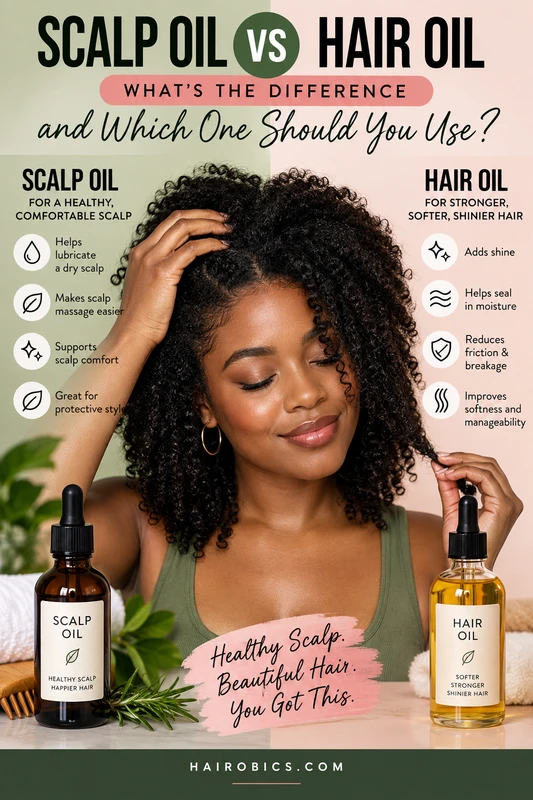
Although the terms are sometimes used interchangeably, scalp oils and hair oils can serve different purposes. A scalp oil is generally applied directly to the scalp to help lubricate dry-feeling skin and support a comfortable scalp-care routine. A hair oil is primarily applied to the hair strands to add shine, reduce friction, improve softness, and help seal in moisture.
Understanding the difference can make it easier to choose the right product, use the right amount, and avoid coating your scalp or hair with more oil than it actually needs.
This guide explains scalp oil vs hair oil, how each is used, which oils work well for different hair needs, whether you need both, and how to incorporate oil into a healthy natural hair routine.
What Is Scalp Oil?
Scalp oil is an oil or oil-based product designed to be applied primarily to the scalp.
Your scalp naturally produces sebum, an oily substance that helps lubricate the skin and hair. With straighter hair, sebum can travel relatively easily from the scalp down the hair shaft.
With tightly curled, coily, and kinky hair, that journey can be more difficult.
The bends and curves in textured hair can make it harder for natural oils to spread evenly down the strands. At the same time, some people simply experience a scalp that feels dry or tight, especially after washing or while wearing protective styles.
A scalp oil can be used to lightly lubricate the scalp and reduce that dry, uncomfortable feeling.
Depending on the formula, scalp oils may contain ingredients such as:
- Jojoba oil
- Castor oil
- Grapeseed oil
- Avocado oil
- Sweet almond oil
- Olive oil
- Coconut oil
- Argan oil
- Sunflower oil
- Essential oils diluted in carrier oils
The important word is lightly.
A healthy scalp does not necessarily need to be covered in a thick layer of oil every day.
What Is Hair Oil?
Hair oil is applied mainly to the hair itself rather than directly to the scalp.
Its primary purpose is usually cosmetic and protective. Hair oils can help improve shine, reduce friction between strands, make the hair feel softer, and help hold onto moisture that has already been introduced through water or a moisturizing product.
That last point is particularly important.
Oil and moisture are not the same thing.
Water provides moisture. Oil generally helps lubricate the hair and can slow moisture loss.
If your natural hair is extremely dry, repeatedly applying oil without introducing enough water-based moisture may leave the hair looking shiny while it still feels dry.
A better routine may involve applying a water-based leave-in or moisturizer first and then using a small amount of oil to help seal that moisture into the hair.
Scalp Oil vs Hair Oil: The Main Difference
The easiest way to understand the difference is to think about where the product is supposed to go.
Scalp oil = scalp
Hair oil = hair strands
Scalp oil is typically used to lubricate the skin underneath your hair.
Hair oil is typically used to improve the condition, appearance, and manageability of your strands.
There can be significant overlap, however. Some natural oils can be used on both the scalp and hair.
Jojoba oil, for example, may work well as a lightweight scalp oil while also being useful on dry hair ends.
The formula and your individual scalp and hair needs matter more than the name printed on the bottle.
What Does Scalp Oil Do?
Scalp oil can have several potential benefits when used appropriately.
1. Helps a Dry-Feeling Scalp
One of the most common reasons people oil their scalp is dryness.
After shampooing, the scalp may occasionally feel tight or dry. Weather, cleansing frequency, styling practices, and individual skin characteristics can also influence how the scalp feels.
Applying a small amount of a suitable oil may help lubricate dry-feeling areas.
You generally do not need to saturate your entire scalp.
Start with a few drops and add more only if necessary.
2. Makes Scalp Massage Easier
Scalp oil can provide slip during a scalp massage.
Instead of rubbing dry fingers aggressively against the scalp, a little oil can reduce friction.
Use the pads of your fingertips rather than your fingernails and massage gently.
Scalp massage can be a relaxing addition to wash day or your weekly hair-care routine.
3. Can Help While Wearing Protective Styles
Braids, twists, cornrows, crochet styles, and some other protective hairstyles provide easy access to the scalp.
This makes it tempting to oil the scalp every day.
Usually, that isn't necessary.
If your scalp feels comfortable, there may be no reason to keep adding oil.
When it does feel dry, applying a small amount along the exposed parts can be enough.
The goal should be scalp comfort—not creating a visible layer of grease.
4. Helps Reduce a Dry or Tight Feeling
A freshly washed scalp can sometimes feel tight.
A few drops of lightweight oil may improve that feeling.
However, persistent tightness, burning, severe itching, redness, sores, or heavy flaking shouldn't automatically be treated with more oil.
Those symptoms may require a different approach.
What Does Hair Oil Do?
Hair oil focuses on your strands rather than your scalp.
Here are some of its most useful functions.
1. Adds Shine
Natural hair doesn't always reflect light in the same way straight hair does.
That doesn't mean the hair is unhealthy.
The curves in curly and coily strands scatter light, which can make the hair appear less shiny.
A small amount of oil smooths and coats the surface of the strands, which can temporarily increase shine.
2. Helps Seal in Moisture
One of the best times to use hair oil is after applying moisture.
For example:
Water or leave-in → moisturizer → oil
You don't necessarily need all three steps every time, but the basic idea is useful.
Oil is generally most effective as a sealant or lubricant, not as a replacement for water.
3. Reduces Friction
Textured strands frequently rub against one another.
This friction can contribute to tangling and mechanical damage.
A small amount of oil can provide additional lubrication so the strands move past each other more easily.
This can be especially useful during styling and manipulation.
4. Helps Protect Dry Ends
Your ends are the oldest part of your hair.
If you have hair that is several years old, the ends have experienced years of washing, styling, detangling, weather exposure, and friction.
That is why your ends often need extra attention.
After moisturizing your hair, concentrating a small amount of oil on your ends may help keep them lubricated and reduce friction.
5. Improves Softness and Manageability
The right oil can make coarse or dry-feeling hair easier to handle.
But more oil isn't always better.
Too much can make the hair greasy, heavy, limp, or difficult to cleanse.
Finding the smallest effective amount is usually better than saturating the hair.
Do You Need Both Scalp Oil and Hair Oil?
Not everyone does.
Your scalp and your hair can have completely different needs.
For example, you might have a naturally oily scalp but extremely dry ends.
In that situation, adding scalp oil may be unnecessary while applying a little oil to your ends could be helpful.
Someone else might have a dry-feeling scalp while their locs already retain enough oil.
That person might use scalp oil but very little hair oil.
The key is to stop treating your scalp and hair as though they are the same thing.
They aren't.
Your scalp is skin.
Your hair shaft is a fiber.
They should be cared for accordingly.
Best Oils for the Scalp
There is no single oil that is best for everyone.
However, certain oils are popular because of their texture and versatility.
Jojoba Oil
Jojoba is technically a wax ester rather than a traditional triglyceride oil.
It is lightweight and commonly used in scalp and hair products.
Because it spreads easily, you don't need much.
Jojoba can be especially appealing to people who dislike thick oils.
Grapeseed Oil
Grapeseed oil is another lightweight option.
It spreads easily across the scalp and generally feels lighter than castor oil.
It may be a good option for people who want lubrication without an extremely heavy finish.
Sweet Almond Oil
Sweet almond oil is popular in natural hair routines because it offers slip without necessarily feeling extremely heavy.
It can be used on the scalp or hair depending on the formula and your preferences.
People with nut allergies should use appropriate caution.
Castor Oil
Castor oil is much thicker.
Many people with natural hair love its rich consistency, particularly for dry-feeling areas and hair ends.
However, its thickness can also cause buildup when overused.
If pure castor oil feels too heavy, it can be blended with a lighter carrier oil.
Avocado Oil
Avocado oil is a versatile option for dry natural hair.
It can be incorporated into scalp products, pre-shampoo treatments, conditioners, and sealing routines.
Again, moderation matters.
Best Oils for Natural Hair
When choosing an oil for your hair strands, consider how heavy the oil is and how your hair responds to products.
Lightweight oils may include:
Grapeseed, jojoba, argan, and sunflower oils.
These can be useful for people whose hair becomes weighed down easily.
Medium-to-richer oils may include:
Avocado, olive, sweet almond, and similar oils.
These can provide more noticeable lubrication.
Heavy oils include:
Castor oil and thick oil blends.
These may work particularly well on ends or very dry-feeling hair but can be too heavy for some textures.
Your curl pattern alone does not determine which oil will work.
Density, strand thickness, styling routine, porosity, climate, product layering, and personal preference can all matter.
Scalp Oil vs Hair Oil for Low-Porosity Hair
Low-porosity hair can sometimes become coated by heavy products relatively quickly.
If your hair falls into this category, you may prefer lighter oils and smaller quantities.
Possible choices include jojoba and grapeseed oil.
Apply your water-based moisture first.
Then use a very small amount of oil.
If your hair constantly feels coated, greasy, or heavy, reduce the amount or frequency.
Low-porosity hair does not necessarily require daily oiling.
Scalp Oil vs Hair Oil for High-Porosity Hair
High-porosity hair often loses moisture relatively quickly.
People with high-porosity hair may find richer creams and oils useful for slowing moisture loss.
Avocado, olive, castor, and other richer oils may work well depending on the individual.
Pay special attention to the ends.
Even with high-porosity hair, however, oil should not replace regular conditioning and water-based moisture.
Should You Oil Your Scalp Every Day?
Usually, you don't need to oil your scalp every day.
Some people enjoy frequent scalp oiling and experience no problems. Others quickly develop buildup, itching, or a greasy scalp.
Rather than following a rigid schedule, pay attention to your scalp.
If it feels comfortable, leave it alone.
If it feels dry, you can apply a small amount of oil where needed.
A routine might involve scalp oil once or twice per week, but your ideal frequency can vary.
The most important thing is not the number of days between applications.
It is how your scalp responds.
Can Too Much Scalp Oil Cause Problems?
Yes.
One of the biggest mistakes in natural hair care is assuming that more product automatically means more benefits.
Repeatedly layering oil can contribute to buildup.
Oil can combine with:
- Sweat
- Dead skin
- Styling products
- Dust
- Environmental debris
- Other hair products
Eventually, the scalp may feel coated rather than moisturized.
If you frequently use scalp oils, cleansing is important.
Does Scalp Oil Help Hair Grow?
This is where hair-care claims can become misleading.
Oil itself does not magically force hair follicles to produce longer hair.
Hair growth occurs inside the follicle and is influenced by many factors, including genetics, age, nutrition, hormones, general health, and the hair-growth cycle.
A good scalp-care routine can help create an environment in which your scalp stays clean and comfortable.
Hair-care practices can also help you retain the hair you grow by reducing unnecessary breakage.
That distinction matters.
You may feel like your hair is growing faster when you're actually retaining more length.
Both outcomes are valuable, but they aren't identical.
Scalp Oil vs Hair Growth Oil
The phrase hair growth oil is widely used in the beauty industry.
But you should approach dramatic growth promises carefully.
A cosmetic oil may help condition the scalp and reduce dryness or friction, but it shouldn't automatically be viewed as a medical treatment for hair loss.
If you're experiencing sudden hair loss, bald spots, severe thinning, scalp pain, sores, or other unusual symptoms, consult a dermatologist or qualified healthcare professional.
Should You Apply Oil to Wet or Dry Hair?
For the hair strands, slightly damp hair is often an excellent time to apply oil.
Why?
Because the water supplies moisture and the oil can help reduce how quickly that moisture escapes.
Try this:
- Lightly dampen your hair.
- Apply a leave-in conditioner or moisturizer if desired.
- Smooth a small amount of oil over the hair.
- Concentrate on the ends.
- Style normally.
You can also use a tiny amount of oil on dry hair to improve shine and reduce friction.
But if your hair is severely dehydrated, adding oil alone may not solve the problem.
Should Scalp Oil Be Applied to a Wet or Dry Scalp?
Either can work.
Some people prefer applying a few drops after washing while the scalp is clean.
Others apply oil between wash days when the scalp begins feeling dry.
What's more important is starting with a reasonably clean scalp.
Continuously applying oil over heavy buildup is rarely the best strategy.
Scalp Oil vs Hair Oil for Braids
Braids create a unique situation.
Your scalp is exposed while much of your natural hair is tucked inside the braids.
That means you may need two different approaches.
For the scalp, apply a small amount of lightweight oil only when necessary.
For your actual hair, moisture becomes especially important.
A water-based moisturizing spray can help introduce moisture to braided hair. Oil can then be used sparingly if additional sealing or lubrication is desired.
Avoid pouring heavy oil over your braids every day.
This can lead to buildup and make wash day more difficult.
Scalp Oil vs Hair Oil for Locs
Locs generally benefit from a minimalist approach.
Too much heavy oil can accumulate inside or around locs, especially when combined with waxes, creams, lint, and other products.
If your scalp needs oil, apply a small amount directly to the scalp.
If your locs feel dry, prioritize hydration rather than simply coating them with oil.
A lightweight water-based moisturizing spray can be useful, followed by a small amount of oil if your hair responds well to it.
The goal should be hydrated, flexible locs—not greasy locs.
Scalp Oil vs Hair Oil for Men
Black men with waves, curls, short afros, braids, or locs can use the same basic principles.
If you have short hair, it's particularly easy for hair oil to reach the scalp.
That means you may not need separate products.
A small amount of a lightweight oil may be enough for both your hair and scalp.
Men who wear waves should be especially careful with excessive layering.
Pomade, moisturizer, leave-in products, and oil can quickly accumulate.
Use enough product to achieve the desired softness and shine without constantly coating the scalp.
Scalp Oil vs Hair Oil for Kids
Children usually don't need complicated hair-care routines.
Gentle cleansing, conditioning, moisturizing, careful detangling, and low-tension hairstyles should form the foundation.
If a child's scalp feels dry, a small amount of simple oil may be appropriate.
Avoid unnecessarily strong essential-oil blends or heavily fragranced products, particularly on sensitive skin.
Persistent flaking, redness, sores, severe itching, or hair loss should be evaluated by a healthcare professional rather than repeatedly covered with oil.
Scalp Oil vs Hair Oil for Dry Natural Hair
If both your scalp and hair feel dry, resist the temptation to simply pour more oil everywhere.
Start by examining your entire routine.
Ask yourself:
Am I drinking enough water?
Hydration is important for overall health, although simply drinking extra water does not directly moisturize the outside of the hair shaft.
Am I cleansing regularly?
Heavy buildup can interfere with how your hair feels and responds to conditioning products.
Am I conditioning after shampooing?
Conditioner can improve softness, slip, and manageability.
Am I using a water-based moisturizer?
Oil isn't a substitute for water.
Am I protecting my hair at night?
Satin or silk accessories can help reduce friction.
Am I using too much heat?
Frequent high-temperature styling can contribute to dryness and damage.
Fixing the overall routine usually produces better results than relying on one oil.
How to Properly Apply Scalp Oil
Scalp oil doesn't need to be complicated.
Start with clean hands and relatively clean hair.
Part your hair into several sections so you can access the scalp.
Place a few drops of oil along the parts rather than soaking every inch.
Then gently massage the oil using the pads of your fingertips.
Do not scratch with your nails.
If your scalp looks visibly drenched after you're finished, you may have used more than necessary.
Start small.
You can always add another drop.
How to Properly Apply Hair Oil
Hair oil works best when applied strategically.
If you're using it to seal moisture, start with damp or freshly moisturized hair.
Place a small amount of oil in your palms.
Rub your hands together.
Smooth the oil down the length of your hair.
Pay particular attention to your ends.
For thick or dense natural hair, work in sections to improve distribution.
Avoid pouring oil directly onto your hair unless you are intentionally doing a pre-shampoo oil treatment.
Should You Oil Your Ends Every Day?
Not necessarily.
Your ends may benefit from additional lubrication, but daily oiling isn't automatically required.
Check how your hair feels.
If the ends remain soft and flexible, leave them alone.
If they feel rough or dry, introduce moisture first and then add a little oil.
Remember:
Dry hair + more oil isn't always the answer.
Sometimes the hair needs water.
What About Coconut Oil?
Coconut oil is one of the most discussed natural hair oils.
Some people love it.
Others say it leaves their hair feeling stiff, dry, or coated.
Both experiences are possible.
Hair is individual.
Coconut oil can be useful in certain pre-shampoo routines and hair products, but you don't have to use it simply because it is popular.
If your hair consistently feels worse after coconut oil, choose something else.
Can You Use the Same Oil on Your Scalp and Hair?
Absolutely.
You don't necessarily need two separate bottles.
A lightweight oil such as jojoba or grapeseed may work well for both purposes.
The difference is often how and where you use it.
On your scalp, you might use a few drops.
On your hair, you might smooth the oil over moisturized strands.
A well-formulated multipurpose oil can simplify your routine considerably.
Essential Oils vs Carrier Oils
This distinction is extremely important.
Carrier oils include oils such as jojoba, grapeseed, sweet almond, avocado, and olive oil.
Essential oils are highly concentrated plant extracts.
Examples include:
- Peppermint essential oil
- Rosemary essential oil
- Tea tree essential oil
- Lavender essential oil
Essential oils generally shouldn't be poured directly onto the scalp undiluted.
They can irritate the skin.
If you want to use essential oils, choose a properly formulated scalp product or dilute them appropriately in a carrier oil.
More essential oil does not mean better results.
How Often Should You Wash Your Hair If You Use Scalp Oil?
There's no universal schedule, but cleansing becomes particularly important when you regularly use oils and styling products.
Some people with natural hair wash weekly.
Others wash every 7–14 days.
People wearing certain protective styles may use different schedules.
The right frequency depends on your scalp, activity level, hairstyle, products, and lifestyle.
If your scalp is extremely greasy, itchy, coated, or developing visible buildup, it may be time to cleanse rather than add another layer of oil.
Signs You're Using Too Much Scalp Oil
Your scalp can tell you when your routine isn't working.
Possible signs of excessive product use include:
- Heavy buildup
- Greasy roots
- Hair that becomes oily quickly
- Product residue
- Increased need for clarifying
- A coated scalp
- Oil transferring heavily onto pillows or headwear
If this happens, reduce the amount and frequency.
You may be surprised by how little oil your scalp actually needs.
Signs You're Using Too Much Hair Oil
Hair can also become overloaded.
You may be using too much if your hair:
- Feels greasy instead of soft
- Looks flat
- Loses volume
- Attracts excessive lint
- Feels coated
- Requires frequent clarifying
- Becomes difficult to style
- Leaves oil on your hands whenever you touch it
Healthy-looking natural hair does not have to look wet with oil.
Common Scalp Oiling Mistakes
Mistake #1: Oiling a Dirty Scalp Repeatedly
Adding fresh oil over weeks of buildup doesn't clean your scalp.
Eventually, you need shampoo and water.
Mistake #2: Assuming Flakes Always Mean Dryness
Flaking can have multiple causes.
Some scalp conditions may actually become worse when covered repeatedly with oil.
If flaking is persistent or severe, seek professional advice.
Mistake #3: Using Too Much Oil
A few drops can go a long way.
Mistake #4: Scratching During Scalp Massage
Use your fingertips, not your nails.
Mistake #5: Expecting Oil to Cure Hair Loss
Cosmetic oils aren't a substitute for medical evaluation when you're experiencing unexplained hair loss.
Common Hair Oiling Mistakes
Mistake #1: Applying Oil Instead of Moisture
Oil isn't water.
Hydrate first when your hair needs moisture.
Mistake #2: Ignoring the Ends
Your oldest hair deserves extra attention.
Mistake #3: Choosing Oil Based Only on Trends
The oil everyone loves on social media may not work for your hair.
Mistake #4: Using Heavy Oils on Fine Hair
Fine strands may become weighed down quickly.
Mistake #5: Never Clarifying
Even natural oils can build up.
Periodic thorough cleansing may be necessary.
A Simple Scalp and Hair Oil Routine
You don't need ten products to maintain natural hair.
Here is a straightforward routine.
Wash Day
Cleanse your scalp thoroughly with shampoo.
Apply conditioner and detangle carefully.
Rinse according to the product instructions.
Apply a leave-in treatment or moisturizer.
If your scalp feels dry after washing, apply a few drops of scalp oil.
Then apply a small amount of hair oil to your strands, concentrating on the ends.
Style your hair.
Between Wash Days
Assess your hair instead of automatically adding products.
If your hair feels dry, lightly moisturize it.
If your scalp feels dry, use a few drops of oil.
If everything feels fine, do nothing.
Sometimes the best thing you can do for your hair is simply leave it alone.
Scalp Oil vs Hair Oil: Which Is Better for Hair Growth?
Neither should be viewed as a miracle growth solution.
Instead, think about healthy hair retention.
Your scalp routine should focus on cleanliness, comfort, and minimizing unnecessary irritation.
Your hair routine should focus on moisture, conditioning, gentle manipulation, low-tension styling, and protecting vulnerable ends.
Hair oil can support those goals by reducing friction and improving lubrication.
Scalp oil can support scalp comfort when dryness is an issue.
Together, they can be useful parts of a comprehensive hair-care routine.
But the basics matter more than constantly applying oil.
Scalp Oil vs Hair Oil for Protective Styles
Protective styles can reduce daily manipulation, but they don't eliminate the need for hair and scalp care.
While wearing braids or twists:
Keep your scalp reasonably clean.
Use scalp oil sparingly when necessary.
Use a lightweight water-based product to moisturize the hair.
Avoid repeatedly layering heavy oils and grease.
Protect the style at night with satin or silk.
Most importantly, don't leave a protective style in simply because you're trying to avoid manipulating your hair.
Your scalp still needs regular care.
Does Oil Prevent Hair Breakage?
Oil cannot make damaged hair permanently healthy again.
However, lubrication can reduce friction between strands and during manipulation.
Less friction can potentially mean less mechanical damage.
For length retention, combine appropriate oil use with:
- Gentle detangling
- Regular conditioning
- Minimal excessive heat
- Low-tension hairstyles
- Protection at night
- Careful handling of the ends
- Appropriate trimming
- Regular cleansing
No single product replaces a complete routine.
Can Scalp Oil Clog Your Pores?
Heavy product use can create buildup on the scalp, and certain products may not agree with everyone's skin.
This is another reason to avoid excessive application.
If you notice persistent bumps, irritation, itching, or discomfort after introducing a particular oil, stop using it and see whether the problem improves.
If symptoms persist, consult a dermatologist.
Scalp Oil vs Hair Oil: Frequently Asked Questions
Is scalp oil the same as hair oil?
Not always. Scalp oil is intended primarily for the scalp, while hair oil is primarily applied to the hair strands. However, some oils can be used for both purposes.
Can I use hair oil on my scalp?
Possibly, depending on the ingredients and formula. Check the product instructions. Some finishing oils contain ingredients or fragrances that may not be intended for direct scalp use.
Can I use scalp oil on my hair?
Many scalp oils can also be used on the hair, particularly if they're made primarily from carrier oils. However, very heavy formulas may make the hair greasy.
Should Black hair be oiled every day?
There is no rule saying Black hair must be oiled daily. Product frequency should depend on the condition of your individual scalp and hair.
Should I oil my scalp before or after moisturizing my hair?
If you're moisturizing your hair, apply the water-based moisture first and oil afterward if you want to help seal it in. Scalp oil can be applied separately where needed.
Does oil moisturize natural hair?
Oil can lubricate and help slow moisture loss, but water is the primary source of moisture. For very dry hair, start with water or a water-based product.
Which oil is best for a dry scalp?
Lightweight oils such as jojoba or grapeseed may work well for some people. The best choice depends on your skin and scalp.
Which oil is best for dry natural hair?
Jojoba, grapeseed, avocado, argan, olive, sweet almond, and castor oils are all popular options. Choose based on how your individual hair responds.
Can I put oil on my scalp with braids?
Yes. Apply a small amount directly along the exposed scalp when needed rather than saturating the entire hairstyle.
Can I oil my locs?
Yes, but use oil sparingly. Locs usually benefit from hydration first. Excessive oil and heavy products can contribute to buildup.
The Bottom Line: Scalp Oil vs Hair Oil
The biggest difference between scalp oil and hair oil is simple:
Scalp oil is primarily for your scalp. Hair oil is primarily for your hair strands.
Scalp oil can help lubricate a dry-feeling scalp and make gentle scalp massage easier.
Hair oil can add shine, improve lubrication, reduce friction, and help seal moisture into natural hair.
You may need both.
You may need only one.
You may even find that the same lightweight oil works perfectly for your scalp and strands.
Instead of applying oil because a schedule says you should, pay attention to what your hair and scalp are telling you.
If your scalp feels comfortable, don't automatically oil it.
If your hair feels moisturized, don't automatically add another layer of product.
If your hair feels dry, introduce moisture before reaching for more oil.
And if you're experiencing persistent itching, heavy flaking, scalp inflammation, sores, or unexplained hair loss, don't assume oil is the solution. Consider seeing a dermatologist or other qualified healthcare professional.
A healthy natural hair routine doesn't have to involve dozens of products.
Cleanse your scalp regularly, condition your hair, provide adequate moisture, protect your ends, minimize unnecessary manipulation, and use oil strategically.
When you understand the difference between scalp oil vs hair oil, oil becomes a tool in your routine rather than something you simply apply out of habit.