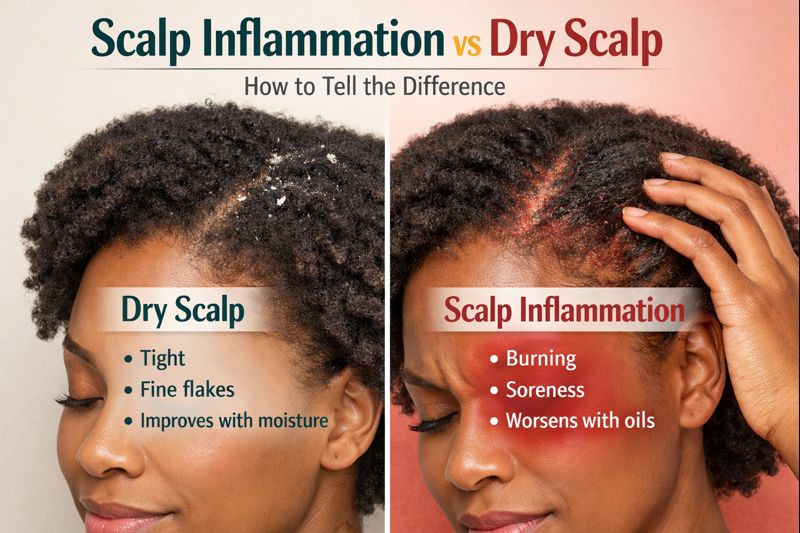
If your scalp itches, flakes, burns, or feels sore, it’s tempting to assume one thing: “My scalp is dry.”
But here’s the uncomfortable truth most people never hear:
? Many people treating “dry scalp” actually have scalp inflammation—and moisturizing it makes the problem worse.
Dry scalp and scalp inflammation can look similar on the surface, but they are not the same condition, they don’t have the same causes, and they absolutely should not be treated the same way.
Misidentifying the problem can lead to:
-
Persistent flakes that never go away
-
Burning, soreness, or tenderness
-
Increased shedding or thinning
-
Hair that won’t retain length
-
Products “stopping working” over time
In this guide, you’ll learn exactly how to tell the difference between dry scalp and scalp inflammation, why they’re often confused, and how each one affects your hair growth long-term.
Why Scalp Health Determines Hair Growth (More Than Products Do)
Hair doesn’t grow from products.
It grows from follicles.
And follicles are surrounded by:
-
Blood vessels
-
Nerve endings
-
Oil glands
-
Immune cells
When your scalp environment is unhealthy—whether dry or inflamed—those follicles go into protection mode, not growth mode.
That’s why people say things like:
-
“My hair is healthy but won’t grow”
-
“My scalp feels fine but my hair keeps thinning”
-
“Nothing works anymore”
The scalp is the gatekeeper. Let’s break down the two most misunderstood scalp conditions.
What Is a Dry Scalp?
Dry scalp is a moisture deficiency problem, not a disease.
What’s Actually Happening
A dry scalp occurs when:
-
The scalp isn’t producing enough natural oil (sebum), or
-
Moisture is escaping faster than it can be retained
This leads to:
-
Tightness
-
Mild itchiness
-
Small, dry flakes
-
Ashy or dull scalp appearance
Dry scalp is not inflammatory by default—it’s more like dry skin on your arms or legs.
Common Causes of Dry Scalp
-
Cold or dry weather
-
Over-washing or harsh shampoos
-
Hot water use
-
Aging (oil production naturally decreases)
-
Low humidity environments
-
Poor internal hydration
-
Lack of scalp oils or occlusives
Dry scalp is especially common in:
-
Natural hair textures
-
Locs and protective styles
-
Older adults
-
People who shampoo frequently
Signs You Have a Dry Scalp
✔ Tight feeling after washing
✔ Fine, powdery white flakes
✔ Minimal redness
✔ No burning or pain
✔ Itch improves after moisturizing
✔ Scalp feels better with oils or creams
If your symptoms improve immediately after adding moisture, dryness is likely the culprit.
What Is Scalp Inflammation?
Scalp inflammation is an immune response, not a moisture issue.
This is the critical difference.
What’s Actually Happening
Inflammation occurs when the scalp:
-
Is irritated by allergens, microbes, or buildup
-
Experiences barrier damage
-
Activates immune cells around follicles
This leads to:
-
Swelling around hair follicles
-
Increased sensitivity
-
Reduced blood flow
-
Interrupted hair growth cycles
Inflammation doesn’t mean visible redness all the time. Many inflamed scalps look “normal” but feel wrong.
Common Causes of Scalp Inflammation
-
Product buildup (especially heavy oils and butters)
-
Fragrance sensitivity
-
Harsh detergents or frequent manipulation
-
Tight styles or traction
-
Hard water residue
-
Fungal or microbial imbalance
-
Chronic scratching
-
Stress and cortisol spikes
Important: Inflammation can exist even if flakes are present, which is why people confuse it with dryness.
Signs You Have Scalp Inflammation
❌ Burning or stinging sensation
❌ Soreness or tenderness to touch
❌ Throbbing or tight “pressure” feeling
❌ Persistent itch that doesn’t improve with oil
❌ Redness, swelling, or shiny patches
❌ Increased shedding or thinning edges
❌ Products suddenly cause irritation
If adding oils makes your scalp itch more, inflammation—not dryness—is likely the problem.
Dry Scalp vs Scalp Inflammation: Side-by-Side Comparison
| Symptom | Dry Scalp | Scalp Inflammation |
|---|---|---|
| Flakes | Small, dry, powdery | Larger, sticky, or irregular |
| Itch | Mild, improves with moisture | Persistent, worsens with products |
| Sensation | Tight, slightly itchy | Burning, sore, tender |
| Redness | Rare | Common (but not always visible) |
| Reaction to oils | Feels better | Feels worse or heavier |
| Hair shedding | Minimal | Often increased |
| Root cause | Lack of moisture | Immune/irritant response |
Why These Two Conditions Are So Often Confused
Because flakes are misleading.
People assume:
“Flakes = dry scalp.”
But inflammation can cause:
-
Accelerated skin turnover
-
Clumping of dead skin cells
-
Yellow, white, or gray flakes
Adding oil to an inflamed scalp can:
-
Trap heat
-
Feed microbial overgrowth
-
Increase follicle congestion
Which explains why so many people say:
“Every time I oil my scalp, it gets worse.”
How Each Condition Affects Hair Growth
Dry Scalp & Hair Growth
Dryness can:
-
Make hair brittle at the root
-
Increase breakage
-
Cause mild shedding
But dry scalp alone rarely causes long-term hair loss.
Once moisture balance is restored, growth typically resumes normally.
Inflamed Scalp & Hair Growth
Inflammation is far more damaging.
It can:
-
Shorten the anagen (growth) phase
-
Push hairs prematurely into shedding
-
Reduce nutrient delivery to follicles
-
Cause miniaturization over time
Chronic inflammation is a silent growth killer, especially around:
-
Edges
-
Crown
-
Temples
The Simple At-Home Test to Tell the Difference
Try this 24-hour test:
Step 1
Wash your hair with a gentle, clarifying shampoo.
Step 2
Do not apply oils or heavy products for 24 hours.
Step 3
Observe:
-
If your scalp feels tight but calm → likely dry
-
If your scalp feels sore, itchy, or irritated → likely inflamed
Step 4
Apply a light, soothing, water-based product (not oil).
-
If itch improves → dryness
-
If itch persists or worsens → inflammation
Why Treating Inflammation Like Dryness Backfires
This is where most routines go wrong.
People with inflammation often:
-
Oil daily
-
Layer heavy butters
-
Avoid washing
But inflammation requires:
-
Cleansing
-
Barrier repair
-
Reduced triggers
Not more buildup.
Over-oiling an inflamed scalp is like putting lotion on a rash without removing the irritant first.
Can You Have Both at the Same Time?
Yes—and it’s common.
An inflamed scalp can:
-
Lose moisture rapidly
-
Feel dry and sore
This is called barrier-impaired inflammation.
In these cases, the scalp needs:
-
Calm first
-
Moisture second
Not the other way around.
Signs Your “Dry Scalp” Is Actually Inflammation
-
Moisturizing helps for an hour, then itch returns
-
Flakes come back quickly after washing
-
Oils feel heavy or suffocating
-
Hair sheds more when scalp is irritated
-
Scalp feels worse at night
These are red flags.
Why This Matters for Long-Term Hair Health
Ignoring scalp inflammation can lead to:
-
Chronic thinning
-
Hair that won’t grow past a certain length
-
Widening parts
-
Receding edges
-
“Healthy hair” with poor density
Hair length means nothing if follicle health is compromised.
The Biggest Mistake People Make
Treating the symptom instead of the signal.
Flakes are a signal.
Itch is a signal.
Soreness is a signal.
Your scalp is communicating—learning the language is the key.
When to Seek Professional Help
You should consult a dermatologist if:
-
Burning or pain persists
-
Redness spreads or worsens
-
Hair loss accelerates
-
Scalp develops thick plaques or sores
Especially if inflammation lasts longer than 4–6 weeks.
Final Thoughts: Listen to Your Scalp, Not Just Your Hair
Dry scalp and scalp inflammation may look similar, but they demand very different care strategies.
One needs:
-
Moisture
-
Protection
-
Gentle nourishment
The other needs:
-
Calm
-
Balance
-
Reduced triggers
When you treat the right condition, hair growth becomes easier—not forced.
Your scalp sets the rules.
Your routine just needs to follow them.