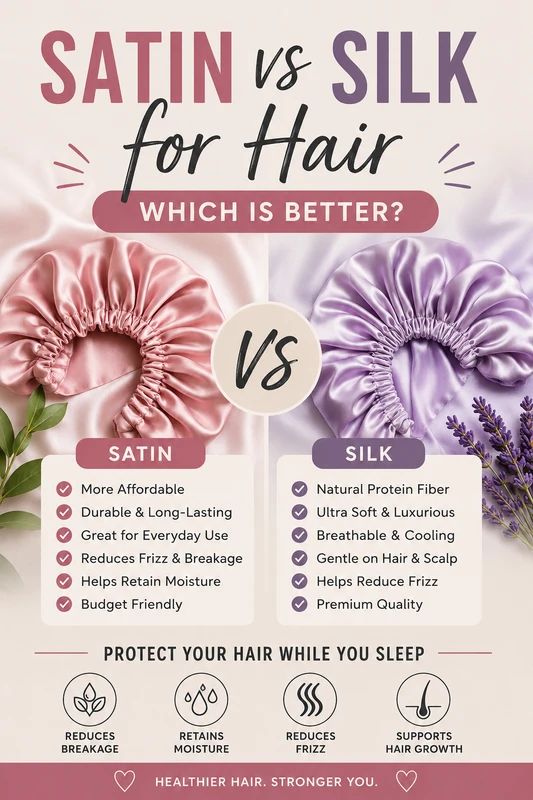
Satin vs Silk for Hair: Which One Actually Protects Your Hair Better?
If you care about healthy hair, hair growth, moisture retention, and reducing breakage, you’ve probably heard people say you should sleep with a satin or silk bonnet, scarf, or pillowcase.
But which one is actually better for your hair — satin or silk?
The answer is more detailed than most people realize.
While both satin and silk can help protect your hair compared to cotton pillowcases, they are not the same material, they perform differently, and each has its own advantages depending on your hair type, lifestyle, and budget.
In this complete guide, we’ll break down:
- The difference between satin and silk
- Which is better for natural hair
- Which reduces frizz more
- Which is best for curly hair, braids, and locs
- Which helps retain moisture better
- Which is more affordable
- Which lasts longer
- Common myths about satin and silk
- The best option for hair growth and hair protection
By the end, you’ll know exactly which one is best for your hair routine.
Why Your Pillowcase Matters for Hair Health
Many people spend hundreds of dollars on oils, conditioners, and hair growth products but still sleep on rough cotton pillowcases every night.
That creates a major problem.
Cotton absorbs moisture and creates friction against your hair while you sleep. Every toss and turn can slowly damage the hair shaft.
Over time, this can lead to:
- Dry hair
- Split ends
- Frizz
- Tangles
- Breakage
- Thinning edges
- Flattened curls
- Loss of moisture
- Increased shedding
This is especially important for:
- Natural hair
- Curly hair
- Coily hair
- Locs
- Braids
- Relaxed hair
- Color-treated hair
Switching to satin or silk can dramatically reduce this nightly damage.
What Is Silk?
Silk is a natural fiber produced by silkworms.
It has been considered a luxury fabric for thousands of years because of its:
- Smooth texture
- Soft feel
- Lightweight structure
- Breathability
- Natural shine
Silk is made from protein fibers, which gives it a very smooth surface that creates less friction against the hair.
The most popular type used for hair products is mulberry silk.
High-quality silk pillowcases and bonnets are often measured using “momme” weight. A higher momme count usually means thicker and more durable silk.
What Is Satin?
One of the biggest misconceptions is that satin is a material.
It’s not.
Satin is actually a weaving technique.
Satin can be made from:
- Polyester
- Nylon
- Rayon
- Silk
- Blended fibers
Most satin hair products today are made from polyester satin because it’s affordable and smooth.
The satin weave creates a glossy, slippery surface that helps hair glide instead of rubbing harshly against fabric.
That smooth surface is what makes satin popular for:
- Bonnets
- Pillowcases
- Scarves
- Hair wraps
- Scrunchies
The Main Difference Between Satin and Silk
The biggest difference is simple:
- Silk is a natural fiber
- Satin is a weave/style of fabric
Silk can actually be satin.
But satin is not always silk.
This means satin products can vary greatly in quality depending on what material they’re made from.
Some cheap satin products may not feel as breathable or luxurious as real silk.
Satin vs Silk for Hair: Which Is Better?
The truth is both are MUCH better than cotton.
But depending on your priorities, one may fit your needs better.
Silk Is Better For:
- Luxury feel
- Sensitive scalps
- Maximum softness
- Breathability
- Temperature regulation
- Premium hair care routines
Satin Is Better For:
- Affordability
- Everyday use
- Durability
- Budget-friendly hair care
- Protective styling
- Easy maintenance
For many people, satin provides nearly all the hair benefits of silk at a fraction of the price.
Does Satin or Silk Help Hair Grow?
Neither satin nor silk magically grows hair overnight.
However, they can help support healthier hair growth indirectly.
How?
By reducing breakage.
Many people think their hair “isn’t growing,” but the real issue is that the hair keeps breaking off before length becomes noticeable.
Satin and silk help by:
- Reducing friction
- Preventing tangles
- Preserving moisture
- Protecting edges
- Minimizing split ends
- Preventing dryness
This allows you to retain more length over time.
Healthy hair retention is one of the biggest keys to seeing longer hair.
Satin vs Silk for Natural Hair
Natural hair tends to be more vulnerable to dryness because natural oils have a harder time traveling down curls and coils.
That makes moisture retention extremely important.
Both satin and silk can help protect natural hair from moisture loss.
However:
Silk Benefits for Natural Hair
- Extremely soft surface
- Less friction
- More breathable
- Feels cooler at night
- Luxurious feel
Satin Benefits for Natural Hair
- Affordable
- Widely available
- Durable
- Effective moisture protection
- Great for nightly use
For most people with natural hair, satin bonnets and pillowcases work perfectly well.
High-quality satin can deliver excellent results without the high cost of silk.
Satin vs Silk for Curly Hair
Curly hair easily becomes frizzy from friction.
Cotton pillowcases rough up the hair cuticle while sleeping, which can destroy curl definition overnight.
Satin and silk help curls stay smoother and more defined.
Benefits for Curly Hair
- Reduced frizz
- Better curl preservation
- Less tangling
- Less matting
- Better moisture retention
Silk may feel slightly smoother, but satin still performs extremely well for curl protection.
Satin vs Silk for Braids
Braids can become dry and frizzy from nightly friction.
Sleeping without protection can also lead to:
- Frayed braids
- Fuzzy roots
- Edge breakage
- Itchy scalp
Both satin and silk help extend the life of braided styles.
However, satin bonnets are often preferred because they are:
- More durable
- Easier to wash
- More affordable
- Better for daily wear
Satin vs Silk for Locs
Locs need protection too.
Friction can cause lint buildup, dryness, and frizz in locs.
Satin and silk help maintain cleaner, smoother locs.
Many people with locs prefer satin because it’s easier to maintain consistently over time.
Large satin bonnets and satin pillowcases are especially popular in the loc community.
Does Silk Reduce Frizz More Than Satin?
Technically, silk may reduce friction slightly more than polyester satin.
But the difference is usually small.
Most people will notice a huge improvement switching from cotton to either satin or silk.
The bigger difference comes from:
- Product quality
- Consistency of use
- Hair care routine
- Moisture balance
Cheap low-quality satin may snag hair, while high-quality satin can feel extremely smooth.
Which Retains Moisture Better?
Both satin and silk retain moisture better than cotton.
Cotton absorbs oils and moisture from the hair overnight.
Satin and silk are less absorbent, which helps keep your hair hydrated longer.
This is especially helpful for:
- Dry hair
- High porosity hair
- Color-treated hair
- Curly hair
- Coily hair
Moisture retention is critical for preventing breakage.
Is Silk Worth the Extra Cost?
That depends on your budget and priorities.
Silk products can be expensive.
A high-quality silk pillowcase may cost several times more than satin.
If you want:
- Premium luxury
- Natural fibers
- Cooling feel
- Breathability
Then silk may be worth it.
But if you mainly want:
- Hair protection
- Frizz reduction
- Moisture retention
- Affordable hair care
Then satin is often the smarter value.
Satin vs Silk Bonnet
A bonnet is one of the best investments for hair protection.
Benefits of Bonnets
- Protect hair while sleeping
- Preserve hairstyles
- Reduce breakage
- Reduce frizz
- Protect edges
- Help retain moisture
Satin Bonnet Pros
- Affordable
- Durable
- Easy to replace
- Great for daily use
Silk Bonnet Pros
- Ultra soft
- Lightweight
- Breathable
- Luxury feel
Most people choose satin bonnets because they are more practical and budget-friendly.
Satin vs Silk Pillowcase
If bonnets slip off at night, pillowcases become extremely important.
A satin or silk pillowcase can still protect your hair while you sleep.
Benefits of Satin or Silk Pillowcases
- Reduced hair friction
- Less morning frizz
- Better moisture retention
- Fewer tangles
- Less breakage
Silk pillowcases usually feel cooler and softer.
Satin pillowcases are often more durable and affordable.
Which Is Better for Low Porosity Hair?
Low porosity hair struggles to absorb moisture.
Because moisture retention matters so much, both satin and silk can help prevent dryness.
Satin is usually sufficient for low porosity hair.
The key is consistency.
Using protective sleep fabrics nightly matters more than choosing the most expensive option.
Which Is Better for High Porosity Hair?
High porosity hair loses moisture quickly.
That means protecting hydration overnight is essential.
Both satin and silk help reduce moisture loss.
Pairing a satin bonnet with moisturizing products can significantly help high porosity hair stay softer longer.
Are Cheap Satin Products Bad for Hair?
Not necessarily.
But very cheap satin products can sometimes:
- Snag hair
- Feel rough
- Trap heat
- Wear out quickly
Higher-quality satin usually performs much better.
Look for:
- Double-layer satin
- Smooth stitching
- Comfortable elastic bands
- Breathable fabric
- Soft interior lining
Common Myths About Satin and Silk
Myth #1: Silk Makes Hair Grow Faster
Silk does not directly speed up hair growth.
It helps reduce breakage so hair can retain length better.
Myth #2: Satin Is Bad for Hair
High-quality satin is excellent for hair protection.
Millions of people successfully use satin bonnets and pillowcases every night.
Myth #3: Only Natural Hair Needs Satin or Silk
All hair types benefit from reduced friction.
Straight hair, wavy hair, curly hair, and chemically treated hair can all benefit.
Myth #4: Cotton Pillowcases Are Fine
Cotton absorbs moisture and creates friction.
Over time, this can contribute to dryness and breakage.
How to Choose the Best Satin or Silk Product
Look for:
- Smooth texture
- Comfortable fit
- Durable stitching
- Breathable fabric
- Quality construction
Avoid:
- Rough seams
- Tight elastic bands
- Cheap scratchy fabric
- Poor-quality stitching
Best Hair Routine for Overnight Protection
For maximum hair protection while sleeping:
Step 1: Moisturize Your Hair
Use lightweight moisturizers or oils.
Step 2: Protect Your Ends
Ends are the oldest and weakest part of the hair.
Step 3: Use a Satin or Silk Bonnet
This reduces friction and moisture loss.
Step 4: Sleep on a Satin or Silk Pillowcase
Extra protection if your bonnet slips off.
Step 5: Avoid Tight Hairstyles at Night
Tension can damage edges and weaken hair.
Which Is Better Overall: Satin or Silk?
Here’s the honest answer:
Choose Silk If You Want:
- Luxury
- Natural fibers
- Premium softness
- Cooler sleeping experience
Choose Satin If You Want:
- Affordability
- Excellent hair protection
- Durability
- Everyday practicality
For most people, satin offers the best balance of price and performance.
That’s why satin bonnets and pillowcases remain extremely popular in the natural hair community.
Final Verdict: Satin vs Silk for Hair
When it comes to protecting your hair while sleeping, both satin and silk are far superior to cotton.
Both can help:
- Reduce breakage
- Retain moisture
- Reduce frizz
- Preserve hairstyles
- Protect edges
- Support healthy hair retention
Silk may offer a more luxurious experience, but satin provides incredible value and excellent hair protection for everyday use.
The most important thing is consistency.
Using either satin or silk nightly can make a major difference in the health, softness, and appearance of your hair over time.
If your goal is stronger, healthier, and longer-looking hair, switching from cotton to satin or silk is one of the smartest hair care changes you can make.
Frequently Asked Questions
Is satin or silk better for hair growth?
Neither directly grows hair, but both help reduce breakage and improve length retention.
Is silk cooler than satin?
Yes, silk is generally more breathable and cooler.
Is satin cheaper than silk?
Yes. Satin is usually much more affordable.
Can satin dry out hair?
High-quality satin typically helps preserve moisture better than cotton.
Is a satin bonnet enough?
Yes, a satin bonnet can greatly reduce friction and moisture loss overnight.
Should I use both a bonnet and pillowcase?
Yes. Using both provides maximum protection.
Which lasts longer?
Satin is often more durable and easier to maintain than delicate silk.
Do satin pillowcases help curly hair?
Yes. Satin helps reduce frizz and preserve curl definition.
Protect Your Hair Naturally
Healthy hair starts with protection.
Pairing a healthy hair routine with moisture-rich products and nighttime protection can help your hair stay stronger, softer, and healthier over time.
Explore natural hair care essentials from Hairobics All Natural to help nourish your scalp, strengthen your strands, and support healthy-looking hair growth naturally.