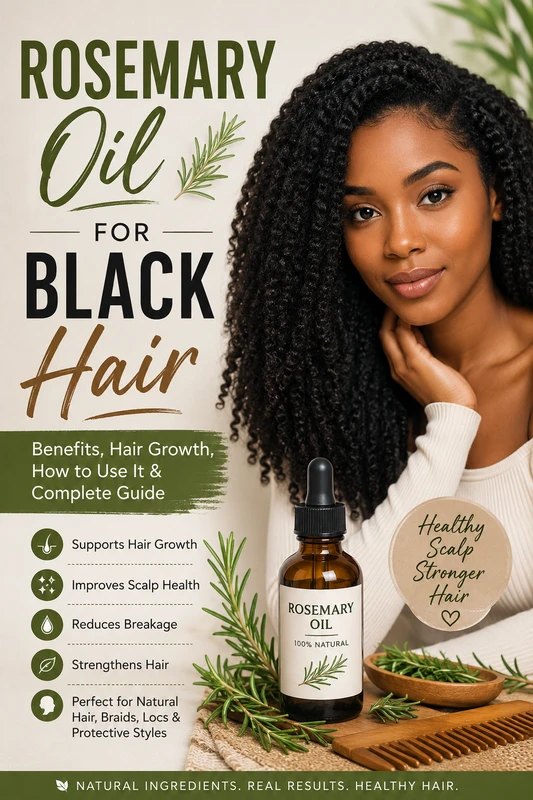
Rosemary oil has become one of the most talked-about natural ingredients in hair care. From scalp oils and shampoos to homemade hair-growth blends, rosemary oil is increasingly being used by people who want to support stronger, healthier-looking hair.
For Black hair in particular, rosemary oil can be an appealing addition to a healthy hair routine. Natural Black hair can be vulnerable to dryness, breakage, tangling, and damage from frequent manipulation. Protective styles such as braids, twists, wigs, and locs can also make maintaining a consistent scalp-care routine especially important.
But is rosemary oil good for Black hair? Can rosemary oil actually help hair grow? How often should you use it? And should you put rosemary essential oil directly on your scalp?
This complete guide explains the potential benefits of rosemary oil for Black hair, how to use it safely, how it fits into a natural hair-growth routine, and mistakes you should avoid.
What Is Rosemary Oil?
Rosemary oil is derived from rosemary (Salvia rosmarinus), an aromatic herb that has been used for centuries in traditional cooking and wellness practices.
When people discuss rosemary oil for hair, they are usually talking about rosemary essential oil.
Essential oils are highly concentrated. This is important because rosemary essential oil generally should not be applied heavily and undiluted directly to the scalp.
Instead, it is commonly mixed with a carrier oil or incorporated into a professionally formulated hair product.
Popular carrier oils include:
- Jojoba oil
- Coconut oil
- Olive oil
- Avocado oil
- Grapeseed oil
- Sweet almond oil
- Argan oil
- Castor oil
Combining rosemary essential oil with a carrier oil allows it to be distributed across the scalp while reducing the concentration of the essential oil.
Is Rosemary Oil Good for Black Hair?
Rosemary oil can be incorporated into a Black hair-care routine, particularly when the goal is maintaining a healthy scalp and supporting healthy-looking hair.
However, rosemary oil isn't a miracle solution.
Healthy Black hair depends on numerous factors, including scalp health, moisture, nutrition, genetics, hormones, styling practices, manipulation, chemical treatments, and overall health.
The biggest mistake is assuming that applying more oil automatically means faster hair growth.
It doesn't.
A better approach is to use rosemary oil as one component of a complete hair-care routine designed to:
- Keep the scalp healthy
- Reduce unnecessary breakage
- Maintain moisture
- Protect fragile ends
- Minimize excessive manipulation
- Avoid overly tight hairstyles
- Maintain consistent cleansing
- Support length retention
When these habits work together, your hair has a better opportunity to retain the length it naturally grows.
Benefits of Rosemary Oil for Black Hair
There are several reasons rosemary oil has become popular in natural hair routines.
1. Rosemary Oil May Support a Healthy Scalp
Healthy-looking hair starts with proper scalp care.
Your scalp naturally produces oil, sweat, and dead skin cells. Hair products can also accumulate over time.
This is especially relevant for people who regularly use:
- Gels
- Edge controls
- Pomades
- Leave-in conditioners
- Styling creams
- Scalp oils
- Dry shampoo
- Protective styling products
Adding more oil isn't necessarily the solution to scalp buildup.
Rosemary oil works best as part of a routine that also includes regular cleansing.
A clean, comfortable scalp creates a better environment for maintaining healthy hair.
2. Rosemary Oil May Support Hair Growth
The potential connection between rosemary oil and hair growth is one of the biggest reasons the ingredient has become so popular.
There has been scientific research examining rosemary oil and hair.
One frequently discussed clinical study compared rosemary oil with 2% minoxidil in people with androgenetic alopecia. After six months, both groups experienced increases in hair counts, although this single study does not establish rosemary oil as an equivalent replacement for medically approved hair-loss treatments.
That's an important distinction.
There is some encouraging research, but much more research is needed.
Rosemary oil should therefore be viewed as a potentially helpful ingredient rather than a guaranteed treatment for hair loss.
3. Rosemary Oil Can Be Used During Scalp Massage
Scalp massage is an easy addition to many Black hair routines.
Once diluted, rosemary oil can be gently massaged into the scalp using your fingertips.
Massage also encourages you to pay attention to different areas of your scalp.
You may notice:
- Unusual tenderness
- Excessive flaking
- Buildup
- Breakage
- Thinning edges
- Changes in density
- Irritated areas
Use the pads of your fingertips rather than scratching your scalp with your fingernails.
A scalp massage does not need to be aggressive.
Gentle and consistent is better than hard and painful.
4. Rosemary Oil Fits Easily Into Natural Hair Routines
One advantage of rosemary oil is its versatility.
It can potentially be incorporated into routines for:
- Natural hair
- Curly hair
- Coily hair
- Locs
- Twists
- Braids
- Short natural hairstyles
- Men's natural hair
The exact method should depend on your hairstyle and scalp.
Someone wearing waist-length knotless braids will not necessarily use rosemary oil the same way as someone wearing a wash-and-go.
Rosemary Oil for Natural Black Hair
Natural Black hair frequently has a curved or coiled structure.
Because of these bends and curves, natural scalp oils may have more difficulty traveling from the scalp all the way down the hair shaft compared with straighter hair textures.
As a result, the ends can become especially vulnerable to dryness.
This is why a natural hair routine shouldn't focus exclusively on the scalp.
You also need to protect your strands.
A complete natural hair routine may include:
- Regular shampooing
- Conditioning
- Periodic deep conditioning when needed
- Gentle detangling
- Leave-in conditioner
- Appropriate moisturizing products
- Scalp care
- Low-manipulation styling
- Nighttime protection
Rosemary oil can fit into this routine, but it shouldn't replace the other steps.
Rosemary Oil for 4C Hair
People with 4C hair often search specifically for rosemary oil for 4C hair growth.
4C hair can have tight coils and significant shrinkage. It may also be vulnerable to breakage when handled roughly or allowed to become excessively dry.
Rosemary oil may be incorporated into a 4C hair routine primarily as a scalp-care product when properly diluted.
However, oil itself isn't a moisturizer.
This is extremely important.
Oil and moisture aren't the same thing.
Water provides hydration. Oils can help lubricate strands and reduce moisture loss in certain routines, but applying rosemary oil to extremely dry hair without addressing hydration may leave your hair feeling oily while still being dry.
For 4C hair, prioritize hydration and conditioning alongside oils.
Rosemary Oil for Hair Growth: What Does the Science Say?
Interest in rosemary oil increased substantially because of research into its potential effects on hair growth.
One study published in 2015 evaluated rosemary oil against 2% minoxidil among people with androgenetic alopecia.
After three months, researchers did not observe significant changes in hair counts in either group. At six months, however, hair counts had increased in both groups.
The study is interesting, but it shouldn't be interpreted to mean rosemary oil is a proven cure for hair loss.
There are important limitations.
Hair loss can have many different causes, and results from one group of participants cannot automatically be applied to every person experiencing thinning.
More high-quality research is needed.
Still, the existing evidence is one reason rosemary oil continues to receive attention as a potential addition to scalp-care routines.
Can Rosemary Oil Make Black Hair Grow Faster?
This is where expectations need to be realistic.
Your hair's growth rate is influenced heavily by biology.
Applying rosemary oil doesn't mean your hair will suddenly grow several inches in a few weeks.
When people notice significantly longer hair after changing their routine, length retention can also be part of the explanation.
Imagine your hair grows steadily but repeatedly breaks at the ends.
You may think:
"My hair isn't growing."
In reality, your hair could be growing from the scalp while breaking at a similar rate from the ends.
The visible length barely changes.
Reducing breakage allows more of the length you grow to remain on your head.
This is why hair-growth routines should address both the scalp and the strands.
Rosemary Oil for Thinning Black Hair
Thinning hair can be frustrating, especially when you don't know what is causing it.
Rosemary oil is often promoted online for thinning hair, but it's important to determine why the thinning is occurring.
Possible contributors to thinning and hair loss include:
- Genetics
- Tight hairstyles
- Repeated tension
- Hair breakage
- Chemical damage
- Heat damage
- Hormonal changes
- Certain medications
- Nutritional deficiencies
- Scalp disorders
- Medical conditions
Because the causes are so different, one product cannot address every situation.
If you experience sudden hair loss, bald patches, scalp pain, inflammation, significant itching, scarring, or progressively worsening thinning, consult a dermatologist or qualified healthcare professional.
Early evaluation can be especially important with some types of hair loss.
Rosemary Oil for Black Women's Edges
Edges are one of the most fragile areas of the hairline.
Unfortunately, they're also frequently subjected to significant manipulation.
Common stressors include:
- Tight ponytails
- Slick-back buns
- Braids installed too tightly
- Heavy extensions
- Wigs with excessive tension
- Strong adhesives
- Repeated edge-control application
- Aggressive brushing
- Tight headbands
Rosemary oil won't compensate for ongoing physical damage.
If your edges are thinning because your hairstyle is repeatedly pulling them, reducing that tension is one of the most important changes you can make.
Give your edges a break.
Avoid hairstyles that cause:
- Pain
- Bumps
- Redness
- Headaches
- Excessive pulling
- Visible stress around the hairline
Hair shouldn't have to hurt to look good.
How to Use Rosemary Oil for Black Hair
There are several ways to incorporate rosemary oil into your routine.
Method 1: Diluted Rosemary Scalp Oil
One of the easiest methods is diluting rosemary essential oil in a carrier oil.
For example, you can add a small amount of rosemary essential oil to a larger amount of carrier oil.
Good carrier-oil options include jojoba, grapeseed, coconut, avocado, olive, or argan oil.
Because essential oils are concentrated, always follow the dilution guidance supplied by the product manufacturer and discontinue use if irritation occurs.
Apply a small amount to the scalp.
Then gently massage it in with your fingertips.
You don't need to saturate your scalp.
Method 2: Use a Hair Product Formulated With Rosemary
This may be easier for people who don't want to make their own mixtures.
Rosemary can be found in:
- Scalp oils
- Hair serums
- Shampoos
- Conditioners
- Hair masks
- Leave-in products
Commercial formulations also eliminate some of the guesswork associated with essential-oil dilution.
Always follow the manufacturer's directions.
Method 3: Rosemary Oil Scalp Massage
Apply your diluted rosemary mixture to several sections of the scalp.
Use your fingertips to gently massage the area.
Try approximately 3–5 minutes.
Avoid digging your nails into your scalp.
Scalp massage should feel relaxing, not painful.
How Often Should Black Hair Use Rosemary Oil?
There isn't one schedule that works for everyone.
Some people may use a rosemary-containing scalp product a few times per week, while others may prefer less frequent applications.
The right frequency depends on:
- Scalp oiliness
- Hair texture
- Hairstyle
- Product formulation
- Wash schedule
- Sensitivity
- Other products being used
More isn't automatically better.
If frequent oiling leaves your scalp coated, greasy, itchy, or uncomfortable, reduce your usage and reassess your cleansing routine.
Can You Use Rosemary Oil Every Day?
You don't necessarily need rosemary oil every day.
Daily scalp oiling can lead to excessive product accumulation for some people.
This is particularly true if you continue adding oil without cleansing your scalp frequently enough.
Instead of asking:
"How much rosemary oil can I use?"
Ask:
"How little do I need to accomplish my goal?"
Hair products work best when used intentionally.
Can You Leave Rosemary Oil in Your Hair Overnight?
Whether a rosemary-containing product can remain on your scalp overnight depends on its formulation and concentration.
A professionally formulated leave-in scalp product may be specifically designed to remain on the scalp.
A homemade essential-oil mixture is different.
Follow the manufacturer's directions and pay attention to how your skin responds.
If you experience burning, redness, itching, swelling, or irritation, stop using the product and wash it from the area.
Should You Put Rosemary Essential Oil Directly on Your Scalp?
Generally, concentrated rosemary essential oil should be diluted rather than liberally applied directly to the skin.
Essential oils are powerful, concentrated substances.
Using too much can cause irritation.
Dilution is particularly important for people with sensitive skin.
Consider performing a small patch test before applying a new product more extensively.
Rosemary Oil and Castor Oil for Black Hair
Castor oil is another extremely popular oil in Black hair care.
It has a thick consistency, making it very different from lightweight oils such as grapeseed or jojoba oil.
Some people mix rosemary essential oil with castor oil.
The combination may be appealing for people who prefer heavier scalp oils.
However, castor oil can feel too thick for some scalps.
If you have:
- Fine hair
- An oily scalp
- Frequent buildup
- Easily weighed-down hair
you may prefer a lighter carrier oil.
Rosemary Oil and Jojoba Oil
Jojoba oil is popular because it is relatively lightweight.
It can be a useful carrier for rosemary essential oil and may be preferable for people who don't like the heavy feeling associated with castor oil.
Again, the best carrier depends on your hair and scalp.
Rosemary Oil and Coconut Oil
Coconut oil is widely used in natural hair care.
Some people love it.
Others find that coconut oil leaves their hair feeling stiff or dry.
Pay attention to your own results rather than assuming an ingredient will work simply because it is popular.
If coconut oil doesn't agree with your hair, choose another carrier.
Rosemary Oil for Braids
Can you use rosemary oil while wearing braids?
Yes, a properly formulated or diluted rosemary scalp product can potentially be used during a braided protective style.
However, avoid drenching your braids in oil.
Focus primarily on your scalp.
Apply small amounts between your parts where needed.
And remember: protective styles don't eliminate the need for scalp hygiene.
Over several weeks, your scalp can accumulate:
- Sweat
- Dead skin
- Oil
- Gel
- Edge control
- Dirt
- Styling products
Oiling over buildup doesn't clean the scalp.
Rosemary Oil for Locs
People with locs can also incorporate rosemary oil into their scalp-care routines.
With locs, lightweight application can be particularly helpful because excessive product usage may contribute to buildup.
Apply your rosemary-containing product primarily to the scalp.
Massage gently.
Avoid repeatedly saturating your locs with thick oils.
Healthy loc maintenance involves balancing:
- Cleansing
- Hydration
- Scalp care
- Drying
- Maintenance
- Product usage
Your locs should be allowed to dry thoroughly after washing to prevent persistent dampness.
Rosemary Oil for Men's Black Hair
Rosemary oil isn't limited to women's natural hair routines.
Black men may use rosemary-containing products with:
- Waves
- Afros
- Locs
- Braids
- Twists
- Fades
- Longer natural hair
Men experiencing thinning at the temples or crown should remember that male-pattern hair loss is common and may progress over time.
Rosemary oil shouldn't delay professional evaluation if hair loss is significant or worsening.
Rosemary Oil for Kids' Hair
Extra caution is appropriate when using essential oils around children.
Children's skin can be more sensitive, and essential-oil safety can vary depending on the child's age and the product.
Don't automatically use an adult rosemary essential-oil mixture on a child.
Use age-appropriate products and consult a pediatrician or qualified healthcare professional if you're uncertain about essential-oil use in children.
Rosemary Oil for Dry Black Hair
If your Black hair feels constantly dry, rosemary oil alone probably isn't the answer.
Remember:
Oil is not water.
A better dry-hair routine should emphasize hydration and conditioning.
You may need to reconsider:
- How frequently you shampoo
- What shampoo you use
- Whether you're conditioning thoroughly
- Whether you're using enough leave-in conditioner
- How frequently you use heat
- Whether you sleep with satin or silk protection
- Whether your ends need trimming
- Whether you have significant product buildup
Oils can complement a moisture routine, but they shouldn't replace it.
Rosemary Oil for High-Porosity Hair
High-porosity hair tends to absorb moisture quickly but may also lose it relatively quickly.
This can occur naturally or because of damage from:
- Bleaching
- Coloring
- Excessive heat
- Chemical processing
- Mechanical damage
People with high-porosity hair may find oils useful as part of a layered moisture routine.
However, rosemary oil itself isn't a treatment that repairs severe structural damage.
Regular conditioning, gentle handling, and reducing damaging practices remain important.
Rosemary Oil for Low-Porosity Hair
Low-porosity hair may be more prone to feeling coated when heavy products are repeatedly applied.
If you have low-porosity hair, lightweight products may work better.
Instead of heavily coating your scalp and hair with castor oil mixtures, consider a lighter rosemary formulation.
Start small.
You can always apply more if necessary.
Rosemary Oil Before or After Washing?
Both approaches are possible depending on the product.
Before Shampooing
A diluted rosemary oil mixture can be used as a pre-shampoo scalp treatment.
Apply it according to the product directions, then shampoo thoroughly.
This approach may be useful for people who dislike leaving oils on their scalp for extended periods.
After Washing
A leave-in scalp product containing rosemary may be applied after cleansing if it is formulated for leave-in use.
Use a small amount.
Freshly washed hair doesn't need to be immediately drowned in oil.
How Long Does Rosemary Oil Take to Grow Hair?
This is one of the most common questions about rosemary oil.
Don't expect meaningful changes overnight.
Hair-growth routines require consistency over months, not days.
The previously mentioned rosemary study evaluated results over six months.
That doesn't mean everyone will see results after six months.
Individual results vary dramatically.
Instead of checking your hair every morning, consider taking consistent monthly photographs.
Photograph:
- Front hairline
- Left temple
- Right temple
- Crown
- Back
- Overall length
Use similar lighting and positioning.
This provides a more useful comparison than relying on memory.
Common Rosemary Oil Mistakes
Rosemary oil can be easy to use, but there are several mistakes worth avoiding.
Mistake #1: Using Too Much
More rosemary oil does not mean more hair growth.
Excessive essential-oil exposure may irritate your skin.
Mistake #2: Applying Undiluted Essential Oil
Rosemary essential oil is highly concentrated.
Use an appropriately diluted or professionally formulated product.
Mistake #3: Oiling a Dirty Scalp Repeatedly
Oil isn't shampoo.
If your scalp has significant buildup, cleanse it.
Mistake #4: Ignoring Breakage
Growing hair from your scalp is only half the battle.
You also have to keep it.
Protect your ends and reduce breakage.
Mistake #5: Wearing Tight Protective Styles
No amount of rosemary oil can make constant excessive tension healthy.
Your protective style should actually protect your hair.
Mistake #6: Expecting Results in a Week
Hair changes take time.
Consistency matters more than chasing overnight results.
Mistake #7: Using Every Hair-Growth Ingredient at Once
You don't need ten different oils, three serums, four supplements, and multiple scalp treatments simultaneously.
Using too many products can make it difficult to determine what is helping—or irritating—your scalp.
Keep your routine manageable.
Build a Rosemary Oil Hair-Growth Routine
If your goal is longer, healthier-looking Black hair, think beyond one ingredient.
Here's a simple framework.
Step 1: Cleanse Your Scalp
Shampoo according to your scalp and lifestyle needs.
People who exercise frequently, sweat heavily, or use lots of styling products may need different cleansing schedules than people who use minimal products.
Step 2: Condition Your Hair
Conditioning helps improve manageability and makes detangling easier.
Pay particular attention to your ends.
Step 3: Detangle Gently
Black hair can break unnecessarily during detangling.
Work in sections.
Start near the ends and gradually work upward.
Avoid ripping through knots.
Step 4: Add Moisture
Use water-based products or leave-in conditioners when your hair needs hydration.
Remember that oil isn't a substitute for moisture.
Step 5: Apply Your Rosemary Product
Apply a properly formulated rosemary scalp product or diluted rosemary oil.
You only need enough to lightly distribute across the desired areas.
Step 6: Massage Your Scalp
Use your fingertips for a gentle scalp massage.
Avoid scratching.
Step 7: Choose Low-Manipulation Hairstyles
Consider styles that don't require constant combing, brushing, pulling, or heat.
Options may include:
- Two-strand twists
- Loose braids
- Buns without excessive tension
- Wash-and-go styles
- Flat twists
- Loose protective styles
Step 8: Protect Your Hair at Night
Use a satin or silk bonnet, scarf, or pillowcase.
Reducing friction at night may help protect your hairstyle and minimize unnecessary tangling and breakage.
Rosemary Oil vs. Hair-Growth Products
Rosemary oil is often presented online as an alternative to everything else.
Hair care isn't that simple.
Natural ingredients and conventional treatments don't have to be viewed as opposing teams.
If you're simply trying to maintain healthy hair, a rosemary-containing hair product may fit comfortably into your routine.
If you're experiencing diagnosed or significant hair loss, however, you may need professional treatment.
A dermatologist can help identify the cause and discuss evidence-based options.
When Rosemary Oil Isn't Enough
There are situations where changing hair products isn't the appropriate next step.
See a dermatologist or qualified healthcare professional if you notice:
- Sudden hair loss
- Rapidly expanding bald spots
- Significant crown thinning
- A receding hairline
- Scarring
- Pus or drainage
- Severe scalp inflammation
- Persistent scalp pain
- Intense itching
- Significant scaling
- Hair loss following medication or illness
- Hair loss that continues to worsen
Hair loss is sometimes a cosmetic issue, but it can also reflect an underlying medical condition.
Don't rely exclusively on oils when professional evaluation is warranted.
Frequently Asked Questions About Rosemary Oil for Black Hair
Is rosemary oil good for African American hair?
Rosemary oil can be incorporated into Black and African American hair-care routines when used appropriately. It is commonly used as part of scalp-care and healthy-hair routines.
Does rosemary oil grow Black hair?
There is limited research suggesting rosemary oil may have potential for supporting hair growth, but it isn't guaranteed to make someone's hair grow. Hair growth and hair loss are affected by many factors.
How often should Black people use rosemary oil?
Frequency depends on the product, scalp condition, hairstyle, and individual tolerance. Follow product instructions and avoid excessive application.
Can I use rosemary oil on 4C hair?
Yes. A properly formulated rosemary product or appropriately diluted rosemary essential oil can be incorporated into a 4C hair-care routine.
Can rosemary oil regrow edges?
Rosemary oil isn't guaranteed to regrow thinning edges. If tension is contributing to the problem, reducing tight styling is especially important.
Can I use rosemary oil with braids?
Yes. Apply small amounts of an appropriate rosemary scalp product between the parts rather than saturating your braids.
Can I put rosemary oil on my locs?
A rosemary-containing scalp oil may be used with locs. Use products sparingly to minimize unnecessary buildup.
Does rosemary oil moisturize Black hair?
Oil isn't the same as moisture. Water and water-based products provide hydration. Oils can complement a moisture routine.
Should I wash rosemary oil out?
It depends on the product. Some treatments are designed to be washed out, while professionally formulated scalp products may be designed for leave-in use. Follow the manufacturer's directions.
Can I mix rosemary oil with castor oil?
Rosemary essential oil can be diluted in suitable carrier oils, including castor oil. Because castor oil is thick, it may be too heavy for some hair and scalp types.
How long before rosemary oil works?
Hair changes generally require time and consistency. One commonly cited clinical study evaluated rosemary oil over six months. Individual outcomes vary, and rosemary oil is not guaranteed to produce hair growth.
The Bottom Line: Is Rosemary Oil Worth Trying for Black Hair?
Rosemary oil can be a useful addition to a well-rounded Black hair and scalp-care routine, particularly for people interested in natural ingredients.
But the key word is addition.
Healthy hair isn't created by one oil.
For the best chance of maintaining strong, healthy-looking Black hair, combine thoughtful scalp care with:
- Regular cleansing
- Adequate conditioning
- Proper hydration
- Gentle detangling
- Minimal unnecessary manipulation
- Protection from excessive heat
- Low-tension hairstyles
- Nighttime protection
- Healthy lifestyle habits
- Consistency
If you decide to try rosemary essential oil, use it appropriately diluted or choose a professionally formulated rosemary hair product.
Most importantly, don't become so focused on making your hair grow that you overlook retaining the hair you already grow.
Your scalp produces new hair, but your daily routine determines how well you protect those strands as they become longer.
For Black hair, that balance between healthy scalp care, moisture, protection, and length retention can make all the difference.