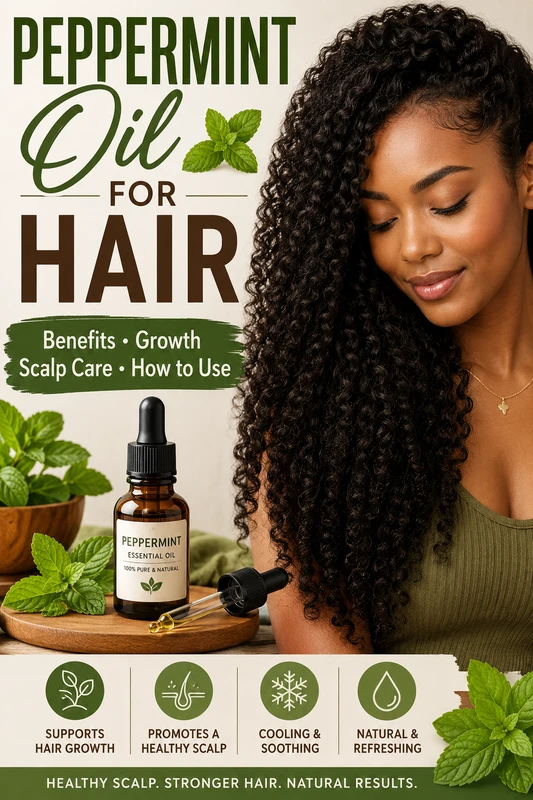
Peppermint oil has become one of the most talked-about essential oils in natural hair care. Known for its fresh scent and cooling sensation, peppermint essential oil is commonly added to scalp oils, shampoos, conditioners, hair masks, and other products designed to support a healthy scalp and stronger-looking hair.
But is peppermint oil actually good for your hair?
Peppermint oil may help support a healthy scalp environment, provide a refreshing sensation, and complement a consistent hair-care routine. It has also attracted attention because of research exploring its potential effects on hair growth. However, peppermint essential oil is extremely concentrated and should generally be diluted before it touches the scalp.
For people with natural hair, curly hair, locs, braids, protective styles, or simply a dry or uncomfortable scalp, peppermint oil can be a useful ingredient when used correctly.
This complete guide explains the benefits of peppermint oil for hair, what research says about peppermint oil and hair growth, how to dilute it, how often to use it, and common mistakes to avoid.
What Is Peppermint Oil?
Peppermint oil is an essential oil obtained from the peppermint plant, Mentha × piperita. One of its best-known naturally occurring components is menthol, which is responsible for much of peppermint's recognizable cooling sensation and aroma.
Peppermint essential oil is much more concentrated than peppermint leaves or peppermint tea.
That distinction matters.
Putting concentrated essential oil directly onto the scalp isn't the same as applying a regular hair oil such as coconut, jojoba, olive, or avocado oil. Essential oils are normally used in relatively small quantities and diluted in another product or carrier oil.
Peppermint oil appears in many types of hair products, including:
- Scalp oils
- Shampoos
- Conditioners
- Hair-growth oils
- Scalp treatments
- Pre-shampoo treatments
- Hair masks
- Leave-in scalp products
- Massage oils
Its popularity is especially understandable for scalp products because the cooling sensation can make the scalp feel fresh and invigorated.
Is Peppermint Oil Good for Hair?
Peppermint oil can be a useful addition to a hair-care routine, particularly when the goal is maintaining a comfortable, healthy scalp.
The potential benefits of peppermint oil for hair include supporting scalp care, providing a cooling sensation, complementing scalp massage, and helping create a cleaner, refreshed scalp experience.
However, peppermint oil shouldn't be viewed as a miracle solution.
Hair growth and hair loss are influenced by numerous factors, including genetics, hormones, nutrition, age, styling practices, scalp conditions, medications, stress, and overall health.
No single oil can overcome all of these factors.
A better way to think about peppermint oil is as one ingredient that can be incorporated into a broader healthy-hair routine.
Peppermint Oil Benefits for Hair
Let's examine some of the main reasons people use peppermint oil on their hair and scalp.
1. Peppermint Oil Provides a Cooling Scalp Sensation
One of the first things you'll notice after using properly diluted peppermint oil is the cooling sensation.
Menthol activates cold-sensitive receptors in the skin, creating the familiar minty cooling feeling.
For some people, this can make scalp massage feel particularly refreshing.
The sensation itself doesn't automatically mean your hair is growing. A tingling scalp should never be used as proof that a product is stimulating hair follicles.
However, many people enjoy the fresh feeling that peppermint-containing scalp products provide.
2. Peppermint Oil May Complement a Healthy Scalp Routine
Healthy-looking hair starts with taking good care of your scalp.
The scalp contains the follicles from which your hair grows. Excessive product buildup, irritation, aggressive scratching, and poor scalp-care habits can make maintaining healthy hair more difficult.
Peppermint oil is commonly incorporated into scalp-care products as part of a routine that may include:
- Regular cleansing
- Proper moisturizing
- Gentle scalp massage
- Limiting excessive buildup
- Avoiding overly tight hairstyles
- Protecting the hair from unnecessary breakage
Peppermint oil isn't a substitute for these habits.
Instead, it can complement them.
Does Peppermint Oil Help Hair Grow?
This is probably the biggest question surrounding peppermint oil.
There is some interesting research, but it's important to understand exactly what that research shows.
A frequently cited 2014 animal study compared peppermint oil with several other topical treatments in mice. Researchers observed increased measures of hair growth in the peppermint-oil group.
The results generated considerable interest in peppermint oil as a possible hair-growth ingredient.
However, the study was performed on mice—not people.
Animal research can help scientists identify substances that deserve further investigation, but results from animal studies don't automatically establish that the same treatment will produce the same results in humans.
Therefore, it would be inaccurate to say that peppermint oil is scientifically proven to regrow human hair based on this study alone.
More high-quality human research is needed.
If you're experiencing significant, unexplained, sudden, or patchy hair loss, consider speaking with a dermatologist or healthcare professional rather than relying exclusively on oils.
Peppermint Oil and Scalp Massage
One of the easiest ways to incorporate diluted peppermint oil into your routine is during scalp massage.
Scalp massage involves gently moving your fingertips across the scalp without aggressively scratching the skin.
You can massage your scalp for several minutes while applying an appropriately diluted scalp oil.
Focus especially on areas where your scalp tends to become dry, but don't assume that massaging harder will produce faster hair growth.
Gentle pressure is enough.
Using your fingernails can cause tiny scratches or irritation.
Instead, use the pads of your fingertips.
Peppermint Oil for Natural Hair
Peppermint oil can fit nicely into a natural-hair routine.
Natural hair often requires careful moisture retention and breakage prevention. Because curls and coils can make it more difficult for natural scalp oils to travel down the entire hair shaft, the ends may become dry even when the scalp produces sufficient oil.
Peppermint oil itself isn't a replacement for moisture.
Oil and water perform different functions in a hair-care routine.
If your natural hair feels dry, concentrate on maintaining adequate moisture and conditioning rather than simply adding more oil.
Peppermint oil is generally better thought of as a scalp-focused ingredient.
A natural-hair routine might include:
- Shampooing the scalp as needed.
- Conditioning the hair thoroughly.
- Applying a leave-in or moisturizer.
- Detangling gently.
- Applying a small amount of oil where appropriate.
- Protecting the hair at night.
Diluted peppermint oil can be incorporated into the scalp portion of this routine.
Peppermint Oil for Black Hair
Peppermint oil is popular in Black hair care, particularly in products marketed toward natural hair, braids, locs, and scalp maintenance.
However, one important principle should remain the same regardless of hair type:
A healthy scalp does not require excessive oil.
Applying large quantities of heavy oil every day can contribute to buildup.
If you're wearing protective styles, buildup can become particularly noticeable because the hair may not be washed as frequently.
Use scalp oils strategically rather than automatically coating the scalp every day.
Peppermint Oil for Curly Hair
Curly hair can benefit from a routine that focuses on moisture retention, gentle handling, and scalp maintenance.
Peppermint oil is primarily useful as a scalp ingredient rather than something that needs to cover every curl.
If your curls are dry, your priorities should usually include:
- Gentle cleansing
- Regular conditioning
- Leave-in moisture
- Reduced heat damage
- Gentle detangling
- Protecting curls overnight
Peppermint oil can then be used occasionally as part of your scalp-care routine.
Peppermint Oil for Dry Scalp
A dry scalp can feel tight, uncomfortable, or flaky.
It's tempting to immediately cover a dry scalp with oil, but dryness can have different causes.
Sometimes the issue may be simple dryness. Other times flakes may be associated with dandruff, product buildup, irritation, or another scalp condition.
Peppermint oil may provide a refreshing scalp sensation, but it doesn't automatically address the underlying cause of every type of flaking.
In fact, using undiluted peppermint oil on an already irritated scalp may make the problem worse.
Persistent itching, redness, scaling, sores, pain, or severe flaking should be evaluated by a qualified healthcare professional.
Peppermint Oil for Itchy Scalp
The cooling effect of menthol may feel soothing to some people.
But be careful about interpreting temporary cooling as treatment for the cause of itching.
An itchy scalp can result from many factors, including:
- Product buildup
- Dryness
- Sensitivity to hair products
- Dandruff
- Tight braids
- Excessive sweating
- Infrequent cleansing
- Certain scalp conditions
If your scalp begins itching immediately after using peppermint oil, wash the product out.
Burning, redness, swelling, or worsening irritation isn't something you should try to "push through."
Peppermint Oil for Braids
Peppermint oil can be incorporated into a braid-care routine, but moderation is important.
Braids provide convenient access to the scalp because the hair is divided into sections.
This makes it easy to apply scalp products directly between the braids.
Instead of pouring oil across your entire scalp, apply a small amount of properly diluted scalp oil along the exposed parts.
Massage gently.
Avoid saturating the roots because excessive product can accumulate around the base of the braids.
Remember that your scalp still needs cleansing while you're wearing braids.
Adding more oil doesn't remove sweat, dead skin cells, or product buildup.
Peppermint Oil for Locs
People with locs may also enjoy peppermint oil as part of their scalp-care routine.
The biggest consideration with locs is buildup.
Heavy oils, waxes, creams, and other products can accumulate over time if they're repeatedly applied without adequate cleansing.
A lightweight scalp product containing diluted peppermint oil may be preferable to saturating your locs with thick mixtures.
Apply primarily to the scalp instead of coating the entire length of every loc.
If your locs themselves feel dry, use products specifically designed to provide appropriate hydration without excessive residue.
Peppermint Oil for Men's Hair
Peppermint oil isn't only for long or natural hairstyles.
Men can also incorporate it into a scalp-care routine.
For short hair, access to the scalp is easy. A small amount of diluted peppermint oil can be massaged over the scalp before shampooing or used according to the directions of a formulated scalp product.
Men experiencing thinning at the temples, crown, or hairline should remember that different types of hair loss require different approaches.
If thinning continues or becomes significant, professional evaluation may help identify the underlying cause.
Peppermint Oil for Edges
Thin edges are a major concern for many people with natural hair.
But peppermint oil alone cannot solve every case of thinning edges.
One of the most important factors to examine is tension.
Frequently wearing tight:
- Braids
- Ponytails
- Buns
- Extensions
- Wigs
- Weaves
can repeatedly pull on the hairline.
If tension is contributing to breakage or hair loss, continuing the same styling practices while applying peppermint oil isn't addressing the main problem.
Give your edges a break from excessive tension and handle them gently.
Peppermint Oil for Hair Breakage
Hair growth and length retention are not exactly the same thing.
Your hair can grow from the scalp while simultaneously breaking at the ends.
When this happens, it may appear that your hair isn't growing.
Peppermint oil applied to the scalp won't automatically repair damaged hair fibers.
Reducing breakage usually requires attention to:
- Moisture
- Conditioning
- Detangling
- Heat use
- Chemical processing
- Protective styling
- Split ends
- Nighttime protection
For longer-looking hair, protecting the length you already have is just as important as supporting healthy growth from the scalp.
How to Use Peppermint Oil for Hair
Because peppermint essential oil is concentrated, it should generally be diluted before scalp application.
One simple method is combining a small amount of peppermint essential oil with a carrier oil.
Potential carrier oils include:
Jojoba Oil
Jojoba oil is lightweight and commonly used in scalp products.
Coconut Oil
Coconut oil is widely used in natural-hair routines, although not everyone's hair or scalp responds to it the same way.
Olive Oil
Olive oil is heavier and may be useful for people who prefer richer oil blends.
Avocado Oil
Avocado oil is another popular option for natural and curly hair.
Grapeseed Oil
Grapeseed oil has a relatively lightweight feel that may appeal to people who dislike heavy scalp oils.
How to Dilute Peppermint Oil for Hair
Peppermint essential oil shouldn't be casually poured directly onto the scalp.
Essential oils are concentrated substances.
A conservative approach is to keep peppermint essential oil at a low percentage of the finished mixture and follow the manufacturer's directions. If you're new to essential oils or have sensitive skin, start especially low.
You can also avoid DIY dilution altogether by choosing a professionally formulated hair or scalp product that already contains peppermint oil at an appropriate concentration.
Before applying a new DIY mixture broadly, consider patch testing a small area first.
Stop using it if you experience irritation.
Can You Put Peppermint Oil Directly on Your Scalp?
Using undiluted peppermint essential oil directly on the scalp isn't recommended.
More isn't better.
Pure essential oils can cause irritation and other skin reactions.
The intense cooling sensation of undiluted peppermint oil can sometimes be mistaken for effectiveness.
Your scalp doesn't need to burn for a product to work.
If a product causes significant burning or irritation, rinse it away.
How Often Should You Use Peppermint Oil on Hair?
There's no universal schedule that works for everyone.
Your ideal frequency depends on your scalp, hairstyle, washing schedule, product formulation, and how your skin responds.
Some people may incorporate a diluted peppermint scalp product a few times per week, while others may prefer occasional use.
Pay attention to your scalp.
If you're developing excessive buildup, greasiness, itching, or irritation, using more oil probably isn't the solution.
Peppermint Oil Before Shampooing
Using diluted peppermint oil as a pre-shampoo scalp treatment is a simple option.
Apply a small amount to the scalp.
Gently massage it in.
Allow it to sit briefly according to your chosen product or formulation, and then shampoo your scalp thoroughly.
This approach can be useful for people who enjoy scalp oils but don't want oil sitting on their scalp for several days.
Adding Peppermint Oil to Shampoo
Some people add peppermint essential oil to shampoo.
However, randomly adding essential oils directly into an entire bottle can change the formulation in ways you may not anticipate.
A simpler option is purchasing a shampoo already formulated with peppermint oil.
Professionally formulated products allow the manufacturer to control ingredient concentrations and overall product stability.
Peppermint Oil vs Rosemary Oil for Hair
Peppermint oil and rosemary oil are two of the most popular essential oils associated with hair care.
They aren't identical.
Peppermint oil is especially known for its cooling menthol sensation.
Rosemary oil has received significant attention because some human research has examined rosemary oil in relation to hair growth.
Some hair products combine the two ingredients.
You don't necessarily have to choose one over the other, but both should be used appropriately.
Neither should be treated as a guaranteed cure for hair loss.
Peppermint Oil vs Castor Oil
Peppermint oil and castor oil serve very different purposes.
Peppermint oil is an essential oil.
Castor oil is a thick carrier oil.
This means castor oil can potentially serve as part of the base used to dilute an essential oil, although its thickness can make it too heavy for some scalps.
Castor oil is particularly popular in Black hair-care routines and is frequently applied to edges, scalp, and dry hair.
Peppermint essential oil is much more concentrated and should be used in substantially smaller quantities.
Peppermint Oil and Protective Styles
Protective styles can help reduce daily manipulation, but they don't eliminate the need for scalp care.
Whether you're wearing box braids, knotless braids, twists, cornrows, or another protective style, continue paying attention to your scalp.
A simple routine may include:
- Keeping the scalp reasonably clean.
- Applying moisture as needed.
- Using lightweight scalp products in moderation.
- Avoiding excessive tension.
- Protecting the style at night.
- Removing the style when necessary.
A peppermint-containing scalp oil can be incorporated into this routine if your scalp tolerates it.
Common Peppermint Oil Mistakes
Peppermint oil can easily become counterproductive when it's used incorrectly.
Mistake #1: Using It Undiluted
Peppermint essential oil is concentrated.
Dilute it appropriately or choose a formulated product.
Mistake #2: Thinking Tingling Means Hair Growth
Cooling or tingling is largely associated with peppermint's menthol content.
Sensation isn't proof of follicle stimulation.
Mistake #3: Using Too Much
Your scalp doesn't need to be drenched in oil.
More product can simply mean more buildup.
Mistake #4: Ignoring Scalp Irritation
If your scalp becomes red, painful, swollen, or intensely itchy, stop using the product.
Mistake #5: Using Oil Instead of Washing Your Scalp
Oil isn't shampoo.
Applying peppermint oil over sweat and buildup doesn't cleanse your scalp.
Mistake #6: Expecting Overnight Hair Growth
Hair growth takes time.
Be skeptical of claims suggesting that any oil can produce dramatic hair growth within days.
Mistake #7: Ignoring Breakage
Growing hair doesn't automatically mean retaining length.
If your ends continuously break, your hair may appear stuck at the same length.
Can Peppermint Oil Make Your Hair Grow Faster?
There isn't strong enough human evidence to promise that peppermint oil will make everyone's hair grow faster.
The animal research is interesting, but more human research is necessary.
What you can do is create conditions that support your hair's natural growth and help protect existing length.
That includes:
- Maintaining scalp health
- Eating a balanced diet
- Reducing unnecessary breakage
- Avoiding excessive tension
- Limiting damaging heat
- Conditioning regularly
- Protecting hair at night
- Addressing persistent scalp problems
- Maintaining a consistent routine
Consistency is generally more valuable than constantly switching between trendy oils.
How Long Does Peppermint Oil Take to Work on Hair?
There's no scientifically established timeline guaranteeing visible hair growth from peppermint oil.
Hair naturally grows gradually, so meaningful changes in length or density typically need to be evaluated over months rather than days.
If you want to track your progress, take photographs every four weeks.
Try to keep the:
- Lighting
- Hairstyle
- Camera angle
- Hair condition
similar in every photograph.
This provides a more useful comparison than looking in the mirror every day.
Can Peppermint Oil Cause Hair Loss?
Properly formulated peppermint-containing hair products aren't expected to automatically cause hair loss.
However, irritation from an improperly diluted essential oil can create scalp problems.
Aggressive scratching caused by irritation may also contribute to unnecessary damage.
Stop using a peppermint product if you develop a significant reaction.
If hair shedding or hair loss is sudden, severe, patchy, painful, or persistent, seek professional evaluation.
Who Should Be Careful With Peppermint Oil?
People with sensitive skin should be especially cautious.
Avoid getting peppermint oil into your eyes.
Don't apply essential oils to broken or severely irritated skin.
Children require additional caution because essential oils can present different safety considerations depending on age and concentration. Ask an appropriate healthcare professional before using concentrated essential oils on young children.
Pregnant or breastfeeding individuals and people with medical concerns may also want professional guidance before using concentrated essential oils.
Peppermint Oil Hair Routine for Natural Hair
Here's a simple routine that incorporates peppermint oil without making it the center of your entire regimen.
Wash Day
Cleanse your scalp thoroughly with shampoo.
Massage gently with your fingertips and rinse thoroughly.
Condition
Apply conditioner primarily through the hair.
Detangle carefully, beginning near the ends and gradually moving upward.
Moisturize
Apply a water-based leave-in or moisturizing product.
Focus especially on dry areas.
Scalp Care
If desired, apply a small amount of properly diluted peppermint-containing scalp oil.
Massage gently.
Style
Choose a low-manipulation hairstyle that doesn't create excessive tension.
Nighttime Protection
Protect your hair with a satin bonnet, scarf, or satin pillowcase.
This complete routine addresses much more than simply applying oil.
How to Support Hair Growth Naturally
If growing longer, healthier-looking hair is your goal, focus on the entire hair-care system.
Keep Your Scalp Clean
Your scalp produces oil, sheds skin cells, and collects sweat and styling products.
Cleanse it regularly according to your needs.
Reduce Breakage
Handle your hair gently, especially while detangling.
Moisturize Consistently
Don't wait until your hair becomes extremely dry and brittle.
Protect Your Ends
The ends are the oldest portion of your hair and often the most vulnerable to breakage.
Avoid Excessive Tension
Your hairstyle shouldn't constantly hurt.
Limit Excessive Heat
Frequent high-temperature styling can weaken the hair shaft.
Protect Hair While Sleeping
Satin or silk-like surfaces can reduce friction compared with rougher fabrics.
Be Consistent
A simple routine performed consistently is often better than buying a new product every week.
Frequently Asked Questions About Peppermint Oil for Hair
Is peppermint oil good for hair growth?
Research involving animals has produced interesting findings, but there isn't currently enough high-quality human evidence to say that peppermint oil is proven to regrow hair. It can still be incorporated into a healthy scalp-care routine when properly diluted.
Can I leave peppermint oil in my hair overnight?
Some formulated products containing peppermint oil are designed to remain on the scalp. DIY essential-oil mixtures require more caution. Follow product directions and stop use if irritation occurs.
Can I use peppermint oil every day?
Daily use isn't necessary for most people. Excessive oil application may contribute to buildup. Use frequency should depend on the product, your scalp, and your washing routine.
Does peppermint oil thicken hair?
There isn't sufficient human evidence to guarantee that peppermint oil will increase hair density or strand thickness.
Can peppermint oil help bald spots?
Bald spots can have many different causes. Peppermint oil shouldn't be considered a universal treatment. Sudden or unexplained bald patches should be evaluated by a healthcare professional.
Is peppermint oil good for natural hair?
Yes, properly diluted peppermint oil can be incorporated into a natural-hair scalp routine. However, moisture, conditioning, gentle handling, and breakage prevention remain essential.
Is peppermint oil good for locs?
It can be used on the scalp while wearing locs, but avoid excessive application because repeated use of oils and styling products can contribute to buildup.
Can peppermint oil be used with braids?
Yes. A lightweight scalp product containing appropriately diluted peppermint oil can be applied between braided sections. Avoid saturating the scalp.
Does peppermint oil moisturize hair?
Peppermint essential oil isn't a replacement for a water-based moisturizer or conditioner. If your hair is dry, focus on hydration and conditioning.
Why does peppermint oil make my scalp tingle?
Menthol produces a cooling sensation by interacting with temperature-sensitive receptors in the skin. Tingling doesn't necessarily indicate increased hair growth.
Peppermint Oil for Hair: Final Thoughts
Peppermint oil can be a refreshing addition to a natural hair and scalp-care routine.
Its distinctive cooling sensation has made it especially popular in scalp oils, shampoos, conditioners, and hair treatments. Early research has also generated interest in peppermint oil's potential relationship with hair growth, although stronger human evidence is still needed before it can be considered a proven hair-regrowth treatment.
The most important thing is to use peppermint essential oil correctly.
Don't assume stronger is better.
Peppermint essential oil is concentrated and should generally be properly diluted or used in a professionally formulated product.
For healthy natural hair, combine good scalp care with the habits that matter most: regular cleansing, moisture, conditioning, gentle detangling, low-tension styling, nighttime protection, and breakage prevention.
If your goal is longer hair, remember that growth is only half the equation.
You also have to keep the hair you grow.
Protecting your strands from unnecessary breakage while maintaining a healthy scalp gives your hair the best opportunity to reach its natural potential.