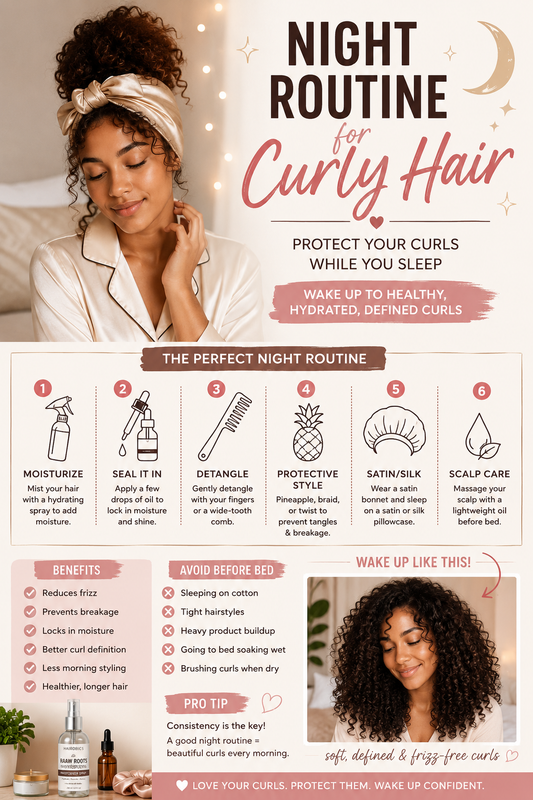
If you spend 30 to 60 minutes styling your curls in the morning only to wake up with flattened, frizzy, tangled hair the next day, your nighttime routine—not your styling products—may be the real problem.
A proper night routine for curly hair protects your curl pattern while you sleep, minimizes moisture loss, reduces breakage, and helps your hairstyle last for several days instead of just one. Whether you have loose waves, springy ringlets, tight coils, or kinky curls, your nighttime habits play a major role in how healthy your hair looks and feels.
Instead of starting every morning from scratch, the right overnight routine allows you to wake up with curls that need only a quick refresh before heading out the door.
In this complete guide, you'll learn exactly how to care for curly hair before bed, what products to use, mistakes to avoid, and how to create the perfect overnight routine for healthier curls.
Why Curly Hair Needs Special Care at Night
Curly hair is naturally more delicate than straight hair.
The twists and bends along each strand make it harder for your scalp's natural oils to travel from your roots to your ends. This often leaves curly hair:
- Drier
- More fragile
- More prone to tangles
- Easier to break
- More susceptible to frizz
While you sleep, your hair constantly rubs against your pillow. Eight hours of friction every night quickly adds up.
Without protection, this friction can cause:
- Split ends
- Knots
- Flattened curls
- Frizz
- Excessive shedding
- Moisture loss
A good nighttime routine dramatically reduces these problems.
What Happens to Curly Hair While You Sleep?
Many people assume their hair simply "rests" overnight.
Actually, several things happen while you're sleeping.
Moisture Evaporates
Dry indoor air, heating systems, and air conditioning pull moisture from your curls overnight.
The drier your environment, the drier your curls become.
Friction Creates Frizz
Cotton pillowcases grab onto curly strands.
Every movement of your head creates friction that roughens the hair cuticle.
The result?
- Puffy curls
- Flyaways
- Broken strands
- Loss of curl definition
Compression Flattens Curl Patterns
Sleeping directly on curls compresses them for hours.
This stretches curls in odd directions and creates flat spots that are difficult to fix without rewetting your entire head.
Tangles Form
Curly strands naturally wrap around one another.
As you move during sleep, those strands twist together even more, creating knots by morning.
Benefits of Following a Night Routine for Curly Hair
When done consistently, an overnight routine provides incredible long-term benefits.
These include:
Better Curl Definition
Protected curls maintain their natural shape much longer.
Instead of waking up with frizz, you'll wake up with curls that still look freshly styled.
Less Breakage
Healthy curls are retained through reduced friction.
Less breakage means better length retention over time.
Increased Moisture
Nighttime moisturizing prevents dryness from developing while you sleep.
Hydrated curls stay softer, shinier, and more manageable.
Less Morning Styling
Instead of spending an hour fixing flattened curls, you'll only need a quick refresh.
Many people reduce styling time to less than ten minutes.
Healthier Ends
Ends are the oldest part of your hair.
Protecting them overnight prevents splitting and excessive trimming.
Step 1: Moisturize Before Bed
Moisture is the foundation of every curly hair routine.
Never go to bed with curls that feel dry.
Instead, lightly refresh them before bedtime.
Use a lightweight moisturizing spray that hydrates without soaking your hair.
For many curly-haired individuals, Hairobics Raaw Roots Moisturizer Spray is an excellent nighttime option because it helps replenish moisture without leaving curls heavy or greasy. A light mist before bed helps maintain softness and flexibility while reducing overnight dryness.
Focus on:
- Mid-lengths
- Ends
- Dry areas
- Hairline
Avoid oversaturating your curls.
Hair should feel hydrated—not wet.
Step 2: Seal In Moisture
After moisturizing, lock hydration inside the hair shaft.
Natural oils help prevent moisture from escaping overnight.
Popular sealing oils include:
- Jojoba oil
- Argan oil
- Avocado oil
- Grapeseed oil
Apply only a few drops.
Too much oil attracts dirt and can weigh curls down.
Massage lightly over your curls rather than soaking them.
Step 3: Detangle Gently Before Sleeping
Never sleep with severely tangled hair.
Small tangles become large knots overnight.
If necessary:
- Use your fingers first.
- Separate large sections.
- Remove only loose knots.
- Avoid aggressive brushing.
Curly hair should rarely be brushed when dry.
Instead, finger detangle gently after moisturizing if needed.
Step 4: Choose a Protective Sleep Hairstyle
One of the biggest secrets to beautiful curls is preventing unnecessary movement while sleeping.
Protective styles reduce friction and preserve curl definition.
Pineapple
The pineapple is one of the most popular nighttime hairstyles.
Gather your curls loosely at the very top of your head using a soft satin scrunchie.
Benefits include:
- Prevents flattening
- Protects curl clumps
- Reduces tangles
- Maintains volume
Avoid pulling tightly.
Loose is best.
Loose Braids
For longer curls, one or two loose braids help reduce tangles while maintaining moisture.
Braids should never feel tight.
Tension can damage both curls and edges.
Loose Twists
Two-strand twists are another excellent option.
Twists:
- Reduce friction
- Lock in moisture
- Stretch curls slightly
- Prevent knotting
Many people alternate between pineapples and twists depending on hairstyle and curl type.
Puff
For tighter curls and coils, a loose puff works well.
Position it high on the head.
Avoid elastic bands that pull excessively.
Use satin scrunchies whenever possible.
Step 5: Sleep With Satin or Silk
One simple change can transform your curls overnight.
Replace cotton with satin or silk.
Cotton absorbs moisture.
Satin and silk help hair retain hydration while reducing friction.
Options include:
- Satin bonnet
- Silk bonnet
- Satin pillowcase
- Silk pillowcase
- Satin scarf
Many curly-haired people combine both a bonnet and satin pillowcase for maximum protection.
Even if the bonnet slips off overnight, the pillowcase still protects your curls.
Satin Bonnet vs. Silk Bonnet
Both are excellent.
Satin:
- Affordable
- Smooth
- Widely available
- Easy to clean
Silk:
- Natural fiber
- Luxurious
- Highly breathable
- Excellent moisture retention
Either choice is significantly better than sleeping directly on cotton.
Common Nighttime Mistakes
Many people unknowingly damage their curls before bed.
Avoid these habits:
- Sleeping with soaking wet hair
- Using tight ponytails
- Skipping moisturizer
- Sleeping on cotton pillowcases
- Using rubber bands
- Brushing dry curls
- Ignoring tangled areas
- Applying heavy greasy products every night
Small improvements make a huge difference over time.
Signs Your Night Routine Is Working
Within a few weeks you may notice:
- Softer curls
- Less frizz
- Easier mornings
- More shine
- Better curl definition
- Reduced breakage
- Improved length retention
- Healthier ends
These improvements become even more noticeable after several months of consistent care.
No two curl patterns have exactly the same needs. While every curly head benefits from moisture and protection overnight, the ideal routine varies depending on your hair type.
Type 2 (Wavy Hair)
Type 2 hair ranges from loose bends to defined S-shaped waves. It is usually less dry than tighter curl patterns but can easily become flat while sleeping.
Night Routine
- Lightly mist hair with a moisturizing spray.
- Apply a tiny amount of lightweight oil to the ends if needed.
- Gather hair into a loose pineapple.
- Sleep on a satin pillowcase.
Avoid heavy creams that weigh waves down.
Type 3 (Curly Hair)
Type 3 curls naturally form spirals and ringlets. These curls require consistent moisture but also benefit from preserving curl clumps overnight.
Night Routine
- Refresh curls with Hairobics Raaw Roots Moisturizer Spray.
- Finger smooth dry areas.
- Pineapple your curls loosely.
- Wear a satin bonnet.
- Sleep on a satin pillowcase.
This routine helps curls last several days before needing another wash.
Type 4 (Coily Hair)
Coily hair is naturally the driest curl type because scalp oils have the hardest time traveling down tightly coiled strands.
Nighttime protection is essential.
Routine
- Lightly moisturize hair.
- Seal with a small amount of oil.
- Twist or braid hair loosely.
- Wear a satin bonnet.
- Sleep on satin bedding.
Many people with Type 4 hair notice dramatically less breakage after switching to satin sleep protection.
Should You Oil Curly Hair Before Bed?
The answer depends on your hair.
If your curls are already moisturized, adding large amounts of oil may simply coat the hair.
Instead:
- Moisturize first.
- Seal only if necessary.
- Use just a few drops.
Remember:
Moisture hydrates.
Oil seals.
Oil alone does not moisturize dry hair.
Overnight Deep Conditioning
Some people enjoy sleeping with a deep conditioner.
This can work well occasionally, but not every night.
Best Practices
- Apply a moisturizing mask.
- Wear a shower cap or bonnet.
- Protect your pillow.
- Rinse thoroughly the next morning.
For most people, once every one to two weeks is enough.
Weekly Night Routine Schedule
Instead of doing everything every night, follow a simple weekly plan.
Monday
- Moisturize
- Pineapple
- Satin bonnet
Tuesday
- Refresh dry areas
- Finger detangle
- Bonnet
Wednesday
- Moisturize lightly
- Seal ends
- Protective twist
Thursday
- Refresh curls
- Pineapple
- Satin pillowcase
Friday
- Scalp massage
- Moisturize
- Bonnet
Saturday
- Wash Day
- Deep condition
- Style curls
Sunday
- Light refresh
- Protective style
- Prepare for the week
A consistent schedule is easier to maintain than guessing each night.
Overnight Scalp Care
Healthy curls begin with a healthy scalp.
Nighttime is an excellent opportunity to care for it because products have several uninterrupted hours to work.
Consider:
- Gentle scalp massage
- Lightweight scalp oil if needed
- Avoid heavy grease buildup
- Keep the scalp clean
Massaging your scalp for just three to five minutes may improve circulation and help distribute natural oils.
Ingredients That Work Well Overnight
Some ingredients are especially beneficial before bedtime.
Aloe Vera
Helps hydrate curls without heaviness.
Glycerin
Draws moisture into the hair in moderate humidity.
Jojoba Oil
Closely resembles natural scalp oils.
Argan Oil
Adds shine while reducing frizz.
Avocado Oil
Rich in nourishing fatty acids.
Coconut Oil
Can reduce protein loss in many hair types, though it may feel heavy on fine curls.
Ingredients to Avoid Before Sleeping
Some products are better reserved for daytime use.
Avoid applying excessive amounts of:
- Heavy petroleum-based products
- Thick waxes
- Sticky gels
- Alcohol-heavy sprays
- Products that leave hair crunchy
Heavy buildup can make curls feel dull and lifeless over time.
Morning Refresh Routine
One of the biggest benefits of a solid nighttime routine is needing very little work the next morning.
Step 1
Remove your bonnet carefully.
Step 2
Shake your curls loose.
Step 3
Fluff roots gently with your fingers.
Step 4
Mist any flattened sections with water or Hairobics Raaw Roots Moisturizer Spray.
Step 5
Scrunch curls upward.
Step 6
Allow hair to air dry for several minutes.
This simple routine often restores curls without requiring a complete restyle.
Frequently Asked Questions
Should curly hair be wrapped every night?
Yes. Wrapping curly hair with a satin bonnet, scarf, or pineapple helps reduce friction, minimize frizz, and preserve curl definition.
Is sleeping with wet curly hair bad?
It is generally better to avoid going to bed with soaking wet hair. Damp hair is more fragile and can become flattened, tangled, or develop mildew-like odors if it stays wet for too long.
How often should curly hair be moisturized?
Most curly hair benefits from light moisturizing several times per week. Very dry or coily hair may benefit from daily light hydration, while finer curls may need less.
Why are my curls frizzy every morning?
Morning frizz is commonly caused by friction, moisture loss, sleeping on cotton pillowcases, or failing to protect curls overnight.
What's the best hairstyle for sleeping with curly hair?
The loose pineapple is one of the most effective styles for preserving curl definition. Twists and loose braids are also excellent options, especially for longer or tighter curls.
Final Thoughts
Creating a consistent night routine for curly hair is one of the easiest ways to improve the health and appearance of your curls. While daytime styling often gets the most attention, your overnight habits determine how well your hair retains moisture, resists breakage, and maintains its natural definition.
By moisturizing before bed, choosing a protective hairstyle, sleeping on satin, and caring for your scalp, you can wake up to softer, healthier curls with far less effort each morning.
Small changes practiced consistently can lead to stronger hair, improved length retention, less frizz, and more beautiful curls over time. Healthy curls aren't created only on wash day—they're built every night while you sleep.