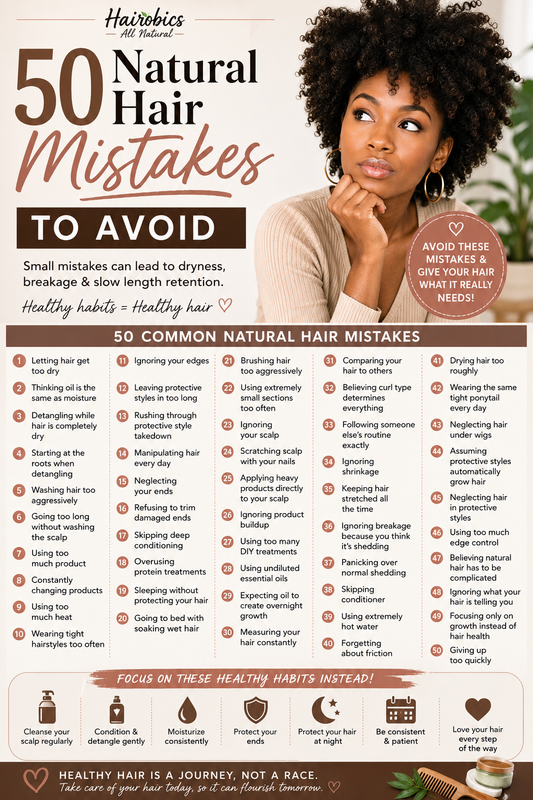
Natural hair can be strong, versatile, and beautiful, but keeping it healthy often requires more than simply buying the right products. Sometimes the biggest obstacle isn't what you're not doing—it's the small hair care mistakes you may be making without realizing it.
If your natural hair constantly feels dry, breaks easily, tangles excessively, struggles to retain length, or seems difficult to manage, your routine may need a few adjustments.
The good news is that you don't necessarily need an expensive or complicated natural hair routine. Healthy hair often comes from consistently doing the basics well: cleansing your scalp, moisturizing your strands, detangling carefully, protecting your ends, limiting unnecessary manipulation, and paying attention to how your individual hair responds.
In this guide, we'll cover some of the most common natural hair mistakes to avoid, why they can create problems, and what you can do instead.
Whether you're newly natural or you've been wearing your natural texture for years, identifying these mistakes can help you create a simpler, healthier hair care routine.
What Are the Biggest Natural Hair Mistakes?
Some of the most common natural hair mistakes include:
- Allowing hair to become excessively dry
- Going too long without cleansing the scalp
- Shampooing too aggressively
- Detangling dry hair
- Using too much heat
- Wearing excessively tight hairstyles
- Ignoring split or damaged ends
- Using too many products
- Manipulating hair every day
- Neglecting nighttime protection
- Keeping protective styles in too long
- Applying oil without adequate moisture
- Using products that don't work well for your hair
- Expecting unrealistic hair growth
- Comparing your hair to someone else's
Many of these habits may appear harmless when done occasionally. The problem usually develops when they become part of your regular routine.
Let's take a closer look.
1. Letting Your Natural Hair Become Too Dry
One of the biggest mistakes people make with natural hair is waiting until their hair feels extremely dry before doing something about it.
Natural hair—particularly tightly curled and coily textures—can be prone to dryness because natural scalp oils don't always travel easily from the roots to the ends.
The bends and curves along curly strands can make oil distribution more difficult.
When hair becomes excessively dry, it may feel:
- Rough
- Brittle
- Stiff
- Tangled
- Difficult to style
Dry hair may also become more vulnerable to breakage during manipulation.
What to Do Instead
Create a consistent moisturizing routine based on how your hair responds.
For some people, moisturizing every few days works well. Others may need more or less frequent attention.
Focus especially on your ends because they're the oldest portion of your hair.
A simple routine may include a water-based moisturizing product followed by a product that helps reduce moisture loss.
The goal isn't to keep your hair soaking wet.
The goal is to prevent it from repeatedly reaching the point where it feels extremely brittle and dehydrated.
2. Thinking Oil Is the Same Thing as Moisture
This is one of the most common misconceptions in natural hair care.
Oil and moisture aren't exactly the same thing.
Water is the primary source of hydration for your hair. Oils can help lubricate strands and may help reduce moisture loss depending on how they're used, but applying oil to extremely dry hair doesn't necessarily provide the hydration your strands need.
Imagine putting oil on a completely dry sponge.
The sponge is still dry underneath.
Your hair can behave similarly.
What to Do Instead
If your hair needs moisture, begin with a water-based product.
Depending on your routine, you might use:
- Water or a water-based leave-in
- Moisturizing cream or conditioner
- A small amount of oil or butter when appropriate
You don't have to follow a complicated layering method.
The important thing is understanding the difference between adding hydration and using products that help your hair stay soft and manageable.
3. Detangling Natural Hair While It's Completely Dry
Aggressively detangling dry natural hair can cause unnecessary breakage.
Curly and coily strands naturally wrap around each other. When they're dry, they may have less flexibility and slip.
Trying to force a comb through tangled, dry hair can lead to:
- Snapping
- Split ends
- Excessive shedding
- Single-strand knots
- Frizz
- Uneven length
A Better Detangling Method
Divide your hair into manageable sections.
Apply water, conditioner, leave-in conditioner, or another product that provides good slip.
Start detangling at the ends.
Gradually work upward toward your roots.
Using your fingers first can also help you identify larger knots before using a comb or detangling brush.
Most importantly, don't rush.
Detangling is one of the moments when natural hair experiences the most mechanical stress.
4. Starting at the Roots When Detangling
Even when your hair is properly moisturized, technique matters.
Dragging a comb from your roots all the way to your ends can push multiple tangles together.
Eventually, you may end up with a large knot near the bottom.
Instead, begin near the ends.
Remove those tangles first.
Move slightly higher.
Continue until you reach the roots.
This method may take longer initially, but it can make detangling easier and potentially reduce unnecessary breakage.
5. Washing Your Hair Too Aggressively
Clean hair and scalp are important.
Aggressive washing isn't.
Scrubbing your hair together vigorously may create unnecessary tangles.
Instead of piling your entire head of hair on top of itself and scrubbing aggressively, concentrate shampoo primarily on your scalp.
Massage gently using the pads of your fingertips.
As you rinse, allow the cleanser and water to travel down the length of your hair.
If your hair tangles easily, washing in sections can be especially helpful.
6. Going Too Long Without Washing Your Scalp
Protective styling sometimes creates the temptation to avoid washing your hair for long periods.
But your scalp still accumulates:
- Sweat
- Oil
- Dead skin
- Styling products
- Environmental debris
A clean scalp should remain an important part of your natural hair routine.
How often you need to shampoo depends on your scalp, activity level, styling routine, product use, and hair needs.
Some people do well washing weekly.
Others may prefer a different schedule.
The important thing is not treating shampoo as the enemy.
Cleansing is part of healthy hair maintenance.
7. Using Too Much Product
More product doesn't automatically equal more moisture.
Natural hair routines can quickly become overloaded with:
- Leave-in conditioner
- Curl cream
- Gel
- Oil
- Butter
- Edge control
- Styling foam
- Hair spray
Layering excessive amounts of products may leave your hair feeling heavy, sticky, dull, greasy, or coated.
Product buildup may also make it difficult to determine whether your hair is actually dry or simply covered in residue.
Simplify Your Routine
Try identifying the purpose of every product.
For example:
Cleanser: removes buildup.
Conditioner: improves softness and manageability.
Leave-in: provides ongoing conditioning and moisture.
Styler: provides definition or hold.
Oil: provides lubrication or helps reduce moisture loss depending on your routine.
You may not need five different products that essentially perform the same job.
Sometimes a simpler routine works better.
8. Constantly Changing Your Hair Products
Natural hair trends move quickly.
One week everyone is using one oil.
The next week it's a new butter.
Then there's another gel, growth serum, mask, spray, or leave-in conditioner.
Constantly switching products makes it difficult to determine what's actually working.
Give your routine enough time to evaluate how your hair responds.
Pay attention to:
- Moisture
- Breakage
- Detangling
- Scalp comfort
- Style longevity
- Buildup
- Softness
If your routine works, you don't have to change it just because social media recommends something new.
9. Using Too Much Heat
Heat can temporarily make natural hair easier to stretch and style, but excessive temperatures and repeated heat exposure can damage the hair's structure.
Signs of heat damage may include:
- Looser curls
- Straight pieces
- Increased dryness
- Breakage
- Difficulty returning to your normal curl pattern
Heat damage doesn't happen to everyone who uses heat.
Technique matters.
Safer Heat Habits
When using heat:
- Apply a heat protectant.
- Avoid repeatedly passing hot tools over the same section.
- Don't automatically use the highest temperature.
- Give your hair breaks between heat styling sessions.
- Make sure your hair is properly conditioned.
- Be especially careful with fragile ends.
Occasional heat and healthy natural hair can coexist.
The key is moderation.
10. Wearing Tight Hairstyles Too Often
A hairstyle shouldn't require pain to look good.
Braids, ponytails, buns, cornrows, wigs, sew-ins, twists, and other styles can all create problems when they're installed or worn too tightly.
Constant tension can stress both the strands and hair follicles, especially around the hairline.
Pay attention to warning signs such as:
- Headaches
- Scalp tenderness
- Bumps
- Redness
- Excessive pulling
- Broken hairs around the edges
Don't ignore pain because you expect the hairstyle to "loosen up."
Your scalp shouldn't have to suffer for your hairstyle.
11. Ignoring Your Edges
The hair around your temples and hairline is often finer and more delicate than hair in other areas.
Unfortunately, it's also an area that receives a lot of manipulation.
Think about how frequently edges may be:
- Brushed
- Gelled
- Pulled
- Braided
- Slicked
- Tied down
- Restyled
Over time, repeated tension can contribute to breakage.
Give your edges regular breaks.
Every hairstyle doesn't need to be extremely sleek.
Healthy edges are more important than perfectly laid edges every day.
12. Leaving Protective Styles in Too Long
Braids, twists, wigs, and other protective styles can make hair maintenance easier.
But protective styles aren't maintenance-free.
Keeping a style installed for too long can result in:
- Heavy buildup
- Tangling
- Matting
- Dryness
- Difficult takedowns
- Breakage
Pay particular attention to new growth.
As your hair grows, shed hairs remain trapped inside the style.
Eventually, those shed hairs can wrap around neighboring strands and contribute to tangling.
Take protective styles down before your hair becomes severely tangled or matted.
13. Rushing Through Protective Style Takedown
Installation gets most of the attention.
Takedown deserves just as much.
After wearing braids for weeks, it's understandable to want them out quickly.
But rushing through removal can cause significant breakage.
Work slowly.
Use your fingers when possible.
Remove extensions carefully.
Once each section is free, gently separate shed hairs before shampooing.
Don't immediately jump into aggressive detangling.
A careful takedown can make the difference between retaining your length and losing unnecessary hair.
14. Manipulating Your Hair Every Day
Natural hair is incredibly versatile.
You can wear:
- Twist-outs
- Braid-outs
- Wash-and-gos
- Afro puffs
- Buns
- Braids
- Twists
- Flat twists
- Cornrows
- Updos
But changing hairstyles constantly can create mechanical stress.
Every time you comb, brush, pull, separate, twist, braid, or restyle your hair, the strands experience manipulation.
That doesn't mean you should never style your hair.
Instead, try reducing unnecessary manipulation.
If a twist-out still looks good on day three, you don't necessarily need to completely redo it.
Sometimes leaving your hair alone is one of the best things you can do for length retention.
15. Neglecting Your Ends
If you're trying to grow long natural hair, pay attention to your ends.
Hair growth happens at the scalp, but length retention happens along the strand.
Your ends are the oldest portion of your hair.
They've experienced more:
- Washing
- Detangling
- Styling
- Friction
- Sun exposure
- Heat
- Manipulation
than your newer hair.
Treat them accordingly.
Moisturize them when needed.
Detangle gently.
Protect them from excessive friction.
And trim damaged ends when appropriate.
16. Refusing to Trim Damaged Ends
Many people trying to grow long natural hair become afraid of scissors.
It makes sense.
If your goal is longer hair, cutting any of it can feel counterproductive.
But severely split, damaged, or tangled ends may make your hair harder to manage.
Trimming doesn't make hair grow faster from your scalp.
Instead, trimming is about maintaining the condition of your ends.
You also don't need to follow an arbitrary trimming schedule if your hair doesn't require it.
Monitor your ends.
Signs you may need a trim include:
- Persistent tangles at the ends
- Visible splitting
- Rough ends
- Thin or see-through ends
- Excessive knots
Healthy length is usually more valuable than holding onto damaged inches.
17. Skipping Deep Conditioning When Your Hair Needs It
Deep conditioning can be helpful for natural hair that feels particularly dry, rough, or difficult to manage.
However, deep conditioning shouldn't become another complicated ritual.
Follow the product directions.
More time doesn't always mean better results.
Leaving a conditioner on overnight when the instructions recommend 20 minutes isn't automatically going to make your hair healthier.
Use treatments intentionally rather than assuming more is always better.
18. Overusing Protein Treatments
Protein has become a major topic in natural hair care.
Protein-containing products can be useful for some hair routines, particularly when hair has experienced certain types of damage.
But more protein isn't always better.
If you're constantly using strengthening masks, reconstructors, protein treatments, and protein-rich styling products, your hair may begin feeling stiff or difficult to manage.
Balance matters.
Pay attention to your hair rather than blindly following a schedule you found online.
If your hair feels good, you don't need to keep adding treatments simply because they're popular.
19. Sleeping Without Protecting Your Hair
Cotton pillowcases and bedding can create friction against your hair while you move during the night.
For some people, that can contribute to:
- Frizz
- Tangling
- Dryness
- Flattened styles
- Breakage
A satin or silk bonnet, scarf, or pillowcase can help reduce friction.
You don't necessarily need all three.
Choose the method that's comfortable enough for you to use consistently.
A nighttime routine doesn't need to take 30 minutes.
Sometimes protecting your hair before bed takes less than a minute.
20. Going to Bed With Soaking Wet Hair
Moisturizing before bed can be helpful, but completely soaking your hair every night isn't always necessary.
Wet hair can be more vulnerable to stretching and mechanical damage.
Going to sleep with soaking wet hair can also make certain styles difficult to maintain.
If your hair needs moisture at night, you may only need a light application of a water-based product.
Your hair doesn't have to be dripping wet to be moisturized.
21. Brushing Your Hair Too Aggressively
There's a difference between detangling and fighting your hair.
If you hear constant snapping while brushing, slow down.
Your brush shouldn't have to force its way through knots.
Use smaller sections.
Add more slip.
Detangle the ends first.
Hold the section above the area you're detangling when appropriate to reduce pulling on your scalp.
Your goal isn't to see how quickly you can get the brush through your hair.
Your goal is to remove tangles while keeping as much healthy hair on your head as possible.
22. Using Extremely Small Sections When Styling Too Frequently
Tiny twists and braids can look beautiful.
But they can also require a lot of manipulation.
If you're constantly installing and removing extremely small styles, you may spend hours handling individual strands.
That repeated manipulation can increase opportunities for breakage.
This doesn't mean you can't wear mini twists or small braids.
It means installation and takedown should be done carefully, particularly if your hair is fine, fragile, or prone to tangling.
23. Ignoring Your Scalp
Natural hair conversations frequently focus on the strands.
But your scalp matters too.
Your scalp should be regularly cleansed and monitored.
Pay attention to persistent:
- Itching
- Flaking
- Tenderness
- Redness
- Bumps
- Unusual irritation
Don't assume every scalp issue can be solved by adding oil.
Sometimes applying more oils and products can worsen buildup.
If you experience persistent or severe scalp symptoms, consider consulting a dermatologist or other qualified healthcare professional.
24. Scratching Your Scalp With Your Fingernails
An itchy scalp can be frustrating, but aggressively scratching with your nails can irritate the skin.
When shampooing, use the pads of your fingertips rather than digging your nails into your scalp.
If itching continues despite regular cleansing and appropriate hair care, investigate the underlying cause rather than simply scratching harder or adding more oil.
25. Applying Heavy Products Directly to Your Scalp
Some people automatically cover their scalp in heavy oils, butters, grease, and styling products every few days.
Your scalp may not need that.
If heavy products consistently leave your scalp greasy, itchy, or coated, reduce the amount you're using.
Products should serve a purpose.
Don't apply something to your scalp simply because you've always been told you should.
26. Ignoring Product Buildup
If your hair suddenly feels unusually dry despite using plenty of moisturizing products, buildup may be part of the problem.
Signs of heavy buildup can include:
- Dull-looking hair
- Sticky strands
- Flakes from styling products
- Hair that feels coated
- Products sitting on top of the hair
- Curls that don't respond normally
Regular cleansing helps reset your hair.
Depending on your routine and product use, occasional clarifying may also be useful.
Follow with conditioning when appropriate.
27. Using Too Many DIY Treatments
The kitchen contains plenty of ingredients that appear in natural hair routines.
But natural doesn't automatically mean appropriate for your hair or scalp.
Be cautious with DIY mixtures containing large amounts of:
- Essential oils
- Acidic ingredients
- Strong herbs
- Food ingredients
- Undiluted concentrates
Your scalp is skin.
It can become irritated.
Patch testing new products and using properly formulated hair products can reduce unnecessary experimentation.
28. Using Undiluted Essential Oils
Essential oils are highly concentrated.
More isn't necessarily better.
Applying concentrated essential oils directly to your scalp can cause irritation for some people.
If you choose to use essential oils, make sure they're appropriately diluted according to safe usage guidance.
Discontinue use if you experience burning, redness, persistent itching, or irritation.
29. Expecting Hair Oil to Create Overnight Growth
Hair growth takes time.
There isn't an oil that can suddenly produce several inches of hair growth in a few weeks.
Human scalp hair generally grows gradually, and individual growth rates vary.
Your genetics, age, nutrition, health, hormones, hair practices, and other factors can all influence what you see.
Instead of obsessing over extremely rapid growth, focus on length retention.
If your hair grows but breaks at approximately the same rate, it may appear that your hair isn't growing.
Reducing breakage can allow you to see more of the length you're already producing.
30. Measuring Your Hair Constantly
Checking your hair length every few days can make normal hair growth feel incredibly slow.
Hair growth is gradual.
Take photographs every few months instead.
Try using:
- The same hairstyle
- Similar lighting
- The same shirt
- The same angle
This gives you a better comparison.
You may discover that your hair has grown significantly even though you didn't notice the change from day to day.
31. Comparing Your Natural Hair to Someone Else's
Social media makes comparison incredibly easy.
You see someone with waist-length curls and immediately wonder:
Why doesn't my hair look like that?
But you're comparing two completely different heads of hair.
People differ in:
- Curl pattern
- Density
- Strand thickness
- Shrinkage
- Growth rate
- Hair history
- Styling practices
- Genetics
Even two people with visually similar curl patterns may need completely different routines.
Your goal should be the healthiest version of your hair, not someone else's.
32. Believing Curl Type Determines Everything
The 3A, 3B, 3C, 4A, 4B, and 4C system can be useful for describing curl appearance.
But curl type doesn't tell you everything you need to know.
Other characteristics can be equally important, including:
Density
How many strands you have on your scalp.
Strand Thickness
Whether your individual strands are fine, medium, or coarse.
Porosity
How your hair interacts with water and products.
Elasticity
How your strands respond to stretching.
Scalp Condition
Whether your scalp tends to be oily, dry, sensitive, or prone to buildup.
Don't choose every product simply because the bottle says it's "for 4C hair."
Pay attention to how your actual hair behaves.
33. Following Someone Else's Routine Exactly
You watch a natural hair influencer.
She has beautiful hair.
She uses seven products.
So you buy all seven.
But your hair still doesn't look like hers.
That's because products are only one part of the equation.
Her:
- Hair density
- Strand thickness
- Length
- Styling technique
- Climate
- Wash frequency
- Genetics
may be completely different from yours.
Use other people's routines as inspiration—not strict instructions.
34. Ignoring Shrinkage
Shrinkage is one of the most misunderstood characteristics of natural hair.
You may stretch a curl and discover that your hair is much longer than it appears.
That's normal.
Tightly textured hair can shrink significantly as it dries.
Shrinkage doesn't mean your hair isn't growing.
It also doesn't automatically mean your hair is unhealthy.
If you want to show more length, you can experiment with gentle stretching methods such as:
- Banding
- African threading
- Braids
- Twists
- Low-heat blow-drying when appropriate
But you don't have to eliminate shrinkage.
It's part of the versatility of textured hair.
35. Keeping Your Hair Stretched All the Time
Stretching can make natural hair easier to detangle and style.
But constantly pulling, blow-drying, banding, braiding, or manipulating your hair solely to prevent shrinkage can become excessive.
Your hair doesn't need to look long every day to be healthy.
Give it opportunities to exist in its natural state too.
36. Ignoring Breakage Because You Think It's Shedding
Seeing hair during wash day is normal.
Humans naturally shed hair.
But shedding and breakage aren't exactly the same.
Shed hairs usually come from the root.
Broken hairs can be shorter pieces that snapped somewhere along the strand.
If you're noticing lots of small broken pieces, examine your routine.
Possible contributors may include:
- Dryness
- Excessive manipulation
- Tight hairstyles
- Rough detangling
- Chemical damage
- Heat damage
- Damaged ends
Understanding what you're seeing helps you determine what to change.
37. Panicking Over Normal Shedding
The opposite mistake also happens.
Someone wears braids for several weeks, removes them, sees a large amount of shed hair, and immediately assumes something is seriously wrong.
Remember that shed hairs can remain trapped inside protective styles.
When you finally take the style down, several weeks of shedding may appear all at once.
Look at the overall pattern rather than one detangling session.
If you're experiencing sudden, significant, patchy, or unexplained hair loss, however, consider speaking with a qualified healthcare professional.
38. Skipping Conditioner
Shampoo cleanses.
Conditioner helps improve softness, manageability, and detangling.
For many people with curly or coily hair, conditioning is an important part of wash day.
Apply conditioner throughout your hair, paying special attention to the lengths and ends.
Use the conditioning stage as an opportunity to gently detangle if that works well for your hair.
39. Using Extremely Hot Water
A steaming hot shower may feel relaxing, but your hair doesn't need extremely hot water to become clean.
Use comfortably warm water during your wash routine.
Water temperature is only one small part of healthy hair care, but there's no need to expose your scalp and strands to unnecessarily high temperatures.
40. Forgetting About Friction
Breakage doesn't only happen during wash day.
Your hair experiences friction throughout the day.
Common sources include:
- Cotton pillowcases
- Wool coats
- Sweaters
- Scarves
- Hats
- Car headrests
- Rough towels
If your hair repeatedly rubs against certain materials, particularly at the ends, pay attention.
You may notice breakage concentrated in specific areas.
Using satin-lined accessories and reducing unnecessary rubbing may help protect fragile strands.
41. Drying Your Hair Too Roughly
Rubbing natural hair aggressively with a rough towel can increase tangling and friction.
Instead, gently squeeze excess water from your hair.
A microfiber towel or soft cotton T-shirt may work well for some people.
Avoid twisting, rubbing, or pulling your hair unnecessarily.
42. Wearing the Same Tight Ponytail Every Day
Repetition matters.
Even if your ponytail doesn't feel painfully tight, putting tension on exactly the same area every day may eventually contribute to breakage.
Rotate your hairstyles.
Try:
- Loose buns
- Twists
- Braids
- Low ponytails
- Puffs
- Protective styles
Give frequently stressed areas time to recover.
43. Neglecting Hair Under Wigs
A wig can protect your hair from daily styling, but the hair underneath still needs care.
Don't install a wig and forget about your natural hair for weeks.
Maintain a routine that includes appropriate:
- Cleansing
- Moisturizing
- Scalp care
- Detangling
Also pay attention to wig caps, adhesives, clips, combs, and tight braids underneath the wig.
Anything creating repeated friction or tension can potentially affect your hairline.
44. Assuming Protective Styles Automatically Grow Hair
Braids don't make your follicles suddenly produce hair faster.
The benefit of protective styling is primarily that it may reduce manipulation and help you retain length when done correctly.
A protective style isn't truly protective if it's:
- Too tight
- Too heavy
- Left in too long
- Constantly manipulated
- Neglected underneath
Think of protective styling as a length-retention strategy, not a magic growth treatment.
45. Neglecting Your Hair Because It's in a Protective Style
Protective doesn't mean forget about it.
Depending on your style, your hair may still need some moisture and scalp care.
At the same time, don't overdo it.
Constantly saturating braids with heavy creams and oils may contribute to buildup.
Find the balance that keeps your hair comfortable without coating it in excessive product.
46. Using Too Much Edge Control
Edge control can create a polished hairstyle, but using strong-hold products and aggressively brushing your edges every day can put unnecessary stress on delicate hairs.
Consider giving your edges days when you don't manipulate them at all.
Your hairline doesn't need to be perfectly slick every time you leave the house.
47. Believing Natural Hair Has to Be Complicated
One of the biggest natural hair mistakes may be making your routine unnecessarily complicated.
You don't necessarily need:
- A 12-step wash day
- Ten oils
- Five conditioners
- Three growth serums
- Weekly DIY treatments
- Daily scalp massages
- Multiple supplements
- Hours of styling
A basic routine can be extremely effective.
For many people, the foundation looks something like:
Cleanse → Condition → Moisturize → Style → Protect → Repeat
Everything else should have a reason for being there.
48. Ignoring What Your Hair Is Telling You
Your hair provides feedback.
If a product repeatedly leaves your hair:
- Hard
- Sticky
- Dry
- Tangled
- Flaky
- Greasy
it may not belong in your routine.
If a hairstyle always causes breakage, reconsider it.
If your scalp becomes irritated every time you use a particular product, stop assuming you need to "get used to it."
Hair care shouldn't be based entirely on trends.
Observe.
Adjust.
Repeat.
49. Focusing Only on Growth Instead of Hair Health
Many natural hair routines revolve around one question:
How can I make my hair grow faster?
A better question is:
How can I keep the hair I'm already growing healthy?
Hair grows from the scalp, but the strands have to survive months and years of:
- Washing
- Styling
- Sleeping
- Detangling
- Weather
- Friction
- Protective styles
If you want longer natural hair, length retention deserves just as much attention as growth.
Reducing unnecessary breakage can make a major difference in the amount of length you see over time.
50. Giving Up Too Quickly
Natural hair care involves experimentation.
You may have to adjust your:
- Wash schedule
- Moisturizing frequency
- Products
- Detangling technique
- Protective styles
- Nighttime routine
Your routine can also change as your hair gets longer.
What worked when your hair was three inches long may not work when it's shoulder length.
Don't view adjustments as failure.
They're part of learning your hair.
A Simple Natural Hair Routine to Help Avoid Common Mistakes
If you're overwhelmed by natural hair care advice, simplify everything.
Here's a basic framework.
Step 1: Cleanse Your Hair and Scalp
Wash often enough to prevent excessive product, oil, sweat, and debris from accumulating.
Focus shampoo primarily on your scalp.
Massage gently.
Rinse thoroughly.
Step 2: Condition
Apply conditioner throughout your hair.
Focus on the lengths and ends.
Use this stage to improve softness and manageability.
Step 3: Detangle Carefully
Divide your hair into sections.
Use conditioner or another product that provides slip.
Start from the ends and work toward your roots.
Step 4: Moisturize
After washing, apply an appropriate water-based moisturizing or leave-in product.
Pay attention to areas that dry out quickly.
Step 5: Style
Choose a style that doesn't create unnecessary tension.
Your style should be comfortable.
Step 6: Protect at Night
Use a satin or silk bonnet, scarf, or pillowcase to help reduce friction.
Step 7: Maintain
Monitor your hair throughout the week.
Moisturize when needed instead of automatically adding product every day.
Step 8: Repeat Consistently
Consistency is more important than constantly chasing new techniques.
Natural Hair Mistakes That Can Lead to Breakage
If breakage is your biggest concern, prioritize avoiding these habits:
Detangling aggressively: Slow down and work in sections.
Allowing hair to become extremely dry: Maintain a consistent moisture routine.
Wearing tight hairstyles: Reduce tension on the hairline and scalp.
Using excessive heat: Limit temperature and frequency.
Ignoring damaged ends: Trim when needed.
Manipulating constantly: Give your hair periods of rest.
Skipping nighttime protection: Reduce friction while sleeping.
Rushing through braid takedowns: Remove protective styles carefully.
You don't have to eliminate every possible source of damage.
The goal is reducing the amount of stress your strands experience over time.
Natural Hair Mistakes That Can Make Hair Look Like It Isn't Growing
Sometimes your hair is growing normally, but you're not retaining enough length to notice.
Imagine your hair grows several inches over a period of time.
If the ends continuously break, your overall length may barely change.
This creates the impression that your hair has "stopped growing."
That's why a good hair growth routine should also focus on protecting existing strands.
Pay particular attention to:
- Moisture
- Detangling
- Ends
- Tension
- Heat
- Friction
- Protective style takedowns
Length retention is one of the most important pieces of the natural hair growth puzzle.
Natural Hair Mistakes Beginners Should Avoid
If you've recently started wearing your natural hair, don't feel pressured to master everything immediately.
Start simple.
Avoid buying dozens of products before you understand your hair.
Focus on learning:
How often does my scalp need cleansing?
How quickly does my hair become dry?
Which products make detangling easier?
Which hairstyles cause the least breakage?
How does my hair respond to heat?
Which areas of my hair need extra attention?
Those observations are often more useful than memorizing dozens of natural hair "rules."
Should You Oil Your Natural Hair Every Day?
Not necessarily.
Daily oiling works for some routines, but it isn't a requirement for healthy natural hair.
If your scalp and hair feel comfortable, you don't need to add oil simply because another person's routine says you should.
If your hair feels dry, determine whether it actually needs hydration rather than automatically adding more oil.
Remember:
Oil isn't the same thing as water.
You may find that a light water-based moisturizing product works better than repeatedly adding oil to dry strands.
How Often Should Natural Hair Be Washed?
There's no universal wash schedule that works for everyone.
Your ideal schedule depends on:
- Scalp condition
- Exercise
- Product use
- Hairstyle
- Hair density
- Lifestyle
Some people prefer weekly cleansing.
Others may wash more or less frequently.
The best schedule is one that keeps your scalp clean and comfortable without making your routine unnecessarily difficult.
If you're experiencing significant buildup, persistent itching, or excessive flaking, don't simply keep applying more products.
Your scalp may need cleansing.
Is Protective Styling Necessary for Natural Hair Growth?
No.
You can grow and retain natural hair without wearing braids, wigs, or extensions.
Protective styles are simply one strategy for reducing daily manipulation.
Twists, buns, braids, and other low-manipulation styles using your own hair may also work.
The best protective style is one that actually protects your strands.
If a style creates extreme tension, dryness, or breakage, it isn't serving its purpose.
What's the Biggest Secret to Healthy Natural Hair?
Consistency.
Natural hair care often becomes confusing because we're constantly searching for the next breakthrough.
But healthy hair usually isn't built from one miracle product.
It's built from repeated habits.
Clean your scalp.
Condition your hair.
Detangle gently.
Maintain adequate moisture.
Protect your ends.
Avoid unnecessary tension.
Limit excessive heat.
Protect your hair at night.
Then keep doing those things.
A simple routine performed consistently can be far more valuable than an elaborate routine you only follow occasionally.
Frequently Asked Questions About Natural Hair Mistakes
What damages natural hair the most?
Natural hair can become damaged through excessive heat, chemical processing, aggressive detangling, repeated tension, dryness, friction, and other forms of mechanical stress. The biggest issue varies from person to person.
Why does my natural hair keep breaking?
Breakage can have many possible causes, including excessive dryness, rough detangling, heat damage, chemical damage, tight hairstyles, damaged ends, or repeated manipulation. If breakage is sudden, severe, or accompanied by unusual hair loss or scalp symptoms, consider consulting a healthcare professional.
Should I moisturize natural hair every day?
Not necessarily. Moisturize according to your hair's needs. Some people need frequent moisturizing, while others can go several days without reapplying products.
Is it bad to wet natural hair every day?
Water itself isn't inherently bad for natural hair, but repeatedly soaking, manipulating, drying, and restyling your hair may become unnecessary. Your ideal routine depends on your hairstyle and hair needs.
Why does my natural hair feel dry even after using oil?
Oil doesn't necessarily provide the hydration dry hair needs. Try applying a water-based moisturizing product before using oil when appropriate.
Should natural hair always be kept in protective styles?
No. Protective styling is optional. Healthy natural hair can be maintained through many different styling routines.
How can I stop natural hair from breaking?
Focus on gentle detangling, adequate moisture, reduced manipulation, protecting your ends, avoiding excessive tension, limiting damaging heat practices, and maintaining an appropriate cleansing and conditioning routine.
Does trimming make natural hair grow faster?
No. Hair growth occurs at the scalp. Trimming removes damaged or split ends and may help you maintain healthier-looking ends, but it doesn't directly increase your scalp's growth rate.
Why isn't my natural hair getting longer?
Your hair may be growing while simultaneously breaking at the ends. This is why length retention is so important. Look closely at dryness, detangling, heat use, tight hairstyles, damaged ends, and daily manipulation.
Can natural hair grow without oil?
Yes. Hair growth occurs from follicles in the scalp and doesn't require topical hair oil. Oils can still be useful as part of a hair care routine for lubrication, softness, or reducing moisture loss.
Final Thoughts: Avoiding Natural Hair Mistakes
Healthy natural hair doesn't require perfection.
You can occasionally forget your bonnet.
You can use heat.
You can wear braids.
You can slick your hair into a ponytail.
You can experiment with new products.
What matters most is your overall pattern of hair care.
If you're consistently experiencing dryness, breakage, tangling, thinning ends, or difficulty retaining length, examine your routine before assuming your hair simply "doesn't grow."
Small changes can make a significant difference.
Start by focusing on the fundamentals:
Keep your scalp clean.
Keep your strands conditioned and adequately moisturized.
Detangle gently.
Reduce unnecessary manipulation.
Protect your ends.
Avoid excessive tension.
Use heat carefully.
Protect your hair while sleeping.
Pay attention to how your own hair responds.
And remember that natural hair isn't supposed to behave exactly like anyone else's.
Your curl pattern, density, strand thickness, shrinkage, and hair goals are uniquely yours.
Instead of trying to force your natural hair to follow every trend, build a routine around what keeps your hair healthy, strong, manageable, and beautiful.
The best natural hair routine isn't necessarily the most complicated one.
It's the one you can consistently maintain.