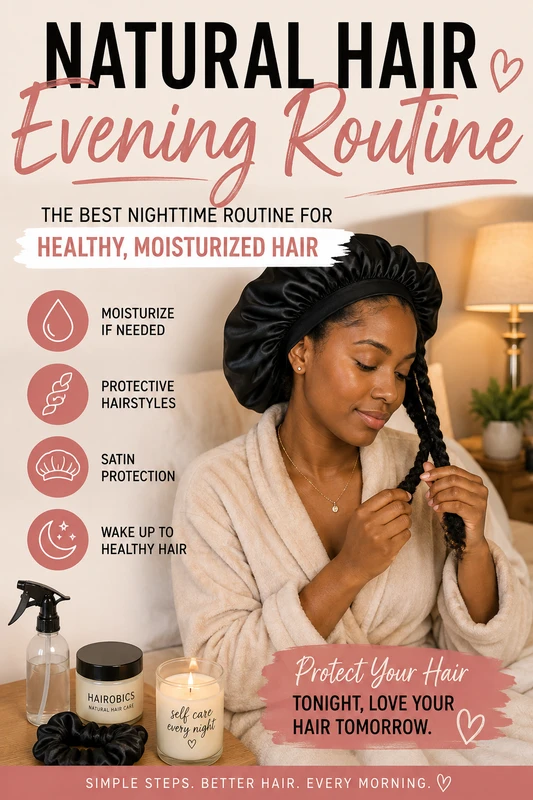
A good natural hair evening routine can make a major difference in how your hair looks and feels the next morning. If you regularly wake up with dry hair, flattened curls, frizz, tangles, or a style that seems completely different from the one you went to bed with, your nighttime habits may be part of the problem.
Natural hair requires consistent care, and that care shouldn't stop when the day ends.
While you sleep, your hair can rub against your pillow, lose moisture, become tangled, and experience unnecessary tension. The right evening routine helps protect your strands during those hours while preparing your hair for an easier morning.
The good news is that your nighttime natural hair routine doesn't need to take an hour.
For many people, 5–15 minutes of intentional nighttime hair care is enough.
The key is knowing what your hair actually needs.
Some nights may require nothing more than putting your hair into a protective nighttime style and covering it with satin. Other nights may call for a little moisture, scalp care, gentle detangling, or preparation for wash day.
In this complete guide, we'll explain how to build the best natural hair evening routine based on your hair's moisture level, hairstyle, length, density, and needs.
Why Is a Natural Hair Evening Routine Important?
Your hair doesn't stop experiencing friction simply because you're asleep.
Think about how much you move during six, seven, or eight hours of sleep. Your head may move across your pillow dozens or even hundreds of times throughout the night.
If your hair is left completely unprotected, that movement can contribute to:
- Frizz
- Tangling
- Dryness
- Flattened curls
- Single-strand knots
- Breakage
- Loss of hairstyle definition
- Rough-feeling ends
Nighttime care is especially important for natural hair because tightly curled and coiled strands can be more vulnerable to dryness and mechanical stress.
Sebum—the natural oil produced by the scalp—doesn't always travel easily down highly textured strands. The bends and curves of curly and coily hair make that journey more difficult.
That means the ends of your hair may not receive as much natural lubrication as the hair closer to your scalp.
Your evening routine gives you an opportunity to protect those vulnerable strands.
The Best Natural Hair Evening Routine
A simple natural hair evening routine can be broken into several steps:
- Assess your hair.
- Add moisture only if needed.
- Seal or protect dry ends when necessary.
- Gently separate or detangle problem areas.
- Put your hair into a low-manipulation nighttime style.
- Protect your hair with satin or silk.
- Leave your hair alone until morning.
You don't necessarily need to complete every step every night.
In fact, one of the biggest nighttime hair mistakes is doing too much.
Let's look at each step more closely.
Step 1: Check Your Hair Before Adding Products
Before reaching for your spray bottle, leave-in conditioner, cream, or oil, touch your hair.
Ask yourself:
Does my hair actually feel dry?
This small step can prevent unnecessary product buildup.
Natural hair does not automatically need to be soaked with water or coated with products every night.
Feel several sections, particularly:
- The ends
- Crown
- Hairline
- Nape
- Areas exposed to the environment
If your hair feels soft, flexible, and moisturized, you may not need to add anything.
Simply protect it and go to sleep.
If your hair feels slightly dry, however, a light moisture refresh may help.
Step 2: Lightly Moisturize Dry Hair
If your natural hair feels dry in the evening, add a small amount of moisture.
The keyword is small.
You don't necessarily want soaking-wet hair right before bed.
Depending on your hairstyle, you can lightly mist the hair with water or use a moisturizing hair spray.
Focus primarily on the areas that feel dry instead of automatically saturating your entire head.
You can also apply a small amount of leave-in conditioner to dry areas.
Should You Wet Natural Hair Every Night?
Not necessarily.
Some people find that frequent light misting works beautifully for their hair. Others experience more shrinkage, tangling, frizz, or product buildup when they repeatedly wet their hair.
Pay attention to how your hair responds.
Your routine should be based on your hair—not a rigid rule you saw online.
Step 3: Pay Special Attention to Your Ends
Your ends are the oldest part of your hair.
If you have shoulder-length hair, for example, the ends may have been growing for several years.
During that time, they've experienced:
- Washing
- Styling
- Weather
- Manipulation
- Detangling
- Clothing friction
- Heat exposure
- Protective styles
This makes your ends particularly important during your natural hair evening routine.
If your ends feel dry, lightly moisturize them.
Depending on your hair's needs, you may follow with a small amount of cream, butter, or oil to help reduce moisture loss and friction.
Avoid coating your ends with large amounts of heavy product every evening.
A little can go a long way.
Should You Oil Natural Hair at Night?
You can use oil during your nighttime routine, but you don't necessarily need to oil your hair every night.
Hair oil and water serve different purposes.
Water provides hydration.
Oil primarily helps lubricate the hair and can help reduce moisture loss depending on how it is used.
If your hair already feels moisturized but the ends feel rough, a very small amount of oil may improve softness and manageability.
Popular oils used in natural hair routines include:
- Jojoba oil
- Coconut oil
- Olive oil
- Avocado oil
- Argan oil
- Castor oil
Different hair types respond differently to oils.
For example, coconut oil works beautifully for some people but can leave other people's hair feeling stiff or coated.
Experiment gradually.
Step 4: Gently Separate Tangled Areas
You don't need to perform a complete detangling session every night.
Constant manipulation can actually become counterproductive.
Instead, check for obvious tangles.
Pay particular attention to your:
- Nape
- Ends
- Crown
- Hairline
If two sections have become tangled together, gently separate them with your fingers.
Never aggressively rake through dry, tangled natural hair before bed.
If a section requires serious detangling, add enough slip and moisture to make the process easier.
Step 5: Choose a Protective Nighttime Hairstyle
How you wear your natural hair while sleeping matters.
Leaving long natural hair completely loose can increase tangling and friction.
The ideal nighttime style keeps your hair organized without creating excessive tension.
Some good options include:
Two-Strand Twists
Loose two-strand twists are one of the most versatile nighttime options for natural hair.
They help keep strands separated and can reduce tangling.
You can create anywhere from four large twists to numerous smaller twists depending on your desired morning style.
Loose Braids
Several loose braids can help stretch the hair overnight and minimize tangling.
Avoid braiding extremely tightly.
Your nighttime hairstyle should protect your hair—not pull on your scalp.
Pineapple
The pineapple method is particularly popular for preserving curls and wash-and-go styles.
Gather the hair loosely toward the top of your head using a satin scrunchie or other gentle hair tie.
This keeps many of the curls from being crushed underneath your head while sleeping.
Bantu Knots
Loose Bantu knots can help keep natural hair organized while creating a stretched or curled appearance the following morning.
Again, avoid excessive tension around the scalp.
Loose Sections
If you don't care about maintaining a particular curl pattern, simply separating your hair into several loose sections may be enough.
Step 6: Protect Your Hair With Satin or Silk
This is arguably one of the most important parts of a natural hair evening routine.
Traditional cotton pillowcases can create friction against your hair.
Satin and silk provide a smoother surface.
You can protect your hair using:
- Satin bonnet
- Silk bonnet
- Satin scarf
- Silk scarf
- Satin pillowcase
- Silk pillowcase
Some people prefer using both a bonnet and satin pillowcase.
That provides backup protection if the bonnet comes off while you're sleeping.
Satin vs. Silk for Natural Hair
Both can work well.
Silk is a natural fiber, while satin refers to a type of weave and can be made from different materials.
The most important factor for nighttime hair protection is having a smooth surface that minimizes friction.
A quality satin bonnet can therefore be perfectly suitable for natural hair.
You don't have to purchase an expensive silk bonnet to create a good nighttime routine.
Natural Hair Evening Routine for Wash-and-Go Styles
Wash-and-go styles require slightly different nighttime care because you usually want to preserve curl definition.
Start by checking whether your curls feel dry.
If they still feel moisturized, don't automatically add water.
Too much nighttime moisture can cause unnecessary frizz and disrupt your curl pattern.
Instead, loosely pineapple your hair.
If your hair is too short for one pineapple, divide it into several smaller pineapples.
Cover with a satin bonnet.
The following morning, remove the bonnet and gently shake your hair.
Allow gravity and a little time to restore your shape before manipulating the curls.
Natural Hair Evening Routine for Twist-Outs
Preserving a twist-out overnight can significantly extend the life of your style.
You have two primary options.
Retwist Your Hair
Divide the hair into several large sections and loosely twist each section.
You don't necessarily need to recreate the small twists you originally used.
Four to eight larger twists may be enough.
Pineapple Your Twist-Out
If your twist-out still has excellent definition, a loose pineapple may preserve the style without requiring retwisting.
Experiment with both methods to see which gives you the best second- and third-day results.
Natural Hair Evening Routine for Braid-Outs
Braid-outs can be maintained similarly.
Loosely rebraid several sections before bed.
Don't pull the hair tightly.
Your goal is simply to maintain some organization and definition.
Cover your hair with satin and unravel the braids carefully in the morning.
Natural Hair Evening Routine for Short Hair
Short natural hair can actually make nighttime routines easier.
You may not need twists or braids.
If your hair feels moisturized, simply put on a satin bonnet or sleep on a satin pillowcase.
If you have a defined short curly style, avoid flattening the hair unnecessarily.
A satin scarf may work well for some short hairstyles, while a loose bonnet may work better for others.
Natural Hair Evening Routine for Long Hair
Long natural hair requires more attention because loose strands can easily become intertwined while you sleep.
Before bed, divide your hair into several sections.
Try:
- 2–6 loose braids
- 4–8 large twists
- Several loose buns
- A pineapple for curly styles
Make sure your ends are tucked or protected.
Avoid sleeping with long natural hair completely loose night after night if you notice excessive tangling.
Evening Routine for Low-Porosity Natural Hair
Low-porosity hair can be prone to product buildup because the cuticle structure makes it more difficult for moisture and products to penetrate.
If you have low-porosity hair, your nighttime routine may work best when kept simple.
Avoid layering large amounts of:
- Leave-in conditioner
- Cream
- Butter
- Gel
- Oil
every single evening.
Instead, evaluate your moisture level.
If your hair still feels soft, don't add anything.
When moisture is needed, use a lightweight product and avoid overloading the hair.
Evening Routine for High-Porosity Natural Hair
High-porosity hair may lose moisture relatively quickly.
This can happen naturally or as a result of chemical treatments, heat, coloring, weathering, or mechanical damage.
If your hair frequently feels dry by evening, you may benefit from:
- Light moisture.
- Leave-in conditioner if needed.
- A small amount of cream or oil.
- Protective styling.
- Satin protection.
Pay particular attention to your ends.
Natural Hair Evening Routine for Type 4 Hair
Type 4 hair includes a wide range of coils, curls, densities, and strand sizes.
The goal isn't to force every Type 4 head of hair into the same routine.
However, reducing tangling and moisture loss is particularly useful for tightly coiled hair.
Try dividing the hair into four to eight sections.
Lightly moisturize only when needed.
Twist or braid each section loosely.
Cover with satin.
This simple routine can dramatically reduce the amount of manipulation needed the next morning.
Natural Hair Evening Routine for Braids
Braids don't eliminate the need for nighttime hair care.
They simply change your routine.
Before bed, check your scalp.
If everything feels comfortable, you don't necessarily need to apply anything.
If your braids or exposed hair feel dry, use a lightweight moisturizing spray.
Avoid drenching your braids immediately before bed.
Excess moisture trapped within thick braids may take a long time to dry.
Then cover your braids with a large satin bonnet or satin scarf.
For long braids, a long bonnet may be more comfortable than trying to squeeze them into a small bonnet.
Natural Hair Evening Routine for Locs
Locs also benefit from nighttime protection.
One of the simplest loc routines is:
- Check the scalp and locs.
- Lightly moisturize if needed.
- Make sure the locs aren't wet.
- Place them loosely into a comfortable position.
- Cover with satin.
Long locs can be gathered loosely or placed inside a long satin bonnet.
Avoid repeatedly pulling locs into extremely tight ponytails at night.
Your scalp should feel relaxed while you sleep.
Should You Moisturize Your Scalp Every Night?
Usually, no.
The scalp produces its own sebum.
Adding oils and products every night can create buildup for some people.
Instead, monitor your scalp.
If your scalp feels comfortable, leave it alone.
If you experience persistent itching, flaking, redness, soreness, or other scalp problems, simply applying more oil may not address the underlying issue.
Healthy scalp care includes proper cleansing and avoiding excessive product accumulation.
What About Scalp Massage Before Bed?
A gentle scalp massage can be a relaxing addition to your evening routine.
Use your fingertips—not your fingernails.
Massage gently using small circular motions.
You don't need to aggressively rub the scalp.
A scalp massage can be performed with or without oil.
If you use oil, start with a small amount.
More oil does not automatically produce better results.
How to Protect Your Edges at Night
Your hairline deserves special attention.
Edges can experience tension from:
- Tight ponytails
- Tight buns
- Braids
- Wigs
- Headbands
- Scarves
- Bonnets with tight elastic
At night, remove unnecessary tension from your hairline.
Your bonnet should stay on your head without painfully squeezing your edges.
If you're wearing braids or another protective style, avoid pulling everything into a tight ponytail every night.
Allow your hairline to relax.
Don't Go to Bed With Soaking-Wet Hair
There is a difference between lightly misting your hair and going to sleep with soaking-wet hair.
Wet hair can be more vulnerable to stretching and mechanical damage.
Sleeping on soaking-wet hair may also leave your hairstyle flattened or tangled.
If you've washed your hair in the evening, give it enough time to dry before going to sleep whenever possible.
If you're creating a twist-out or braid-out, make sure your hair has sufficient drying time.
Otherwise, you may wake up with damp sections and poor definition.
Should You Detangle Natural Hair Every Night?
No.
Natural hair generally does not need a complete detangling session every night.
Frequent detangling can mean frequent manipulation.
Instead, detangle thoroughly when necessary—often during wash day when the hair has water and a product that provides slip.
Between wash days, gently separate obvious tangles.
This can prevent small tangles from becoming larger knots without unnecessarily combing through your entire head every night.
How to Prevent Single-Strand Knots at Night
Single-strand knots are common with tightly curled hair because individual strands can curl around themselves.
You may not eliminate them completely.
However, you can reduce opportunities for tangling by:
- Keeping hair moisturized
- Keeping ends trimmed when necessary
- Sleeping with hair stretched or sectioned
- Wearing twists or braids
- Using satin protection
- Avoiding excessive nighttime manipulation
Longer natural hair may particularly benefit from being divided into sections before bed.
How to Keep Natural Hair Moisturized Overnight
Moisture retention begins before bedtime.
If your hair becomes extremely dry every single evening, consider your entire routine.
Ask yourself:
- Am I cleansing too frequently?
- Is my shampoo too harsh for my needs?
- Am I conditioning properly?
- Am I using excessive heat?
- Am I layering too many products?
- Am I protecting my hair at night?
- Are my ends damaged?
- Am I experiencing excessive buildup?
Sometimes the solution isn't adding another nighttime product.
It may involve adjusting what you're doing earlier in the week.
The 5-Minute Natural Hair Evening Routine
You don't need a complicated 20-step routine.
If you're tired and ready for bed, try this:
Minute 1: Feel your hair and determine whether it needs moisture.
Minute 2: Lightly moisturize dry areas if necessary.
Minutes 3–4: Put your hair into a few loose twists, braids, sections, or a pineapple.
Minute 5: Put on your satin bonnet.
Done.
Consistency is often more useful than complexity.
The 15-Minute Evening Routine
If your hair needs more attention, try this longer routine.
Minutes 1–3: Assess Your Hair
Check your scalp, ends, moisture level, and tangles.
Minutes 4–7: Moisturize
Lightly mist dry sections and apply your preferred moisturizing product if needed.
Minutes 8–12: Section
Create several loose twists or braids.
Minutes 13–14: Protect Your Ends
Make sure the ends are moisturized and not rubbing unnecessarily against clothing or bedding.
Minute 15: Satin Protection
Put on your bonnet or scarf and you're ready for bed.
Natural Hair Evening Routine After Wash Day
Wash day evenings require slightly different care.
Make sure your hair is sufficiently dry before sleeping.
If you've created twists or braids for a twist-out or braid-out, avoid constantly touching them.
Once your hair is styled:
- Allow it to dry.
- Keep your hands out of it.
- Put on your satin bonnet.
- Go to sleep.
You generally don't need to add another layer of products immediately after completing your wash-day styling routine.
Night Before Wash Day Routine
The evening before wash day can be a good time to prepare your hair.
Depending on your routine, you might:
- Divide hair into sections
- Gently finger-detangle
- Remove shed hairs
- Apply a pre-shampoo treatment
- Organize your wash-day products
Pre-sectioning can make wash day much easier, especially for long or dense natural hair.
Common Natural Hair Nighttime Mistakes
Even a well-intentioned evening routine can create problems if you're doing too much.
1. Adding Product Every Single Night
More product doesn't automatically mean more moisture.
Constant layering can cause buildup.
2. Sleeping Without Satin Protection
Repeated friction can contribute to frizz, tangling, and breakage.
3. Making Nighttime Styles Too Tight
Your protective style should feel comfortable.
If your scalp hurts, it's too tight.
4. Going to Bed With Wet Hair
Give wet hair time to dry whenever possible.
5. Aggressively Detangling Dry Hair
Add moisture and slip when detangling is necessary.
6. Ignoring Your Ends
The ends are the oldest and often most vulnerable part of your hair.
7. Wearing the Same Tight Ponytail Every Night
Repeated tension in the same location can stress those strands.
8. Using Heavy Oils Constantly
Heavy product use can lead to buildup without necessarily solving dryness.
9. Using Dirty Bonnets and Scarves
Your nighttime accessories need washing too.
Product, sweat, and oils accumulate on them over time.
10. Making Your Routine Too Complicated
You don't need 12 products every night.
Keep it simple.
How Often Should You Wash Your Satin Bonnet?
Wash your bonnet regularly, particularly when you notice visible product buildup, oil, sweat, or odor.
How frequently you need to wash it depends on:
- How much product you use
- How oily your scalp becomes
- How much you sweat
- How often you wear the bonnet
Consider having several bonnets so you always have a clean one available.
Follow the manufacturer's washing instructions to avoid damaging the material.
What Products Do You Need for a Natural Hair Evening Routine?
You don't need an enormous collection.
A basic routine may include:
- Water or moisturizing mist
- Leave-in conditioner
- Light oil
- Hair cream if needed
- Satin bonnet
- Satin scarf
- Gentle scrunchies
You may not use all of these every night.
The products should support the routine—not become the routine.
Natural Hair Evening Routine by Hair Condition
Your nighttime routine should change depending on what your hair is telling you.
If Your Hair Feels Moisturized
Don't add more product.
Protect it with satin and go to bed.
If Your Hair Feels Slightly Dry
Lightly mist dry areas and add a small amount of moisturizer if necessary.
If Your Ends Feel Dry
Concentrate your moisture routine on your ends.
If Your Hair Is Tangled
Separate into sections and gently address the tangled areas.
If Your Scalp Feels Oily
Don't automatically add more oil.
You may need cleansing rather than additional products.
If Your Hair Is Extremely Dry
Consider whether buildup, cleansing habits, environmental conditions, damaged ends, or your overall moisturizing routine may be contributing.
Evening Routine vs. Morning Routine for Natural Hair
Your evening and morning routines should work together.
Your evening routine is primarily about protection and preparation.
Your morning routine is primarily about restoring shape and styling.
A good evening routine can dramatically shorten your morning routine.
Instead of waking up with severely tangled hair and starting over, you may only need to:
- Remove your bonnet.
- Undo your twists or braids.
- Separate gently.
- Fluff the roots.
- Style your edges if desired.
That's the benefit of nighttime preparation.
How Long Should a Natural Hair Evening Routine Take?
For most people, approximately 5–15 minutes is enough for daily maintenance.
More time may be necessary if you're:
- Preparing for wash day
- Detangling
- Installing twists
- Changing hairstyles
- Deep conditioning
- Doing scalp care
But your normal nightly routine doesn't need to become another wash day.
The best routine is one you can realistically maintain.
Sample Weekly Natural Hair Evening Schedule
Your nighttime routine doesn't have to be identical every day.
Monday
Check moisture → loose twists → satin bonnet.
Tuesday
No additional product → retwist loose sections → bonnet.
Wednesday
Light moisture refresh → protect ends → bonnet.
Thursday
No product if hair still feels moisturized → pineapple or twists → bonnet.
Friday
Check scalp and hair → light refresh if necessary → protective nighttime style.
Saturday
Wash day or regular nighttime protection.
Sunday
Assess hair for the upcoming week → moisturize if necessary → section and protect.
Notice that you're not automatically applying products every night.
Your hair determines what happens next.
Frequently Asked Questions About Natural Hair Evening Routines
Should I moisturize natural hair every night?
Not necessarily. Moisturize when your hair needs moisture rather than automatically applying products every evening.
Should I oil my scalp every night?
Usually not. Frequent scalp oiling can create buildup for some people. Use scalp products based on your scalp's needs.
Is it okay to sleep with natural hair loose?
You can, particularly with shorter hair, but longer natural hair may become more tangled when left loose. Sectioning, twisting, braiding, or pineappling can provide more protection.
Is a bonnet enough to protect natural hair?
A satin or silk bonnet provides valuable friction protection. For longer hair or hair prone to tangling, combining a bonnet with a loose protective nighttime style can provide additional benefits.
Should I braid my natural hair every night?
You don't have to. Loose braids can help reduce tangling and stretch the hair, but twists, pineapples, loose sections, and other methods can also work.
How do I stop my natural hair from getting dry overnight?
Use satin or silk protection, maintain an appropriate moisturizing routine, avoid excessive manipulation, and pay attention to your ends. If dryness continues, evaluate your entire wash and styling routine.
Is sleeping in a satin bonnet good for natural hair?
A smooth satin bonnet can help reduce friction between your hair and bedding, which may help preserve styles and minimize tangling and frizz.
Should I spray water on my natural hair before bed?
Only when your hair needs it. Light misting works well for some people, while others experience excessive shrinkage or frizz from daily water application.
How can I make my curls look better in the morning?
Protect your curl pattern overnight using a pineapple, loose sections, twists, or another low-manipulation method. Avoid crushing the curls underneath your head whenever possible.
What's the best nighttime hairstyle for natural hair?
There isn't one universal best style. Pineapples are excellent for preserving curls, while loose twists and braids are useful for reducing tangles and maintaining stretched styles.
Final Thoughts: Build an Evening Routine Your Hair Actually Needs
The best natural hair evening routine isn't necessarily the routine with the most products.
It's the routine that protects your hair while you sleep without creating unnecessary manipulation, tension, moisture, or buildup.
Start by paying attention to your hair.
If it feels moisturized, don't automatically add another product.
If it feels dry, lightly refresh it.
If your ends need extra attention, focus there.
Then put your hair into a comfortable nighttime style and protect it with satin or silk.
A simple routine might look like this:
Check → Moisturize if needed → Protect your ends → Section → Satin → Sleep.
That's it.
Over time, you may notice that protecting your hair at night makes your mornings easier, helps hairstyles last longer, reduces tangling, and makes it easier to maintain soft, manageable natural hair.
Remember that natural hair routines are personal.
Your porosity, density, strand thickness, hairstyle, climate, length, and product preferences all influence what works best for you.
Instead of trying to follow someone else's routine perfectly, use your hair's condition as your guide.
When your evening routine complements your wash-day and morning routines, caring for natural hair becomes much more manageable.
Consistency matters far more than complexity.
Protect your hair tonight so you have less work to do tomorrow.