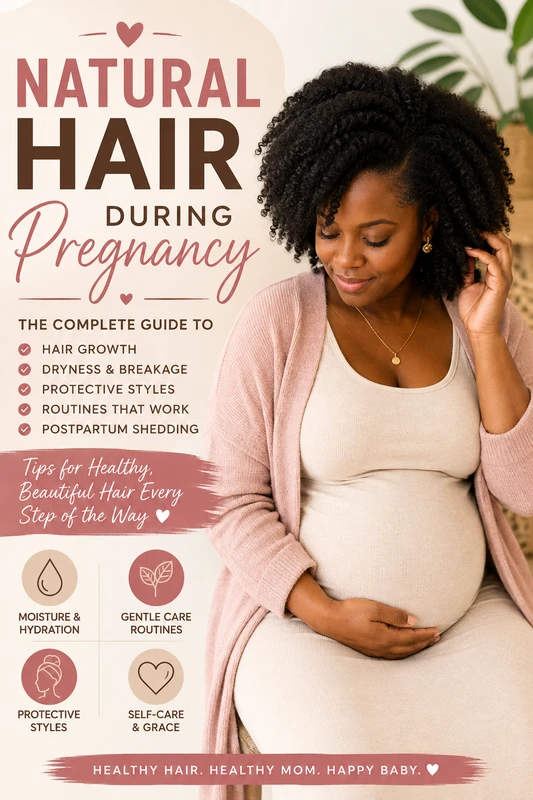
Pregnancy can bring noticeable changes to your body—and your natural hair may be one of them. Some women notice that their hair suddenly looks thicker, fuller, or shinier. Others experience dryness, changes in curl pattern, scalp sensitivity, breakage, or difficulty maintaining the same natural hair routine they used before pregnancy.
For Black women with natural hair, these changes can be especially noticeable because curly, coily, and kinky textures already require careful moisture management and gentle handling.
The important thing to remember is that there is no single way natural hair behaves during pregnancy.
Your hair may flourish. It may become more difficult to manage. It may barely change at all. You may even notice different changes during different stages of your pregnancy.
Hormonal shifts are a major reason for these differences, but your routine, nutrition, stress levels, styling practices, scalp health, and individual hair characteristics can also influence how your hair looks and feels.
This complete guide explains natural hair during pregnancy, including why pregnancy can affect your hair, how to build a simple pregnancy hair routine, what to do about dryness and breakage, and what you should know about postpartum shedding.
What Happens to Natural Hair During Pregnancy?
Pregnancy causes substantial hormonal changes throughout the body. Those changes can influence the normal hair growth cycle.
Hair generally moves through several phases:
- Anagen: active growth
- Catagen: transition
- Telogen: resting
- Exogen: shedding
At any given time, different hairs on your scalp are in different stages.
During pregnancy, hormonal changes may cause more hairs to remain in the growth phase longer than usual. This is one reason some pregnant women feel as though their hair has suddenly become much thicker.
The individual strands aren't necessarily growing dramatically faster. Instead, you may simply be retaining more of the hair that would normally have shed.
For someone with natural hair, this can create a surprisingly dramatic difference.
Your afro may look denser.
Your ponytail may feel thicker.
Your twists may look fuller.
Your wash-and-go may have more volume.
Your locs may seem denser around the roots.
However, not everyone experiences these changes.
Some women notice very little difference, while others deal with increased dryness, shedding, breakage, or scalp changes.
Pregnancy hair is highly individual.
Does Natural Hair Grow Faster During Pregnancy?
This is one of the most common questions about pregnancy and hair.
It can certainly look like your natural hair is growing faster during pregnancy, but the reality is more complicated.
Pregnancy may reduce normal shedding for some women. Because you are retaining more strands, your hair becomes fuller and it may seem as though your growth rate has increased substantially.
This can be especially noticeable with curly and coily hair because length retention is already a major part of achieving longer-looking natural hair.
There is an important distinction between:
Hair growth — new hair growing from the follicle.
and
Length retention — keeping the hair that has already grown without excessive breakage.
You can grow hair normally but struggle to see length if your ends continually break.
During pregnancy, some women experience better retention because their hair feels stronger or thicker. Others may experience the opposite if pregnancy leaves their hair particularly dry.
Therefore, don't become discouraged if you don't suddenly grow several inches of hair.
Every pregnancy is different.
Why Does Hair Get Thicker During Pregnancy?
One of the most celebrated pregnancy hair changes is increased thickness.
You may suddenly notice that your natural hair looks extremely full.
This commonly happens because fewer hairs enter or progress through the normal shedding process during pregnancy.
Imagine that you normally lose a certain number of hairs every day.
Now imagine that many of those hairs temporarily stay attached.
Over several months, the difference becomes noticeable.
Your hair isn't necessarily producing twice as many follicles. You're simply holding onto more strands.
For women with Type 3 and Type 4 hair, the added density can make hairstyles look particularly full.
Twist-outs can appear larger.
Braid-outs may have more volume.
Ponytails can feel thicker.
Wash-and-go styles may look denser.
Unfortunately, there is another side to this process.
After pregnancy, many of those retained hairs can eventually shed.
We'll discuss postpartum shedding later in this guide.
Can Pregnancy Change Your Curl Pattern?
Some women report changes in their hair texture or curl pattern during or after pregnancy.
You may notice that your curls seem:
- Looser
- Tighter
- Less defined
- More defined
- Frizzier
- Straighter in certain areas
- More difficult to style
Hormonal changes can affect different parts of the body, including the hair.
However, apparent curl-pattern changes aren't always caused by pregnancy hormones alone.
Your hair may also behave differently because of changes in:
- Moisture levels
- Product usage
- Styling frequency
- Hair density
- Hair length
- Humidity
- Heat usage
- Chemical treatments
- Overall hair condition
For example, if your hair becomes significantly drier during pregnancy, your curls may look frizzier and less defined.
That doesn't necessarily mean your permanent curl pattern has changed.
Focus more on keeping your hair healthy than trying to force it to behave exactly the way it did before pregnancy.
Why Is My Natural Hair So Dry During Pregnancy?
While some women experience beautiful, shiny pregnancy hair, others ask:
Why is my natural hair suddenly so dry during pregnancy?
Natural hair is naturally more vulnerable to dryness because the curves and bends of curly and coily strands make it harder for scalp oils to travel all the way down the hair shaft.
If your hair's behavior changes during pregnancy, your old moisture routine may no longer be sufficient.
You may notice:
- Rough strands
- Dry ends
- Excessive frizz
- Tangling
- Dull-looking hair
- Increased breakage
- Hair that feels dry soon after moisturizing
Instead of immediately adding five new products, simplify your routine and determine what your hair actually needs.
You may benefit from moisturizing more consistently, deep conditioning when needed, protecting your ends, and reducing unnecessary manipulation.
How to Moisturize Natural Hair During Pregnancy
A consistent moisture routine can make pregnancy hair significantly easier to manage.
Start with water.
Water is the foundation of hair hydration.
Applying oils or heavy butters to extremely dry hair without adding moisture first may make the hair feel coated rather than truly hydrated.
Depending on your hair's needs, your routine might include:
- Water or a water-based moisturizing product.
- A leave-in conditioner.
- A cream or moisturizer if your hair benefits from one.
- A small amount of oil or butter to help reduce moisture loss.
You don't necessarily need every layer.
Fine natural hair can become weighed down by too many products, while thick, coarse hair may tolerate richer formulas.
Pay attention to how your hair responds rather than following a rigid routine.
Build a Simple Natural Hair Pregnancy Routine
Pregnancy can be tiring.
The last thing you may want is a four-hour wash day followed by hours of twisting your hair.
Your natural hair routine doesn't need to be complicated.
A simple routine can be extremely effective.
Step 1: Cleanse Your Scalp Regularly
Healthy natural hair starts with a clean scalp.
Wash often enough to remove:
- Sweat
- Oil
- Dead skin
- Product buildup
- Dirt
The perfect wash schedule varies from person to person.
Some women prefer weekly cleansing, while others can comfortably go longer.
If your scalp is itchy, excessively oily, flaky, or covered in buildup, waiting weeks simply because you follow a strict schedule may not be helpful.
Listen to your scalp.
Step 2: Condition Your Hair
Conditioner provides slip that can make detangling curly and coily hair easier.
Apply conditioner throughout your hair, concentrating on areas that become particularly tangled or dry.
Work in sections when necessary.
Sections help prevent your hair from becoming one giant mass of tangles.
Step 3: Detangle Gently
Pregnancy isn't the time to fight with your hair.
Aggressive detangling can cause unnecessary breakage.
Start near the ends and gradually work toward the roots.
Use your fingers, a wide-tooth comb, or a detangling brush that works well with your texture.
Most importantly, don't rush.
If you encounter a knot, don't repeatedly rip a comb through it.
Separate the strands carefully.
Step 4: Deep Condition When Needed
If pregnancy leaves your hair noticeably drier than normal, periodic deep conditioning may help improve manageability and softness.
Your exact schedule depends on your hair.
Some women deep condition weekly.
Others may only need it occasionally.
More isn't automatically better.
If your hair feels soft, manageable, and moisturized, you don't need to constantly add treatments simply because someone online follows a complicated regimen.
Step 5: Moisturize
Apply your preferred moisturizing products while your hair is damp or according to the product directions.
Pay particular attention to your ends.
Your ends are the oldest part of your hair and are especially vulnerable to:
- Dryness
- Splitting
- Knots
- Friction
- Breakage
Keeping your ends moisturized and protected can improve length retention.
Step 6: Choose a Low-Manipulation Style
You don't have to restyle your natural hair every morning.
Low-manipulation hairstyles can save enormous amounts of time during pregnancy.
Options include:
- Two-strand twists
- Flat twists
- Buns
- Braids
- Cornrows
- Updos
- Tucked styles
The goal is not to avoid touching your hair forever.
The goal is to reduce unnecessary manipulation.
Step 7: Protect Your Hair at Night
Cotton pillowcases can create friction and absorb moisture from your hair.
Consider sleeping with a:
- Satin bonnet
- Satin scarf
- Satin pillowcase
You can also put long natural hair into loose twists or braids before bed to minimize tangling.
Nighttime protection takes only a few minutes but can save considerable styling time the following morning.
Best Hairstyles for Natural Hair During Pregnancy
Comfort becomes increasingly important as pregnancy progresses.
A hairstyle that requires hours of standing, sitting, braiding, or detangling may become less appealing.
Low-maintenance styles can be extremely useful.
Two-Strand Twists
Two-strand twists are one of the most versatile options for natural hair.
They can help reduce manipulation while keeping your hair accessible for moisturizing.
Depending on your hair and technique, twists can last several days or longer.
When you remove them, you can also wear a twist-out.
Flat Twists
Flat twists can keep your hair neatly tucked away and require relatively little daily styling.
They can also be incorporated into updos and other protective styles.
Braids
Braids can dramatically reduce daily styling.
However, protective styling should actually protect your hair.
Braids should not cause significant pain, headaches, bumps, or excessive pulling around your hairline.
Extremely tight braids can put unnecessary tension on your scalp and edges.
Comfort matters.
Cornrows
Simple cornrows can be convenient when you want to minimize daily manipulation.
Keep the tension comfortable, particularly around the edges.
Buns
A loose bun can be an easy option when you're tired and need to style your hair quickly.
Avoid pulling the hair extremely tight every day.
Repeated tension in the same areas can contribute to breakage.
Wash-and-Go Styles
If wash-and-go styling works well for your texture, there is no reason you must abandon it during pregnancy.
The key is preventing excessive tangling.
Make sure you detangle properly and keep your hair moisturized.
Protective Styles During Pregnancy
Protective styles can make pregnancy hair care easier, but they aren't maintenance-free.
Your scalp still needs care while your hair is braided or twisted.
Keep these principles in mind:
Avoid Excessive Tension
Your style should not feel painfully tight.
Beauty shouldn't require days of scalp pain.
Keep Your Scalp Clean
A protective style doesn't prevent sweat, oil, or buildup from accumulating.
Clean your scalp as appropriate for the style and your needs.
Moisturize Your Hair
Don't install braids and completely ignore your natural hair for weeks.
Your hair may still require moisture.
Protect Your Hairline
Baby hairs and edges are delicate.
Ask your stylist not to pull aggressively around your hairline.
Don't Leave Styles in Forever
Eventually, protective styles need to come down.
Leaving them in too long can contribute to matting, buildup, tangling, and difficult detangling.
Natural Hair Products During Pregnancy
Pregnancy often makes people look at ingredient labels much more carefully.
That's understandable.
However, "natural" doesn't automatically mean appropriate for everyone, and "chemical" doesn't automatically mean dangerous. Everything is made of chemicals, including water.
The best approach is to evaluate products individually.
If you have questions about whether a specific hair treatment, active ingredient, medication, essential oil, chemical service, or scalp treatment is appropriate during pregnancy, discuss it with your obstetric clinician or another qualified healthcare professional.
This is especially important if the product is medicated or intended to treat a scalp condition.
Don't rely solely on social-media claims that something is "pregnancy safe."
Should You Use Hair Oils During Pregnancy?
Oils can be useful in a natural hair routine, particularly for reducing moisture loss and adding lubrication.
Common hair oils include:
- Coconut oil
- Olive oil
- Avocado oil
- Jojoba oil
- Argan oil
- Grapeseed oil
Remember that oil and moisture aren't the same thing.
If your hair is dehydrated, repeatedly applying more oil may leave it greasy while it still feels dry.
Moisturize first when necessary and use oil strategically.
Pregnancy is also a time to be more cautious about highly concentrated essential oils. If you're unsure about a particular essential oil or scalp product, check with your healthcare professional before using it.
Can You Relax Your Hair During Pregnancy?
This is a question that should be discussed with your healthcare provider rather than answered with a universal yes or no.
Hair relaxers are chemical treatments, and individual circumstances vary.
Some women choose to avoid chemical processing during pregnancy, while others discuss their options with their healthcare providers.
If you are concerned about relaxers, hair dyes, keratin treatments, or other chemical services, bring the exact product or ingredient information to your clinician.
That allows you to receive advice based on the specific treatment rather than a general internet recommendation.
Can You Dye Natural Hair During Pregnancy?
Hair coloring during pregnancy is another common concern.
Rather than assuming every hair dye is identical, speak with your obstetric clinician about your specific situation, especially if you plan to use permanent dyes, bleaching products, or strong chemical treatments.
If you visit a salon, good ventilation is also sensible when products produce strong fumes.
Natural Hair Breakage During Pregnancy
Hair may become fuller during pregnancy, but that doesn't mean breakage is impossible.
Remember:
Shedding and breakage are different.
Shedding usually involves an entire strand coming from the scalp.
Breakage occurs when the strand snaps somewhere along its length.
Common causes of natural hair breakage include:
- Dryness
- Excessive manipulation
- Tight hairstyles
- Rough detangling
- Heat damage
- Chemical damage
- Split ends
- Friction
- Neglecting hair under protective styles
If you're noticing lots of short broken pieces, review your styling and moisture routine.
Pay Attention to Your Ends
Women trying to grow long natural hair often focus entirely on their scalp.
But your ends matter just as much.
Your scalp produces new growth.
Your routine helps determine how much of that growth you retain.
If your ends continually split and break, your hair may seem like it isn't growing.
During pregnancy, protect your ends by:
- Moisturizing them
- Detangling gently
- Reducing friction
- Limiting excessive heat
- Wearing low-manipulation styles
- Trimming damaged or split ends when necessary
Length retention is one of the biggest secrets to growing longer natural hair.
Pregnancy and Scalp Changes
Pregnancy may also coincide with changes in your scalp.
You might notice differences in:
- Oiliness
- Dryness
- Sensitivity
- Itching
- Flaking
Don't automatically assume every scalp problem is caused by pregnancy.
Persistent or severe scalp symptoms can have other causes.
If you develop significant inflammation, sores, unusual scaling, sudden bald patches, severe itching, or another concerning scalp change, consider seeing a dermatologist or healthcare professional.
What About Prenatal Vitamins for Hair Growth?
Prenatal vitamins are designed to help meet nutritional needs associated with pregnancy—not to serve as hair-growth supplements.
Some women notice stronger nails or changes in their hair while taking prenatal vitamins, but that doesn't mean taking extra vitamins will produce faster hair growth.
More isn't always better.
Certain vitamins and minerals can be harmful in excessive amounts, particularly during pregnancy.
Take supplements according to the recommendations of your healthcare professional.
Don't double up on prenatal vitamins or add high-dose "hair growth" supplements simply because you want longer hair.
Nutrition and Healthy Natural Hair During Pregnancy
Hair is part of your body, so overall nutrition matters.
During pregnancy, nutritional needs can change.
A balanced diet may include appropriate sources of:
- Protein
- Iron
- Zinc
- Healthy fats
- Vitamins
- Minerals
However, pregnancy nutrition should prioritize your health and your baby's development—not cosmetic hair goals.
If you're worried about nutrient deficiencies or have significant changes in your hair, discuss your concerns with your healthcare provider.
Avoid diagnosing yourself based solely on hair symptoms.
How Often Should You Wash Natural Hair During Pregnancy?
There is no universal pregnancy wash-day schedule.
The best frequency depends on factors such as:
- Scalp oil production
- Exercise
- Product usage
- Protective styles
- Hair density
- Lifestyle
- Scalp conditions
Many naturals prefer washing approximately once a week, but your ideal schedule may be shorter or longer.
The important thing is not allowing an arbitrary schedule to override what your scalp is telling you.
If your scalp becomes uncomfortable, dirty, sweaty, or covered in buildup, it may be time to cleanse.
How to Make Wash Day Easier While Pregnant
As your pregnancy progresses, wash day may become physically tiring.
Simplify it.
Instead of turning every wash day into an enormous event, focus on the essentials:
Cleanse → condition → detangle → moisturize → style.
You can also divide thick hair into sections before washing.
Try four to eight sections depending on your density and length.
Working in sections can:
- Reduce tangles
- Make shampooing easier
- Improve conditioner distribution
- Simplify detangling
- Reduce frustration
If you're exhausted, choose a simple style afterward instead of trying to create the perfect twist-out.
Hair care should fit your life.
What Happens to Natural Hair After Pregnancy?
This is where many new mothers become concerned.
Several months after giving birth, you may suddenly notice substantially more shedding.
Hair may appear:
- Thinner
- Less dense
- Flatter
- Sparse around certain areas
- Less voluminous
This is commonly called postpartum hair shedding.
The medical term often associated with this type of shedding is telogen effluvium.
During pregnancy, some of the hairs that normally would have shed may remain in place longer.
After delivery and the hormonal shift that follows, many hairs can enter a shedding phase around the same general period.
As a result, the shedding can look dramatic.
You may see hair in:
- Your hands
- The shower
- Your comb
- Your brush
- Your bonnet
- Your bathroom floor
This can be alarming, especially if you became accustomed to extremely thick pregnancy hair.
Does Postpartum Hair Loss Grow Back?
For many women, postpartum shedding is temporary and hair density gradually improves as the hair-growth cycle normalizes.
However, every case of hair loss should not automatically be labeled postpartum shedding.
Talk with a healthcare professional if your hair loss is severe, persistent, patchy, painful, associated with scalp inflammation, or otherwise concerns you.
A dermatologist can also evaluate the scalp and determine whether something besides typical postpartum shedding may be contributing.
How to Care for Natural Hair During Postpartum Shedding
You usually cannot stop a normal hair-cycle shift simply by applying more oil to your scalp.
However, you can protect the hair that remains.
Focus on gentle care.
Avoid Excessive Tension
This is especially important around your hairline.
Skip extremely tight ponytails, braids, and buns.
Detangle Carefully
More shed hair may become trapped inside curly or coily strands before wash day.
That can make detangling seem much worse.
Take your time.
Keep Your Hair Moisturized
You don't want breakage adding to the appearance of shedding.
Limit Unnecessary Manipulation
Simple hairstyles can make this period easier.
Keep Your Scalp Healthy
Continue cleansing appropriately.
Don't stop washing your hair because you're frightened by seeing shed strands in the shower.
Those loose hairs may simply become more visible during washing.
Pregnancy Hair vs. Postpartum Hair
It can feel unfair.
During pregnancy, you may have the thickest hair you've ever had.
Then several months after giving birth, it may seem like all that beautiful volume is disappearing.
Understanding what's happening can make the transition less frightening.
Pregnancy can temporarily change the normal hair cycle.
Postpartum shedding can represent the cycle readjusting.
That doesn't mean you ruined your natural hair.
Continue practicing gentle hair care and seek professional evaluation if the shedding seems unusual or persistent.
10 Tips for Healthy Natural Hair During Pregnancy
Here are ten simple principles to remember:
- Keep your scalp clean.
Healthy hair care begins at the scalp. - Moisturize consistently.
Adjust your routine if pregnancy makes your hair feel drier. - Be gentle when detangling.
Don't sacrifice length retention by ripping through knots. - Reduce manipulation.
Simple hairstyles can protect your hair and save energy. - Avoid excessively tight hairstyles.
Your edges don't need extra tension. - Protect your hair while sleeping.
Use satin or another low-friction option that works for you. - Protect your ends.
Your oldest hair requires extra attention. - Don't overload your hair with products.
More products don't automatically create healthier hair. - Be cautious with supplements and specialized treatments.
Pregnancy isn't the time to experiment carelessly. - Ask a healthcare professional when you're uncertain.
This is particularly important for medications, supplements, chemical treatments, scalp conditions, and significant hair loss.
Frequently Asked Questions About Natural Hair During Pregnancy
Does pregnancy make natural hair thicker?
It can. Hormonal changes during pregnancy may cause more hairs to remain in the growth phase, resulting in fuller-looking hair and reduced shedding for some women.
Does natural hair grow faster when pregnant?
It may appear to grow faster because some women experience reduced shedding and increased retention. Actual growth experiences vary.
Why is my natural hair dry during pregnancy?
Hair behavior can change during pregnancy, and your previous moisture routine may no longer be sufficient. Product usage, styling habits, environment, and individual hair characteristics can also influence dryness.
Can pregnancy change your natural hair texture?
Some women report texture or curl-pattern changes during pregnancy or postpartum. Hair can also look different because of changes in moisture, density, styling, damage, and length.
Can I wear braids while pregnant?
Braids can be a convenient low-maintenance hairstyle. Avoid excessive tension, keep your scalp clean, moisturize as needed, and don't leave the style installed indefinitely.
Are protective styles good during pregnancy?
They can be extremely convenient because they reduce daily styling. A protective style should not be painfully tight or cause excessive stress on your hairline.
Should I take hair vitamins while pregnant?
Don't add supplements specifically for hair growth without discussing them with your healthcare provider. Prenatal supplements should be taken according to professional guidance.
Why is my hair shedding after pregnancy?
Postpartum hormonal changes can cause a larger number of hairs to enter the shedding stage around the same time. This is often temporary.
When does postpartum hair shedding stop?
The timeline varies between individuals. Hair density commonly improves as the normal growth cycle reestablishes itself, but persistent, severe, or unusual hair loss should be evaluated by a healthcare professional.
Should I cut my natural hair during pregnancy?
There is no general requirement to cut your hair because you're pregnant. Trim when your hair needs it—for example, if you have damaged or split ends.
A Simple Weekly Pregnancy Natural Hair Routine
If you want to keep things uncomplicated, consider a routine similar to this:
Wash Day
Cleanse your scalp and hair.
Apply conditioner.
Detangle gently in sections.
Deep condition if your hair needs additional moisture.
Apply your leave-in or preferred moisturizer.
Style your hair in twists, braids, a bun, or another low-manipulation hairstyle.
During the Week
Monitor your hair for dryness.
Refresh moisture when necessary rather than automatically piling on products every day.
Pay particular attention to your ends.
At Night
Cover your hair with a satin bonnet or scarf, or sleep on a satin pillowcase.
If your hair tangles easily, loosely section it before sleeping.
Next Wash Day
Repeat based on what your hair actually needs.
That's it.
Your routine doesn't have to involve 15 products.
Consistency usually matters more than complexity.
Don't Compare Your Pregnancy Hair to Someone Else's
Social media can make pregnancy hair seem magical.
You may see someone eight months pregnant with incredibly thick waist-length natural hair and wonder why your hair hasn't changed at all.
Don't make that comparison.
Genetics, hair density, strand thickness, curl pattern, routine, health, styling history, and many other factors differ from person to person.
One person's pregnancy experience doesn't predict yours.
Your goal should be maintaining the healthiest hair and scalp you reasonably can—not recreating someone else's results.
When Hair Changes May Need Professional Attention
Most changes in hair appearance aren't emergencies.
However, significant hair loss deserves attention when it seems unusual.
Consider talking with your healthcare provider or dermatologist if you experience:
- Sudden bald patches
- Severe or rapidly progressing thinning
- Painful scalp symptoms
- Sores
- Significant inflammation
- Persistent excessive shedding
- Hair loss that doesn't seem to improve
- Other new physical symptoms accompanying hair loss
There are many possible causes of hair loss, and pregnancy or postpartum status doesn't automatically explain everything.
Professional evaluation is preferable to guessing.
Final Thoughts: Caring for Natural Hair During Pregnancy
Pregnancy can be an unpredictable chapter in your natural hair journey.
Your curls may become thicker.
Your hair may retain length more easily.
Your strands may become drier.
Your curl pattern may seem different.
Your favorite products may suddenly behave differently.
Or your hair may remain almost exactly the same.
All of these experiences are possible.
Instead of chasing perfect pregnancy hair, build your routine around healthy hair, a clean scalp, adequate moisture, gentle detangling, low manipulation, protected ends, and comfortable hairstyles.
Most importantly, give yourself permission to simplify.
You don't need a complicated wash day every week.
You don't need to try every viral pregnancy hair-growth hack.
And you don't need to panic if your hair behaves differently than it did before pregnancy.
Listen to your hair, adjust your routine when necessary, and seek professional guidance for significant or concerning changes.
Pregnancy is temporary, and your hair journey will continue long after your baby arrives.