Healthy hair doesn't happen by accident—it happens through consistency. Whether your goal is longer hair, stronger curls, healthier locs, thicker edges, or a flake-free scalp, having a monthly hair planner can transform your routine.
Instead of wondering when to wash, deep condition, trim, moisturize, or clarify your hair, a monthly planner gives you a simple roadmap to follow. It removes guesswork, helps you stay organized, and ensures your hair receives everything it needs throughout the month.
No matter if you wear:
- Natural hair
- 4A, 4B, or 4C curls
- Locs
- Braids
- Twists
- Wigs
- Relaxed hair
A monthly planner can help you stay consistent and see better results over time.
Why You Need a Monthly Hair Planner
Many people spend hundreds of dollars on products but never follow a consistent schedule.
Consistency is often more important than buying expensive products.
A monthly planner helps you:
- Reduce breakage
- Improve moisture retention
- Remember wash days
- Prevent product buildup
- Keep your scalp healthy
- Track hair growth
- Schedule protective styles
- Stay motivated
Hair thrives when cared for regularly.
Benefits of Following a Hair Planner
Better Moisture Balance
Dry hair breaks.
Regular moisturizing keeps strands flexible and strong.
Stronger Hair
Protein treatments, conditioning, and gentle handling all strengthen hair over time.
Healthier Scalp
A planner reminds you to cleanse your scalp before buildup becomes excessive.
Healthy hair begins with a healthy scalp.
Faster Length Retention
Hair grows continuously.
Length retention depends on preventing unnecessary breakage.
A planner helps reduce damage.
Easier Wash Days
Knowing exactly what to do every week saves time.
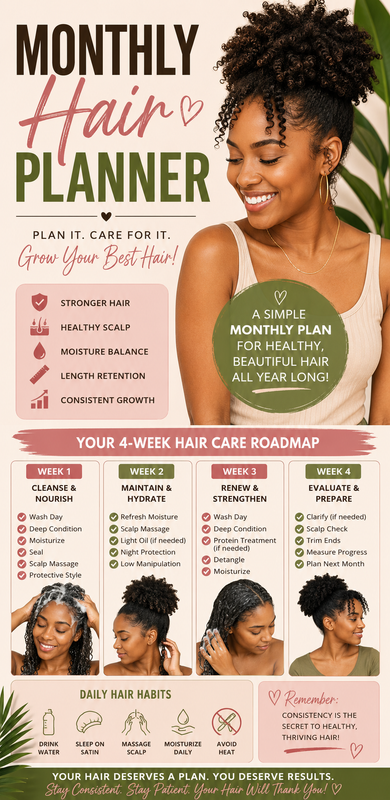
Monthly Hair Planner Overview
Here's a simple four-week cycle.
Week 1
- Wash
- Deep condition
- Moisturize
- Seal
- Massage scalp
- Protective style
Week 2
- Refresh moisture
- Scalp massage
- Light oil if needed
- Protect hair while sleeping
Week 3
- Wash
- Deep condition
- Protein treatment if necessary
- Moisturize
- Trim tangles
Week 4
- Clarify if needed
- Scalp inspection
- Trim split ends (when necessary)
- Evaluate progress
- Plan next month
Week 1 Hair Planner
Wash Day
Use a sulfate-free cleanser.
Massage your scalp gently.
Don't rush.
Clean hair absorbs moisture better.
Deep Conditioning
Hydration restores elasticity.
Leave conditioner on for 20–30 minutes.
Use heat if desired.
Moisturize
Layer products from lightest to heaviest.
Water
↓
Leave-in conditioner
↓
Cream
↓
Oil or butter
Scalp Massage
Spend five minutes gently massaging your scalp.
This promotes circulation and relaxation.
Protective Styling
Good options include:
- Twists
- Flat twists
- Braids
- Buns
- Pineapple
- Loose puff
Avoid styles that pull tightly.
Week 2 Planner
This week focuses on maintenance.
Refresh Hair
Mist with water.
Apply leave-in if needed.
Seal moisture.
Night Care
Wear:
- Satin bonnet
- Satin scarf
- Silk pillowcase
These reduce friction.
Scalp Check
Look for:
- Dryness
- Itching
- Flakes
- Redness
Address issues early.
Week 3 Planner
Another wash day helps remove buildup.
Gentle Cleansing
Focus on the scalp.
Allow shampoo to rinse through the lengths.
Protein Treatment
If your hair feels:
- Mushy
- Weak
- Overly stretchy
A protein treatment may help.
Avoid overusing protein.
Detangle Carefully
Always work in sections.
Use conditioner.
Start from the ends.
Week 4 Planner
Time to evaluate.
Clarify
Clarifying removes heavy buildup.
Most people only need clarifying once every month or two.
Trim Check
Split ends can travel upward.
Trim only when necessary.
Measure Progress
Take photos.
Measure length.
Track moisture.
Record products used.
Sample Monthly Hair Calendar
Monday
Moisturize
Tuesday
Protective style maintenance
Wednesday
Scalp massage
Thursday
Moisturize
Friday
Low manipulation
Saturday
Wash day (Weeks 1 and 3)
Sunday
Rest and protect
Monthly Planner for Natural Hair
Natural hair benefits from regular hydration.
Priorities include:
- Moisture
- Gentle detangling
- Stretching styles
- Protective styling
- Deep conditioning
Monthly Planner for 4C Hair
4C hair often needs more moisture.
Weekly goals include:
- Hydration
- Finger detangling
- Stretching overnight
- Low manipulation
Monthly Planner for Curly Hair
Curly hair responds well to:
- Curl refreshes
- Deep conditioning
- Lightweight leave-ins
- Gel only when necessary
Avoid over-cleansing.
Monthly Planner for Locs
Loc maintenance includes:
Week 1
Wash
Week 2
Moisturize
Week 3
Wash again
Week 4
Retwist if needed
Always keep locs hydrated.
Monthly Planner for Braids
Braids still require maintenance.
Weekly:
- Clean scalp
- Moisturize roots
- Oil scalp lightly
- Protect at night
Never ignore your natural hair underneath.
Monthly Planner for Twists
Twists last longer when:
- Wrapped nightly
- Refreshed with moisture
- Avoided excessive manipulation
Monthly Planner for Protective Styles
While wearing protective styles:
Clean scalp every 2–3 weeks.
Moisturize regularly.
Avoid excessive tension.
Remove styles before excessive matting occurs.
Hair Growth Tracking
Keep a journal including:
Date
Products used
Wash day
Deep condition
Protein treatment
Hair length
Scalp condition
Photos
Notes
Tracking helps identify what works best.
Common Mistakes
Skipping Wash Days
Dirty scalp can lead to buildup.
Using Too Many Products
Keep routines simple.
Forgetting Moisture
Dry hair breaks faster.
Tight Hairstyles
Protective styles should never hurt.
Ignoring the Scalp
Healthy hair begins at the scalp.
Seasonal Monthly Planning
Spring
Increase cleansing.
Manage pollen and humidity.
Summer
Protect hair from chlorine and UV rays.
Increase moisture.
Fall
Repair summer dryness.
Deep condition regularly.
Winter
Use heavier moisturizers.
Reduce frequent washing if necessary.
Protect hair from dry indoor air.
Healthy Habits to Add Every Month
- Drink more water
- Eat protein-rich foods
- Sleep on satin
- Reduce heat styling
- Massage scalp
- Stay consistent
- Handle hair gently
- Stay patient
Products to Include in Your Planner
Your routine should include:
- Gentle shampoo
- Moisturizing conditioner
- Deep conditioner
- Leave-in conditioner
- Lightweight oil
- Hair butter or cream
- Clarifying shampoo (monthly)
- Satin bonnet
- Wide-tooth comb
Signs Your Planner Is Working
After several months you may notice:
- Less shedding
- Softer hair
- Stronger strands
- Healthier scalp
- Fewer split ends
- Better moisture retention
- Easier detangling
- More consistent curl definition
- Improved length retention
Frequently Asked Questions
How often should I wash my hair?
Most people benefit from washing every 1–2 weeks, depending on hair type, activity level, and product buildup.
Can I deep condition every wash day?
Yes. Regular deep conditioning is especially helpful for dry or damaged hair.
Should I oil my scalp every day?
Usually not. Oil should complement moisture rather than replace it. Apply only as needed based on your scalp's condition.
How often should I clarify?
Generally once every 4–8 weeks, depending on product usage and buildup.
Do protective styles eliminate the need for maintenance?
No. You should still cleanse your scalp, moisturize your hair, and protect it while sleeping.
30-Day Monthly Hair Planner Checklist
Week 1
- □ Shampoo
- □ Deep condition
- □ Moisturize
- □ Seal moisture
- □ Scalp massage
- □ Protective style
Week 2
- □ Refresh moisture
- □ Cleanse scalp if needed
- □ Nightly satin protection
- □ Scalp massage
- □ Hydrate
Week 3
- □ Shampoo
- □ Deep condition
- □ Detangle
- □ Moisturize
- □ Protein treatment (if needed)
Week 4
- □ Clarify (if needed)
- □ Check for split ends
- □ Trim if necessary
- □ Measure progress
- □ Take comparison photos
- □ Plan next month
Final Thoughts
A monthly hair planner is one of the simplest yet most effective tools for achieving healthier, stronger, and longer hair. Rather than relying on memory or reacting to problems after they appear, a structured plan helps you stay consistent with cleansing, moisturizing, deep conditioning, scalp care, and protective styling.
Whether you have natural hair, curls, locs, braids, twists, or relaxed hair, creating a monthly routine makes healthy habits automatic. Over time, these small, consistent actions can lead to improved moisture retention, less breakage, healthier edges, stronger strands, and better length retention.
Remember that healthy hair is a journey, not a race. Track your progress, adjust your routine based on your hair's needs, and stay committed month after month. Consistency—not perfection—is the foundation of beautiful, thriving hair.
By following this monthly hair planner, you'll build a routine that supports healthy hair growth all year long while making hair care less stressful and more rewarding.