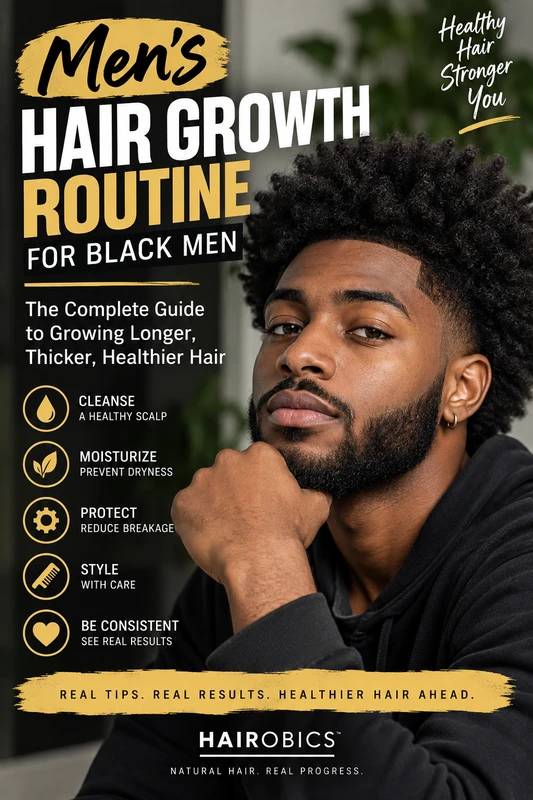
Growing longer, stronger, healthier hair as a Black man is usually less about finding one miracle product and more about building a consistent routine.
Black men can wear their hair in countless ways—waves, curls, twists, braids, locs, fades, afros, cornrows and more. But regardless of the style, healthy hair growth starts with the same basic principles: maintain a healthy scalp, keep the hair adequately moisturized, minimize unnecessary breakage and handle the hair gently.
One of the biggest misconceptions about Black hair is that it simply doesn't grow as quickly as other hair types. Hair growth rates vary from person to person, but tightly curled and coily hair can make growth harder to notice because of shrinkage and breakage.
Your hair may actually be growing while you struggle to retain the new length.
That distinction is important.
Instead of focusing only on making your hair "grow faster," an effective Black men's hair growth routine should focus on creating good conditions for normal growth while helping you keep as much of that growth as possible.
This guide explains how to build a simple routine you can actually stick with.
Why Black Men Need a Hair Growth Routine
Hair grows from follicles beneath the skin. Once the hair emerges from the scalp, the visible strand is exposed to washing, brushing, combing, friction, dryness, heat and styling.
This is where length retention becomes important.
Coily and curly strands contain bends and curves that can make them more susceptible to tangling and mechanical breakage. Natural scalp oils may also have a harder time traveling down tightly curled strands than they do down straighter hair.
This can contribute to dry-feeling ends.
A consistent routine helps you manage these challenges.
Your routine should accomplish several things:
- Keep your scalp clean
- Prevent excessive product buildup
- Maintain adequate moisture
- Reduce unnecessary manipulation
- Protect fragile ends
- Minimize tangles
- Reduce breakage
- Keep hairstyles from creating excessive tension
- Help you identify scalp or hair problems early
You don't need 20 products.
You need consistency.
Step 1: Understand Your Hair
Before buying products, spend some time learning how your hair behaves.
Two Black men can have completely different hair needs even if their hair looks similar.
Consider your:
Curl pattern
Hair may range from loose curls to extremely tight coils.
Hair density
Density refers to how many strands you have on your scalp.
Strand thickness
Individual strands can be fine, medium or coarse.
Porosity
Porosity describes how readily your hair absorbs and loses moisture.
Current hairstyle
An afro requires different day-to-day maintenance than locs or waves.
Scalp condition
A scalp that frequently becomes oily, flaky, irritated or itchy may require different care.
Rather than becoming obsessed with identifying an exact hair "type," pay attention to what your hair actually does.
Does it dry out quickly?
Does it break when combed?
Does it become tangled easily?
Does your scalp develop buildup?
These observations are often more useful than a curl-pattern chart.
Step 2: Keep Your Scalp Clean
Healthy-looking hair starts with proper scalp care.
Sweat, oil, dead skin, styling products and environmental debris can accumulate on the scalp.
Some men avoid shampoo because they believe washing their hair will prevent growth.
That's a mistake.
Washing doesn't stop hair growth.
The goal is to find a cleansing schedule appropriate for your scalp, activity level and hairstyle.
For many Black men, shampooing approximately once every 7–14 days can be a reasonable starting point, but there is no universal schedule.
You may need to wash more frequently if you:
- Exercise heavily
- Sweat frequently
- Use substantial styling products
- Have an oily scalp
- Swim regularly
- Develop noticeable buildup
Someone with a dry scalp and minimal product use may prefer a different schedule.
Pay attention to your scalp rather than blindly following a calendar.
How to Shampoo Black Men's Hair
Technique matters.
First, thoroughly wet your hair with lukewarm water.
Apply shampoo primarily to your scalp.
Use your fingertips to gently massage your scalp rather than aggressively scratching it with your nails.
Work through the scalp carefully.
As you rinse, the shampoo will travel down the hair.
If your hair is particularly dirty or covered in styling products, you may need a second gentle cleanse.
Rinse thoroughly.
One of the biggest mistakes men make is scrubbing their hair aggressively as though they're washing a carpet.
Your goal is cleanliness—not maximum friction.
Step 3: Condition After Shampooing
Shampoo and conditioner serve different purposes.
Shampoo removes dirt, excess oils and product buildup.
Conditioner helps improve softness, manageability and lubrication.
This can make detangling easier and reduce the amount of force needed to manipulate your hair.
After shampooing, apply conditioner through your hair, paying particular attention to areas that feel dry.
Allow it to sit according to the product instructions.
Then rinse.
If your hair is longer, detangling while it is lubricated with conditioner can make the process easier.
Step 4: Deep Condition When Your Hair Needs Extra Care
Deep conditioning can be useful for men growing longer natural hair, particularly when hair regularly feels dry or difficult to manage.
You don't necessarily need to deep condition every time you wash.
Instead, determine how your hair responds.
Some men incorporate deep conditioning weekly, while others use it occasionally.
A good deep conditioner should leave your hair feeling:
- Softer
- More manageable
- Easier to detangle
- Less rough
More isn't automatically better.
Follow the manufacturer's directions rather than leaving treatments on for hours simply because social media says you should.
Step 5: Moisturize Your Hair Consistently
Moisture management is one of the most important parts of a Black men's natural hair routine.
Dry hair tends to feel rougher and can be more difficult to manipulate without breakage.
Water is the foundation of hydration.
That doesn't mean you need to completely soak your hair every morning.
Instead, depending on your hairstyle and hair needs, you can use a water-based leave-in product or moisturizing spray to refresh the hair.
Focus especially on areas that become dry quickly.
Your ends deserve special attention because they are the oldest part of your hair.
How Often Should Black Men Moisturize Their Hair?
There is no perfect number.
Some men may need moisture every day or two, while others may find that their hair remains soft for several days.
Your hair should guide the schedule.
If it feels:
- Rough
- Extremely dry
- Brittle
- Difficult to manipulate
…it may be time to reassess your moisture routine.
At the same time, constantly piling products onto your hair can cause buildup.
The goal is balanced moisture—not permanently wet or product-coated hair.
Step 6: Use Oils Strategically
Hair oils are extremely popular in Black hair care.
Common choices include:
- Jojoba oil
- Coconut oil
- Avocado oil
- Grapeseed oil
- Olive oil
- Castor oil
Oils can help lubricate strands, improve feel and reduce friction. Depending on the product and routine, they may also help reduce moisture loss.
But oil and water aren't the same thing.
If your hair feels dehydrated, coating extremely dry strands with heavy oil may make them shiny without actually addressing the underlying dryness.
This is why many men prefer to use oil alongside water-based hair care.
A little may go a long way.
Step 7: Massage Your Scalp Gently
Scalp massage can be a relaxing addition to your routine.
Using the pads of your fingertips, gently massage different areas of your scalp.
You don't need to scratch aggressively or apply enough pressure to make your scalp sore.
Try several minutes when convenient.
Scalp massage shouldn't be treated as a guaranteed method of dramatically accelerating hair growth. Think of it as a supportive scalp-care habit rather than a miracle treatment.
Step 8: Stop Combing Your Hair Dry
This is a major mistake for many men with longer coily hair.
Imagine trying to drag a small-tooth comb through a completely dry afro.
Every snag creates resistance.
The harder you pull, the greater the chance of breaking strands.
Instead, detangle when your hair is appropriately softened and lubricated.
Depending on your hair, that may mean using:
- Water
- Leave-in conditioner
- Conditioner
- Detangling product
Use your fingers first when necessary.
Then use a wide-tooth comb or appropriate detangling tool.
Start near the ends.
Gradually work upward toward the roots.
Don't start at the roots and aggressively rip downward through every knot.
Step 9: Reduce Excessive Manipulation
Sometimes the best thing you can do for your hair is stop touching it constantly.
Repeated:
- Brushing
- Combing
- Picking
- Twisting
- Pulling
- Restyling
…creates mechanical stress.
This doesn't mean you can never style your hair.
It means you should be intentional.
If your goal is growing a large afro, for example, you don't necessarily need to pick it aggressively from roots to ends several times every day.
Style it carefully and give your hair a chance to rest.
Step 10: Protect Your Hair While Sleeping
You can have a great daytime routine and still create unnecessary friction every night.
Your hair rubs against your pillow for hours while you sleep.
Many Black men use a satin or silk bonnet, durag, scarf or pillowcase to reduce friction and help preserve hairstyles.
Which option works best depends on your hairstyle.
Waves
A durag is often useful for maintaining the pattern and protecting the hair overnight.
Afro
A satin bonnet or pillowcase may help minimize friction.
Braids and twists
Use a bonnet, durag or appropriately sized scarf depending on the style.
Locs
Longer locs may benefit from a larger satin bonnet or loc cap.
Your nighttime routine doesn't need to be complicated.
The important thing is protecting your hair consistently.
Step 11: Be Careful With Tight Hairstyles
Braids, cornrows, twists and other protective styles can reduce daily manipulation.
But a style isn't protective if it is excessively tight.
If your hairstyle causes significant:
- Pain
- Bumps
- Redness
- Persistent soreness
- Excessive pulling around the hairline
…that's a warning sign.
Repeated tension can damage hair and, in some circumstances, contribute to traction alopecia.
Your edges and temples are particularly important.
Don't sacrifice your hairline for a hairstyle.
Step 12: Take Care of Your Hairline
For many men, the hairline is one of the first areas where changes become noticeable.
Avoid repeatedly brushing, pulling or tightly styling the edges.
Be cautious with hairstyles that create constant tension around your temples.
If you frequently wear hats, helmets or other headwear, make sure unnecessary friction isn't repeatedly occurring in the same areas.
Most importantly, don't assume every receding hairline is caused by poor hair care.
Male-pattern hair loss is extremely common and is largely influenced by genetics and hormones.
If your hairline is noticeably receding or thinning, consider speaking with a dermatologist early rather than relying solely on oils.
Step 13: Trim Damaged Ends When Necessary
Many men trying to grow their hair refuse to trim anything.
That isn't always the best strategy.
A trim doesn't make hair grow faster from the scalp.
However, removing badly split or damaged ends can improve the overall condition and appearance of your hair.
You may need a trim if your ends are:
- Splitting
- Extremely tangled
- Thin
- Rough
- Breaking repeatedly
You don't need to cut large amounts unnecessarily.
The goal is to remove damage while retaining healthy length.
Step 14: Limit Excessive Heat
Heat can make styling easier, but frequent high-temperature styling can damage hair.
If you blow-dry your hair, consider:
- Using moderate heat
- Avoiding excessive passes
- Keeping the dryer moving
- Using an appropriate heat protectant
- Avoiding unnecessary heat sessions
If your main goal is length retention, minimizing unnecessary damage is important.
Occasional heat and constant high-heat styling are very different things.
Step 15: Protect Your Hair at the Barbershop
Your barber can also affect your hair-growth journey.
If you're growing the top while maintaining a fade, clearly communicate your goal.
Tell your barber exactly what should and shouldn't be cut.
Be particularly careful with the hairline.
Repeatedly pushing a lineup farther backward can create the appearance of a receding hairline.
You may want to tell your barber:
"Keep my natural hairline. Don't push it back."
A sharp haircut is great.
Maintaining your actual hairline is better.
A Simple Daily Hair Growth Routine for Black Men
You don't need an hour-long routine every morning.
Try something like this.
Morning
Check how your hair feels.
If it still feels moisturized and manageable, you may not need to add anything.
If it feels dry, lightly apply an appropriate water-based moisturizer or leave-in product.
Style gently.
Avoid unnecessary combing.
For waves, follow your normal brushing routine without applying excessive pressure.
For afros, curls or longer natural hair, manipulate only as much as necessary to create your desired style.
Black Men's Nighttime Hair Routine
Before bed:
Assess your hair.
If it's extremely dry, apply a small amount of your preferred moisturizing product as appropriate.
Put on your:
- Durag
- Bonnet
- Satin scarf
- Loc cap
Or sleep on a satin or silk pillowcase.
The goal is simple:
Reduce overnight friction and preserve your hairstyle.
Weekly Hair Growth Routine for Black Men
Your weekly routine might look like this:
Wash day
- Shampoo the scalp thoroughly.
- Rinse completely.
- Apply conditioner.
- Detangle carefully if necessary.
- Deep condition when needed.
- Apply leave-in or moisturizer.
- Style gently.
During the rest of the week, monitor your hair and scalp rather than automatically piling on more products.
If your scalp becomes dirty before your planned wash day, wash it.
Your schedule should adapt to your life.
Hair Growth Routine for Black Men With Waves
Wave routines are different because brushing is central to maintaining the pattern.
A basic routine may include:
- Regular shampooing
- Conditioning
- Moderate moisturizing
- Brushing in your wave pattern
- Using a durag
- Avoiding excessive product buildup
One common mistake is applying too much pomade.
Heavy product doesn't automatically create better waves.
Your brushing technique, consistency and hair health matter tremendously.
Keep your scalp clean and don't allow layers of product to accumulate indefinitely.
Hair Growth Routine for Black Men With Afros
If you're growing an afro, length retention becomes increasingly important as the hair gets longer.
Focus on:
- Regular cleansing
- Conditioning
- Moisturizing
- Gentle detangling
- Low manipulation
- Nighttime protection
Avoid repeatedly picking dry hair aggressively.
Your afro may look dramatically shorter after washing because of shrinkage.
That's normal for tightly coiled hair.
Don't mistake shrinkage for lost growth.
Hair Growth Routine for Black Men With Twists
Twists can be an excellent low-manipulation style.
Keep your scalp clean and monitor your hair's moisture level.
Avoid making twists unnecessarily tight.
At night, cover them to reduce friction and preserve the style.
When removing twists, don't rush.
Carefully unravel each twist rather than pulling strands apart.
Take your time during detangling before reinstalling the style.
Hair Growth Routine for Black Men With Braids
Braids can make longer hair easier to manage, but scalp care still matters.
Clean your scalp as needed.
Avoid excessive tension, especially around your edges.
Moisturize according to your hair's needs.
Protect the braids at night.
Most importantly, don't leave a style installed indefinitely simply because you're trying to avoid manipulating your hair.
Your scalp and hair still need proper care.
Hair Growth Routine for Black Men With Locs
Locs require their own maintenance strategy.
The scalp still needs regular cleansing.
One common misconception is that locs should rarely be washed.
In reality, maintaining a clean scalp and minimizing excessive buildup is important.
Use products that work well with your loc routine and avoid constantly applying thick substances that are difficult to wash out.
Allow locs to dry thoroughly after washing.
Persistent dampness trapped inside dense locs is something you want to avoid.
Retwist according to your preferred maintenance schedule without creating excessive scalp tension.
Foods That Support Healthy Hair
Hair health isn't only about what you put on your scalp.
Nutrition matters too.
Hair is largely composed of keratin, a protein.
A balanced diet that provides adequate calories, protein, vitamins and minerals supports normal body functions, including hair production.
Consider foods such as:
- Eggs
- Fish
- Chicken
- Beans
- Lentils
- Nuts
- Seeds
- Leafy vegetables
- Fruit
- Whole grains
Avoid treating a single food as a miracle hair-growth solution.
Overall nutrition matters more.
Does Drinking Water Grow Your Hair?
Water is essential for normal body function.
But drinking huge amounts of water won't suddenly cause your hair to grow several inches.
Stay adequately hydrated as part of your overall health routine.
Don't expect water alone to transform your hair-growth rate.
Do Hair Vitamins Make Black Men's Hair Grow Faster?
Supplements are heavily marketed for hair growth.
But more vitamins aren't always better.
If you have a nutritional deficiency, addressing it may be important.
If you don't have a deficiency, taking huge amounts of certain nutrients doesn't necessarily make your hair grow faster and can sometimes cause problems.
Talk with a qualified healthcare professional before taking high-dose supplements, especially if you have medical conditions or take medications.
How Fast Does Black Men's Hair Grow?
Hair growth varies among individuals.
Rather than obsessing over weekly measurements, track your progress over several months.
Take a photograph every month under similar conditions.
Use the same:
- Hairstyle
- Lighting
- Angle
- Hair state
You may be surprised by how much progress becomes visible after six months.
Remember that shrinkage can hide significant length.
Stretching one curl may reveal considerably more hair than you thought you had.
Why Your Hair May Seem Like It Isn't Growing
If your hair appears to remain at exactly the same length for years, growth may not necessarily be the problem.
You could be experiencing breakage at roughly the same rate your scalp produces new length.
Imagine gaining several inches of new growth but gradually losing similar amounts from damaged ends.
Your visible length barely changes.
That's why length retention is so important.
Instead of asking:
"Why won't my hair grow?"
Also ask:
"Why am I not keeping my length?"
Common Hair Growth Mistakes Black Men Make
1. Combing dry hair aggressively
This can create unnecessary breakage.
2. Never washing the scalp
Dirty hair isn't required for hair growth.
3. Using too much product
More product isn't automatically better.
4. Ignoring nighttime protection
Hours of friction can affect fragile strands and styles.
5. Wearing excessively tight styles
Constant tension can damage hair.
6. Picking the hair constantly
Repeated manipulation can increase breakage.
7. Ignoring the ends
Your ends are the oldest part of your hair and often need extra care.
8. Expecting overnight results
Hair growth requires patience.
9. Constantly changing products
Switching routines every week makes it difficult to determine what actually works.
10. Treating every hair-loss problem with oil
Hair loss can have many causes and sometimes requires professional evaluation.
What About a Hair Growth Oil?
Hair oils can play a useful role in a grooming routine, but marketing claims should be viewed realistically.
Oil can help condition, lubricate and improve the feel of hair.
However, significant hair loss shouldn't automatically be treated as a cosmetic problem.
If you're experiencing sudden or unexplained shedding, bald patches, scalp inflammation or significant recession, consult a dermatologist.
How to Grow Black Men's Hair From a Fade
Growing from a fade can feel awkward because the sides and top may grow at different stages.
First, decide what you're trying to achieve.
Do you want:
- An afro?
- Braids?
- Twists?
- Cornrows?
- Locs?
- Longer curls?
Once you have a target, communicate it to your barber.
You can continue cleaning up selected areas while allowing the rest of your hair to gain length.
Don't accidentally restart your growth journey every month by cutting off more than you intended.
How to Grow an Afro
Growing an afro requires patience.
As the hair gets longer, prioritize detangling and moisture management.
Avoid aggressively pulling a pick through completely dry hair every morning.
Detangle strategically.
Protect your hair while sleeping.
Trim damaged ends when necessary.
And remember:
Shrinkage is part of having highly textured hair.
Your afro can look shorter while still becoming significantly longer.
How Long Does It Take Black Men to Grow Long Hair?
Think in months and years rather than days.
The exact timeline depends on your starting length, individual growth rate, breakage, hair goals and how much you trim.
If your goal is significantly longer hair, consistency becomes much more important than short-term hacks.
A simple routine performed for a year can be more effective for length retention than an elaborate routine you abandon after two weeks.
30-Day Black Men's Hair Growth Challenge
For the next 30 days, focus on consistency.
Week 1
Establish your wash routine.
Clean your scalp, condition your hair and begin protecting it at night.
Week 2
Focus on moisture.
Pay attention to how long your hair remains soft after moisturizing.
Week 3
Reduce manipulation.
Stop unnecessarily picking, combing and restyling your hair.
Week 4
Evaluate your progress.
Ask:
- Does my hair feel softer?
- Am I seeing less breakage?
- Is my scalp cleaner?
- Is detangling easier?
- Does my hair look healthier?
Don't expect dramatic length changes in 30 days.
The goal is building habits that can produce better results over many months.
6-Month Hair Growth Plan for Black Men
Month 1: Establish Your Routine
Determine how frequently your scalp needs cleansing.
Find a shampoo, conditioner and moisturizer that work for you.
Start nighttime protection.
Month 2: Improve Your Technique
Focus on gentle detangling.
Reduce dry combing.
Pay attention to your ends.
Month 3: Reduce Breakage
Evaluate your hairstyle.
Make sure you're not creating excessive tension or manipulation.
Month 4: Evaluate Your Progress
Compare photos from month one.
Don't judge growth only by how tall your afro appears.
Stretching and shrinkage can significantly affect visual length.
Month 5: Stay Consistent
Don't abandon a routine simply because you saw a viral hair-growth hack online.
Month 6: Review
Compare your hair with your starting point.
Evaluate:
- Length
- Fullness
- Breakage
- Scalp condition
- Moisture retention
- Overall manageability
Then adjust your routine.
When Should Black Men See a Dermatologist About Hair Loss?
Not every hair problem can be fixed by changing shampoo or applying oil.
Consider professional evaluation if you experience:
- Sudden hair loss
- Circular bald patches
- Significant scalp pain
- Persistent inflammation
- Severe itching
- Scarring
- Rapidly receding areas
- Unexplained heavy shedding
- Noticeable thinning that continues to worsen
A dermatologist can help determine what's actually happening.
Early evaluation can be particularly important with certain forms of hair loss.
Frequently Asked Questions About Black Men's Hair Growth
How can a Black man grow his hair faster?
You can't completely control your genetically influenced growth rate, but you can create a healthy routine that supports normal growth and improves length retention. Focus on scalp cleansing, conditioning, moisture, gentle handling, low manipulation and nighttime protection.
Should Black men oil their scalp every day?
Not necessarily. Some scalps tolerate oils well, while others may experience buildup. Apply products based on your scalp and hair needs rather than assuming daily oiling is mandatory.
How often should Black men wash their hair?
There is no universal schedule. Your frequency depends on your scalp, hairstyle, activity level and product use. Many men can begin experimenting around a weekly or biweekly schedule and adjust as needed.
Should Black men wet their hair every day?
Not everyone needs to completely wet their hair daily. If your hair requires refreshing, a water-based moisturizing product may be useful. Your hairstyle and individual moisture needs should determine your routine.
Is a durag good for hair growth?
A durag doesn't directly make follicles produce hair faster. However, it can help protect certain hairstyles and reduce overnight friction, which may support length retention.
Does wearing a bonnet help Black men's hair grow?
A bonnet doesn't directly accelerate follicle growth either. Its primary benefit is reducing friction and helping protect the hair overnight.
Can Black men grow long hair?
Absolutely. Hair length depends on factors including genetics, time, health, grooming practices and how successfully you retain length.
How often should Black men moisturize their hair?
Moisturize according to your hair's needs. Some hair becomes dry quickly, while other hair remains soft for several days after moisturizing.
Should I comb my afro every day?
You don't necessarily need to thoroughly detangle an afro every day. Excessive manipulation can contribute to breakage. Style gently and save intensive detangling for when it is actually needed.
Are protective styles good for hair growth?
Protective styles can reduce manipulation and help with length retention when installed and maintained properly. They shouldn't be painfully tight or neglected for excessive periods.
The Best Hair Growth Routine Is the One You Can Maintain
Black men's hair care doesn't have to be complicated.
You don't need a bathroom cabinet containing dozens of products.
Start with the fundamentals:
- Keep your scalp clean.
- Condition after cleansing.
- Maintain adequate moisture.
- Detangle gently.
- Minimize unnecessary manipulation.
- Protect your hair while sleeping.
- Avoid excessive hairstyle tension.
- Protect your hairline.
- Trim damaged ends when necessary.
- Stay consistent.
Most importantly, give your routine time.
Hair growth is a long-term process.
Instead of jumping from one "miracle" remedy to another, spend the next six to twelve months improving the health and manageability of your hair.
Take monthly pictures.
Pay attention to breakage.
Learn how your hair responds to different products and techniques.
Whether your goal is deeper waves, longer locs, two-strand twists, braids, curls or a massive afro, the same principle applies:
Healthy-looking long hair is built through consistency, patience and length retention.
A routine doesn't need to be complicated to work.
It simply needs to be good enough that you'll continue following it.