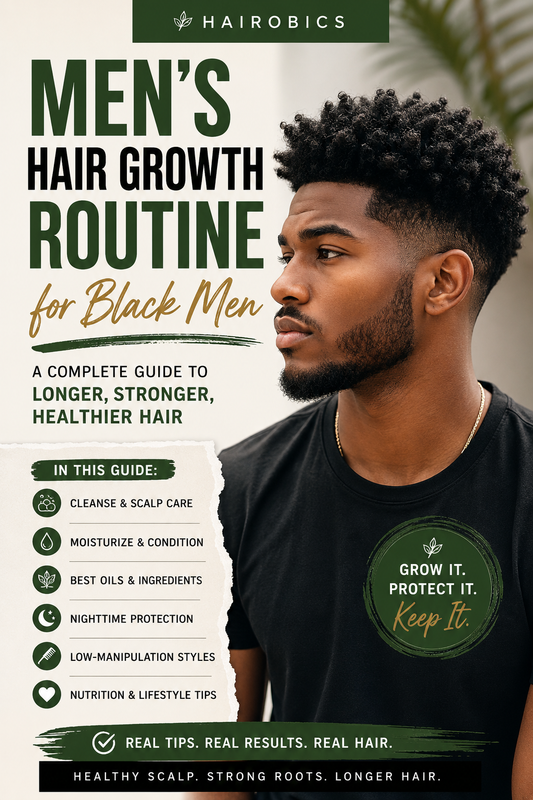
Growing healthy hair as a Black man is not simply about waiting for your hair to get longer. A successful men’s hair growth routine focuses on maintaining a healthy scalp, keeping the hair moisturized, minimizing breakage, protecting the ends, and developing consistent habits that help you retain the length you grow.
Black men’s hair can range from loose curls to tight coils and kinky textures. These textures are versatile and can be worn in waves, curls, Afros, twists, braids, cornrows, locs, fades, and many other styles. However, tightly curled and coiled hair can also be more vulnerable to dryness and breakage because natural scalp oils may have difficulty traveling along the curves of the hair shaft.
That means your hair may actually be growing normally while breakage makes it seem as though it has stopped growing.
The solution isn't necessarily to use more products. It's to create a simple, consistent routine that supports your scalp and protects the hair you already have.
This complete guide explains how to build a practical men’s hair growth routine for Black men, including washing, conditioning, moisturizing, scalp care, protective styling, nighttime protection, trimming, and common mistakes to avoid.
Quick Answer: What Is the Best Hair Growth Routine for Black Men?
A good Black men's hair growth routine typically includes:
- Keeping the scalp clean.
- Shampooing regularly without excessively stripping the hair.
- Conditioning after shampooing.
- Deep conditioning when additional moisture is needed.
- Moisturizing the hair between wash days.
- Paying attention to scalp health.
- Minimizing excessive heat and chemical damage.
- Avoiding hairstyles that place excessive tension on the hairline.
- Protecting hair while sleeping.
- Trimming damaged ends when necessary.
- Eating a balanced diet.
- Staying consistent for months rather than expecting overnight results.
The key word is consistency.
Hair growth is gradual. Your routine should therefore be something you can realistically maintain over the long term.
Understanding Black Men's Hair Growth
Before building your routine, it helps to understand what you're actually trying to accomplish.
Hair grows from follicles located within the skin. The visible portion of your hair is the hair shaft.
A topical hair-care routine cannot magically force hair to grow several inches overnight. What a good routine can do is create better conditions for your scalp and help reduce unnecessary breakage.
This distinction is extremely important.
If your hair grows but continually snaps at approximately the same rate, you may see very little change in overall length.
For example, imagine your hair grows a certain amount over several months but you repeatedly lose length because of dryness, rough detangling, heat damage, tight hairstyles, or damaged ends.
It can look as though your hair isn't growing.
In reality, your problem may be length retention.
That's why an effective hair growth routine for Black men needs to focus on both sides of the equation:
Healthy scalp + reduced breakage = better opportunity to retain length.
Why Black Men's Hair Can Be Prone to Dryness
Sebum is the natural oil produced by your scalp.
With relatively straight hair, these oils can move down the hair shaft more easily.
With curly, coily, and kinky hair, the twists and bends along the hair shaft can make it more difficult for those oils to coat the entire strand.
As a result, the ends can become particularly dry.
And your ends matter.
They are generally the oldest portion of your hair and have experienced the most washing, styling, friction, weather exposure, and manipulation.
If you're trying to grow long natural hair, your ends deserve special attention.
Step 1: Determine Your Current Hair and Scalp Condition
Don't immediately buy ten new products.
First, examine what is happening with your hair.
Ask yourself:
- Does my scalp frequently feel dry?
- Does my scalp feel excessively oily?
- Do I experience persistent flaking?
- Does my hair break during combing?
- Does my hair feel brittle?
- Does my hair become dry soon after moisturizing?
- Are my edges or temples becoming thinner?
- Do I wear tight braids or cornrows?
- Do I frequently use heat?
- Do I sleep without covering my hair?
- Do I shampoo consistently?
- Do I condition after shampooing?
- Am I seeing split or damaged ends?
Your answers can help determine where your routine needs improvement.
For example, someone experiencing substantial dryness may need to improve conditioning and moisturizing.
Someone experiencing buildup may need to improve cleansing.
Someone experiencing breakage around the hairline may need to evaluate styling tension.
A routine should address your actual needs instead of copying another person's routine exactly.
Step 2: Shampoo Your Hair and Scalp Consistently
A healthy hair routine starts with cleansing.
Your scalp accumulates:
- Sweat
- Sebum
- Dead skin
- Dirt
- Styling products
- Environmental debris
Regular cleansing helps remove this accumulation.
How frequently you shampoo depends on your scalp, hairstyle, activity level, and products.
Many Black men find that washing approximately once every 7–14 days works well, but there is no universal schedule.
Someone who exercises heavily and sweats frequently may need to cleanse more often.
Someone wearing a protective style may follow a different schedule.
The goal is not to stretch wash day as long as possible. The goal is to maintain a comfortable, clean scalp without unnecessarily drying out your hair.
How to Shampoo Black Men's Hair
Start by thoroughly wetting your hair with lukewarm water.
Apply shampoo primarily to your scalp.
Use your fingertips to gently massage the shampoo across the scalp. You do not need to aggressively scratch your scalp with your fingernails.
Allow the shampoo and water to move through the lengths of your hair as you rinse.
If your scalp has substantial product buildup, a second gentle cleanse may be useful.
Rinse thoroughly.
Follow with conditioner.
Don't Be Afraid of Shampoo
There is a persistent myth in natural hair communities that shampoo automatically prevents hair growth.
It doesn't.
The issue is usually how frequently you're shampooing, what cleanser you're using, and whether you restore moisture afterward.
Keeping layers of buildup on the scalp isn't a substitute for proper hair care.
Step 3: Condition After Shampooing
Conditioner is one of the most important parts of a Black men's hair routine.
Shampoo cleanses.
Conditioner helps improve softness, manageability, and lubrication.
This can make detangling easier and reduce some of the mechanical stress caused by grooming.
Apply conditioner throughout the hair, concentrating particularly on the lengths and ends.
Allow it to sit according to the product instructions.
Then rinse.
Men with very short hair sometimes skip conditioner because they assume it's unnecessary.
But if you have enough hair to experience dryness, tangling, or roughness, conditioning can still be useful.
As your hair gets longer, conditioning generally becomes even more important.
Step 4: Deep Condition When Your Hair Needs Extra Care
If your hair is consistently dry or difficult to manage, consider incorporating a deep-conditioning treatment periodically.
Some Black men deep condition weekly, while others do it every few weeks.
Your ideal frequency depends on your hair.
A deep conditioner may be particularly useful after:
- Removing braids
- Removing twists
- Extended protective styling
- Significant heat styling
- Excessive dryness
- Swimming
- Heavy sun exposure
- Periods when the hair feels unusually rough
Follow the instructions for the specific deep conditioner you use.
More is not always better.
Leaving a product on your hair for several hours when its directions recommend a much shorter period doesn't necessarily improve the result.
Step 5: Moisturize Your Hair Between Wash Days
Moisture is extremely important for curly and coily hair.
Dry hair is often more difficult to manipulate without breakage.
The objective is to keep your hair reasonably soft and manageable without constantly coating it with heavy products.
A simple moisturizing routine might involve:
Water or water-based moisture → leave-in product → optional oil or styling product.
You don't necessarily need all three steps.
Some people prefer a lightweight leave-in conditioner.
Others prefer moisturizing sprays.
Some use a small amount of oil afterward.
Experiment to determine what leaves your hair soft without excessive buildup.
How Often Should Black Men Moisturize Their Hair?
There is no single answer.
Some men may need additional moisture every couple of days.
Others can go considerably longer.
Instead of moisturizing solely according to a calendar, learn how your hair feels.
If your hair remains soft and manageable, you may not need to add more product.
If it becomes rough, brittle, or unusually difficult to manipulate, it may need attention.
Step 6: Pay Attention to Your Scalp
Your scalp is where your hair follicles are located, so scalp care should be part of your routine.
Keep it clean and avoid continuously layering heavy products over buildup.
If you use scalp oils, apply them reasonably rather than assuming that saturating your scalp every day will make your hair grow faster.
More oil does not automatically equal more growth.
A lightweight scalp-care routine may be preferable to coating your scalp with large amounts of oil.
Scalp Massage
Some Black men also enjoy incorporating scalp massage into their routines.
Use your fingertips rather than your fingernails.
Apply gentle pressure and move your fingertips across different areas of your scalp.
A scalp massage can be relaxing and can be incorporated while shampooing or during your regular grooming routine.
However, avoid treating scalp massage as a guaranteed cure for hair loss.
If you're experiencing unexplained or progressive thinning, professional evaluation is more appropriate than simply massaging the area harder.
Step 7: Detangle Carefully
Detangling is one of the easiest times to accidentally break natural hair.
The longer your hair becomes, the more important your detangling technique becomes.
Avoid aggressively pulling a comb through dry, tangled hair.
Instead, work in manageable sections when necessary.
Depending on your texture and hairstyle, detangling may be easier when the hair is damp and has conditioner or another product providing slip.
Start near the ends.
Gradually work upward.
Don't immediately start at the roots and force the comb through every knot below.
Finger Detangling vs Combs
Neither technique is automatically superior for everyone.
Finger detangling gives you more direct feedback about knots.
Wide-tooth combs can make the process faster.
Some men use both.
The important factor is reducing unnecessary pulling and snapping.
Step 8: Reduce Excessive Manipulation
One of the biggest improvements you can make to your hair growth routine is simply leaving your hair alone more often.
Constantly:
- Combing
- Brushing
- Picking
- Twisting
- Retwisting
- Restyling
- Pulling
- Scratching
creates repeated mechanical stress.
That doesn't mean you can never style your hair.
It means you should avoid manipulating it unnecessarily throughout the day.
This becomes especially important when you're trying to retain enough length to grow a larger Afro, longer twists, braids, or locs.
Step 9: Choose Low-Manipulation Hairstyles
Low-manipulation hairstyles can make a hair growth journey easier because they reduce the amount of daily styling required.
Depending on your length and preference, options can include:
- Two-strand twists
- Braids
- Cornrows
- Locs
- Larger twists
- Natural curls
- Afro styles
The hairstyle itself doesn't make your follicles suddenly grow faster.
Its primary advantage is reducing manipulation and helping protect the hair.
Avoid Excessively Tight Styles
A protective hairstyle stops being protective when excessive tension is involved.
Braids and cornrows should not cause severe pain.
Be especially cautious around the temples and hairline.
Repeated pulling can contribute to traction-related hair loss.
If a style feels excessively tight, address the tension instead of assuming pain is required for the hairstyle to last.
Step 10: Protect Your Hair at Night
You can have an excellent daytime routine and still create unnecessary friction for hours every night.
Traditional cotton bedding can create friction against your hair as you move while sleeping.
A satin or silk bonnet, durag, scarf, or pillowcase can help reduce friction.
For Black men growing their hair longer, nighttime protection is one of the easiest habits to add.
For Waves
A durag is commonly used to help maintain waves and keep the hair laid.
For Afros and Longer Natural Hair
A satin bonnet or scarf may be more practical depending on your hairstyle and length.
For Locs
A sufficiently large bonnet, loc cap, or satin/silk accessory can help keep longer locs contained and reduce friction.
Choose whatever you'll actually use consistently.
Step 11: Be Careful With Heat
Heat can be useful for styling, but excessive heat can damage the hair.
Repeated high-temperature blow-drying or flat-ironing can weaken the hair and alter curl patterns.
If you use heat:
- Avoid unnecessarily high temperatures.
- Consider using a heat protectant.
- Limit repeated passes.
- Avoid using heat more frequently than necessary.
- Pay attention to how your hair responds.
If your main goal is maximum length retention, reducing unnecessary heat can simplify your routine considerably.
Step 12: Trim Damaged Ends When Necessary
Some men avoid trimming because they are trying to grow their hair.
But keeping severely damaged ends indefinitely doesn't necessarily help your length-retention goals.
Split, rough, or severely damaged ends can contribute to tangling and breakage.
You don't need to trim simply because a certain number of weeks have passed.
Instead, monitor the condition of your ends.
Signs you may need a trim include:
- Persistent split ends
- Rough ends
- Excessive tangling at the ends
- Uneven damaged sections
- Ends that continually snap
A professional barber or stylist experienced with longer natural hair can help if you're unsure how much should be removed.
A Simple Daily Hair Growth Routine for Black Men
Your daily routine doesn't need to take 30 minutes.
In fact, doing too much every day can create more manipulation than necessary.
Morning
Check your hair.
If it still feels moisturized, don't automatically add more products.
Style gently.
Avoid repeatedly combing your entire head simply to achieve perfection.
If your hair feels dry, lightly moisturize it with an appropriate water-based product.
Throughout the Day
Leave your hair alone as much as possible.
Avoid repeatedly touching, pulling, or picking it.
Night
If necessary, gently prepare the hair for sleeping.
Put on your satin or silk hair covering.
Go to sleep.
That's it.
A good hair routine doesn't have to be complicated.
Weekly Hair Growth Routine for Black Men
Here is an example of a simple weekly schedule.
Sunday: Wash Day
Shampoo your scalp and hair.
Condition thoroughly.
Detangle carefully.
Deep condition if needed.
Apply your preferred moisturizing products.
Style your hair.
Monday
Minimal manipulation.
Protect your hair at night.
Tuesday
Check moisture levels.
Lightly moisturize if necessary.
Wednesday
Minimal manipulation.
Perform a gentle scalp massage if desired.
Thursday
Check your hair and scalp.
Avoid unnecessary product application if your hair still feels good.
Friday
Refresh your hairstyle if necessary.
Keep manipulation minimal.
Saturday
Assess whether you need to shampoo based on your scalp, activity level, hairstyle, and product buildup.
Then repeat.
Your routine does not have to follow these exact days. Consistency matters more than choosing a particular weekday.
Black Men's Hair Growth Routine for Short Hair
If you're starting with a fade, low cut, or very short Afro, your routine can be extremely simple.
Focus on:
- Regular shampooing
- Conditioning
- Scalp care
- Light moisturizing
- Avoiding excessive brushing
- Nighttime protection when appropriate
- Regular barber maintenance
This stage is an excellent time to establish good habits.
As your hair becomes longer, you can gradually add detangling, sectioning, deep conditioning, and protective styling.
Black Men's Hair Growth Routine for Medium-Length Hair
Once your hair reaches several inches, tangles and dryness may become more noticeable.
At this stage, focus more heavily on:
- Conditioning
- Detangling
- Moisturizing
- Protecting your ends
- Low-manipulation styling
- Nighttime protection
You may also find it useful to divide your hair into sections while washing or detangling.
This can make longer, thicker hair easier to manage.
Black Men's Hair Growth Routine for Long Hair
Long natural hair requires more attention to length retention.
Your ends may be several years old.
That means they have experienced countless wash days, hairstyles, nights of sleeping, environmental exposure, and grooming sessions.
At this stage, minimizing breakage becomes extremely important.
Focus on:
- Gentle detangling
- Regular conditioning
- Protecting the ends
- Low-manipulation hairstyles
- Nighttime protection
- Monitoring damaged ends
- Avoiding excessive heat
- Reducing unnecessary styling
The longer your hair gets, the less you can afford to treat it roughly.
Hair Growth Routine for Black Men With 4C Hair
4C hair is known for tight coils and significant shrinkage.
Shrinkage can make it difficult to visually judge how much your hair has grown.
Your hair may be considerably longer than it appears when fully shrunken.
Don't mistake shrinkage for a lack of growth.
For 4C hair, prioritize:
- Moisture
- Gentle detangling
- Sectioning
- Conditioning
- Low manipulation
- Nighttime protection
- Avoiding unnecessary tension
Stretching methods such as twists, braids, banding, or other low-heat techniques can also make length easier to manage.
The objective isn't to eliminate shrinkage completely.
Shrinkage is a natural characteristic of tightly coiled hair.
Hair Growth Routine for Black Men With Waves
If you're growing waves, your routine will look somewhat different.
You may brush regularly to train the wave pattern, but excessive brushing can irritate your scalp or stress the hair.
Keep the scalp clean.
Use moisturizing products appropriately.
Avoid loading your hair with excessive grease and pomade.
Wear your durag appropriately.
Wash consistently.
Condition when necessary.
And remember that wave definition and hair growth are two different objectives.
You can pursue both, but brushing harder does not make your follicles grow hair faster.
Hair Growth Routine for Black Men With Braids
Braids can make hair easier to manage while growing, but they still require maintenance.
While wearing braids:
- Keep your scalp reasonably clean.
- Avoid excessive product buildup.
- Moisturize when necessary.
- Protect your braids while sleeping.
- Avoid excessive tension around the edges.
- Don't leave damaged or severely tangled styles installed indefinitely.
When removing braids, take your time.
Shed hairs accumulate while your hair is braided, so seeing hair during takedown does not automatically mean all of it is breakage.
Detangle gently before rushing into shampooing.
Hair Growth Routine for Black Men With Locs
Locs require a somewhat different maintenance strategy because you generally aren't detangling them like loose natural hair.
Focus on:
- Scalp cleansing
- Thorough rinsing
- Proper drying
- Avoiding excessive buildup
- Protecting locs while sleeping
- Avoiding excessively tight retwists
- Keeping the scalp comfortable
- Handling locs gently
Be careful with heavy products that can accumulate inside locs.
And make sure your locs dry thoroughly after washing.
Best Oils for Black Men's Hair
Hair oils are extremely popular, but it's important to understand what they can and cannot do.
Oils can be useful for lubrication, shine, scalp care, and helping reduce moisture loss depending on how they're used.
Common oils used in Black hair care include:
- Coconut oil
- Jojoba oil
- Castor oil
- Jamaican black castor oil
- Olive oil
- Avocado oil
- Argan oil
- Grapeseed oil
You don't need every oil on this list.
Choose products based on how your hair responds.
Does Castor Oil Grow Black Men's Hair Faster?
Castor oil is popular in hair-growth routines because of its thick texture and ability to coat the hair.
However, don't assume that applying large quantities of castor oil guarantees dramatically faster growth.
Think of oils as part of your overall hair-care routine rather than a miracle shortcut.
Healthy hair habits still matter.
What Should Black Men Eat for Healthy Hair?
Hair care isn't only external.
Hair follicles require nutrients supplied through your body.
A balanced diet that provides sufficient protein, vitamins, minerals, and calories supports normal body functions, including hair production.
Useful foods can include:
- Eggs
- Fish
- Chicken
- Beans
- Lentils
- Nuts
- Seeds
- Leafy vegetables
- Fruits
- Whole grains
- Avocados
Hydration also matters for overall health.
You don't need a "hair growth diet" composed of exotic ingredients.
A balanced nutritional pattern is more important.
Should Black Men Take Hair Growth Vitamins?
Be careful with supplements marketed as guaranteed hair-growth solutions.
If you have a nutritional deficiency, correcting it may be important.
But taking excessive amounts of vitamins when you aren't deficient doesn't automatically make your hair grow faster and can sometimes be harmful.
If you're concerned about nutritional deficiencies or unexplained hair loss, talk with an appropriate healthcare professional.
How Exercise Fits Into a Hair Growth Routine
Exercise is excellent for overall health, but sweating can change your hair-care schedule.
If you work out frequently, your scalp may accumulate sweat more quickly.
You may need to cleanse more often than someone with a less active lifestyle.
Don't avoid exercise because you're worried about your hairstyle.
Instead, build your hair routine around your lifestyle.
After workouts, allow your scalp to dry properly.
If sweat, odor, or buildup becomes persistent, consider adjusting your cleansing frequency.
Does Drinking Water Make Hair Grow Faster?
Staying hydrated is important for your body, but drinking extreme quantities of water will not magically double your hair-growth rate.
Think of hydration as one component of overall health.
Hair growth depends on numerous factors, including genetics, age, health, nutrition, hormones, and hair-care practices.
How to Prevent Hair Breakage in Black Men
Preventing breakage is one of the most important parts of achieving visibly longer hair.
Focus on these habits:
Keep hair conditioned.
Hair that is easier to manipulate is less likely to be aggressively ripped apart during grooming.
Detangle gently.
Don't fight knots.
Reduce heat.
Particularly if your hair already feels brittle.
Avoid tight styles.
Your hairline should not constantly be under tension.
Protect hair at night.
Reduce unnecessary friction.
Keep your ends healthy.
Trim severely damaged ends when needed.
Stop over-manipulating.
You don't have to comb your entire head several times per day.
Why Is My Hair Growing So Slowly?
If your hair seems to grow extremely slowly, several possibilities exist.
First, consider whether you're actually measuring growth accurately.
Shrinkage can hide substantial length.
Second, look for breakage.
You may be growing hair while simultaneously losing length.
Third, consider your grooming habits.
Excessive manipulation can make retention difficult.
Finally, consider whether you're experiencing actual hair thinning or hair loss rather than simply slow length retention.
If you notice sudden shedding, bald patches, scalp inflammation, progressive thinning, or unexplained changes, consider consulting a dermatologist or another qualified healthcare professional.
How Long Does It Take Black Men to Grow Long Hair?
There is no universal timeline.
Hair growth varies from person to person.
Your starting length also matters.
Growing from a buzz cut to shoulder-length natural hair is a multi-year process for many people.
Shrinkage can also make curly and coily hair look substantially shorter than its stretched length.
Instead of obsessing over daily changes, track your progress every few months.
Take photographs from similar angles.
If desired, measure a small section of stretched hair.
Long-term comparisons are much more useful than checking your length every morning.
The Biggest Hair Growth Mistakes Black Men Make
1. Expecting Overnight Results
Hair growth is a long-term process.
A new oil is unlikely to transform your hair length in one week.
2. Using Too Much Product
More product isn't automatically better.
Excessive product can lead to buildup.
3. Never Washing the Scalp
Trying to preserve a hairstyle for weeks while ignoring scalp hygiene can create unnecessary problems.
4. Combing Dry Hair Aggressively
This can contribute to unnecessary breakage.
5. Wearing Styles Too Tight
Pain is not evidence that a hairstyle is working.
6. Ignoring Nighttime Protection
Hours of friction every night add up.
7. Using Excessive Heat
Repeated high temperatures can weaken your hair.
8. Changing Products Every Week
Constantly switching products makes it difficult to determine what actually works for your hair.
9. Comparing Your Hair to Someone Else's
Genetics, texture, density, shrinkage, lifestyle, and starting length all differ.
Track your own progress.
10. Focusing Only on Growth Instead of Retention
This may be the biggest mistake of all.
Your follicles can produce new hair while your ends continually break.
Protect what you've already grown.
A 30-Day Black Men's Hair Growth Routine
If you're starting from scratch, use the next month to establish consistent habits rather than expecting dramatic length.
Week 1: Reset
Wash your hair and scalp thoroughly.
Condition.
Deep condition if your hair needs it.
Remove severely damaged ends if appropriate.
Choose a simple moisturizing routine.
Start protecting your hair every night.
Take a starting photograph.
Week 2: Reduce Manipulation
Pay attention to how often you touch and style your hair.
Reduce unnecessary combing.
Keep your hair moisturized without overloading it with products.
Continue nighttime protection.
Week 3: Evaluate Your Scalp
Look for buildup, dryness, persistent flaking, or irritation.
Wash when needed.
Evaluate whether your current products are making your scalp feel better or worse.
Week 4: Review Your Routine
Ask yourself:
Is my hair softer?
Is detangling easier?
Am I experiencing less breakage?
Does my scalp feel comfortable?
Am I consistently protecting my hair at night?
Which products actually helped?
Then repeat the habits that worked.
90-Day Hair Growth Challenge for Black Men
Three months is a more useful period for evaluating your routine.
Take photographs on:
- Day 1
- Day 30
- Day 60
- Day 90
Try to use similar lighting, hairstyles, and angles.
Throughout the 90 days, focus on:
- Consistent cleansing
- Conditioning
- Moisturizing
- Gentle detangling
- Reduced manipulation
- Scalp care
- Nighttime protection
- Balanced nutrition
- Avoiding unnecessary tension
- Limiting damaging heat
Don't introduce five new products every week.
Consistency makes it easier to determine whether your routine is working.
When Hair Growth Problems May Need Professional Attention
Not every hair problem can be solved with shampoo, conditioner, oil, or protective styling.
Hair loss can have many causes.
Consider speaking with a dermatologist or qualified healthcare professional if you notice:
- Sudden hair loss
- Circular bald patches
- Progressive thinning
- Significant thinning at the temples
- Persistent scalp pain
- Severe itching
- Scalp sores
- Significant inflammation
- Unusual shedding
- Scarring
- Hair loss accompanied by other unexplained symptoms
Early evaluation can be particularly important for some forms of hair loss.
Don't assume every thinning area simply needs more oil.
Frequently Asked Questions About Black Men's Hair Growth
How often should Black men wash their hair for growth?
There is no universal schedule. Many men wash approximately every 7–14 days, but your ideal frequency depends on your scalp, hairstyle, activity level, sweating, and product use. Clean your scalp often enough to prevent excessive buildup without unnecessarily stripping your hair.
Should Black men moisturize their hair every day?
Not necessarily. Moisturize according to your hair's needs. If your hair remains soft and manageable, you may not need to add product every day.
What is the best oil for Black men's hair growth?
There is no single oil guaranteed to be best for everyone. Castor, jojoba, coconut, avocado, olive, argan, and grapeseed oils are commonly used. Choose an oil based on your hair and scalp needs rather than expecting one ingredient to produce extraordinary growth.
Does wearing a durag help hair grow?
A durag doesn't directly make follicles grow faster, but it can reduce friction, help maintain certain hairstyles, and protect the hair while sleeping.
Do braids help Black men's hair grow?
Braids don't directly accelerate follicle growth. However, properly installed braids can reduce daily manipulation, potentially making it easier to retain length. Excessively tight braids can have the opposite effect.
Does cutting your hair make it grow faster?
Cutting the visible hair shaft does not increase the biological growth rate occurring inside the follicle. Trimming can, however, remove damaged ends and improve the appearance and manageability of your hair.
How often should Black men oil their scalp?
There isn't one correct schedule. Some scalps tolerate oil well, while others become irritated or develop buildup. Start conservatively and monitor how your scalp responds.
Is Jamaican black castor oil good for Black men's hair?
Jamaican black castor oil is commonly used in natural hair routines because of its thick consistency. It can help coat and lubricate hair, but it should not be treated as a guaranteed cure for thinning or hair loss.
Can Black men grow waist-length hair?
Hair length potential varies significantly between individuals due to genetics, growth cycles, breakage, grooming habits, and other factors. Some Black men can grow extremely long hair when they maintain it for years and retain sufficient length.
How can Black men grow an Afro faster?
You cannot safely force your hair follicles to dramatically exceed their natural growth rate. Instead, concentrate on keeping your scalp healthy and reducing breakage so that your Afro retains more of the length it grows.
Why are my temples thinning?
Temple thinning can have several causes, including repeated hairstyle tension and certain types of hair loss. Avoid tight hairstyles and seek professional evaluation if thinning is persistent or progressive.
Is it okay to wet Black men's hair every day?
Water itself isn't inherently harmful to Black hair, but repeatedly wetting, drying, manipulating, and restyling the hair may not be necessary. Your routine should reflect your hairstyle and how your hair responds.
The Best Hair Growth Routine Is the One You Can Maintain
The biggest secret to growing longer natural hair isn't really a secret.
It's consistency.
You don't need 20 oils.
You don't need to spend an hour on your hair every morning.
You don't need to follow every viral hair-growth trend.
Build a routine around a few fundamentals:
Clean your scalp.
Condition your hair.
Keep your hair moisturized.
Handle your hair gently.
Reduce unnecessary manipulation.
Protect your hair at night.
Avoid excessive tension and heat.
Take care of your body.
Give the process time.
For many Black men, the biggest improvement doesn't come from making hair grow dramatically faster. It comes from learning how to keep more of the hair that is already growing.
When breakage decreases and length retention improves, months of consistent growth can finally become visible.
Final Thoughts: Building a Black Men's Hair Growth Routine
Growing longer, stronger-looking natural hair is a marathon rather than a sprint.
Whether you're trying to grow a bigger Afro, longer curls, twists, braids, waves, or locs, the basic principles remain similar.
Start with your scalp.
Keep your hair clean without excessively stripping it.
Condition consistently.
Moisturize when needed.
Detangle gently.
Reduce unnecessary manipulation.
Protect your hair while sleeping.
Avoid hairstyles that constantly pull at your edges.
And don't let viral "grow your hair overnight" claims distract you from the habits that matter most.
Give your routine several months.
Document your progress.
Adjust based on how your own hair responds.
Your goal shouldn't simply be to grow hair.
Your goal should be to create a routine that allows your hair and scalp to remain healthy while helping you retain as much length as possible.
With patience, consistency, gentle hair care, and a routine designed for your individual texture and lifestyle, you can give your hair the best possible environment to thrive.