When it comes to caring for natural hair, choosing the right moisturizing ingredients can make a noticeable difference in how your hair looks, feels, and responds to daily styling.
Two popular plant-based ingredients found in natural hair products are mango butter and shea butter.
Both are widely used in conditioners, leave-in treatments, styling creams, deep conditioners, and hair butters. They help soften strands, reduce friction, improve manageability, and protect hair from excessive moisture loss.
However, mango butter and shea butter are not exactly the same.
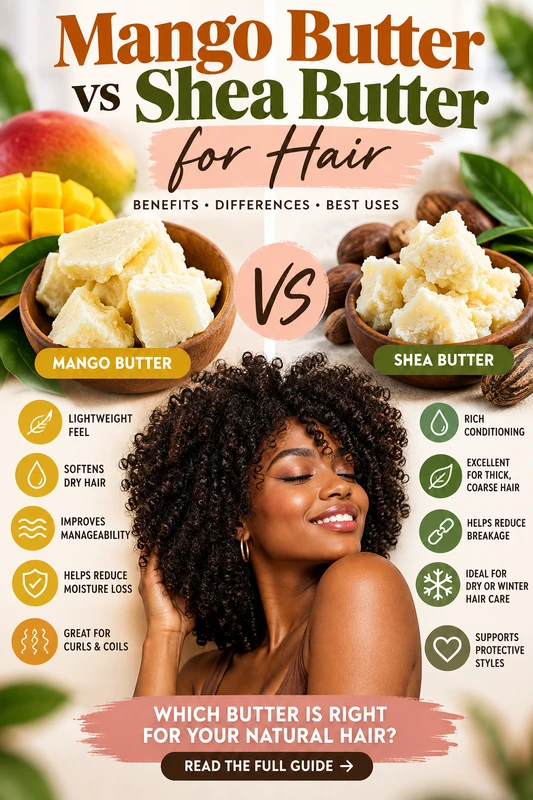
Mango butter generally has a smoother, less greasy feel, making it appealing to people who prefer lightweight hair products. Shea butter has a richer consistency and is especially popular among people with thick, coarse, or extremely dry natural hair.
For Black women embracing their natural curls, coils, twists, braids, and protective hairstyles, understanding the differences between these two ingredients can help create a more effective hair care routine.
But which butter is better for natural hair? Does mango butter help hair grow? Is shea butter too heavy for low-porosity hair? Can you use both together?
In this comprehensive guide from Hairobics All Natural, we explore everything you need to know about mango butter vs shea butter for hair, including their benefits, differences, and how to choose the right one for your individual hair needs.
1. What Is Mango Butter?

Mango butter is a natural plant-based fat extracted from the seed kernel of the mango fruit, scientifically known as Mangifera indica.
Unlike mango fruit pulp, which contains water, sugars, and various vitamins, mango butter is produced from the fatty portion of the seed.
The resulting butter typically has a creamy white or pale yellow appearance and a smooth consistency.
Mango butter is commonly incorporated into natural hair products because of its emollient properties. Emollients help soften the hair surface and improve flexibility, making strands feel smoother and easier to manage.
Key characteristics of mango butter
-
Smooth, creamy consistency.
-
Generally less greasy-feeling than shea butter.
-
Contains oleic and stearic fatty acids.
-
Helps soften dry, rough strands.
-
Suitable for many curly and coily hair types.
-
Can be used in leave-in conditioners and styling creams.
-
Helps reduce friction during detangling.
Mango butter is particularly appealing to people who want the benefits of a natural hair butter without an excessively heavy finish.
2. What Is Shea Butter?

Shea butter is a natural fat extracted from the nuts of the African shea tree, scientifically known as Vitellaria paradoxa.
It has been used for generations in African skin and hair care traditions.
Today, shea butter is a familiar ingredient in natural hair products, particularly those designed for textured hair.
Its rich consistency makes it popular in moisturizing creams, twisting butters, deep conditioners, and protective styling products.
Shea butter contains fatty acids, including oleic and stearic acid, along with smaller amounts of other naturally occurring compounds.
These components contribute to its conditioning properties.
Key characteristics of shea butter
-
Rich, creamy texture.
-
Provides substantial lubrication to dry strands.
-
Helps improve softness and manageability.
-
Particularly useful for thick or coarse hair.
-
Helps reduce friction during styling.
-
Commonly used in twist-outs and braid-outs.
-
Can leave buildup when applied excessively.
Shea butter is especially popular among people whose natural hair struggles to maintain softness between wash days.
However, its richness means it may not be suitable for everyone.
3. Mango Butter vs Shea Butter: Key Differences
Although both ingredients belong to the plant butter family, they differ in texture, application, and how they feel on natural hair.
|
Feature |
Mango Butter |
Shea Butter |
|---|---|---|
|
Source |
Mango seed kernel |
African shea nut |
|
Texture |
Smooth and creamy |
Rich and dense |
|
Hair feel |
Generally lighter |
Generally heavier |
|
Greasiness |
Usually less greasy |
Can feel greasy |
|
Fine hair |
Often easier to formulate lightly |
May weigh hair down |
|
Thick natural hair |
Excellent conditioning ingredient |
Excellent conditioning ingredient |
|
Low-porosity hair |
Often preferable in small amounts |
Best used sparingly |
|
High-porosity hair |
Helps improve softness |
Useful for richer conditioning |
|
Twist-outs |
Softer, lighter finish |
Richer hold and definition in formulated products |
|
Scalp application |
Use cautiously |
Use cautiously |
One important distinction is that the finished product matters just as much as the butter itself.
A well-formulated shea butter leave-in conditioner may feel lighter than a product containing a high concentration of mango butter.
Always consider the complete ingredient list rather than judging a product by one ingredient.
4. Benefits of Mango Butter for Natural Hair
Mango butter offers several advantages for maintaining healthy-looking curls and coils.
Helps soften dry natural hair
One of mango butter's most appealing qualities is its ability to improve hair softness.
Natural hair often experiences dryness because its curved structure can make it difficult for scalp oils to travel along the hair shaft.
Mango butter helps lubricate the surface of individual strands, improving how they feel when touched or styled.
This can be particularly beneficial for people experiencing roughness around their ends.
Improves hair manageability
Detangling natural hair can become difficult when strands are dry and constantly catching on one another.
Products containing mango butter can help improve slip and reduce friction.
When combined with conditioning ingredients, this makes combing and finger detangling more manageable.
Less friction during styling can also help minimize unnecessary mechanical damage.
Helps reduce moisture loss
Mango butter is an emollient, not a source of water-based hydration.
However, it can support a moisturizing routine by helping condition the hair surface and limit moisture loss.
For better results, apply mango butter after a water-based moisturizer or use a leave-in conditioner that combines water and conditioning ingredients with mango butter.
Supports softer twist-outs
Mango butter can be useful in styling creams designed for twist-outs and braid-outs.
It provides conditioning without necessarily leaving the extremely rich finish associated with heavier hair butters.
This makes it appealing to people who prefer soft, touchable styles with natural movement.
Helps improve the appearance of dry ends
The ends of natural hair are often the oldest and most vulnerable sections.
They experience regular friction from clothing, pillows, combing, and styling.
A small amount of mango butter can help smooth dry ends and temporarily improve their appearance.
However, it cannot permanently repair split ends.
5. Benefits of Shea Butter for Natural Hair
Shea butter is especially valued for its rich conditioning properties.
Provides rich conditioning for coarse hair
Thick, coarse, and tightly coiled hair may benefit from products containing richer emollients.
Shea butter helps coat and lubricate the hair surface, making strands feel softer and more manageable.
For people with dense 4B or 4C hair, shea butter can be particularly useful when incorporated into a balanced moisturizing routine.
Helps reduce friction and breakage
Hair breakage frequently occurs during detangling, brushing, and repeated manipulation.
Shea butter helps improve lubrication, potentially reducing friction between strands.
This may support length retention when combined with gentle handling, appropriate conditioning, and protective styling.
However, shea butter does not directly stimulate hair follicles or guarantee faster growth.
Supports protective styling
Shea butter is commonly found in products designed for:
-
Two-strand twists.
-
Flat twists.
-
Braid-outs.
-
Twist-outs.
-
Cornrows.
-
Protective updos.
Its rich consistency can help strands feel conditioned while styling.
For the best results, avoid applying excessive amounts directly to the scalp, especially when wearing long-term protective hairstyles.
Helps condition dry ends
Hair ends often require additional attention because they have experienced years of environmental exposure and manipulation.
A small amount of shea butter can help improve lubrication and softness.
Applying it after a water-based leave-in conditioner can be especially helpful.
Supports winter hair care
Cold weather, indoor heating, and low humidity can contribute to dry-feeling natural hair.
Shea butter can be useful in richer winter conditioning products.
However, moisture balance still requires water-based conditioning, not simply applying more butter.
6. Mango Butter vs Shea Butter for 4C Hair
![Beautiful Black Women With 4C Hair | [site:name] | Essence](https://images.openai.com/static-rsc-4/5Lt93fgC_t6L8HEbE-uYF7l-vy1q8ozTV4aTOaFIZg7m54BBFZTZ_Kbgaeb5IdxGtIGPV4MunmJTcBmt2lqKklsP0myMRULoSsxlbWRsH56yd8sb2Sad81j9oV1dKDMgfxi9HqTIyL_-arPK9PaRz8M1EwrHWHtggbmmZM7MLSo?purpose=inline)
People with 4C hair often seek ingredients that help maintain softness, reduce tangling, and improve styling flexibility.
Both mango butter and shea butter can be useful.
The better choice depends on hair density, strand thickness, porosity, climate, and personal preference.
Mango butter for 4C hair: Mango butter may be preferable when you want soft, manageable hair without an excessively coated feeling. It works particularly well in creamy leave-in conditioners and lighter styling products.
Shea butter for 4C hair: Shea butter may be appealing when your strands are coarse, dense, or frequently feel dry. Richer shea-based products can help improve lubrication and make protective styling easier.
For many people, using a lightweight leave-in conditioner followed by a small amount of richer butter provides a practical balance.
Remember that 4C hair does not automatically require heavy products. Fine 4C strands can become weighed down just as easily as other fine hair types.
7. Which Butter Is Better for Low-Porosity Hair?
Low-porosity hair has a cuticle structure that can make it slower to absorb water and certain conditioning products.
People with low-porosity natural hair frequently experience product buildup, especially when applying multiple heavy creams and oils.
Mango butter is often a practical option because products formulated with it can provide conditioning without an overly rich finish.
Shea butter can still work, but the amount and formulation matter.
For low-porosity hair, consider these habits:
-
Start with freshly washed hair.
-
Apply a lightweight, water-based leave-in conditioner.
-
Use small amounts of butter.
-
Avoid layering several heavy styling products.
-
Clarify when buildup becomes noticeable.
-
Adjust your routine based on how your hair responds.
Neither mango butter nor shea butter automatically penetrates the hair shaft simply because it is natural.
8. Which Butter Is Better for High-Porosity Hair?
High-porosity hair tends to absorb water readily but may also lose moisture more easily, especially when its cuticle has been damaged.
People with high-porosity hair may notice dryness, tangling, frizz, and difficulty maintaining softness.
Shea butter is commonly preferred in richer conditioning routines because of its substantial emollient feel.
Mango butter can also be beneficial, particularly when included in a balanced conditioner.
A useful high-porosity routine includes a water-based leave-in conditioner, an appropriate conditioning cream, and a small amount of butter if additional lubrication is needed.
For chemically damaged hair, protein-containing conditioning treatments may also be useful, depending on the condition of the strands.
Neither butter can reverse structural damage on its own.
9. Mango Butter vs Shea Butter for Hair Growth
One of the biggest questions surrounding these ingredients is whether they can help natural hair grow faster.
The answer requires understanding the difference between hair growth and length retention.
Hair grows from follicles beneath the scalp. Its growth cycle is influenced by genetics, hormones, nutrition, age, and general health.
There is currently insufficient high-quality clinical evidence showing that applying mango butter or shea butter directly increases human hair growth rates.
However, both ingredients may support length retention by helping improve hair softness and manageability.
When hair experiences less mechanical breakage, it may become easier to retain the length that naturally grows.
This is especially important for tightly coiled hair, where shrinkage and breakage can sometimes make growth difficult to recognize.
Can mango butter grow your edges?
Mango butter can condition the hair around your edges, but it has not been proven to regrow hair lost through traction alopecia or other forms of hair loss.
Can shea butter make hair thicker?
Shea butter can make strands feel coated and appear smoother, but it does not permanently increase follicle density or change the natural diameter of individual hairs.
If you experience persistent thinning, bald patches, or a receding hairline, consult a dermatologist rather than relying exclusively on cosmetic ingredients.
10. Which Butter Is Better for Dry Natural Hair?
Dryness is one of the most common concerns among people with natural hair.
However, not all dryness is the same.
Some hair feels dry because it lacks sufficient water-based conditioning. Other hair may feel rough because of environmental damage, product buildup, excessive heat styling, or mechanical wear.
Mango butter and shea butter are both emollients, meaning they improve softness and lubrication.
They do not replace water.
For effective moisture management, follow a simple routine:
-
Cleanse your hair with a suitable shampoo.
-
Apply a moisturizing conditioner.
-
Use a water-based leave-in treatment.
-
Apply a small amount of mango butter or shea butter if needed.
-
Protect your hair overnight with satin or silk accessories.
If your hair feels greasy but still dry, adding more butter may not solve the problem.
You may need to remove buildup and reassess your conditioning routine.
11. Mango Butter vs Shea Butter for Fine Natural Hair
Fine hair refers to the diameter of individual hair strands, not how much hair you have.
People with fine natural hair often struggle with products that leave their curls flat, greasy, or overly coated.
Mango butter is frequently easier to incorporate into lightweight formulations.
It may be a suitable choice for fine natural hair when used in small concentrations.
Shea butter can still be beneficial, but applying large amounts of raw shea butter may reduce volume and definition.
For fine hair, prioritize lightweight leave-in conditioners, moderate product application, and regular cleansing.
A product's overall formulation matters more than the presence of one particular butter.
12. Can You Mix Mango Butter and Shea Butter Together?
Yes. Mango butter and shea butter can be combined in homemade hair butters and commercial conditioning products.
Combining them allows you to adjust the consistency and richness of your hair treatment.
For example, mango butter can contribute a smoother texture, while shea butter adds a richer conditioning feel.
Simple DIY mango and shea hair butter
Ingredients:
-
2 tablespoons mango butter.
-
1 tablespoon shea butter.
-
1 teaspoon jojoba oil.
-
1 teaspoon grapeseed oil.
Instructions:
-
Gently melt the mango butter and shea butter using a double boiler.
-
Remove the mixture from the heat.
-
Stir in the jojoba and grapeseed oils.
-
Allow the mixture to cool until partially solid.
-
Whip until creamy, if desired.
-
Transfer into a clean, dry container.
Apply a small amount to your hair after using a water-based moisturizer.
Because this recipe contains no added water, it is an anhydrous butter. Keep water out of the container and avoid introducing wet fingers.
Do not add aloe juice, water, or other water-based ingredients without an appropriate preservative system.
13. Mango Butter vs Shea Butter for Twist-Outs and Braid-Outs

Both ingredients can improve the feel and appearance of protective and low-manipulation styles.
Mango butter is appealing when you want a soft finish without excessive heaviness.
Shea butter is useful when you prefer richer conditioning, especially for thick or coarse strands.
However, raw butter does not necessarily provide strong styling hold.
For defined twist-outs, use a properly formulated styling cream, mousse, or gel alongside your preferred conditioning product.
Apply products evenly, avoid excessive amounts, and allow your hair to dry completely before separating twists.
This helps reduce frizz and improve style longevity.
14. Which Butter Is Better for Natural Hair in Summer?
Summer hair care can be challenging because of humidity, heat, sweat, and frequent outdoor activities.
Heavy products may feel uncomfortable, particularly when applied close to the scalp.
Mango butter may be more appealing during warmer months because it can be incorporated into lighter conditioning formulas.
Shea butter can still work, especially for dry ends or protective styles.
The key is adjusting how much product you apply.
For summer hair care, prioritize scalp cleansing, lightweight conditioning, adequate hydration, and protection from excessive sun exposure.
Neither mango butter nor shea butter should be considered a replacement for a properly formulated UV-protective hair product.
15. Which Butter Is Better for Natural Hair in Winter?
During winter, low humidity and indoor heating can make natural hair feel rough and dry.
Richer conditioning products may become more appealing.
Shea butter is a popular ingredient for winter routines because of its substantial conditioning properties.
Mango butter is also effective when included in moisturizing creams and leave-in treatments.
For winter hair care, focus on conditioning regularly, protecting your ends, limiting unnecessary heat styling, and reducing friction from wool hats and scarves.
A satin-lined hat can help protect delicate strands.
16. Can Mango Butter or Shea Butter Cause Product Buildup?
Yes. Both ingredients can contribute to product buildup, particularly when applied repeatedly without adequate cleansing.
Signs of excessive buildup may include:
-
Hair feeling coated or waxy.
-
Reduced curl definition.
-
Products sitting on the hair surface.
-
Difficulty achieving a clean feeling after washing.
-
Hair appearing dull or unusually heavy.
Buildup does not necessarily mean an ingredient is harmful.
It often means your application amount, cleansing frequency, or product combination needs adjustment.
If your hair feels heavily coated, use an appropriate clarifying shampoo and follow with conditioner.
17. Should You Apply Mango Butter or Shea Butter Directly to Your Scalp?
Although both ingredients are commonly found in scalp and hair products, applying thick layers of raw butter directly to the scalp is not necessary for everyone.
Excessive application may contribute to buildup and make cleansing more difficult.
If you experience dandruff, seborrheic dermatitis, persistent itching, or scalp inflammation, avoid assuming that applying more butter will solve the issue.
These conditions may require targeted treatment.
For routine hair care, concentrate heavier butters primarily on the lengths and ends unless a product is specifically formulated for scalp application.
18. How to Incorporate Hair Butters Into Your Hairobics Hair Care Routine
Maintaining healthy-looking natural hair involves more than choosing one ingredient.
A balanced routine combines proper cleansing, conditioning, gentle styling, and consistency.
At Hairobics All Natural, we encourage developing a routine that supports your hair's individual needs rather than following every new ingredient trend.
Step 1: Cleanse your hair
Begin with a shampoo that removes excess oil, dirt, and product buildup without leaving your strands unnecessarily stripped.
Step 2: Condition thoroughly
Use a conditioner appropriate for your hair's texture and condition.
Pay particular attention to your ends, where dryness and tangling often occur.
Step 3: Apply a leave-in treatment
Hairobics All Natural Leave-In Treatment
Incorporate a leave-in treatment into your regular hair care routine to help maintain softness and manageability between wash days.
Visit Hairobics All Natural to explore the collection.
Step 4: Apply your preferred butter
After moisturizing, apply a small amount of mango butter or shea butter to the lengths and ends if additional conditioning is needed.
Start with less product than you think you need.
Step 5: Protect your hair at night
Use a satin bonnet, satin scarf, or silk pillowcase to minimize friction while sleeping.
This can help preserve your hairstyle and reduce unnecessary tangling.
19. Common Mistakes When Using Mango Butter or Shea Butter
Even beneficial ingredients can produce disappointing results when used incorrectly.
One common mistake is applying butter to extremely dry hair without first using a water-based moisturizer.
Another is assuming that using more product automatically produces better results.
Heavy application can leave strands coated without addressing the underlying cause of dryness.
Some people also avoid cleansing because they believe shampoo removes all beneficial moisture.
However, regular cleansing is necessary to remove buildup and maintain a healthy scalp environment.
Finally, remember that no single butter can prevent every type of hair damage.
Healthy hair care requires appropriate cleansing, conditioning, gentle detangling, reduced tension, and consistent maintenance.
20. Frequently Asked Questions About Mango Butter vs Shea Butter for Hair
Is mango butter better than shea butter for natural hair?
Neither ingredient is universally better. Mango butter generally offers a lighter feel, while shea butter provides richer conditioning. Your hair type, product formulation, and personal preferences determine which works best.
Does mango butter moisturize 4C hair?
Mango butter helps soften and condition 4C hair. For better moisture management, combine it with a water-based leave-in conditioner.
Is shea butter too heavy for low-porosity hair?
It can be, particularly when used in large amounts. However, lightweight products containing moderate concentrations of shea butter may work well.
Can mango butter help with hair breakage?
Mango butter can help improve lubrication and manageability, potentially reducing friction-related breakage during styling. It does not permanently repair damaged strands.
Can I use shea butter every day?
Daily use is not necessary for everyone. Frequent application may cause buildup, especially if you already use rich conditioners and styling products.
Does mango butter make hair grow faster?
There is insufficient clinical evidence that mango butter directly accelerates hair growth. Its conditioning properties may support length retention by reducing friction and improving manageability.
Which butter is better for twist-outs?
Both can work. Mango butter is appealing for a lighter finish, while shea butter provides richer conditioning. A formulated styling product may be needed for additional hold.
Is mango butter good for locs?
Mango butter can condition hair, but applying thick raw butter to mature locs may contribute to residue. Lightweight, water-based moisturizing products are generally easier to distribute and remove.
Can shea butter clog scalp pores?
Heavy application can contribute to buildup, but whether a product causes scalp irritation or follicular problems depends on the formulation and individual response. Avoid applying excessive amounts to the scalp.
Can I use both mango butter and shea butter?
Absolutely. Many hair care formulations combine multiple plant butters to achieve a balanced texture and conditioning effect.
Final Thoughts: Mango Butter or Shea Butter for Natural Hair?
Mango butter and shea butter are both valuable ingredients in natural hair care.
Mango butter is an appealing option for people who prefer smoother, less greasy conditioning products. Shea butter is popular among those who enjoy richer creams and butters, particularly for thick or coarse natural hair.
Neither ingredient should replace regular cleansing, water-based conditioning, or gentle styling practices.
The most effective routine is one that leaves your hair soft, manageable, and free from excessive buildup.
Whether you wear your natural hair in an afro, twist-out, braids, locs, or protective updo, maintaining healthy-looking strands requires consistency and choosing products that complement your hair's individual needs.
Explore the natural hair care collection at www.hairobicsallnatural.com and discover products designed to support your everyday hair care routine.