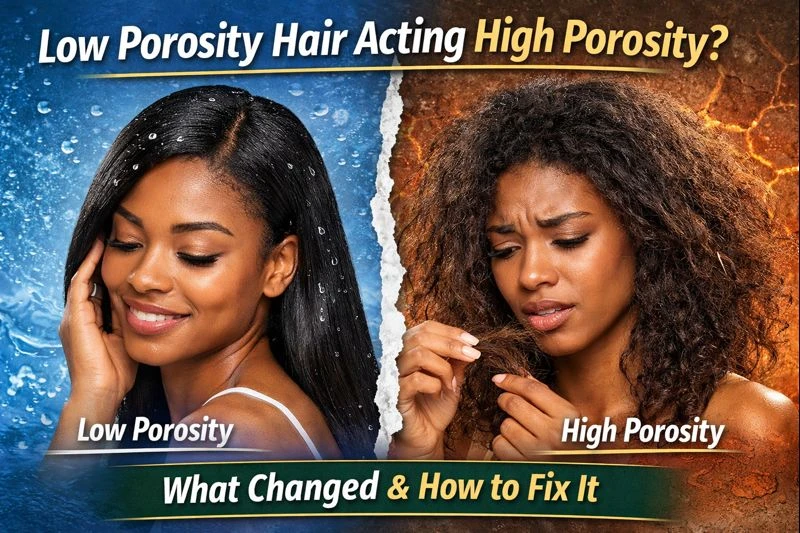
If you’ve always had low porosity hair, you probably knew your routine by heart. Water used to bead up on your strands. Products sat on top until you applied heat. Moisture lasted once it finally got in.
Then suddenly…
Your hair starts drying out faster, soaking up products instantly, tangling more, breaking easier, and feeling rough instead of smooth.
Now you’re wondering:
“Did my hair porosity change?”
“Why is my low porosity hair acting high porosity?”
The truth is: your hair didn’t betray you — something changed.
And once you identify what changed, you can fix it.
This guide breaks down:
-
Why low porosity hair can suddenly behave like high porosity
-
The exact signs this shift is happening
-
Common mistakes that trigger porosity damage
-
How to restore balance and protect your strands long-term
Understanding Hair Porosity (Quick Refresher)
Hair porosity describes how open or closed your hair cuticle is, which determines how easily your hair:
-
Absorbs moisture
-
Retains moisture
-
Responds to products
Low Porosity Hair Characteristics
-
Cuticles lie flat and tightly packed
-
Water beads up on strands
-
Products sit on top before absorbing
-
Hair takes longer to dry
-
Heat is usually needed for deep moisture
Low porosity hair is naturally strong — until the cuticle gets disrupted.
Can Hair Porosity Change Over Time?
Yes.
And this is where most people get confused.
You are not permanently locked into one porosity type.
Porosity can shift due to:
-
Chemical damage
-
Mechanical stress
-
Heat exposure
-
Environmental factors
-
Product misuse
-
Health or hormonal changes
Low porosity hair often acts high porosity temporarily when the cuticle becomes damaged or forced open.
Signs Your Low Porosity Hair Is Acting High Porosity
If you’re noticing these changes, you’re not imagining things:
1. Your Hair Absorbs Products Instantly
What used to sit on your hair now disappears immediately — but your hair still feels dry afterward.
That’s a red flag.
High porosity hair absorbs fast but leaks moisture just as fast.
2. Your Hair Feels Dry Shortly After Washing
Low porosity hair usually stays moisturized longer once hydrated.
If your hair feels dry within hours or a day, your cuticle may no longer be sealing moisture properly.
3. Increased Breakage and Split Ends
Low porosity hair is typically resilient.
Sudden breakage often means the cuticle has been compromised — allowing moisture loss and weakening the strand.
4. Rough or Straw-Like Texture
Healthy low porosity hair feels smooth.
A rough, brittle feel usually means the cuticle layers are lifted or chipped.
5. More Tangling Than Usual
Raised cuticles snag on each other easily, causing:
-
Knots
-
Matting
-
Increased shedding during detangling
Why Low Porosity Hair Suddenly Acts High Porosity
This shift doesn’t happen randomly. Something caused it.
Let’s break down the most common triggers.
1. Protein Overload (The #1 Cause)
Low porosity hair is protein-sensitive.
Too much protein:
-
Hardens the cuticle
-
Creates microscopic cracks
-
Prevents flexibility
-
Causes dryness and breakage
Common Protein Overload Sources
-
Frequent use of strengthening treatments
-
Rice water rinses
-
Keratin masks
-
Products labeled “repair,” “bond,” or “reconstructor”
Instead of strengthening your hair, excess protein forces the cuticle open, mimicking high porosity behavior.
2. Excessive Heat Use
Heat temporarily lifts the cuticle.
Repeated exposure:
-
Flat irons
-
Blow dryers without protection
-
Hooded dryers used too often
Over time, heat permanently disrupts the cuticle, even on low porosity hair.
3. Harsh Clarifying or Stripping Shampoos
Clarifying shampoos are helpful — but overuse can be damaging.
Harsh surfactants strip:
-
Natural oils
-
Protective lipid layers
-
Cuticle smoothness
Low porosity hair doesn’t need frequent clarifying. Too much can leave the cuticle unable to reseal properly.
4. Chemical Services (Even Mild Ones)
You don’t need bleach to damage your cuticle.
These can still cause porosity shifts:
-
Permanent hair dye
-
Relaxers
-
Texturizers
-
Frequent toners
Chemicals lift the cuticle to work — and repeated exposure can keep it from laying flat again.
5. Environmental Stress
Sun, wind, hard water, and pollution all impact porosity.
Over time:
-
UV rays weaken the cuticle
-
Hard water leaves mineral buildup
-
Dry climates pull moisture out
Low porosity hair exposed consistently can lose its natural resistance.
6. Mechanical Damage
Yes — even gentle hair can be damaged by habits.
Examples:
-
Aggressive detangling
-
Tight protective styles
-
Constant friction from cotton pillowcases
-
Over-manipulation
These cause micro-tears along the cuticle.
How to Confirm What’s Happening to Your Hair
Before fixing it, you need clarity.
Porosity Test (Simple Version)
-
Clean hair (no products)
-
Place a strand in water
-
Watch what happens
If it sinks quickly but dries fast:
Your hair is behaving high porosity — even if it used to be low.
How to Fix Low Porosity Hair Acting High Porosity
The goal is not to force moisture in — it’s to repair and reseal the cuticle.
Step 1: Stop Protein Immediately
Pause all protein treatments for at least 2–4 weeks.
Avoid products with:
-
Hydrolyzed proteins
-
Keratin
-
Collagen
-
Amino acids high on ingredient lists
Your hair needs flexibility, not strength right now.
Step 2: Deep Moisture Without Heavy Protein
Focus on:
-
Humectants (aloe, glycerin, honey)
-
Lightweight oils
-
Creamy, moisture-rich conditioners
Use gentle heat (warm towel or steamer) to help hydration without damage.
Step 3: Seal the Cuticle Properly
After moisturizing:
-
Use lightweight oils or butters
-
Apply while hair is damp
-
Avoid heavy layering
This mimics how low porosity hair naturally seals moisture.
Step 4: Reduce Heat and Mechanical Stress
For at least 30 days:
-
Skip flat ironing
-
Air-dry or use low heat
-
Protective styles with low tension
-
Detangle gently in sections
Your cuticle needs recovery time.
Step 5: Clarify Once — Then Stop
If buildup is present:
-
Clarify once
-
Follow immediately with a moisturizing deep conditioner
Do not repeat clarifying weekly.
Step 6: Reintroduce Protein Carefully (Optional)
Once your hair feels:
-
Softer
-
More elastic
-
Less brittle
You may add light protein once every 4–6 weeks — not weekly.
How Long Does It Take to Fix This?
That depends on damage level.
Mild Porosity Shift
-
2–4 weeks with proper care
Moderate Damage
-
6–8 weeks of consistent moisture focus
Severe Damage
-
May require trimming and long-term routine changes
Hair doesn’t heal overnight — but it does respond quickly when treated correctly.
Can Low Porosity Hair Return to Normal?
Yes — if the cuticle isn’t permanently damaged.
Low porosity hair has a strong natural structure. Once stressors are removed and moisture balance is restored, the cuticle often lays flat again.
Common Mistakes That Make It Worse
Avoid these while recovering:
-
Adding more protein “to fix it”
-
Layering too many products
-
Clarifying repeatedly
-
Using heavy butters on dry hair
-
Confusing dryness with needing strength
Moisture imbalance ≠ weak hair.
Best Routine for Low Porosity Hair Acting High Porosity
Weekly
-
Gentle shampoo or co-wash
-
Moisturizing conditioner
-
Light leave-in
Bi-Weekly
-
Deep moisturizing mask (no heavy protein)
Daily/Every Other Day
-
Water-based hydration
-
Light oil seal
Monthly
-
Clarify once if needed
-
Reassess hair feel
Final Thoughts: Your Hair Isn’t “Broken”
Low porosity hair that suddenly acts high porosity is responding to stress, not failing.
Once you:
-
Remove the stressors
-
Restore moisture balance
-
Protect the cuticle
Your hair can regain its smoothness, strength, and moisture retention.
Listen to your strands — they’re telling you exactly what they need.