If you have low-porosity natural hair, keeping your strands moisturized can sometimes feel like an ongoing battle. You may apply a leave-in conditioner, oil, and styling cream only to discover that your hair still feels dry a few hours later. Or you may have the opposite problem: products seem to sit on top of your hair, leaving it coated, greasy, or weighed down instead of soft and hydrated.
This is where understanding the LOC method for low-porosity hair becomes important.
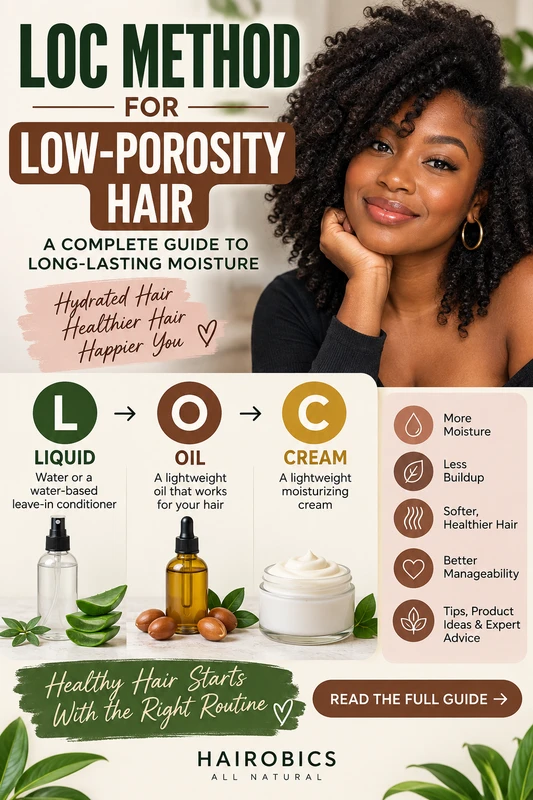
LOC stands for Liquid, Oil, Cream. It is a popular layering technique designed to add moisture to natural hair and help slow moisture loss. But low-porosity hair behaves differently from highly porous hair, so simply applying three products in the LOC order doesn't guarantee good results.
For some people with low-porosity hair, the traditional LOC method works beautifully. For others, it needs to be modified with lighter products, smaller amounts, warmth, or even a different layering order.
In this guide, we'll explain exactly how the LOC method works, how to use it on low-porosity natural hair, which types of products are most suitable, what mistakes to avoid, and how to tell whether LOC is actually helping your hair.
What Is the LOC Method?
The LOC method is a moisturizing technique commonly used for curly, coily, kinky, and natural hair.
LOC represents three steps:
L – Liquid or Leave-In Conditioner
O – Oil
C – Cream
The idea is simple. You first give your hair moisture with a water-based product. Next, you apply oil. Finally, you apply a cream or butter-based moisturizer to help your hair remain soft and manageable.
Although the method is often described as "sealing in moisture," oils and creams do not create a perfectly waterproof barrier around the hair. Instead, certain conditioning and occlusive ingredients may help slow water loss while improving softness, lubrication, and manageability.
The challenge is that low-porosity hair often doesn't tolerate heavy layers particularly well.
That's why your product choices matter just as much as the order in which you apply them.
What Is Low-Porosity Hair?
Hair porosity describes how readily your hair takes up and loses water and products.
Low-porosity hair has a relatively resistant outer cuticle structure. As a result, water and products may not seem to absorb as readily as they do on more porous hair.
Common characteristics associated with low-porosity hair include:
- Water beads on the hair before soaking in.
- Hair can take a while to become completely wet.
- Thick products appear to sit on the surface.
- Oils can make the hair feel greasy quickly.
- Product buildup develops easily.
- Hair may take a long time to dry.
- Too many products leave the hair feeling coated.
- Hair can feel dry even after several products have been applied.
Low porosity isn't automatically a problem.
It is simply a characteristic of your hair that can influence the way you moisturize and style it.
The goal isn't necessarily to "open" your hair permanently. Instead, you want to develop a routine that allows you to effectively hydrate and condition your strands without creating excessive buildup.
Does the LOC Method Work for Low-Porosity Hair?
Yes, the LOC method can work for low-porosity hair, but traditional LOC routines may need some adjustment.
The biggest mistake is assuming that more products automatically equal more moisture.
They don't.
Low-porosity hair can become overwhelmed by multiple layers of heavy products. Applying a thick leave-in conditioner followed by castor oil and then a heavy butter, for example, may leave some low-porosity hair feeling greasy or coated.
A better approach is often:
Water-based leave-in + lightweight oil + lightweight cream
You may also discover that you need very small amounts of each product.
Think of LOC as a framework rather than a strict rule.
Your hair should determine how much product you use.
Why Low-Porosity Hair Can Still Feel Dry
One of the most frustrating experiences is applying moisturizer and still having dry-feeling hair.
There are several possible reasons.
Products Are Sitting on the Surface
When too much product is applied, your hair may become coated before enough water-based moisture reaches the strands.
Adding another product isn't necessarily the solution.
Sometimes the answer is actually less product.
You're Applying Products to Hair That Isn't Wet Enough
Water is the foundation of the LOC method.
Oil alone doesn't hydrate dry hair.
If you're beginning the process on extremely dry hair and immediately applying oil, you may simply be coating dry strands.
Starting with properly damp hair generally gives you a better foundation.
Your Products Are Too Heavy
Low-porosity hair can become weighed down by heavy oils, butters, creams, pomades, and styling products.
If your hair looks shiny but feels stiff or dry underneath, excessive layering may be contributing to the problem.
You Have Product Buildup
Repeated applications of oils, creams, gels, butters, conditioners, and styling products can accumulate over time.
Eventually, you may notice that your normal moisturizing products aren't working as well.
Clarifying occasionally can help remove accumulated residue and give you a cleaner starting point.
How to Do the LOC Method on Low-Porosity Hair
Let's walk through the process from beginning to end.
Step 1: Start With Clean Hair
A good LOC routine begins before you apply your leave-in conditioner.
If your strands are heavily coated with old products, new products may not perform the way you expect.
Wash your hair with a shampoo appropriate for your hair and scalp.
If you regularly use oils, creams, gels, edge control, pomades, or butters, periodic clarifying may also be useful.
You don't necessarily need to clarify every wash day.
How frequently you clarify depends on your products, styling habits, scalp condition, water quality, and how quickly buildup develops.
Your hair should feel clean but not excessively stripped.
Step 2: Condition Your Hair
After shampooing, apply conditioner.
Many people with low-porosity natural hair find that warmth makes conditioning easier.
You might condition your hair while wearing a plastic cap or use gentle indirect heat if appropriate for the product you're using.
Always follow the instructions provided with your conditioner.
After rinsing, your hair should feel hydrated and manageable.
Now you're ready for LOC.
L: Apply Liquid or Leave-In Conditioner
The first step is the most important because water provides the actual hydration.
You can use:
- Water
- A water-based moisturizing spray
- A lightweight leave-in conditioner
- A water-based moisturizing leave-in
Check the ingredient list.
Water—often listed as "water" or "aqua"—will commonly appear near the beginning of a water-based leave-in product's ingredient list.
Apply the leave-in to damp hair rather than hair that is dripping wet.
Divide your hair into manageable sections so that you can distribute the product evenly.
Don't automatically use a large amount.
Begin with a small quantity and increase it only when your hair needs more.
Pay Special Attention to Your Ends
Your ends are the oldest portion of your hair and are exposed to repeated manipulation and environmental stress.
Make sure they're receiving adequate moisture.
Gently work the leave-in through your hair from section to section.
Your hair should begin feeling softer and easier to manipulate.
O: Apply a Lightweight Oil
Once you've applied your liquid or leave-in, move to the oil step.
For low-porosity hair, lightweight oils are often a practical starting point because they may provide lubrication and shine without making the hair feel excessively coated.
Examples include:
Jojoba Oil
Jojoba oil is lightweight and commonly used in natural-hair routines. A small amount can help improve lubrication and shine.
Grapeseed Oil
Grapeseed oil has a relatively light feel and can be useful for people who dislike heavy oils.
Sweet Almond Oil
Sweet almond oil is another option that can add softness and shine.
Argan Oil
Argan oil is frequently found in hair-care products and can work particularly well when only a small amount is needed.
Avocado Oil
Avocado oil may also be used, although how heavy it feels will vary from person to person.
The key is experimentation.
There isn't one oil that is automatically best for every person with low-porosity hair.
How Much Oil Should You Use?
Less than you may think.
Instead of saturating each section, place a small amount of oil in your hands, rub your palms together, and lightly smooth it over your hair.
If your hair immediately becomes greasy, limp, or heavily coated, you're probably using too much.
Remember that the goal isn't to make your hair oily.
The goal is to support moisture retention, reduce friction, and improve manageability.
C: Apply a Lightweight Cream
The final step is your cream.
Creams can help provide additional conditioning, softness, definition, and manageability.
However, this is another stage where low-porosity hair can easily become overloaded.
Avoid assuming that the thickest butter will give you the longest-lasting moisture.
Heavy products aren't necessarily more moisturizing.
Look for a cream that spreads easily and doesn't leave a thick film behind.
Depending on your hair, this could be:
- Lightweight moisturizing cream
- Curl cream
- Styling cream
- Light hair lotion
- Creamy leave-in moisturizer
Smooth a small amount through each section.
Once finished, your hair should ideally feel:
Soft, hydrated, flexible, and manageable.
It shouldn't feel:
Greasy, sticky, stiff, waxy, or heavily coated.
How Much Product Should You Use?
There isn't one universal measurement because hair density, length, strand thickness, styling method, and product formulation all affect how much product is appropriate.
The best principle for low-porosity hair is:
Start small.
You can always add a little more.
Removing excessive product is much harder.
For example, instead of immediately applying a large handful of cream, start with a small amount and distribute it thoroughly.
Give the product time to spread.
If the section still feels dry, add slightly more.
This approach reduces waste and minimizes buildup.
Should You Use LOC or LCO for Low-Porosity Hair?
Another popular moisturizing method is LCO.
LCO stands for:
Liquid → Cream → Oil
Instead of applying oil before cream, you apply the cream first and finish with oil.
Which is better?
There is no universal answer.
Some low-porosity hair responds better to LCO because a water-based cream is applied before the oil. Other hair responds beautifully to traditional LOC.
You can test both.
For example:
Wash Day 1: Use LOC.
Wash Day 2: Use LCO.
Keep the other parts of your routine as similar as possible.
Then compare how your hair feels over the following several days.
Ask yourself:
- Which method made my hair softer?
- Which caused less buildup?
- Which maintained moisture longer?
- Which gave me better definition?
- Which made my hair easier to detangle?
- Which made my hair feel heavy?
- Which produced the best style?
Your own results are more useful than blindly following a method because it's popular online.
Best LOC Method for Low-Porosity Natural Hair
A simple routine might look like this:
Liquid
Start with damp hair and apply a lightweight, water-based leave-in conditioner or moisturizing spray.
Oil
Apply a very small amount of jojoba, grapeseed, argan, sweet almond, or another oil that works well for your hair.
Cream
Finish with a lightweight moisturizing or styling cream.
That's it.
You don't necessarily need five additional products.
Keeping the routine simple makes it easier to identify what is working.
Can You Use the LOC Method Every Day?
Most people don't need to perform a complete LOC routine every single day.
Repeatedly adding leave-in, oil, and cream without washing can eventually produce substantial buildup.
Instead, monitor your hair.
If your hair remains soft and moisturized for several days, leave it alone.
When it begins feeling slightly dry, you might refresh it with a light water-based moisturizer rather than repeating the entire LOC routine.
Your refresh routine could be as simple as:
Light mist of water or moisturizing spray → tiny amount of leave-in if necessary
Then evaluate your hair.
Only add oil or cream when you actually need it.
LOC Method for Low-Porosity 4C Hair
People often search specifically for the LOC method for low-porosity 4C hair.
It's important to understand that curl pattern and porosity describe different characteristics.
Someone can have 4C hair with low porosity, normal porosity, or higher porosity.
If your 4C hair is low porosity, focus on moisture penetration, lightweight layering, gentle detangling, and preventing unnecessary buildup.
A good routine may include:
- Shampoo thoroughly.
- Condition and detangle.
- Rinse.
- Keep hair damp.
- Apply a water-based leave-in.
- Apply a small amount of lightweight oil.
- Apply a lightweight cream.
- Style.
- Protect your hair overnight.
Twists, braids, twist-outs, braid-outs, puffs, and other natural hairstyles can all work with this routine.
LOC Method for Low-Porosity Hair in Protective Styles
LOC can also be incorporated before protective styles such as twists or braids.
Before installing your style, make sure your hair is clean, conditioned, detangled, and properly moisturized.
Apply your products in sections.
Don't overload the hair simply because you're planning to leave the style in for an extended period.
Too much oil and cream at installation can contribute to buildup.
Once your protective style is installed, focus on your scalp and hair's actual needs.
If the hair becomes dry, a lightweight moisturizing spray may be easier to use than repeatedly applying heavy cream.
Using Warmth With Low-Porosity Hair
Many people with low-porosity hair notice that products seem to distribute better when the hair is warm and damp.
You don't need extreme heat.
Warm water during your wash routine, conditioning under a cap, or applying products while your hair is still comfortably warm from washing may be enough.
The goal is not to use dangerously high temperatures.
Gentle warmth can simply make the moisturizing process more comfortable and effective for some routines.
Best Ingredients for Low-Porosity Hair
Instead of choosing products based solely on labels that say "for low porosity," look at the complete formula and how your hair responds.
Useful ingredients may include:
- Water
- Aloe-based ingredients
- Glycerin
- Panthenol
- Conditioning agents
- Lightweight emollients
- Jojoba oil
- Grapeseed oil
- Argan oil
- Sweet almond oil
- Avocado oil
Remember that ingredient performance depends on the entire formulation.
One ingredient doesn't automatically make a product good or bad for your hair.
Should Low-Porosity Hair Avoid Coconut Oil?
Not necessarily.
Coconut oil works well for some people's hair and poorly for others.
Some people report that coconut oil leaves their hair feeling stiff, hard, or coated.
If that describes your experience, you don't need to force coconut oil into your routine simply because it's popular.
Try another oil.
Your hair's response matters more than trends.
Should Low-Porosity Hair Avoid Castor Oil?
Castor oil is much thicker than many commonly used hair oils.
That doesn't automatically make it unsuitable for low-porosity hair, but it may feel too heavy for some people.
If you enjoy castor oil but find it difficult to distribute, use a very small amount or choose a product that combines it with lighter ingredients.
If your hair consistently feels greasy or coated after using castor oil, switching to a lighter oil may give you better results.
Common LOC Method Mistakes
The LOC method is straightforward, but several mistakes can prevent you from getting good results.
Mistake #1: Starting With Dry Hair
Applying oil and cream to extremely dry hair isn't the same as moisturizing it.
Begin with water or a water-based leave-in.
Mistake #2: Using Too Much Oil
Your hair doesn't need to look drenched in oil.
Excessive oil can create a greasy appearance and contribute to buildup.
Use enough to lightly distribute throughout your hair.
Mistake #3: Using Heavy Butter After Heavy Oil
Layering thick oil underneath a heavy butter can overwhelm some low-porosity hair.
If your hair feels coated, simplify the routine.
Mistake #4: Applying More Products Every Day
When your hair feels dry, your instinct may be to add another layer.
After several days, however, you may have layers of old products sitting on your hair.
Sometimes the solution isn't more moisturizer.
It's wash day.
Mistake #5: Ignoring Product Buildup
Low-porosity hair can be especially frustrating when buildup develops.
If water appears to sit on your hair more than usual and your normal products stop performing well, buildup could be involved.
A proper shampoo routine is essential.
Mistake #6: Confusing Oil With Moisture
This is one of the biggest natural-hair misconceptions.
Oil is not water.
If your hair is dehydrated, adding more oil alone doesn't replace the water it needs.
Think:
Hydrate first. Then use oil strategically.
Mistake #7: Copying Someone Else's Routine Exactly
Someone on social media may have gorgeous hair while using several tablespoons of heavy cream and castor oil.
That doesn't mean the same routine will work for you.
Their porosity, density, strand thickness, climate, styling habits, and products may be completely different.
Use other routines for ideas—not rules.
How to Know if the LOC Method Is Working
A successful moisturizing routine should produce noticeable improvements in the way your hair feels and behaves.
You may notice:
- Softer hair
- Better flexibility
- Easier detangling
- Less roughness
- Better style definition
- Less friction
- Moisture lasting longer
- Less need to constantly reapply products
Your hair should feel moisturized—not simply oily.
That's an important distinction.
Signs You're Using Too Much Product
More product doesn't always mean better results.
Possible signs that you're overdoing your LOC routine include:
- Hair feels greasy shortly after application.
- Hair looks dull despite having oil on it.
- White residue appears.
- Flaking develops when products mix.
- Hair feels sticky.
- Curls become limp.
- Hair loses volume.
- Products visibly sit on the strands.
- Hair takes extremely long to dry after styling.
- You constantly feel like you need to shampoo away residue.
If this happens, don't immediately purchase another moisturizer.
First try reducing the amount of product you're using.
What If Your Hair Still Feels Dry After LOC?
If you've followed LOC and your hair remains dry, investigate the routine rather than adding more layers.
Ask yourself:
Did I start with enough water?
Was my hair clean?
Am I using products that are too heavy?
Am I using too much oil?
Does my leave-in actually make my hair feel moisturized?
Would LCO work better?
Do I need to wash away buildup?
Are my ends damaged and in need of trimming?
Dry-feeling hair doesn't always mean you need another oil.
Sometimes simplifying your routine creates better results.
LOC Method at Night
Your nighttime routine can determine how long your moisture lasts.
After moisturizing and styling your hair, protect it while you sleep.
Consider using:
- Satin bonnet
- Satin scarf
- Silk scarf
- Satin pillowcase
- Silk pillowcase
These materials generally create less friction than rougher bedding fabrics and can help preserve your hairstyle.
If your hair is long, you may also loosely twist or braid it before bed.
You usually don't need to repeat LOC every night.
Protecting the moisture already in your hair is often more useful.
LOC Method in the Winter
Cold weather and dry indoor heating can make maintaining comfortable, moisturized natural hair more challenging.
During winter, you may need slightly richer products or more frequent moisturizing.
But don't immediately jump to extremely heavy oils and butters.
Adjust gradually.
For example, if grapeseed oil isn't giving you the feel you want during winter, you might experiment with a somewhat richer oil or cream.
Monitor the results.
LOC Method in the Summer
Warm and humid conditions can change the way your hair behaves.
You may find that you need less cream or oil in summer.
If your hair becomes greasy quickly, simplify the routine.
Your summer LOC method might involve:
Lightweight leave-in → tiny amount of oil → lightweight cream
You can also adjust your routine according to your hairstyle.
An afro may have different product needs than a twist-out or protective style.
How Often Should You Moisturize Low-Porosity Hair?
There isn't a universal schedule.
Some people need to refresh their hair every few days, while others can go longer between moisturizing sessions.
Rather than automatically moisturizing every morning, pay attention to your hair.
Touch it.
Look at it.
Assess your ends.
Ask:
Does my hair actually feel dry?
If not, don't add products simply because your calendar says it's time.
How to Reduce Buildup While Using LOC
Because LOC involves layering multiple products, preventing buildup should be a priority.
Try these habits:
- Start with small amounts.
- Avoid unnecessary daily layering.
- Shampoo regularly.
- Clarify when needed.
- Don't combine too many styling products.
- Pay attention to how your products interact.
- Use lightweight formulas when appropriate.
- Give your hair time before adding more product.
Your routine doesn't need to be complicated.
Often, simple routines are easier to maintain.
Sample Low-Porosity Hair Wash-Day Routine
Here is a straightforward example.
1. Shampoo
Clean your scalp and hair thoroughly.
2. Condition
Apply conditioner and gently detangle.
3. Rinse
Rinse according to your product directions.
4. Section
Separate your hair into four to eight sections depending on density and length.
5. Liquid
Apply a water-based leave-in or moisturizing spray.
6. Oil
Smooth a small amount of lightweight oil over each section.
7. Cream
Apply a lightweight cream.
8. Style
Twist, braid, define curls, create a puff, or wear your preferred style.
9. Protect at Night
Use satin or silk to reduce friction while sleeping.
Simple.
Consistent.
Easy to adjust.
Can the LOC Method Help Hair Grow?
The LOC method doesn't directly make hair follicles grow faster.
Hair growth occurs from the follicle.
However, a good moisturizing and conditioning routine can support length retention by helping hair remain manageable and reducing unnecessary breakage from dryness, friction, and manipulation.
That's an important difference.
You can be growing hair normally while struggling to see additional length because the ends are breaking at a similar rate.
Healthy hair practices that support retention include:
- Gentle detangling
- Regular cleansing
- Proper conditioning
- Moisturizing appropriately
- Protecting your ends
- Reducing excessive manipulation
- Avoiding unnecessarily tight hairstyles
- Minimizing damaging heat and chemical practices
- Trimming damaged ends when appropriate
The LOC method can be one part of a larger healthy-hair routine.
LOC Method FAQs
Is LOC good for low-porosity hair?
It can be. The key is using appropriate products and avoiding excessive layering. Lightweight leave-ins, oils, and creams are often a useful starting point.
What is the best oil for low-porosity hair?
There isn't one best oil for everyone. Jojoba, grapeseed, argan, sweet almond, and avocado oils are options worth experimenting with.
Is LOC or LCO better for low-porosity hair?
Either can work. Try both methods separately and compare moisture retention, softness, buildup, and styling results.
Can I do LOC every day?
You can moisturize according to your hair's needs, but repeating all three LOC steps daily may lead to unnecessary product buildup for some people.
Should I use LOC on wet or dry hair?
LOC generally works best when the liquid step provides adequate hydration. Applying your products to clean, damp hair is a good starting point.
Why does my low-porosity hair feel greasy after LOC?
You may be using too much product, an oil that is too heavy for your hair, a heavy cream, or a combination of all three.
Try reducing the quantity of each product before completely changing your routine.
Why does my low-porosity hair still feel dry after oiling?
Oil doesn't replace water. If your hair needs hydration, begin with water or a water-based moisturizing product rather than relying on oil alone.
Do I need heat for the LOC method?
No. However, gentle warmth during the conditioning process or applying products to comfortably warm, damp hair may improve the experience for some people.
Can LOC be used on 4C hair?
Yes. LOC can be used on 4C hair, but your curl pattern alone doesn't determine whether LOC is appropriate. Porosity, density, strand thickness, styling habits, and product choice also matter.
Can I use LOC before braiding my hair?
Yes. LOC can be used before twists, braids, and other protective styles. Just avoid loading the hair with excessive amounts of product.
Final Thoughts: Keep Your Low-Porosity Routine Simple
The LOC method for low-porosity hair doesn't need to involve an overflowing shelf of products.
The basic formula remains:
Liquid → Oil → Cream
But low-porosity hair often responds best when that formula is kept light and intentional.
Start with clean, damp hair. Apply a water-based leave-in. Follow with a small amount of lightweight oil. Finish with a cream that leaves your strands soft without making them feel coated.
Most importantly, listen to your hair.
If traditional LOC leaves your hair soft and moisturized for days, continue using it.
If it leaves your hair greasy or weighed down, reduce your product amounts, switch to lighter formulas, or experiment with the LCO method.
Natural hair care isn't about following one universal rule. It's about learning how your own hair responds and building a routine around those results.
With the right balance of water, conditioning, gentle handling, and moisture retention, low-porosity natural hair can remain soft, manageable, and beautiful between wash days.