Fine natural hair can be beautiful, soft, flexible, and full of movement, but it also requires the right balance of moisture and protection. One of the biggest challenges people with fine natural hair face is finding oils that provide softness and shine without leaving the hair greasy, limp, or weighed down.
If you have ever applied a heavy oil or butter to your natural hair only to watch your curls lose their definition and volume, you already understand why choosing the right oil matters.
The good news is that you don't have to avoid oils completely.
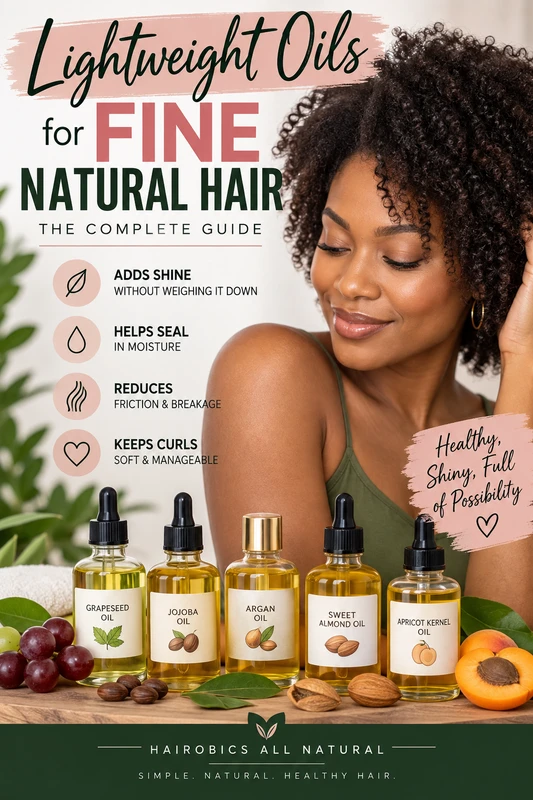
Lightweight oils can be an excellent addition to a fine natural hair routine when they're used correctly. Oils such as grapeseed oil, jojoba oil, sweet almond oil, argan oil, and apricot kernel oil can help reduce friction, add shine, seal in moisture, and protect fragile strands without creating the heavy coating associated with thicker oils and butters.
In this guide, we'll explore the best lightweight oils for fine natural hair, how to choose the right one, how much oil you should use, and how to incorporate oils into your routine without weighing down your curls.
What Is Fine Natural Hair?
Before choosing an oil, it's important to understand what "fine hair" actually means.
Fine hair refers to the diameter of an individual strand of hair.
A person can have fine hair while still having a lot of hair overall. This is because hair density and strand thickness are two different characteristics.
You can have:
- Fine strands with high density
- Fine strands with low density
- Medium strands with high density
- Coarse strands with low density
Someone with fine, high-density natural hair may appear to have extremely thick hair because there are many strands growing from the scalp. However, each individual strand may still be relatively thin.
Fine natural hair generally requires gentler handling because thinner strands can be more vulnerable to mechanical damage and breakage.
This becomes especially important when selecting styling products.
Heavy creams, thick butters, waxes, and excessive amounts of oil can coat fine strands and make the hair feel heavy.
That's why lightweight products often work particularly well.
Why Lightweight Oils Work Well for Fine Natural Hair
Natural hair requires water to remain hydrated. One of the most important things to understand about oils is that oil is not the same thing as moisture.
Water provides hydration.
Oil can help lubricate the hair, reduce friction, improve shine, and slow moisture loss by creating a light coating around the strands.
This distinction matters because applying more oil to dry hair doesn't necessarily solve the underlying dryness.
Fine natural hair often benefits from a simple combination:
Water or water-based product + lightweight leave-in + small amount of lightweight oil.
The key phrase is small amount.
Fine hair has less surface area per strand than thicker hair, which means it may take significantly less product to coat it.
Using too much oil can quickly result in buildup.
The goal isn't to make your hair oily.
The goal is to use just enough oil to support softness, shine, manageability, and protection.
10 Best Lightweight Oils for Fine Natural Hair
There isn't one perfect oil for every person. Your ideal oil depends on your hair's porosity, density, styling routine, climate, and personal preferences.
However, several oils are particularly useful when you want something lighter.
1. Grapeseed Oil
Grapeseed oil is one of the first oils worth considering for fine natural hair.
It has a relatively lightweight texture and spreads easily, meaning you generally don't need much product to coat your hair.
Grapeseed oil can be used to help seal in moisture after applying a water-based moisturizer or leave-in conditioner.
It can also add shine without creating the extremely heavy feeling associated with thick oils and butters.
Grapeseed oil may be useful for:
- Fine natural hair
- Low-porosity hair
- Twist-outs
- Braid-outs
- Wash-and-go styles
- Protective styles
- Dry ends
- Hair that becomes greasy easily
Try starting with only a few drops.
Rub the oil between your palms before smoothing it over the ends and lengths of your hair.
Fine hair rarely needs to be saturated with oil.
2. Jojoba Oil
Jojoba oil is another excellent option when you want something relatively lightweight.
Interestingly, jojoba oil is technically a liquid wax rather than a traditional triglyceride oil.
It is popular in hair and skin products because it spreads easily and provides lubrication without necessarily creating an extremely greasy finish when used sparingly.
For fine natural hair, jojoba oil can be particularly useful on the ends.
Your ends are the oldest portion of your hair and have experienced years of washing, styling, detangling, environmental exposure, and friction.
A tiny amount of jojoba oil can help reduce friction and give dry-looking ends a smoother appearance.
Try jojoba oil for:
- Sealing your ends
- Adding shine
- Scalp massage
- Protective styles
- Refreshing older hairstyles
- Reducing a dry appearance
Because fine hair can become overloaded quickly, start with approximately 2–4 drops rather than pouring oil directly onto your hair.
You can always add more.
Removing excess oil is much harder.
3. Argan Oil
Argan oil is widely used in hair products because of its ability to provide lubrication and shine.
It is especially useful when you want your natural hair to look polished without applying a thick layer of product.
A few drops can be smoothed over the surface of the hair after styling.
This makes argan oil especially attractive for:
- Blowouts
- Silk presses
- Twist-outs
- Braid-outs
- Roller sets
- Stretched natural hairstyles
If frizz is your primary concern, try applying a tiny amount to your palms and gently smoothing it over the finished hairstyle.
Avoid repeatedly adding oil throughout the day.
Fine strands can become coated much faster than you realize.
4. Sweet Almond Oil
Sweet almond oil offers another middle ground between extremely light oils and heavier options.
It can help lubricate the strands, improve softness, and provide shine.
Sweet almond oil works especially well when used after a leave-in conditioner.
For example:
- Lightly mist your hair with water.
- Apply your favorite water-based moisturizer or leave-in.
- Apply a few drops of sweet almond oil.
- Style your hair.
The oil helps create a light barrier over the hair.
If your hair becomes limp after using sweet almond oil, reduce the quantity before deciding that the oil itself doesn't work for you.
With fine natural hair, the amount of product can matter just as much as the product itself.
5. Apricot Kernel Oil
Apricot kernel oil doesn't receive as much attention as coconut, castor, or jojoba oil, but it can be a useful option for fine hair.
It has a relatively light feel and can be used for sealing or adding shine.
This oil may be particularly appealing if your hair doesn't tolerate extremely thick oils.
Try applying it primarily to the middle and ends of your hair instead of saturating your roots.
Fine natural hair usually looks fuller when the root area remains light and free-moving.
6. Sunflower Oil
Sunflower oil is another relatively lightweight plant oil.
It contains a high proportion of unsaturated fatty acids and can provide lubrication to hair strands.
For fine natural hair, sunflower oil may work particularly well as a sealing oil.
After moisturizing your hair, spread a few drops across your palms and lightly smooth your hands over your strands.
Pay particular attention to your ends.
Avoid pouring the oil directly onto your head.
That makes it extremely easy to use too much.
7. Safflower Oil
Safflower oil is another option for people who find thicker oils uncomfortable.
It spreads relatively easily and can be incorporated into moisturizing routines without necessarily leaving the heavy coating associated with products such as thick pomades or butters.
Safflower oil can be useful for:
- Sealing
- Scalp massage
- Pre-shampoo treatments
- Protective styling
- Dry ends
As always, quantity matters.
Fine natural hair may only need several drops for an entire section.
8. Camellia Oil
Camellia oil has traditionally been used for hair and skin care in parts of East Asia.
Its smooth texture makes it an interesting option for people looking for shine and lubrication without excessive heaviness.
For natural hair, it can be used sparingly after styling.
Try one or two drops on each major section of your hair.
This is especially useful for hairstyles where you want movement rather than a highly coated appearance.
9. Fractionated Coconut Oil
Traditional coconut oil can feel heavy on some fine natural hair.
Fractionated coconut oil is different.
During processing, certain fatty acids are removed, leaving an oil that remains liquid and generally feels lighter.
This can make fractionated coconut oil easier to use on fine strands than heavier coconut oil products.
However, everyone's hair responds differently.
If coconut-based products leave your hair feeling stiff, rough, or coated, another oil may be a better choice.
10. Lightweight Oil Blends
You don't necessarily need to use a single oil.
A well-formulated lightweight hair oil may contain several oils, such as:
- Jojoba
- Grapeseed
- Sweet almond
- Argan
- Sunflower
- Avocado
- Vitamin E-containing ingredients
Oil blends can provide the benefits of several ingredients while making application easier.
However, always examine the complete ingredient list.
A product marketed as "lightweight" could still contain heavier butters, waxes, silicones, or oils.
Grapeseed Oil vs Jojoba Oil for Fine Natural Hair
Two of the most popular choices for fine natural hair are grapeseed and jojoba oil.
So which one should you choose?
Grapeseed oil tends to be appealing when you want a very light sealing oil that spreads easily.
Jojoba oil can be useful when you're looking for lubrication, shine, and a light coating.
Neither is automatically better.
Try each individually for several wash cycles.
This gives you enough time to evaluate how your hair responds without constantly changing multiple products at once.
Lightweight Oils vs Heavy Oils
Not every oil feels the same on fine hair.
Some products naturally create a thicker coating.
Castor oil is one example.
Castor oil is extremely popular in natural hair routines, but its thick consistency may feel heavy on fine strands when used generously.
That doesn't mean someone with fine hair can never use castor oil.
You might simply need less.
You can also blend a small amount of castor oil with a lighter oil such as jojoba or grapeseed.
Other ingredients that may feel heavy when overused include:
- Shea butter
- Cocoa butter
- Thick pomades
- Heavy grease
- Large amounts of coconut oil
- Castor oil
- Thick styling creams
Your hair should guide your decision.
If your curls consistently become flat, greasy, sticky, or difficult to cleanse after applying a product, you're probably using too much product or a formula that is too heavy for your current routine.
Fine Hair vs Low-Porosity Hair
Fine hair and low-porosity hair aren't the same thing.
This is a common source of confusion in natural hair care.
Fine hair describes strand diameter.
Porosity describes how easily hair absorbs and loses water and other substances.
You can have fine, high-porosity hair.
You can also have fine, low-porosity hair.
If your hair is both fine and low porosity, buildup may become particularly noticeable.
You may benefit from:
- Lightweight leave-ins
- Lightweight oils
- Smaller product amounts
- Regular shampooing
- Occasional clarifying
- Fewer overlapping styling products
Instead of applying a leave-in, cream, butter, gel, and oil every wash day, experiment with a simpler routine.
Your hair may respond better.
How to Apply Oil to Fine Natural Hair
Technique can completely change your results.
Someone may say that jojoba oil is too heavy for their fine hair when the real problem is that they're applying a tablespoon instead of several drops.
Start small.
For short or low-density fine natural hair, you may only need several drops for your entire head.
Longer or higher-density hair may require more, but you should still apply gradually.
Step 1: Hydrate Your Hair
Start with damp hair or a water-based leave-in conditioner.
Remember:
Oil doesn't replace water.
If your hair is dehydrated, applying oil alone may simply coat strands that are still lacking hydration.
Step 2: Apply Leave-In Conditioner
Choose a lightweight leave-in conditioner appropriate for your hair.
Distribute it evenly.
Fine hair generally benefits from thin layers rather than large quantities of product.
Step 3: Add Your Oil
Place approximately 2–5 drops of your chosen oil into your palm.
Rub your palms together.
Then gently smooth your hands over your hair.
Focus primarily on the ends.
Step 4: Style
Continue with your preferred hairstyle.
This might include:
- Twist-out
- Braid-out
- Wash-and-go
- Mini twists
- Braids
- Afro
- Roller set
- Bun
Step 5: Evaluate the Results
The next day, ask yourself:
Does my hair feel soft?
Does it have movement?
Does it look greasy?
Did my curls become flat?
Does my scalp feel coated?
Your answers will tell you whether to increase or decrease the amount next time.
How Much Oil Does Fine Natural Hair Need?
There isn't one exact amount that works for everyone.
However, fine hair generally requires less oil than you think.
Start with a few drops.
You should be able to lightly coat your palms without having oil dripping from your hands.
Apply it to your hair.
Wait.
If your hair still feels like it needs more, add another drop or two.
This gradual method is much better than applying a large quantity at once.
Remember:
You can always add more oil. You can't easily remove excess oil without washing your hair.
Should You Oil Fine Natural Hair Every Day?
Probably not in most routines.
Daily oiling can lead to unnecessary buildup, especially if you're applying additional oil without washing your hair.
Fine strands can become weighed down quickly.
Instead of automatically oiling every morning, evaluate your hair.
If it still feels soft and looks healthy, leave it alone.
If your ends feel dry, apply a tiny amount specifically to your ends.
You don't necessarily need to reapply oil throughout your entire head.
Many people with fine natural hair find that oiling once or twice between wash days is sufficient.
Others need even less.
Should You Put Oil on Wet or Dry Fine Hair?
Both methods can serve different purposes.
Applying oil to damp hair is useful when you're trying to seal in moisture after washing or refreshing.
Applying a tiny amount of oil to dry hair can help add shine and reduce friction.
For moisture retention, try:
Water → Leave-in → Lightweight oil
For finishing:
Finished hairstyle → 1–3 drops of oil
Again, the goal isn't saturation.
It's a light coating.
Best Lightweight Oil for Fine Low-Porosity Hair
If your hair is fine and low porosity, start with very lightweight options.
Grapeseed oil and jojoba oil are two good oils to experiment with.
You might also try argan or sunflower oil.
The bigger priority, however, is preventing buildup.
Low-porosity hair can become coated when multiple layers of heavy products are continuously applied.
Try simplifying your routine.
Instead of:
Leave-in + cream + butter + oil + gel
experiment with:
Leave-in + small amount of oil + styling product
You may discover that your curls feel lighter, softer, and more defined.
Best Lightweight Oil for Fine High-Porosity Hair
High-porosity hair may lose moisture more quickly.
Fine, high-porosity hair creates an interesting challenge.
You want enough protection to reduce moisture loss without applying so much product that your fine strands collapse.
Sweet almond, argan, jojoba, and grapeseed oils are worth experimenting with.
You can also focus additional product specifically on your ends.
Damaged or highly porous ends often require more attention than healthier hair closer to the scalp.
Signs You're Using Too Much Oil
Fine natural hair will usually tell you when you've gone too far.
Watch for:
- Greasy appearance
- Flat roots
- Reduced volume
- Limp curls
- Sticky strands
- Hair attracting excessive lint
- Frequent need for clarifying
- Hair that feels coated after washing
- Product flakes
- Difficulty maintaining curl definition
If you notice these signs, don't immediately assume your hair hates oil.
Reduce your quantity first.
You may discover that five drops work beautifully while fifteen drops create buildup.
Signs Your Oil Routine Is Working
A good oil routine should support your hairstyle rather than dominate it.
Your hair may:
- Feel soft
- Maintain movement
- Look naturally shiny
- Detangle more easily
- Experience less friction
- Maintain better-looking ends
- Feel protected without being greasy
Your hair should still feel like hair.
If every strand feels heavily coated, reconsider your product quantity.
Can Lightweight Oils Help Fine Natural Hair Grow?
Hair oils are frequently marketed as hair-growth products, but it's important to separate hair growth from length retention.
Hair grows from follicles in the scalp.
Applying an oil to your existing hair strands doesn't directly cause those strands to grow from the root.
However, a good hair-care routine can support length retention.
Fine hair is more vulnerable to mechanical damage because individual strands are thinner.
Reducing breakage can therefore be extremely important.
Lightweight oils may support a length-retention routine by helping to:
- Reduce friction
- Improve lubrication
- Make detangling easier
- Protect ends
- Reduce mechanical stress during styling
When your hair breaks less, you're more likely to retain the length that naturally grows.
That's why someone may believe a particular oil "made their hair grow" when improved length retention may have played an important role.
Lightweight Oils for Protective Styles
Protective styles don't eliminate the need for hair care.
If you're wearing:
- Box braids
- Knotless braids
- Cornrows
- Mini twists
- Flat twists
- Crochet styles
you can still maintain your natural hair underneath.
However, avoid pouring large quantities of oil onto your scalp every day.
This can contribute to buildup.
Instead, lightly moisturize when necessary and apply a small amount of oil.
Pay attention to exposed areas and your scalp.
Your protective style shouldn't feel constantly greasy.
Lightweight Oils for Natural Hair Ends
Your ends deserve special attention.
They are the oldest part of your hair.
If your goal is longer natural hair, preserving your ends is critical.
Try this simple routine:
Mist your ends lightly with water.
Apply a small amount of leave-in conditioner.
Seal with 1–2 drops of jojoba, grapeseed, argan, or sweet almond oil.
Then place your hair into a low-manipulation style.
You don't necessarily need to do this every day.
Monitor how your ends feel and adjust accordingly.
Should Fine Natural Hair Avoid Castor Oil?
Not necessarily.
Castor oil is simply much thicker than many of the oils discussed in this article.
Someone with fine hair may still enjoy castor oil when it's used strategically.
For example, instead of coating your entire head with castor oil, you could mix:
1 part castor oil + 3 parts grapeseed or jojoba oil.
This creates a lighter mixture.
You can also reserve thicker oils for specific areas rather than using them throughout your entire head.
The important thing is finding what works for your strands.
How Often Should Fine Natural Hair Be Washed?
Your wash schedule depends on your lifestyle, scalp, hairstyle, and products.
However, people who frequently use oils, gels, creams, and styling products need to remove buildup periodically.
A clean scalp and clean strands create a better foundation for your routine.
Many people wash natural hair approximately once every 7–14 days, although individual needs vary considerably.
If your scalp becomes itchy, greasy, uncomfortable, or heavily coated before your normal wash day, you may need to wash more frequently or reduce the amount of product you're applying.
Do You Need Clarifying Shampoo?
Sometimes.
Regular shampoo removes dirt, oil, sweat, and styling products.
However, repeated product use can eventually leave some people feeling like their hair is coated.
That's where a clarifying shampoo can be useful.
Signs you may need clarification include:
- Hair feels coated after washing
- Styling products suddenly stop working well
- Hair looks dull
- Curls feel unusually limp
- Products sit on the hair
- Hair feels greasy shortly after washing
Clarifying doesn't need to happen every wash day.
Use it when your hair needs a deeper reset.
A Simple Wash-Day Routine for Fine Natural Hair
Fine natural hair routines don't need to involve ten different products.
In many cases, simpler is better.
Try this:
1. Shampoo
Clean your scalp and remove buildup.
2. Condition
Apply conditioner and gently detangle your hair.
3. Deep condition when needed
Fine hair can benefit from conditioning, but avoid assuming that leaving heavy treatments on your hair for hours will automatically improve your results.
Follow product instructions.
4. Apply lightweight leave-in
Use enough to provide slip and softness without saturating your strands.
5. Apply a lightweight oil
Start with several drops.
6. Style
Choose a hairstyle that minimizes unnecessary tension and manipulation.
7. Protect your hair at night
Use a satin or silk bonnet, scarf, or pillowcase to reduce friction.
Sample Weekly Routine for Fine Natural Hair
Here's a simple example.
Wash Day
Shampoo.
Condition and detangle.
Apply lightweight leave-in.
Apply 3–8 drops of grapeseed or jojoba oil, depending on your hair's length and density.
Style.
Midweek
Assess your hair before adding anything.
If your hair still feels moisturized, don't add more product simply because it's Wednesday.
If your ends feel dry, lightly mist them and apply a tiny amount of oil.
Nighttime
Protect your hair from friction.
Loosely secure your hairstyle and sleep with satin or silk protection.
Next Wash Day
Cleanse the hair thoroughly and repeat.
This type of minimalist routine can be especially effective for fine strands.
Common Mistakes When Using Oils on Fine Natural Hair
Mistake #1: Using Oil Instead of Moisture
If your hair is dry, pouring oil onto it isn't necessarily going to hydrate it.
Start with water or a water-based product.
Mistake #2: Using Too Much
Fine natural hair usually doesn't require large amounts of oil.
Start small.
Mistake #3: Applying Oil Every Day Automatically
Your hair may not need daily oil.
Use your hair's condition rather than the calendar as your guide.
Mistake #4: Layering Too Many Products
Leave-in.
Cream.
Butter.
Oil.
Gel.
Mousse.
Edge control.
Serum.
Using everything simultaneously can overwhelm fine strands.
Simplify your routine.
Mistake #5: Ignoring Your Ends
Your ends are particularly vulnerable to breakage.
Give them extra attention.
Mistake #6: Never Shampooing Properly
Oil buildup doesn't disappear simply because you add more moisturizer.
Clean your hair regularly.
Frequently Asked Questions About Lightweight Oils for Fine Natural Hair
What is the best oil for fine natural hair?
There isn't one universally best oil. Grapeseed, jojoba, argan, sweet almond, sunflower, and apricot kernel oils are all worth considering because they can provide lubrication and shine without necessarily feeling extremely heavy when used sparingly.
What is the lightest oil for natural hair?
Grapeseed oil is commonly chosen when someone wants a relatively lightweight oil. Argan and jojoba are also popular lightweight options.
Is jojoba oil good for fine natural hair?
Yes, jojoba oil can work well for fine natural hair when used in small quantities. Try several drops rather than saturating your hair.
Is grapeseed oil good for fine hair?
Grapeseed oil can be an excellent choice because of its lightweight texture and easy spreadability.
Is castor oil too heavy for fine natural hair?
Castor oil can feel heavy on fine strands, especially when applied generously. If you like castor oil, try mixing a small amount with a lighter oil or using less.
Should fine hair use oil every day?
Usually, there is no need to apply oil automatically every day. Reapply only when your hair actually needs it.
Can I put oil directly on dry natural hair?
You can apply a small amount to dry hair for lubrication and shine. However, if your goal is hydration, apply water or a water-based moisturizing product first.
What oil is good for fine low-porosity natural hair?
Grapeseed, jojoba, sunflower, and argan oils are worth experimenting with. The amount you apply is just as important as your choice of oil.
How do I keep fine natural hair moisturized without weighing it down?
Focus on water-based hydration, lightweight leave-in conditioners, small quantities of oil, regular cleansing, and avoiding unnecessary product layering.
Final Thoughts: Finding the Best Lightweight Oil for Your Fine Natural Hair
Fine natural hair doesn't have to be drenched in oil to stay soft, shiny, and manageable.
In fact, one of the biggest improvements you can make to your routine may simply be using less product.
Start with lightweight options such as grapeseed oil, jojoba oil, argan oil, sweet almond oil, sunflower oil, or apricot kernel oil.
Apply your oil after water or a water-based moisturizing product when your goal is moisture retention.
Start with just a few drops.
Focus on your ends.
Pay attention to how your hair responds.
And don't be afraid to simplify your routine.
Healthy natural hair care isn't about using the largest number of products. It's about creating a consistent routine that keeps your scalp clean, your strands conditioned, and your ends protected.
For fine natural hair, lightweight oils can provide that extra layer of lubrication and protection without sacrificing the volume, bounce, and movement that make your natural hair beautiful.