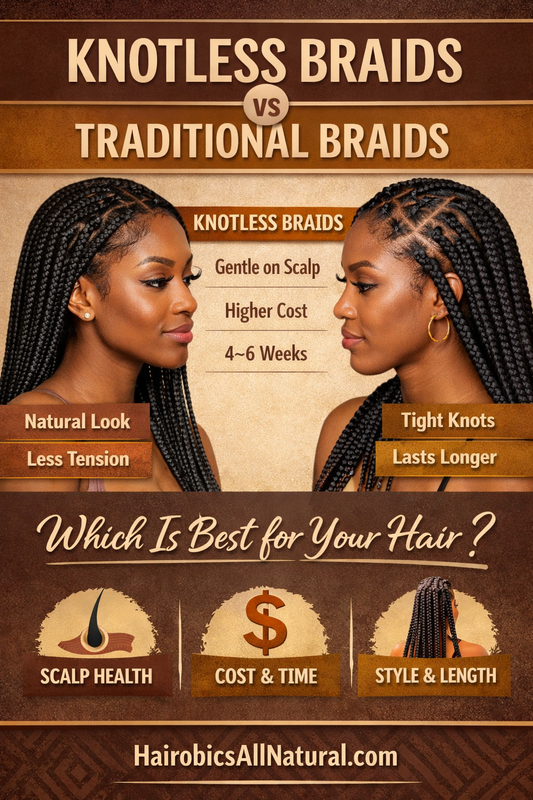
Braids have been a cornerstone of Black hair care and cultural expression for thousands of years. From ancient African civilizations to modern protective styling trends, braids continue to evolve while maintaining their deep cultural significance.
Two of the most popular braided styles today are knotless braids and traditional braids (box braids). While they may look similar at first glance, the way they are installed, how they feel on the scalp, and their impact on hair health can be very different.
If you’re trying to decide between these two styles, this guide will break down everything you need to know — including installation methods, pros and cons, scalp health, cost, maintenance, and which style is best for long-term hair growth.
What Are Traditional Braids?
Traditional braids, often called box braids, are one of the most widely recognized protective hairstyles. They involve sectioning the hair into square parts and adding synthetic braiding hair at the root using a tight knot.
The knot is what anchors the braiding hair to your natural hair.
This method has been used for decades and is known for its durability and structure.
How Traditional Braids Are Installed
-
Hair is washed, conditioned, and detangled.
-
The stylist sections the hair into square parts.
-
Synthetic braiding hair is folded and attached at the root.
-
The stylist creates a tight knot to secure the extension hair.
-
Hair is braided down the shaft.
Because the extension hair is attached at the root immediately, the braid begins thick and structured from the scalp.
Why Traditional Braids Became So Popular
Traditional braids became popular because they are:
-
Fast to install
-
Very secure
-
Long lasting
-
Versatile in size and length
For many years, they were the default braided style in salons across the world.
What Are Knotless Braids?
Knotless braids are a modern evolution of traditional braids. Instead of attaching extension hair with a knot at the root, stylists gradually feed in braiding hair as they braid.
This technique creates a braid that starts with your natural hair and slowly becomes thicker as extensions are added.
How Knotless Braids Are Installed
-
Hair is parted into sections.
-
The stylist begins braiding using only your natural hair.
-
Small amounts of extension hair are gradually fed into the braid.
-
The braid builds thickness naturally down the shaft.
Because there is no knot at the base, knotless braids lay flatter and look more natural.
Key Differences Between Knotless and Traditional Braids
| Feature | Knotless Braids | Traditional Braids |
|---|---|---|
| Root appearance | Natural and flat | Visible knot |
| Installation method | Feed-in technique | Knot added at root |
| Scalp tension | Low | Moderate to high |
| Comfort | Lightweight | Can feel tight initially |
| Longevity | 4–6 weeks | 6–8 weeks |
| Cost | Higher | More affordable |
| Installation time | Longer | Faster |
Each style has unique advantages depending on your hair goals and lifestyle.
Scalp Tension and Hair Health
One of the biggest debates in the natural hair community is which braid style is healthier for your scalp.
Traditional Braids and Scalp Tension
Because traditional braids use a knot at the root, they often create immediate tension on the scalp.
Many people experience:
-
Tightness
-
Tender scalp
-
Headaches
-
Redness around parts
Over time, excessive tension can contribute to traction alopecia, a form of hair loss caused by repeated pulling on the hair follicle.
Knotless Braids and Reduced Tension
Knotless braids eliminate the root knot, which significantly reduces scalp tension.
Benefits include:
-
Less pulling on edges
-
More flexibility
-
Lower risk of hair loss
-
More comfortable sleeping
This is one of the biggest reasons knotless braids have grown so popular in recent years.
Which Style Looks More Natural?
If your goal is a seamless natural appearance, knotless braids typically win.
Traditional braids create a bulky knot at the root, which can make the braid look more structured and less natural.
Knotless braids, on the other hand:
-
Lay flat against the scalp
-
Blend better with natural hair
-
Move more freely
-
Look lighter
Because of this, knotless braids are often preferred for smaller braid sizes and longer styles.
Installation Time
Time is an important factor when choosing between braid styles.
Traditional Braids
Average install time:
4–6 hours
Because extension hair is added immediately at the root, stylists can work faster.
Knotless Braids
Average install time:
6–8 hours (sometimes longer)
Since hair must be fed in gradually, the process is more detailed and takes additional time.
For this reason, knotless braids usually cost more at salons.
Which Braids Last Longer?
Longevity is another important factor.
Traditional braids tend to last longer because the knot secures the braid tightly to the root.
Typical wear time:
6–8 weeks
Knotless braids generally last:
4–6 weeks
Because there is less tension at the root, the braid may loosen faster as your hair grows.
However, many people find the comfort tradeoff worth it.
Weight and Movement
Another noticeable difference is how the braids feel when you move.
Traditional braids can feel heavier at the root because all extension hair is added at once.
Knotless braids distribute weight gradually throughout the braid.
This creates:
-
More natural movement
-
Less scalp pressure
-
A lighter feel
People who exercise frequently often prefer knotless braids because they are less restrictive on the scalp.
Cost Differences
Salon prices vary depending on location and braid size, but knotless braids almost always cost more.
Typical price ranges:
Traditional braids
$120 – $250
Knotless braids
$200 – $400+
The higher cost comes from:
-
Longer installation time
-
More technical skill
-
Greater stylist demand
Maintenance for Both Styles
Proper maintenance helps both braid styles last longer and protects your natural hair.
Keep the Scalp Clean
Use diluted shampoo or scalp cleansers every 1–2 weeks.
Moisturize Your Hair
Protective styles can still dry out your natural hair.
Moisturize using:
-
Lightweight oils
-
Leave-in sprays
-
Hydrating scalp treatments
Protect Hair at Night
Always sleep with:
-
Satin bonnet
-
Silk scarf
-
Satin pillowcase
This prevents frizz and reduces tension.
Avoid Excessive Weight
Very long or extremely thick braids can stress your roots.
Moderation helps protect hair health.
Which Style Is Better for Hair Growth?
Many people believe braids directly cause hair growth, but that’s not exactly true.
Hair grows from the scalp, not from the style itself.
However, protective styles can help retain length by reducing breakage.
Knotless braids may have a slight advantage for hair health because they:
-
Reduce scalp tension
-
Protect edges
-
Minimize pulling
When combined with a consistent hair care routine, protective styles can help maintain length over time.
Who Should Choose Knotless Braids?
Knotless braids may be best for people who:
-
Have sensitive scalps
-
Want a natural look
-
Experience headaches from tight braids
-
Want less tension on edges
-
Prefer lightweight styles
They are especially popular among people focused on long-term hair health.
Who Should Choose Traditional Braids?
Traditional braids may be better for people who:
-
Want longer-lasting styles
-
Need a faster install
-
Prefer a lower cost
-
Want extremely small braids
-
Don’t mind tighter roots
For many people, they remain a reliable protective style.
The Cultural Significance of Braids
Braids are far more than just hairstyles.
Throughout African history, braided patterns were used to communicate:
-
Tribal identity
-
Social status
-
Age
-
Marital status
Braids also played an important role during the transatlantic slave trade, where enslaved Africans used braided patterns to map escape routes or hide seeds for survival.
Today, braids remain a powerful symbol of cultural pride, beauty, and identity.
Common Mistakes People Make With Braids
Even protective styles can damage hair if done incorrectly.
Common mistakes include:
Installing Braids Too Tight
Pain is a warning sign.
Healthy braids should never cause severe discomfort.
Leaving Braids In Too Long
Keeping braids longer than 8 weeks can cause:
-
Matting
-
Breakage
-
Tangling
Skipping Scalp Care
A dry scalp can lead to itching and buildup.
Ignoring Edge Protection
Edges are fragile and require gentle care.
Tips for Healthy Braided Styles
To keep your hair healthy while wearing braids:
-
Hydrate your scalp regularly
-
Avoid excessive tension
-
Choose experienced stylists
-
Take breaks between installs
-
Deep condition between braid cycles
Healthy hair begins with consistent care, even while wearing protective styles.
Final Thoughts: Knotless vs Traditional Braids
Both braid styles have their advantages.
Traditional braids offer durability and affordability, while knotless braids prioritize comfort and scalp health.
If your goal is long-term hair protection and a natural appearance, knotless braids are often the better option.
However, traditional braids remain a timeless style that continues to work well for many people.
The best choice ultimately depends on your hair goals, budget, and comfort preferences.
With proper maintenance and gentle styling, both braid styles can be excellent protective options for maintaining healthy natural hair.
✅ For more natural hair care tips, visit:
HairobicsAllNatural.com