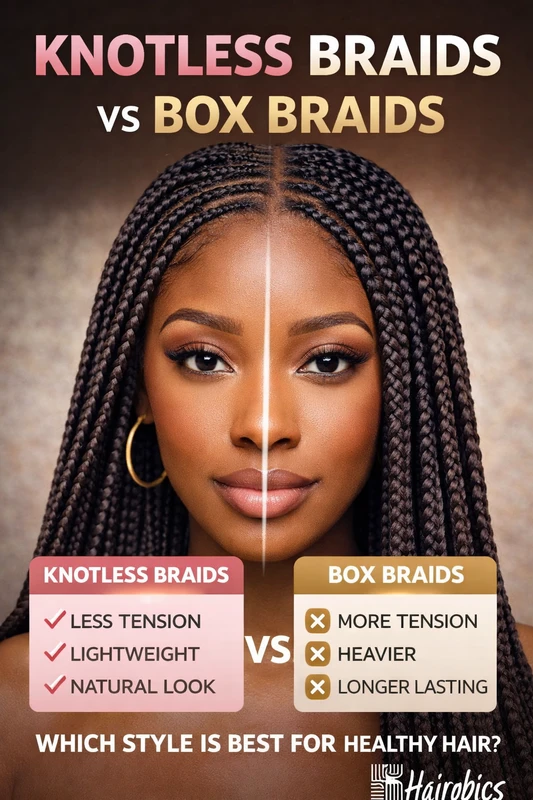
Braids have been a cornerstone of Black hair care for centuries. From protective styling to cultural expression, braided hairstyles remain one of the most popular ways to maintain and grow natural hair. Two of the most requested braid styles today are knotless braids and box braids.
Many people wonder:
-
Are knotless braids better for hair growth?
-
Do box braids last longer?
-
Which style causes less breakage?
-
Which is best for thin edges?
-
Which style protects natural hair best?
This comprehensive guide explains knotless braids vs box braids, including installation methods, hair health effects, maintenance tips, and how to choose the best style for your hair.
What Are Box Braids?
Box braids are one of the most traditional and widely recognized braided hairstyles. The hair is divided into square (box-shaped) sections, and braiding hair is added at the root using a knot.
This knot secures the extension hair tightly to the natural hair.
Key Features of Box Braids
-
Hair divided into square sections
-
Extension hair attached using a knot
-
Firm base at the root
-
Uniform look
-
Faster installation
-
Long-lasting style
Box braids are known for their durability and structure, making them a favorite protective style.
What Are Knotless Braids?
Knotless braids are a newer technique designed to reduce tension on the scalp. Instead of starting with a knot, the stylist begins with the natural hair and gradually feeds in extension hair.
This creates a braid that lies flatter against the scalp.
Key Features of Knotless Braids
-
No knot at the root
-
Feed-in braiding method
-
Lightweight feel
-
Natural appearance
-
Less scalp tension
-
Flexible styling
Knotless braids are often recommended for people with sensitive scalps or thinning edges.
Knotless Braids vs Box Braids: Installation Method
The biggest difference between knotless braids and box braids is how the hair extensions are installed.
Box Braids Installation
With box braids:
-
Hair is sectioned into squares
-
Extension hair is folded
-
A knot is tied at the root
-
Hair is braided down
The knot creates tension that helps the braid stay secure.
Knotless Braids Installation
With knotless braids:
-
Hair is sectioned
-
Stylist begins braiding natural hair
-
Extensions are fed in gradually
-
Braid grows thicker
This method spreads tension more evenly.
Winner for Comfort: Knotless Braids
Most people report less scalp pain with knotless braids.
Which Style Is Better for Hair Growth?
Both styles can support hair growth if installed and maintained properly.
Hair grows from the scalp — not from the braid style — but protective styles help retain length.
Knotless Braids and Hair Growth
Knotless braids:
-
Reduce scalp stress
-
Protect edges
-
Allow movement
-
Reduce breakage risk
These factors help retain length.
Box Braids and Hair Growth
Box braids:
-
Protect ends
-
Reduce manipulation
-
Last longer
-
Require less frequent styling
These factors also support growth.
Winner for Growth Retention: Knotless Braids
Knotless braids often cause less breakage, especially around edges.
Which Style Causes Less Breakage?
Breakage usually happens because of tension, dryness, or improper removal.
Box Braids Breakage Risks
Box braids may cause:
-
Root tension
-
Edge thinning
-
Traction alopecia risk
-
Tight scalp stress
Very tight box braids are a common cause of hairline damage.
Knotless Braids Breakage Risks
Knotless braids usually cause:
-
Minimal root tension
-
Less pulling
-
Lower traction risk
Winner for Low Breakage: Knotless Braids
Knotless braids generally create less stress on natural hair.
Which Style Lasts Longer?
Longevity matters for protective styling.
Box Braids Lifespan
Box braids typically last:
6–10 weeks
Reasons they last longer:
-
Strong knot anchor
-
Firm base
-
Less slipping
Knotless Braids Lifespan
Knotless braids typically last:
4–8 weeks
Reasons they may loosen faster:
-
No knot anchor
-
Softer base
-
More movement
Winner for Longevity: Box Braids
Box braids usually stay neat longer.
Which Style Looks More Natural?
Appearance matters for many people.
Box Braids Appearance
Box braids:
-
Thicker roots
-
Visible knots
-
Structured look
-
Defined sections
Knotless Braids Appearance
Knotless braids:
-
Flat roots
-
Seamless transition
-
Natural flow
-
Lightweight movement
Winner for Natural Look: Knotless Braids
Knotless braids mimic natural hair growth better.
Which Style Feels Lighter?
Weight affects comfort.
Box Braids Weight
Box braids often feel:
-
Heavier
-
More tension at roots
-
Pulling sensation
Knotless Braids Weight
Knotless braids feel:
-
Lightweight
-
Flexible
-
Easy to move
Winner for Lightweight Feel: Knotless Braids
Which Style Is Better for Thin Edges?
Edges are the most fragile part of the hairline.
Box Braids and Edges
Box braids can:
-
Pull edges
-
Cause thinning
-
Create stress points
Especially if tight.
Knotless Braids and Edges
Knotless braids:
-
Reduce tension
-
Protect edges
-
Move freely
Winner for Edges: Knotless Braids
Which Style Is Faster to Install?
Time matters when sitting in a salon chair.
Box Braids Installation Time
Box braids usually take:
4–6 hours
Knotless Braids Installation Time
Knotless braids usually take:
6–8 hours
Winner for Speed: Box Braids
Cost Comparison
Knotless braids usually cost more.
Average Prices
Box braids:
-
$150–$300
Knotless braids:
-
$200–$450
Reasons knotless costs more:
-
Longer installation
-
Higher skill required
-
More precision work
Winner for Budget: Box Braids
Scalp Health Differences
Healthy braids protect the scalp.
Box Braids Scalp Effects
Possible issues:
-
Tightness
-
Bumps
-
Inflammation
-
Tenderness
Knotless Braids Scalp Effects
Usually allow:
-
Better airflow
-
Less inflammation
-
Better comfort
Winner for Scalp Health: Knotless Braids
Maintenance Differences
Both styles need maintenance.
How to Maintain Box Braids
-
Oil scalp 2–3 times weekly
-
Clean scalp regularly
-
Wrap hair at night
-
Avoid tight ponytails
How to Maintain Knotless Braids
-
Moisturize regularly
-
Oil scalp
-
Wear satin bonnet
-
Avoid over-styling
Maintenance is similar overall.
Winner: Tie
Washing Knotless vs Box Braids
Braids must be washed to maintain scalp health.
Washing Box Braids
Box braids handle washing well because:
-
Knots stay secure
-
Braids hold shape
Washing Knotless Braids
Knotless braids require gentler washing because:
-
Roots loosen faster
Winner for Washing: Box Braids
Removal Differences
Proper removal prevents damage.
Removing Box Braids
Box braids may:
-
Be harder to remove
-
Create tangles near knots
-
Cause shedding clumps
Removing Knotless Braids
Knotless braids:
-
Slide out easier
-
Cause less tangling
-
Reduce breakage risk
Winner for Removal: Knotless Braids
Which Style Is Better for Beginners?
If you're new to braids:
Box Braids Advantages
-
Longer-lasting
-
Less maintenance
-
More forgiving
Knotless Braids Advantages
-
More comfortable
-
More natural
Best Beginner Choice
Box braids are usually easier for first-time braid wearers.
Who Should Choose Knotless Braids?
Knotless braids are ideal if you:
-
Have sensitive scalp
-
Have thin edges
-
Want a natural look
-
Want lightweight braids
-
Experience braid pain
-
Want less breakage risk
Who Should Choose Box Braids?
Box braids are ideal if you:
-
Want long-lasting braids
-
Need a budget-friendly option
-
Prefer a structured look
-
Don't mind knots
-
Want faster installation
How to Keep Braids Healthy
Regardless of braid type:
1. Moisturize Regularly
Dry hair breaks.
Use:
-
Leave-in conditioner
-
Water-based sprays
-
Light oils
2. Clean Your Scalp
Dirty scalp leads to inflammation.
Wash every:
2–3 weeks
3. Protect Your Hair at Night
Use:
-
Satin bonnet
-
Silk scarf
-
Satin pillowcase
4. Avoid Tight Styling
High buns and ponytails cause tension.
Signs Your Braids Are Too Tight
Remove braids if you notice:
-
Red bumps
-
Severe pain
-
Headaches
-
Thinning edges
-
Shiny scalp
-
Hairline stress
Tight braids can cause permanent hair loss.
The Truth About Protective Styles
Braids do not magically grow hair.
They help by:
-
Reducing manipulation
-
Protecting ends
-
Preventing breakage
-
Retaining length
Healthy growth still requires:
-
Moisture
-
Nutrition
-
Scalp care
-
Low tension
Final Verdict: Knotless Braids vs Box Braids
Both styles are excellent protective styles when done correctly.
Choose Knotless Braids If You Want:
-
Less tension
-
Healthier edges
-
Lightweight feel
-
Natural look
-
Lower breakage risk
Choose Box Braids If You Want:
-
Longer-lasting braids
-
Lower cost
-
Faster installation
-
Stronger base
-
Durable style
Best Overall for Hair Health
Knotless braids are generally safer for natural hair, especially for people with fragile edges or sensitive scalps.
Best Overall for Longevity
Box braids last longer and require less frequent touch-ups.
Bottom Line
The best braid style is the one that protects your hair without causing tension or dryness.
Whether you choose knotless braids or box braids, the key to healthy hair is:
-
Gentle installation
-
Proper moisture
-
Regular scalp care
-
Safe removal
When maintained correctly, both styles can help you retain length, protect your natural hair, and support long-term hair growth.