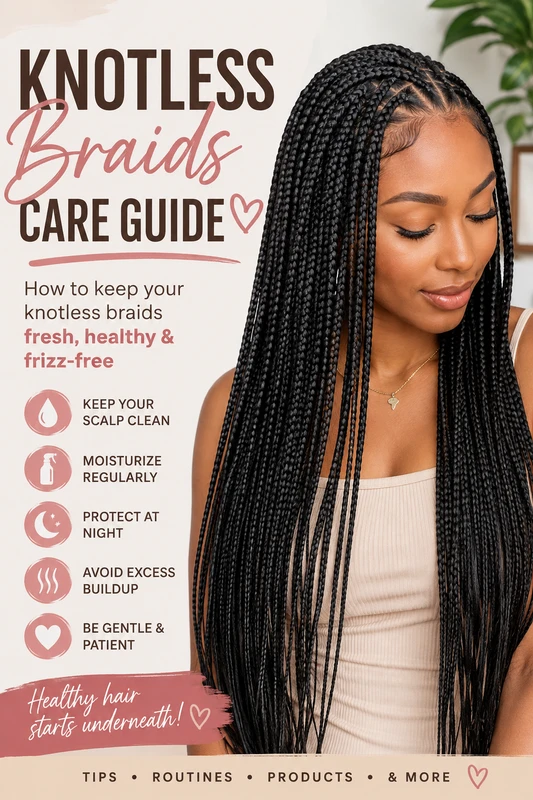
Knotless braids have become one of the most popular protective hairstyles for Black women—and for good reason. They are lightweight, versatile, beautiful, and typically place less tension on the scalp than traditional box braids. Whether you choose small knotless braids, medium knotless braids, jumbo braids, waist-length braids, or a shorter style, proper maintenance can make a major difference in how long your hairstyle looks fresh.
But knotless braids are not completely maintenance-free.
Your natural hair and scalp still need moisture, cleansing, protection, and attention while tucked inside the braids. Without the right knotless braids care routine, you may experience excessive frizz, product buildup, dryness, scalp irritation, breakage, or premature unraveling.
The good news is that caring for knotless braids does not have to be complicated.
This complete knotless braids care guide explains how to maintain knotless braids, moisturize your hair, protect your scalp, reduce frizz, sleep with braids, wash them properly, and know when it is finally time to take them down.
What Are Knotless Braids?
Knotless braids are a variation of traditional box braids that generally begin with your natural hair rather than immediately attaching a large section of extension hair at the root.
With traditional box braids, extension hair may be incorporated near the base of the braid, creating the recognizable "knot" at the root.
Knotless braids use a feed-in technique.
The stylist starts braiding your natural hair and gradually adds small pieces of extension hair as the braid progresses. This creates a flatter and often more natural-looking transition between your scalp and the braid.
Because the extension hair is gradually added, knotless braids may feel lighter around the roots.
They can also provide more styling flexibility immediately after installation because there may be less tightness at the scalp.
However, technique matters enormously.
Any braided hairstyle can cause excessive tension when installed too tightly.
How Long Do Knotless Braids Last?
Knotless braids commonly last approximately four to eight weeks, depending on several factors.
These include:
- Braid size
- Installation technique
- Hair texture
- Hair growth
- Exercise frequency
- Scalp oil production
- Swimming
- Humidity
- Sleeping habits
- Maintenance routine
- Amount of product used
Small knotless braids generally maintain their appearance longer than jumbo knotless braids because there are more braids distributing the hair throughout the style.
However, keeping braids installed longer is not always better.
Your natural hair continues growing while it is braided. As new growth increases, the roots become looser and more susceptible to tangling.
For many people, around six weeks provides a reasonable balance between getting good wear from the hairstyle and preventing excessive buildup or tangling.
Your individual hair and scalp should ultimately determine your takedown schedule.
How to Care for Knotless Braids
A good knotless braids maintenance routine should focus on five major things:
- Keeping your scalp clean
- Maintaining moisture
- Reducing unnecessary manipulation
- Protecting the braids overnight
- Preventing excessive product buildup
You do not need ten different products.
In fact, applying too many heavy products can make knotless braids harder to maintain.
A simple routine performed consistently usually works better.
1. Start With Healthy Hair Before Getting Knotless Braids
Knotless braid maintenance actually begins before your appointment.
Braids are protective hairstyles, but they cannot repair severely damaged hair simply by covering it.
If your hair is extremely dry, tangled, or breaking before installation, those problems may still be present when you remove your braids.
Before getting knotless braids, give your hair a thorough wash.
Remove dirt, oils, styling products, and buildup from your scalp and strands.
Follow your shampoo with a moisturizing conditioner.
If your hair needs additional hydration, consider deep conditioning before your appointment.
Detangle carefully and remove shed hairs.
Hair naturally sheds every day. When your hair is braided for several weeks, much of that shed hair remains trapped inside the hairstyle.
Starting with thoroughly detangled hair helps reduce unnecessary tangling later.
You may also want to trim severely damaged or split ends before getting braids.
Healthy preparation creates a better foundation for your protective style.
2. Avoid Knotless Braids That Are Too Tight
Knotless braids are often promoted as a low-tension protective hairstyle.
But knotless does not automatically mean tension-free.
A stylist can still install knotless braids too tightly.
Some tightness during installation may occur, but your braids should not cause intense or persistent pain.
Pay attention to warning signs such as:
- Severe scalp pain
- Headaches
- Redness
- Small bumps around the hairline
- Burning sensations
- Difficulty sleeping because of scalp pain
- Skin appearing pulled around the braids
Do not assume extreme pain means your hairstyle will last longer.
Excessive tension can place unnecessary stress on your follicles and strands.
The hairline deserves particular attention because those hairs tend to be finer and more fragile.
Ask your braider not to pull excessively around your edges.
Beautiful braids should not require sacrificing your hairline.
3. Keep Your Scalp Moisturized
One of the biggest mistakes people make while wearing knotless braids is forgetting about the hair underneath.
Your natural hair still requires care.
If your scalp and hair tend to become dry, a lightweight braid moisturizing spray can make maintenance easier.
Focus especially on areas where your natural hair is incorporated into the braids.
Avoid soaking your braids with heavy creams every day.
Too much product may lead to buildup.
Instead, use small amounts of lightweight moisture as needed.
How frequently you moisturize depends on your hair.
Some people may benefit from light moisture every few days, while others can go longer.
Learn to recognize how your scalp and hair feel instead of following a rigid schedule.
4. Use Lightweight Products on Knotless Braids
Heavy products can quickly become a problem with braided hairstyles.
Thick butters, waxes, pomades, and creams may collect around the roots and become difficult to remove.
Over time, they can combine with:
- Sweat
- Dead skin
- Natural scalp oils
- Dust
- Lint
- Styling products
This mixture can create visible buildup.
For routine knotless braid maintenance, lightweight products are often easier to manage.
Look for products designed to moisturize without coating the hair excessively.
If you use oil, apply a small amount rather than saturating your scalp.
More product does not necessarily mean more moisture.
5. Don't Oil Your Scalp Every Day
Scalp oil can be useful for people who experience dryness while wearing braids, but daily oiling is not necessary for everyone.
Your scalp naturally produces sebum.
Adding large amounts of oil every day can contribute to greasy roots and buildup.
Start with a small amount.
Apply it where your scalp actually feels dry instead of automatically coating your entire head.
Your ideal schedule might be once or twice a week—or less frequently—depending on your scalp.
If your scalp already feels oily, additional oil may not be necessary.
6. Protect Knotless Braids at Night
Your nighttime routine is one of the most important parts of keeping knotless braids looking fresh.
Cotton bedding can create friction against the braids as you move during sleep.
Repeated friction may contribute to frizz and make the hairstyle look older faster.
Before bed, gently gather your braids.
Avoid extremely tight ponytails or buns.
Then cover your braids using a satin or silk scarf, bonnet, or braid bonnet.
Long bonnets are particularly convenient for long knotless braids because they allow the braids to hang naturally without folding them into a small bonnet.
You can also use a satin or silk pillowcase as an additional layer of protection.
A good nighttime routine can dramatically improve how your braids look several weeks after installation.
7. How to Sleep With Long Knotless Braids
Extra-long braids can be uncomfortable if you simply lie directly on them.
Try gathering your braids loosely before bed.
Depending on their length, you can:
- Put them into a loose low ponytail
- Use a large braid bonnet
- Loosely wrap them
- Divide them into two sections
- Position them above your head
Avoid sleeping with extremely tight hairstyles.
Your scalp deserves a break after wearing braids throughout the day.
The goal is to keep the braids contained without creating additional tension.
8. Can You Wash Knotless Braids?
Yes.
Knotless braids can be washed.
In fact, cleansing your scalp can become increasingly important when wearing braids for several weeks—especially if you exercise frequently or use several styling products.
However, you do not necessarily need to wash braided hair exactly the same way you wash loose natural hair.
Focus primarily on cleansing the scalp and roots.
How to Wash Knotless Braids
Start by thoroughly wetting your scalp.
Diluting shampoo with water can make it easier to distribute between the braids.
Apply the shampoo directly to the scalp.
Using the pads of your fingertips, gently massage your scalp.
Do not aggressively scratch with your fingernails.
Work section by section.
Pay particular attention to areas where you notice sweat or buildup.
Allow the shampoo and water to travel down the braids as you rinse.
Unless your braids are extremely dirty, aggressive scrubbing of the entire length usually is not necessary.
Rinse thoroughly.
Leftover shampoo can contribute to irritation.
The most important step comes next:
Dry your braids completely.
9. Never Leave Knotless Braids Wet for Long Periods
Braids can hold a surprising amount of water.
Thick or long knotless braids may remain damp internally long after the outside feels dry.
After washing, gently squeeze excess water from the braids using a towel.
Do not aggressively rub them.
Allow plenty of time for your braids to air-dry, or use a dryer on a comfortable setting if appropriate for your hair and extensions.
Avoid going to sleep with soaking-wet braids.
Repeatedly keeping braids damp for extended periods can create an unpleasant environment around your hair and scalp and may contribute to odor.
Plan wash day early enough that your braids have plenty of time to dry before bedtime.
10. How Often Should You Wash Knotless Braids?
There is no universal schedule.
Some people cleanse their scalp approximately every one to two weeks while wearing braids.
Others may need cleansing sooner.
You might wash more frequently if you:
- Exercise heavily
- Sweat often
- Swim
- Have an oily scalp
- Use numerous styling products
- Notice visible buildup
Instead of focusing only on the calendar, pay attention to your scalp.
If it feels dirty, excessively oily, or coated with buildup, it may be time to cleanse.
11. How to Keep Knotless Braids From Getting Frizzy
Some frizz is unavoidable.
Your natural hair grows, sheds, and responds to humidity while inside the hairstyle.
Knotless braids are not supposed to look exactly the same on week six as they did on installation day.
However, you can reduce premature frizz.
The biggest strategies include:
- Covering braids every night
- Avoiding excessive touching
- Keeping braids out of constant friction
- Avoiding unnecessary water exposure
- Using lightweight products
- Keeping styling manipulation moderate
Constantly restyling braids into elaborate buns and ponytails can gradually create frizz around the roots.
Enjoy your styling options, but give your hair breaks between high-manipulation looks.
12. Refresh Knotless Braids With Mousse
Styling mousse can temporarily improve the appearance of frizzy knotless braids.
Apply a modest amount over the braids.
Smooth the product downward rather than aggressively rubbing it into the hair.
You can then wrap the hair with a satin scarf while the mousse sets.
This may help flatten flyaways and create a smoother appearance.
However, mousse cannot permanently reverse weeks of new growth.
At some point, refreshing should give way to removing the hairstyle.
13. Protect Your Edges
Your edges are particularly vulnerable while wearing braided hairstyles.
Avoid constantly brushing and slicking them down.
Frequent use of edge-control products can also create buildup around the hairline.
Give your edges breaks.
If possible, avoid incorporating extremely small sections of fragile edge hair into large or heavy braids.
When styling knotless braids, choose loose hairstyles more frequently.
Extremely tight ponytails can pull on the same follicles repeatedly.
14. Avoid Constant High Ponytails
One advantage of knotless braids is styling flexibility.
You can create buns, ponytails, half-up styles, side parts, and many other looks.
But just because you can put your braids into a tight ponytail every day does not mean you should.
Remember that extension hair adds weight.
Pulling all that weight upward can create additional tension around your hairline and roots.
Alternate between updos and loose styles.
When making ponytails, avoid pulling excessively.
15. Exercise While Wearing Knotless Braids
Knotless braids can be very convenient for active lifestyles.
However, sweat can accumulate around the scalp.
After exercising, avoid immediately covering a heavily sweaty scalp with a tight hat or bonnet for hours.
Allow your scalp to dry.
If you exercise regularly, you may need to cleanse your scalp more frequently.
You can also use a clean towel to gently blot excessive moisture around the scalp.
Your maintenance routine should match your activity level.
Someone exercising intensely five days per week may need a different braid routine from someone with minimal scalp sweating.
16. Swimming With Knotless Braids
You can swim with knotless braids, but chlorine and salt water may affect both your natural hair and the appearance of the extensions.
Before swimming, thoroughly wetting your hair with clean water can help reduce how much pool or ocean water the hair immediately absorbs.
After swimming, rinse your braids thoroughly.
Do not allow chlorine or salt water to repeatedly dry on your hair.
Most importantly, make sure your braids dry completely afterward.
Frequent swimmers may notice their braids become frizzy faster.
That is normal.
If you know you will be swimming frequently during a vacation, consider whether extremely small or elaborate knotless braids are worth the maintenance.
17. Avoid Excessive Product Buildup
Product buildup can become particularly noticeable around the roots of knotless braids.
The easiest way to reduce it is prevention.
Avoid layering numerous products every day.
For example, your scalp usually does not need:
oil + cream + gel + edge control + mousse + spray
every morning.
Use products intentionally.
Ask yourself what problem you are trying to solve.
Dryness?
Use lightweight moisture.
Dry scalp?
Use a small amount of an appropriate scalp product.
Frizz?
Try mousse and nighttime protection.
There is rarely a need to apply everything simultaneously.
18. What to Do About an Itchy Scalp With Knotless Braids
Mild occasional itching can occur with braided hairstyles.
Sweat, dryness, buildup, or irritation from hair products may contribute.
If your scalp feels dry, lightweight moisture may help.
If it feels dirty or coated, cleansing may be more appropriate than adding additional oil.
This distinction matters.
People sometimes assume every itchy scalp is dry and immediately add more oil.
If buildup is causing the problem, more oil may make the scalp feel worse.
Persistent, severe, painful, inflamed, or unusual scalp symptoms should not simply be covered with additional products. Consider removing the hairstyle and consulting an appropriate healthcare professional if symptoms are concerning.
19. How to Reduce Buildup Around Knotless Braid Roots
By weeks three, four, or five, you may notice a ring of buildup around certain braids.
Do not aggressively pick at it.
Pulling hardened buildup away from your roots can also pull or break your natural hair.
Instead, cleanse the area gently.
The goal is to soften and remove buildup without excessive manipulation.
This is another reason prevention is easier than correction.
The less unnecessary product you apply during the first few weeks, the less buildup you may have to deal with later.
20. Moisturize Your Natural Hair Under the Braids
Your natural hair does not stop needing moisture because you cannot see most of it.
Pay attention to the sections of natural hair incorporated into each braid.
A lightweight moisturizing spray can help you reach the hair without coating the braids in heavy cream.
Mist lightly.
You do not need to drench the hairstyle.
Focus on maintaining softness and flexibility.
If your braids constantly feel wet or sticky from product, you are probably using too much.
21. Don't Constantly Redo Your Hairline
When knotless braids become older, some people redo the entire front section to make the hairstyle look freshly installed.
This can extend the visual life of the style.
However, repeatedly braiding the same fragile hairline without adequate rest can create unnecessary tension.
If you refresh the perimeter, make sure the braids are not excessively tight.
Your edges are more important than making six-week-old braids look brand new.
22. Protect Knotless Braids in the Shower
If you are not washing your hair, cover your braids before showering.
A large shower cap can help protect them from unnecessary moisture and humidity.
This is especially helpful for preserving the appearance of your roots.
Steam can cause your natural hair to expand slightly and contribute to frizz.
You do not need to avoid humidity completely, but reducing unnecessary exposure can help your hairstyle remain neat longer.
23. How to Make Knotless Braids Last Longer
If you want your knotless braids to stay fresh, focus on consistency rather than constantly refreshing them with styling products.
The most effective habits are simple:
Protect your braids at night.
Keep your scalp clean.
Moisturize appropriately.
Avoid excessive tension.
Minimize unnecessary manipulation.
Dry braids completely after washing.
Keep heavy product buildup under control.
Protect your hair while swimming.
These small habits add up over several weeks.
Week-by-Week Knotless Braids Care Routine
Week 1
Your braids should still be relatively fresh.
Focus primarily on protecting them overnight and monitoring scalp comfort.
Avoid unnecessary manipulation.
You usually do not need large amounts of product immediately after installation.
Week 2
Continue nighttime protection.
Assess your scalp.
If it feels dry, apply lightweight moisture.
If you have significant sweat or buildup, consider cleansing.
Week 3
Some new growth and frizz may become noticeable.
Use mousse if desired and wrap the braids with a satin scarf.
Continue moisturizing your natural hair as needed.
Week 4
Check your roots carefully.
Look for buildup, excessive tangling, or tension.
Cleanse your scalp if necessary.
Avoid trying to make the hairstyle look brand new by constantly applying gel.
Weeks 5–6
New growth may become significantly more noticeable.
Continue protecting the braids, but begin paying more attention to the condition of your natural hair.
If the roots are becoming very tangled or the style is excessively frizzy, consider planning your takedown.
Weeks 7–8
Some people can comfortably wear knotless braids this long, particularly smaller braids.
However, longer wear is not automatically better.
If you notice excessive buildup, matting, tangling, discomfort, or significant new growth, remove the braids.
Signs It's Time to Take Out Knotless Braids
Do not judge your braids only by whether the extensions still look good.
Pay attention to your natural hair and scalp.
Possible signs that it may be time for removal include:
- Significant new growth
- Excessive root tangling
- Heavy product buildup
- Persistent scalp discomfort
- Braids repeatedly slipping
- Excessive frizz
- Matted roots
- Unpleasant odor that persists after cleansing
- Excessive tension
- Hairline concerns
Protective styling should support your hair-care goals rather than becoming a competition to see how long you can keep a hairstyle installed.
How to Take Down Knotless Braids Without Breaking Your Hair
Removal deserves just as much attention as installation.
Rushing through the takedown process can cause unnecessary breakage.
Give yourself plenty of time.
Cut the extensions only when you are absolutely certain your natural hair ends well above the cutting point.
If you are unsure, do not cut.
Unravel each braid carefully.
When you reach your natural hair, use your fingers to gently separate the strands.
You will probably see a considerable amount of shed hair.
Do not panic.
Remember that people naturally shed hairs daily. When your hair has been braided for several weeks, many of those shed strands have remained trapped inside the braids.
Detangle Before Shampooing
One of the biggest takedown mistakes is removing braids and immediately jumping into the shower.
Your roots may contain shed hairs, lint, oils, and product buildup.
Water can cause these materials to tighten together.
Before shampooing, carefully detangle your hair.
Work in sections.
Use your fingers first if necessary, then follow with your preferred detangling tool.
Be patient around the roots.
Once most shed hair and tangles have been removed, proceed with your wash routine.
Wash and Deep Condition After Knotless Braids
After several weeks in a protective style, give your hair and scalp a thorough cleansing.
Depending on the amount of buildup, you may want to use a clarifying shampoo.
Follow with conditioner.
A moisturizing deep-conditioning treatment may also be beneficial if your hair feels particularly dry.
Detangle carefully and evaluate your ends.
This is a good opportunity to see how your hair responded to the protective style.
Should You Get Knotless Braids Again Immediately?
You technically can, but giving your hair and scalp some time without extensions may be beneficial—particularly if you notice tenderness, breakage, dryness, or hairline stress.
Wear your natural hair loose or in a low-tension style for a while.
Cleanse your scalp.
Deep condition.
Trim if necessary.
Then decide when you are ready for your next protective style.
There is no prize for keeping your hair continuously braided throughout the year.
Your natural hair needs attention too.
Knotless Braids Care for Fine Hair
Fine hair may require extra caution because individual strands are smaller in diameter.
Avoid braids that are disproportionately heavy compared with the amount of natural hair supporting them.
Smaller sections do not necessarily need extremely long or heavy extensions.
Keep ponytails loose.
Pay close attention to your edges.
If individual braids begin hanging from very little natural hair, remove them rather than allowing the weight of the extension to continue pulling.
Knotless Braids Care for Thick Hair
Thick hair can look incredible in knotless braids, but dense hair may take longer to dry after washing.
Make drying a priority.
Separate the braids into sections so air can circulate around the scalp.
Do not assume the roots are completely dry just because the ends feel dry.
Thicker natural hair inside the braids may retain moisture longer.
Knotless Braids Care for Kids
Children's scalps and hairlines should be treated gently.
Knotless braids for kids should not be extremely tight or unnecessarily heavy.
Choose an age-appropriate length and braid size.
Keep maintenance simple.
Use lightweight moisture when necessary, protect the hairstyle at night, and keep the scalp clean.
Most importantly, listen when a child says a hairstyle hurts.
Pain should not be considered a normal requirement for neat braids.
Best Products for Knotless Braids
You do not need an enormous collection of products.
A simple knotless braid maintenance kit might include:
- Gentle shampoo
- Lightweight moisturizing braid spray
- Light scalp oil if needed
- Styling mousse
- Satin or silk scarf
- Long satin bonnet
- Large shower cap
The products you choose should solve specific problems rather than simply adding more layers to your hair.
For example, Hairobics All Natural hair-care products can be incorporated into a braid routine according to your hair and scalp's individual moisture needs.
The goal is always healthy hair underneath the protective style.
Common Knotless Braids Mistakes
Using Too Much Product
Product buildup can make the roots sticky, dirty, and difficult to detangle.
Use only what your hair needs.
Never Washing Your Scalp
Protective styles do not eliminate the need for scalp hygiene.
Sleeping Without Protection
Nightly friction can age braids quickly.
Wearing Tight Ponytails Every Day
Repeated tension can stress the hairline.
Keeping Braids Installed Too Long
Longer wear does not always mean better protection.
Ignoring Pain
Persistent pain, bumps, or significant irritation should not be ignored.
Going to Sleep With Wet Braids
Give your braids enough time to dry thoroughly after washing or swimming.
Neglecting Your Natural Hair
Remember: the extensions are temporary.
Your natural hair underneath is the priority.
Frequently Asked Questions About Knotless Braids
How long should you keep knotless braids in?
Many people wear knotless braids for approximately four to eight weeks. The appropriate time depends on braid size, new growth, scalp condition, buildup, and how well the style has been maintained.
How do you keep knotless braids looking fresh?
Protect them with satin or silk at night, minimize unnecessary manipulation, keep the scalp clean, use lightweight products, and use mousse occasionally to smooth frizz.
Should I oil my scalp with knotless braids?
You can apply a small amount of scalp oil if your scalp needs it, but you do not necessarily need to oil every day.
Can I wash knotless braids?
Yes. Focus on gently cleansing the scalp and rinsing thoroughly. Make sure the braids dry completely afterward.
How often should I moisturize knotless braids?
There is no universal schedule. Apply lightweight moisture when your natural hair or scalp begins feeling dry rather than automatically applying products every day.
How do I stop knotless braids from frizzing?
Nighttime protection is one of the best defenses against premature frizz. You can also reduce excessive manipulation and occasionally use mousse to smooth flyaways.
Can I shower with knotless braids?
Yes. If you are not washing your hair, wear a large shower cap to minimize unnecessary moisture and steam exposure.
Can I swim with knotless braids?
Yes, but rinse the braids afterward and allow them to dry completely. Frequent swimming may cause the style to frizz sooner.
Can I sleep with knotless braids down?
You can, but covering them with a satin or silk bonnet is recommended to reduce friction.
Why are my knotless braids frizzy after one week?
Early frizz can be caused by humidity, frequent manipulation, sleeping without protection, water exposure, hair texture, or the installation technique.
Why does my scalp itch with knotless braids?
Dryness, sweat, product buildup, or irritation may contribute. Determine whether your scalp needs moisture or cleansing before automatically adding more oil.
Should knotless braids hurt?
Knotless braids should not cause severe or persistent pain. Significant pain, headaches, bumps, or redness may indicate excessive tension.
Are knotless braids good for natural hair?
They can be an effective protective hairstyle when installed and maintained properly. However, no hairstyle is automatically protective if it creates excessive tension, buildup, or breakage.
Do knotless braids help your hair grow?
Your hair continues its natural growth cycle while braided. Braids do not magically accelerate growth, but a low-manipulation hairstyle may help some people retain length by reducing daily handling and breakage.
How do you refresh old knotless braids?
Clean the scalp if needed, lightly moisturize, apply a modest amount of mousse to frizzy areas, and wrap the braids with a satin scarf.
Final Thoughts: Healthy Hair Comes First
Knotless braids are beautiful, versatile, and convenient, but the real purpose of a protective hairstyle should be protecting the natural hair underneath.
The best knotless braids care routine does not require dozens of products or hours of daily maintenance.
Keep things simple.
Maintain a clean scalp. Give your natural hair moisture when it needs it. Protect your braids every night. Avoid excessive tension and manipulation. Keep your braids thoroughly dry after washing. Pay attention to your edges. And remove the hairstyle when your hair tells you it is time.
Remember that frizz is not necessarily failure.
Some frizz simply means your natural hair is growing and behaving like natural hair.
Instead of trying to preserve perfectly smooth braids indefinitely, focus on what your hair looks and feels like when the extensions finally come out.
If your natural hair remains moisturized, strong, manageable, and protected from unnecessary breakage, your knotless braid routine has done its job.