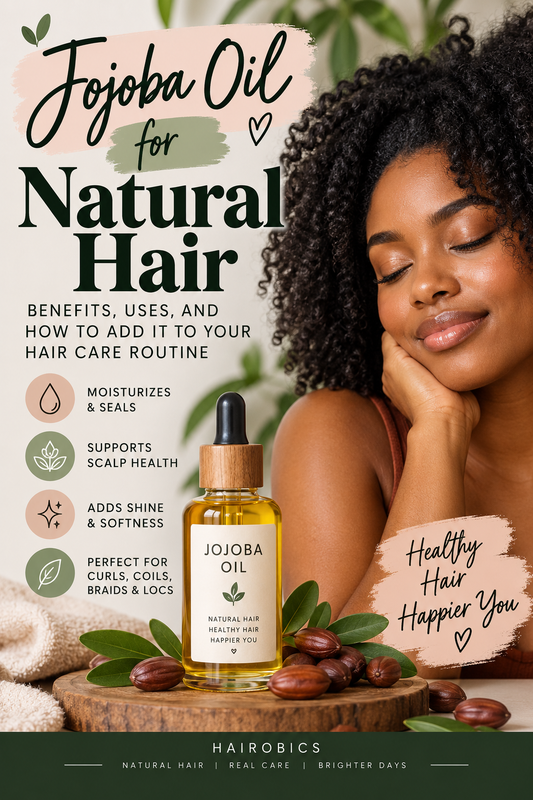
Natural hair thrives when it has the right balance of moisture, gentle handling, scalp care, and protection. While there are dozens of natural oils used in curly and textured hair routines, jojoba oil for natural hair has become a popular choice because of its lightweight feel, versatility, and unique composition.
Unlike heavier oils that may leave some hair types feeling coated or greasy, jojoba oil can be relatively light and easy to spread. It can be used on the scalp, applied to the ends of the hair, mixed with other oils, or incorporated into a moisturizing routine.
Whether you have type 3 curls, type 4 coils, low-porosity hair, high-porosity hair, braids, twists, or locs, jojoba oil may have a place in your routine.
In this complete guide, we'll explore the benefits of jojoba oil for natural hair, how to use it, how often to apply it, whether it can support healthier hair growth, and common mistakes to avoid.
What Is Jojoba Oil?
Jojoba oil comes from the seeds of the jojoba plant, Simmondsia chinensis, a shrub native to dry regions of North America.
Interestingly, jojoba oil isn't technically an oil in the same way that coconut, olive, or avocado oil is. It consists primarily of liquid wax esters.
That distinction helps explain some of jojoba oil's distinctive characteristics.
Jojoba oil is known for being:
- Lightweight
- Relatively stable
- Easy to spread
- Suitable for scalp and hair application
- Useful for sealing in moisture
- Compatible with many natural hair routines
Because natural hair can be prone to dryness, especially when tightly curled or coiled, jojoba oil can be useful as part of a routine designed to keep hair soft, manageable, and protected.
12 Benefits of Jojoba Oil for Natural Hair
Jojoba oil isn't a miracle treatment, but it has several properties that can make it useful for textured hair.
Here are some of the biggest potential jojoba oil benefits for natural hair.
1. Helps Seal Moisture Into Natural Hair
One of the most important things to understand about oils is that oil and moisture are not the same thing.
Water provides hydration.
Oil can help reduce how quickly that moisture is lost.
This distinction is especially important for natural hair.
If your hair constantly feels dry, simply applying more oil may not solve the problem. Instead, apply a water-based moisturizer or leave-in conditioner first and then use a small amount of jojoba oil to help seal that moisture into your strands.
A simple routine might look like this:
Water → Leave-in conditioner → Jojoba oil
This approach can be particularly helpful for people whose hair feels moisturized immediately after wash day but becomes dry again shortly afterward.
2. Lightweight Enough for Many Hair Types
Some natural oils can feel extremely heavy.
Castor oil, for example, has a thick consistency that some people love but others find difficult to distribute.
Jojoba oil is generally lighter.
That makes it especially attractive for people who want the benefits of an oil without making their curls feel excessively greasy or weighed down.
People with:
- Fine natural hair
- Loose curls
- Low-density hair
- Low-porosity hair
may particularly appreciate lighter applications.
However, how much you use matters.
Even lightweight oils can create buildup when they're repeatedly applied without properly cleansing the hair.
3. Helps Keep Natural Hair Soft
Dry natural hair can feel rough, stiff, or difficult to manipulate.
Applying jojoba oil after moisturizing may help create a smoother feel along the hair shaft.
This can make the hair feel:
- Softer
- More flexible
- Easier to style
- Less rough
- More manageable
Soft hair can also be easier to detangle gently.
Remember that the goal isn't necessarily to make your hair feel oily. You generally want enough product to provide slip and softness without leaving your strands saturated.
4. Can Be Used on a Dry Scalp
Many people with natural hair use jojoba oil as part of their scalp-care routine.
A few drops can be massaged into the scalp when it feels dry.
The key word is small.
You don't need to completely coat your scalp in oil.
Using too much can contribute to buildup, especially if you also use styling creams, gels, pomades, edge controls, and leave-in conditioners.
Start with a few drops and increase only if necessary.
And remember: persistent itching, flaking, redness, sores, or other scalp problems aren't always caused by simple dryness. If symptoms continue or worsen, consider speaking with a dermatologist or other qualified healthcare professional.
5. Works Well for Scalp Massage
Jojoba oil can also work as a lubricant for scalp massage.
Scalp massage can feel relaxing and helps you manipulate the scalp without excessive friction.
Place a few drops of jojoba oil on your fingertips and gently massage your scalp using small circular motions.
Avoid aggressively scratching your scalp with your fingernails.
A scalp massage doesn't need to last 30 minutes.
Even several minutes can be enough to incorporate it into your regular self-care routine.
6. Helps Protect Dry Ends
The ends of your hair are the oldest part of your strands.
That means they've experienced more:
- Washing
- Styling
- Detangling
- Environmental exposure
- Friction
- Manipulation
than the newer hair near your scalp.
This is one reason ends can become dry, rough, split, and fragile.
After moisturizing your hair, concentrate a tiny amount of jojoba oil on the ends.
This may help keep them lubricated and reduce friction during styling.
However, no oil can permanently repair split ends. If your ends are severely split or damaged, trimming may ultimately be necessary.
7. Adds Natural-Looking Shine
Natural hair doesn't always reflect light in the same way straight hair does.
The bends and curves of curly and coily strands can scatter light, which may make healthy textured hair appear less shiny.
Jojoba oil can provide a subtle sheen without requiring an extremely heavy application.
Try rubbing one or two drops between your palms and lightly smoothing your hands over your finished hairstyle.
This can work especially well for:
- Twist-outs
- Braid-outs
- Wash-and-gos
- Puffs
- Buns
- Two-strand twists
The goal is a healthy-looking sheen—not greasy hair.
8. Can Reduce Friction During Styling
Friction can contribute to mechanical damage.
Natural hair is particularly vulnerable when it's tangled, dry, or manipulated roughly.
A small amount of jojoba oil can provide additional lubrication when styling or separating curls.
For example, when unraveling a twist-out, rub a tiny amount between your fingertips before taking the twists apart.
This can make your fingers glide more easily over the strands and may help minimize unnecessary friction.
9. Useful for Protective Styles
Jojoba oil doesn't have to disappear from your routine just because you're wearing braids or twists.
You can use small amounts while wearing protective styles such as:
- Box braids
- Knotless braids
- Cornrows
- Two-strand twists
- Flat twists
- Crochet styles
If your scalp or exposed natural hair becomes dry, apply a light water-based moisturizer first when appropriate, followed by a small amount of oil.
Avoid repeatedly soaking your scalp in oil.
Protective styles can already make buildup harder to remove, so moderation is particularly important.
10. Can Work for Locs
People with locs often prefer products that don't leave heavy residue behind.
Because jojoba oil is relatively lightweight, it can be an option for maintaining softness and adding shine to locs.
A simple routine could involve lightly misting your locs with water or a water-based moisturizing spray and then smoothing a very small amount of jojoba oil over them.
The emphasis should be on light application.
Locs can trap excess products, so continually applying thick layers of oils and creams can eventually contribute to buildup.
11. Can Be Combined With Other Hair Oils
You don't necessarily have to use jojoba oil alone.
It can be incorporated into an oil blend with other carrier oils.
Popular combinations include:
- Jojoba oil + castor oil
- Jojoba oil + coconut oil
- Jojoba oil + avocado oil
- Jojoba oil + sweet almond oil
- Jojoba oil + grapeseed oil
For example, if you like castor oil but find it too thick, combining it with a lighter oil such as jojoba can create a thinner mixture that's easier to distribute.
When using essential oils, however, proper dilution and safety precautions are important. Essential oils are highly concentrated and should not simply be poured directly onto the scalp.
12. Can Support a Healthy Hair-Retention Routine
One of the biggest misconceptions surrounding hair oils is that applying an oil automatically makes hair grow dramatically faster.
Hair growth is influenced by many factors, including genetics, age, nutrition, health, hormones, and hair-care practices.
There isn't strong evidence that jojoba oil itself dramatically accelerates human hair growth.
But that doesn't mean it's useless for people trying to grow longer hair.
There is an important difference between hair growth and length retention.
Your scalp grows hair from the follicles.
You retain length by preventing excessive breakage of the hair you've already grown.
If jojoba oil helps you keep your strands moisturized, lubricated, and easier to manipulate gently, it may indirectly support a routine designed to reduce breakage and retain more length.
Is Jojoba Oil Good for Black Hair?
Yes, jojoba oil can be a useful option for Black hair and Afro-textured hair.
Black hair commonly has pronounced curls, coils, and bends.
Natural scalp oils may have difficulty traveling all the way down tightly curled strands compared with straighter hair.
As a result, the mid-lengths and ends may become dry more easily.
Using a small amount of jojoba oil after applying moisture can help create a more comfortable balance.
It can be especially useful for:
- Type 3 curly hair
- Type 4 natural hair
- 4A hair
- 4B hair
- 4C hair
- Transitioning hair
- Protective styles
- Locs
- Twists
- Braids
Your curl type isn't the only factor that matters, though.
Hair porosity, strand thickness, density, styling habits, climate, and product usage can all influence whether jojoba oil works well for you.
Jojoba Oil for 4C Hair
Jojoba oil for 4C hair can be particularly useful as a sealing oil.
4C hair has very tight coils and can experience significant shrinkage.
Because the strand has many bends, maintaining softness and reducing unnecessary friction can be especially important.
Try this routine:
- Divide your hair into manageable sections.
- Lightly dampen each section.
- Apply your favorite leave-in conditioner.
- Apply several drops of jojoba oil.
- Work the product through the section.
- Twist or braid the section.
- Cover your hair with satin or silk at night.
Don't assume that 4C hair automatically needs enormous amounts of oil.
Start small.
If your hair still feels dry, consider whether you need more water or conditioner rather than simply adding another layer of oil.
Jojoba Oil for Low-Porosity Hair
Low-porosity hair has cuticles that tend to resist the movement of water and products into the strand.
People with low-porosity hair often complain that products seem to sit on top of their hair.
Heavy butters and oils can sometimes make this worse.
Jojoba oil's lighter texture can make it worth experimenting with.
Use only a small amount after your water-based moisturizing product.
Applying your moisturizer to damp, warm hair may also help with product distribution.
The most important rule is to pay attention to how your own hair responds.
If your hair begins feeling waxy, greasy, coated, or unusually dull, you may be using too much product.
Jojoba Oil for High-Porosity Hair
High-porosity hair tends to take in moisture easily but may also lose it relatively quickly.
This can occur naturally or become more pronounced after:
- Bleaching
- Coloring
- Excessive heat
- Chemical processing
- Mechanical damage
Jojoba oil can be used after a moisturizing product to help reduce that dry feeling between wash days.
However, people with very porous hair may find that jojoba oil alone isn't rich enough.
In that case, you could experiment with combining it with a heavier product or oil.
How to Use Jojoba Oil for Natural Hair
There isn't only one way to use jojoba oil.
Here are several methods you can experiment with.
Method 1: Use Jojoba Oil as a Sealant
This is one of the easiest approaches.
After washing your hair:
- Leave your hair damp.
- Apply a leave-in conditioner.
- Divide your hair into sections.
- Add a few drops of jojoba oil to each section.
- Concentrate on your ends.
- Style normally.
Remember:
Moisturizer first. Oil second.
Method 2: Use It for Scalp Massage
Apply a few drops to your fingertips.
Gently massage the scalp for several minutes.
Avoid saturating the scalp or scratching aggressively.
You can do this occasionally as part of your routine rather than automatically applying oil every day.
Method 3: Add Jojoba Oil to Your Deep Conditioner
If you enjoy customizing your wash-day routine, try adding a small amount of jojoba oil to a portion of deep conditioner immediately before applying it.
Don't pour a large quantity into the entire container.
Mixing products can sometimes change how a formula performs, so it's better to experiment with a single-use portion first.
Method 4: Apply It to Your Ends
Your ends often need the most attention.
After moisturizing, rub several drops of jojoba oil between your fingers and gently smooth it over the ends.
Then tuck your ends into a low-manipulation hairstyle when appropriate.
Method 5: Use It for Twist-Outs
Jojoba oil can be useful during both the installation and takedown of a twist-out.
After applying your moisturizer and styling product, use a small amount of oil before twisting.
When you're ready to unravel the twists, put one or two drops on your fingertips.
Carefully separate each twist.
This may help reduce friction while providing a subtle shine.
Jojoba Oil for Braids
If you're wearing braids for several weeks, don't forget about the natural hair underneath.
You can lightly mist the exposed hair with a water-based moisturizing product and apply a small amount of jojoba oil afterward.
Pay attention to:
- Your roots
- Exposed sections of natural hair
- Your scalp
- The ends of your natural hair inside the braids
Avoid applying large amounts every day.
Remember that all those products will eventually need to be washed out.
Jojoba Oil for Locs
Locs require a slightly different approach.
Heavy products can become trapped inside locs and create buildup over time.
Jojoba oil can work because only a small amount is necessary.
Try:
Light moisturizing mist → small amount of jojoba oil
Gently distribute the product along your locs.
If your locs feel greasy afterward, you've probably used more than you need.
Jojoba Oil vs. Coconut Oil for Natural Hair
Both oils can be useful, but they're different.
Coconut oil is rich in lauric acid and has been studied for its ability to penetrate hair and reduce protein loss under certain conditions.
Jojoba oil behaves differently and is composed largely of wax esters.
Coconut oil may be better suited for people whose hair responds well to penetrating oils.
Jojoba oil may appeal more to someone looking for a lighter-feeling finishing or sealing product.
Some people find coconut oil makes their hair feel stiff or dry.
If that sounds familiar, jojoba oil may be worth trying.
Jojoba Oil vs. Castor Oil
Castor oil is much thicker than jojoba oil.
For thick, dense hair, that heaviness may be desirable.
For fine or easily weighed-down hair, it can be excessive.
Jojoba oil:
- Feels lighter
- Spreads more easily
- Works well for light sealing
- May create less of a heavy coated feeling
Castor oil:
- Is much thicker
- Provides heavier lubrication
- Can work well for very dry-feeling hair
- May be too heavy for some routines
You can also combine the two.
Jojoba Oil vs. Argan Oil
Argan oil and jojoba oil are both popular lightweight options.
Argan oil is often used to improve the feel, smoothness, and shine of hair.
Jojoba oil can perform similar cosmetic roles while also being commonly used directly on the scalp.
Neither one is universally better.
Your hair's response should determine which you choose.
Can Jojoba Oil Grow Hair?
This question deserves a clear answer.
Jojoba oil should not be treated as a guaranteed hair-growth treatment.
Applying jojoba oil isn't proven to suddenly make your follicles produce dramatically more hair.
However, healthy-looking long natural hair isn't only about how quickly hair grows.
It's also about how much hair you retain.
Imagine your hair grows approximately half an inch in a month, but your ends continually snap off.
You may feel like your hair isn't growing even though new hair is being produced.
Reducing excessive dryness, friction, tangling, and breakage can make it easier to retain the hair you've grown.
That's where a well-designed moisturizing and sealing routine can be helpful.
How Often Should You Use Jojoba Oil on Natural Hair?
There is no universal schedule.
Some people may use it several times a week.
Others may only need it on wash day.
Your ideal frequency depends on:
- Hair porosity
- Hair density
- Strand thickness
- Climate
- Hairstyle
- How frequently you wash
- Other products in your routine
Start with once or twice per week and observe your hair.
If it becomes greasy, heavy, or coated, reduce the amount or frequency.
If your hair becomes dry between applications, first determine whether it actually needs more moisture rather than more oil.
Can You Leave Jojoba Oil in Your Hair Overnight?
Yes, jojoba oil can generally be used as a leave-in oil when your scalp and hair tolerate it.
You don't need to drench your hair.
Apply a light amount, particularly to dry areas and ends.
Then protect your hair overnight with:
- A satin bonnet
- A satin scarf
- A silk scarf
- A satin pillowcase
Your hair shouldn't necessarily be dripping with oil when you go to sleep.
Can You Use Jojoba Oil Every Day?
You can, but that doesn't mean you should.
Daily application can lead to unnecessary buildup for some people.
If your hair seems to require oil every single day, examine the rest of your routine.
Ask yourself:
- Am I drinking—no, applying—enough actual moisture to my hair?
- Is my leave-in conditioner working?
- Am I using too much shampoo?
- Do I have product buildup?
- Am I sleeping without satin protection?
- Are my ends damaged?
- Is my environment particularly dry?
Oil should complement your moisturizing routine rather than replace it.
Can Jojoba Oil Cause Buildup?
Yes.
Virtually any hair product can contribute to buildup when used excessively.
This includes natural oils.
Repeatedly layering:
- Jojoba oil
- Leave-in conditioner
- Curl cream
- Gel
- Edge control
- Butter
- Styling mousse
without adequate cleansing can eventually leave hair feeling coated.
Signs of product buildup may include:
- Dull-looking hair
- Greasy roots
- Hair that feels coated
- Products no longer working as expected
- Hair that doesn't seem to absorb water easily
- Flaking from product residue
Regular cleansing is still important even when you use natural ingredients.
Should You Apply Jojoba Oil to Wet or Dry Hair?
For moisture retention, applying jojoba oil to damp or moisturized hair is generally more useful than putting oil on completely dry hair.
Why?
Because oil doesn't provide the same hydration as water.
If your hair is already extremely dry and you simply coat it in oil, it may feel smoother temporarily while still lacking moisture.
A better sequence is:
Water → Leave-in/moisturizer → Jojoba oil
You can still use a tiny amount on dry hair to add shine or reduce friction during styling.
Best Jojoba Oil Routine for Natural Hair
Here's a simple weekly routine.
Step 1: Cleanse
Wash your scalp and hair thoroughly enough to remove sweat, dirt, and accumulated products.
Step 2: Condition
Use a conditioner with good slip and carefully detangle.
Step 3: Deep Condition When Needed
Deep conditioning can be helpful when your hair feels particularly dry or stressed.
Step 4: Apply a Leave-In
Apply a water-based leave-in conditioner to damp hair.
Step 5: Seal With Jojoba Oil
Use several drops per section.
Focus especially on the ends.
Step 6: Choose a Low-Manipulation Style
Consider:
- Two-strand twists
- Braids
- Buns
- Flat twists
- Braid-outs
- Twist-outs
Step 7: Protect Your Hair at Night
Wear satin or silk protection to reduce friction against your pillow.
This combination can be far more important than relying on a single "miracle" oil.
Common Mistakes When Using Jojoba Oil
Even a good ingredient can be used incorrectly.
Mistake #1: Using Oil Instead of Moisturizer
This is probably the biggest mistake.
If your hair needs moisture, give it water or a water-based moisturizing product first.
Then use oil when appropriate.
Mistake #2: Using Too Much
More oil doesn't automatically mean healthier hair.
Start small.
You can always add more.
Removing excess oil is much harder.
Mistake #3: Never Washing It Out
Natural doesn't mean buildup-free.
Cleanse your hair and scalp regularly.
Mistake #4: Expecting Overnight Hair Growth
Hair growth takes time.
No single oil can replace:
- Good nutrition
- Gentle handling
- Proper scalp care
- Consistent cleansing
- Moisture
- Breakage prevention
- Patience
Mistake #5: Ignoring Your Hair's Response
Someone else's perfect routine may be terrible for your hair.
Use your results as feedback.
If jojoba oil leaves your hair soft and manageable, continue using it.
If your hair consistently feels greasy, limp, or coated, reduce the amount or try something else.
Who Should Consider Jojoba Oil?
Jojoba oil may be particularly worth trying if you:
- Have natural or curly hair
- Prefer lightweight oils
- Have dry-feeling ends
- Wear braids or twists
- Have locs
- Want extra shine
- Need lubrication during styling
- Find castor oil too heavy
- Want an oil for sealing after moisturizing
People with very fine hair should start with extremely small amounts.
Frequently Asked Questions About Jojoba Oil for Natural Hair
Is jojoba oil good for natural hair?
Yes. Jojoba oil can be a useful lightweight oil for sealing moisture, lubricating strands, adding shine, and supporting a healthy natural-hair routine.
Does jojoba oil moisturize 4C hair?
Jojoba oil can help seal in moisture, but oil itself shouldn't replace water or a water-based moisturizer. Apply moisture first and then use jojoba oil.
Is jojoba oil good for low-porosity hair?
It can be. Its relatively lightweight feel may make it preferable to very thick oils for some people with low-porosity hair. Use small amounts to minimize buildup.
Is jojoba oil good for high-porosity hair?
Yes, it can be used as part of a moisture-sealing routine. Some people with highly porous hair may prefer combining it with richer products.
Can I put jojoba oil directly on my scalp?
A small amount can be applied directly to the scalp if your skin tolerates it. Avoid excessive applications, and discontinue use if irritation develops.
Does jojoba oil help hair grow?
Jojoba oil isn't proven to dramatically accelerate hair growth. However, it can support a routine focused on keeping hair manageable and minimizing unnecessary breakage, which may improve length retention.
Can I use jojoba oil on braids?
Yes. Use it sparingly on your scalp and natural hair while wearing braids, ideally after using a lightweight water-based moisturizing product when moisture is needed.
Can I use jojoba oil on locs?
Yes. Its relatively light texture can work well for locs when applied sparingly. Avoid excessive product application because buildup can become trapped inside locs.
Can jojoba oil be used on children's natural hair?
It can be incorporated into a simple hair-care routine when appropriate and tolerated, but use small amounts and avoid unnecessary essential-oil mixtures, particularly on young children.
Do I have to wash jojoba oil out?
If you're using a few drops as a leave-in sealant, you don't need to immediately wash it out. However, regular shampooing or cleansing is still necessary to prevent accumulated oil and product buildup.
How Long Does It Take to See Results?
That depends on what you mean by "results."
You may notice improved softness or shine immediately after applying jojoba oil correctly.
Changes in manageability and reduced dryness may become more apparent after several consistent wash-day cycles.
Length retention takes considerably longer to evaluate.
Instead of checking your hair every day, take photographs every one to three months under similar conditions.
Pay attention to:
- Breakage
- Split ends
- Overall length
- Hair softness
- Detangling difficulty
- Scalp condition
Consistency is more valuable than constantly switching between oils.
Building a Healthy Natural Hair Routine Beyond Jojoba Oil
It's easy to focus on individual ingredients.
But healthy natural hair requires a complete routine.
Jojoba oil works best as one piece of that system.
Prioritize:
Regular cleansing: Remove dirt, sweat, oil, and styling-product buildup.
Conditioning: Improve softness, slip, and manageability.
Gentle detangling: Work in sections and avoid ripping through knots.
Moisture: Use water and water-based products when your hair needs hydration.
Sealing: Use oils such as jojoba when appropriate to help maintain softness and reduce moisture loss.
Low manipulation: Constantly combing, brushing, pulling, and restyling can contribute to breakage.
Night protection: Satin and silk materials can reduce friction while you sleep.
Trimming: Remove severely damaged or split ends when necessary.
Scalp care: Keep the scalp clean and pay attention to persistent irritation or unusual changes.
No oil can compensate for a routine that consistently damages the hair.
Final Thoughts: Is Jojoba Oil Worth Using for Natural Hair?
For many people, yes.
Jojoba oil for natural hair is a versatile option that can fit into routines for curls, coils, 4C hair, low-porosity hair, high-porosity hair, braids, twists, and locs.
Its relatively lightweight consistency makes it especially appealing for people who dislike the heaviness of oils such as castor oil.
The most important thing is to use it correctly.
Don't depend on jojoba oil to provide all the moisture your hair needs. Start with water or a water-based moisturizing product and then use a small amount of jojoba oil to help seal in that moisture, lubricate your strands, protect your ends, or add shine.
And don't fall into the trap of believing that more oil equals faster hair growth.
Healthy natural hair is built through consistency.
Cleanse regularly, condition thoroughly, moisturize when necessary, minimize unnecessary manipulation, protect your hair at night, care for your scalp, and pay attention to how your hair responds.
Jojoba oil can be an excellent addition to that routine—but the routine as a whole is what matters most.