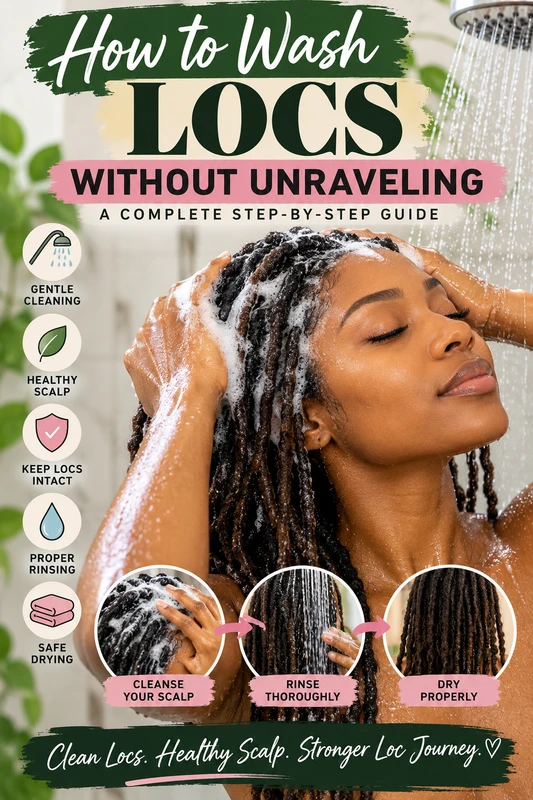
Washing your locs should leave your scalp clean and your hair refreshed—not make you feel like your entire loc journey is coming apart.
But if you have starter locs, comb coils, two-strand-twist locs, or another newer loc method, wash day can be intimidating.
You may wonder:
Can I wash my locs without them unraveling?
Yes.
The key is understanding that washing itself is not necessarily the problem. How you wash your locs makes the biggest difference.
New locs have not yet developed the tightly intertwined internal structure of mature locs. Aggressive rubbing, scratching, twisting, pulling, and towel drying can therefore loosen them much more easily.
That does not mean you should avoid cleansing your scalp indefinitely.
A healthy loc journey still requires a clean scalp and clean hair. Sweat, natural oils, dead skin, styling products, lint, and environmental debris can accumulate when locs are not washed regularly.
The goal is simple:
Clean your scalp and locs while creating as little unnecessary manipulation as possible.
This complete guide explains how to wash locs without unraveling, how starter locs should be handled differently from mature locs, what to do when a loc starts coming loose, and how to dry your locs properly after washing.
Table of Contents
- Can You Wash Locs Without Unraveling?
- Why Starter Locs Unravel During Washing
- When Can You First Wash Starter Locs?
- What You Need Before Wash Day
- How to Wash Locs Without Unraveling
- How to Wash Very New Starter Locs
- How to Wash Mature Locs
- Should You Use a Stocking Cap?
- How to Rinse Locs Properly
- How to Dry Locs Without Unraveling
- What to Do if a Loc Unravels
- Common Washing Mistakes
- How Often Should You Wash Locs?
- Moisturizing Locs After Washing
- Frequently Asked Questions
- Final Thoughts
Can You Wash Locs Without Unraveling?
Yes, you can wash locs while minimizing unraveling.
However, the amount of unraveling you experience depends heavily on the maturity of your locs and how they were started.
Mature locs are generally much more resistant to unraveling because the individual hairs have already intertwined and compacted.
Starter locs are different.
During the early stages, your hair is still learning to lock together. Your original coil, twist, braid, or other starter pattern may still be visible.
Water can cause the hair to swell and frizz. Shampooing adds movement. Rinsing adds more movement.
If you then aggressively scrub, twist, rub, or towel-dry the hair, you create even more manipulation.
That combination can cause some starter locs to loosen.
The solution is not necessarily avoiding water.
The solution is gentler technique.
Our guide to Starter Locs: What to Do the First 30 Days explains the especially delicate early stage in greater detail.
Why Do Starter Locs Unravel When You Wash Them?
A mature loc contains countless hairs that have intertwined with one another over time.
A brand-new starter loc does not yet have that structure.
Imagine a two-strand twist you created yesterday compared with a loc that has been developing for three years.
The twist is being held primarily by its pattern.
The mature loc is held together by a much more established network of intertwined hairs.
This is why new locs require additional care during washing.
Several things can increase unraveling.
Your Locs Are Extremely New
The newer your locs are, the less established their internal structure will be.
Your Hair Texture Unravels Easily
Some textures naturally hold starter methods more securely than others.
Your starting method should therefore be appropriate for your hair texture, lifestyle, and desired loc size.
You're Scrubbing Too Aggressively
Using the same vigorous circular motion you might have used on loose natural hair can disturb new locs.
You're Pulling Shampoo Through the Hair
Constantly squeezing, pulling, and rubbing individual starter locs can loosen them.
You're Rough-Drying Your Hair
You successfully make it through shampooing—and then aggressively rub your head with a towel.
That can undo the gentle handling you practiced during the wash.
You're Constantly Retwisting Loose Pieces
A little frizz after washing does not mean your locs have failed.
Frizz and puffiness are normal parts of loc development.
In fact, our guide explaining why new locs feel puffy discusses why swelling and frizz after washing do not automatically mean your locs are unraveling.
When Can You First Wash Starter Locs?
There is no universal number of days that works for every person.
Your starting method, hair texture, scalp condition, activity level, and loctician's technique all matter.
Someone with interlocked starter locs may have a very different washing experience from someone with freshly installed comb coils.
If a loctician installed your starter locs, follow the aftercare instructions they gave you based on your specific installation.
However, don't assume you must tolerate an extremely dirty, irritated scalp for months simply because you have starter locs.
If you're experiencing significant sweat, flakes, itching, or buildup, your scalp may need cleansing.
Hairobics has a separate guide explaining how often you should wash locs based on loc maturity, scalp condition, activity level, and other factors.
What You'll Need to Wash Locs Without Unraveling
You don't need an enormous collection of products.
Keeping wash day simple can actually make loc maintenance easier.
Consider having:
- A shampoo appropriate for your scalp and hair
- Lukewarm water
- A microfiber towel or soft T-shirt
- Hair clips if your mature locs need to be divided into sections
- A dryer or sufficient air-drying time
- A lightweight water-based moisturizer for after your hair is clean and appropriately dried
Avoid turning every wash into a complicated layering routine.
Locs can hold onto products, particularly when those products are thick, sticky, oily, or difficult to rinse.
How to Wash Locs Without Unraveling: Step by Step
Here is the basic technique.
Step 1: Prepare Your Locs
Before getting into the shower, examine your hair.
Look for starter locs that are already significantly loose.
If you have mature locs, gently separate them so you can reach your scalp easily.
Avoid unnecessarily combing, pulling, or manipulating the roots.
If your locs are extremely new, your main objective is keeping the sections intact while cleansing your scalp.
Step 2: Completely Wet Your Hair
Use lukewarm water and allow it to flow over your scalp and locs.
Don't immediately start scrubbing.
Give the water time to saturate your hair.
This is particularly important with thick, dense, or mature locs because water may take longer to penetrate them.
Gently press water through the hair rather than aggressively rubbing your locs together.
Step 3: Concentrate Shampoo on Your Scalp
This is one of the most important steps for preventing unnecessary unraveling.
Your scalp is where oil, sweat, flakes, dead skin, and much of your residue accumulate.
Apply shampoo primarily to the scalp.
Use the pads of your fingertips—not your fingernails—to gently massage your scalp.
Instead of aggressive circular scrubbing, use controlled movements between your parts.
With delicate starter locs, try to disturb the roots as little as reasonably possible.
You want your scalp clean without turning wash day into a vigorous scalp massage.
Step 4: Let the Lather Move Through Your Locs
You don't need to aggressively scrub every starter loc.
As you rinse, allow the shampoo and water to travel down the hair.
For mature locs that require additional cleansing, you can gently work shampoo through them using squeezing motions.
Think:
press and release.
Not:
rub, twist, scrub, and pull.
That difference becomes especially important when you're trying to preserve starter locs.
Step 5: Rinse Thoroughly
Never sacrifice rinsing because you're afraid of unraveling.
Shampoo left behind can create another problem: residue.
Allow water to flow from the scalp through the length of your locs.
Gently squeeze mature locs to help release shampoo.
Continue rinsing until the water runs clear and you no longer feel cleanser in your hair.
Dense locs may require significantly more rinsing than you expect.
A thorough rinse helps reduce residue that can contribute to dullness, stiffness, itching, and buildup.
If residue has already become an issue, read our guide explaining why locs can feel stiff and how to make them softer again.
Step 6: Repeat Shampoo Only if Necessary
You don't automatically need three or four shampoo rounds.
If your scalp was extremely oily or dirty and the first cleanse did not remove enough residue, a second gentle cleanse may be appropriate.
But more shampoo is not automatically better.
The objective is clean hair—not stripping your hair unnecessarily.
With very delicate starter locs, minimizing unnecessary manipulation is particularly important.
Step 7: Remove Excess Water Carefully
Once you're finished rinsing, don't grab your locs and violently wring them out.
For mature locs, gently squeeze excess water downward.
For starter locs, be even more cautious.
Place a microfiber towel or soft T-shirt around your hair and gently blot or press out excess moisture.
Avoid rubbing your head back and forth with a rough bath towel.
That friction can create unnecessary frizz and loosen delicate starter locs.
How to Wash Very New Starter Locs
Starter locs deserve their own section because this is where most unraveling concerns occur.
Your strategy should be:
clean scalp + minimal manipulation.
Instead of repeatedly rubbing the length of every loc, focus your attention on the scalp.
Work carefully between the parts.
Let shampoo and water do much of the work.
Rinse in the direction your locs naturally hang rather than tossing them around continuously.
Some frizz is normal.
Some puffiness is normal.
Some loosening may also occur.
Do not evaluate the success of your wash based on whether every hair looks exactly as neat as it did immediately after your installation.
Your hair is supposed to change during the locking process.
How to Wash Mature Locs
Once your locs are mature, you generally have more flexibility.
Mature locs are less likely to completely unravel from normal shampooing.
That doesn't mean you should scrub them aggressively.
Your focus becomes:
scalp cleanliness + buildup prevention + thorough rinsing + complete drying.
Mature locs can trap residue internally.
Pay particular attention to rinsing if your locs are:
- Very thick
- Long
- Dense
- Frequently styled
- Exposed to heavy sweating
- Regularly treated with styling products
Clean locs are an important part of long-term loc maintenance.
Should You Wash Starter Locs With a Stocking Cap?
The stocking-cap method is sometimes used to reduce manipulation during early starter-loc washes.
The basic concept is simple: a clean mesh or stocking-type cap holds the starter locs in place while water and diluted cleanser move through them.
This can be helpful for very delicate starter locs.
However, it isn't mandatory for everyone.
Some people can successfully wash starter locs without a cap by simply using gentle technique.
If you use a cap, don't treat it as permission to aggressively scrub through the material.
You still want gentle pressure.
And most importantly, rinse thoroughly.
The cap should help reduce movement—not prevent water from properly cleansing and rinsing your hair.
Don't Confuse Frizz With Unraveling
This distinction is extremely important.
Your locs can become frizzy after washing without actually unraveling.
Frizz means individual hairs are sticking out from the loc.
Unraveling means the original starter structure is actually coming apart.
Water naturally causes textured hair to swell.
New growth may become more visible.
Loose hairs may stand away from the loc.
The loc may appear thicker or puffier.
None of these automatically means something has gone wrong.
Trying to eliminate every loose hair after every wash can actually lead to over-manipulation.
Allow your locs time to mature.
How to Dry Locs Without Causing Unraveling
Drying is just as important as shampooing.
First, gently remove excess water.
Do not aggressively wring starter locs.
Do not rub them rapidly with a towel.
Instead, blot and press.
Then allow enough time for your hair to dry completely.
This becomes increasingly important as locs become thicker and denser because the outside of a loc can feel dry while moisture remains trapped inside.
Whenever possible, wash early enough in the day that you are not forced to go to bed with wet locs.
Avoid immediately putting soaking-wet locs under a bonnet, scarf, hat, or tight style for hours.
Complete drying helps keep locs fresh and prevents the prolonged dampness that can contribute to an unpleasant musty odor.
What Should You Do if a Loc Unravels After Washing?
Don't panic.
A small amount of unraveling does not necessarily mean you ruined your loc journey.
First determine how much actually came loose.
Minor Loosening
If the end or a small portion becomes loose, leave it alone until it can be addressed appropriately during maintenance.
Constantly twisting it throughout the day can create more manipulation.
Significant Unraveling
If a large portion of a starter loc completely comes apart, especially repeatedly, your starting method may need attention.
A professional loctician can determine whether it should be reconstructed or whether another starter method would hold better for your hair.
Multiple Locs Unravel Every Wash
Look at your washing technique.
Are you aggressively scrubbing?
Are you rubbing with a towel?
Are you manipulating your locs constantly while they're wet?
Are you washing immediately after a fresh starter installation despite being advised to wait?
Or is your starter method simply not holding well for your particular texture?
Correct the cause instead of repeatedly forcing the locs back together.
10 Washing Mistakes That Can Make Locs Unravel
1. Scratching With Your Fingernails
Use your fingertips instead.
Aggressive scratching can irritate your scalp and disturb your roots.
If itching is a recurring problem, see our guide to stopping an itchy scalp with locs rather than simply scratching harder.
2. Scrubbing Starter Locs Together
You don't need to rub loc against loc to make your hair clean.
3. Using Aggressive Circular Motions
Be particularly gentle around new roots and starter sections.
4. Rough Towel Drying
Rubbing a towel rapidly across your head creates friction.
Blot instead.
5. Constantly Touching Wet Starter Locs
Wet hair doesn't need to be repeatedly twisted, rolled, and inspected.
Let it dry.
6. Trying to Eliminate Every Bit of Frizz
Frizz is part of the locking process.
7. Using Excessive Product
More product can mean more residue, which eventually requires more aggressive cleansing.
Keep your routine simple.
8. Not Rinsing Thoroughly
Shampoo residue trapped inside locs can contribute to buildup.
9. Going to Bed With Wet Locs
Give your locs adequate drying time.
10. Avoiding Washing for Months
Fear of unraveling shouldn't lead to an unhealthy scalp.
Your locs need cleanliness too.
How Often Should You Wash Locs?
There isn't one schedule that fits every head of locs.
Your ideal washing frequency depends on:
- Loc maturity
- Scalp oil production
- Exercise frequency
- Sweating
- Product usage
- Dandruff or scalp concerns
- Hair density
- Loc thickness
- Lifestyle
For many people with established locs, approximately every 7–14 days can be a practical starting point, although individual needs vary.
Someone who exercises frequently may need more frequent cleansing.
Someone with very new starter locs may initially use a different schedule based on their starting method and professional guidance.
What you don't want to do is allow fear of unraveling to become an excuse for continuously accumulating sweat, oil, dead skin, and styling products.
Regular cleansing also helps reduce the sticky residue that can attract environmental debris. Our guide to why locs collect lint and how to prevent it explains why keeping locs clean is part of lint prevention.
Should You Retwist Every Time You Wash Your Locs?
No.
Washing and retwisting do not have to happen on the same schedule.
This is an important concept because some people avoid washing because they think every shampoo requires another retwist.
It doesn't.
You can cleanse your scalp while allowing your new growth to remain natural between maintenance sessions.
Constant retwisting can place unnecessary manipulation on the roots.
This is particularly important if your locs are already showing signs of weakness.
If you notice reduced density or narrow areas near the scalp, read Why Are My Locs Thinning at the Roots? for a closer look at tension, manipulation, breakage, and other potential causes.
Should You Condition Locs After Washing?
This depends on the maturity of your locs and the product.
Some people with mature locs successfully use lightweight conditioners that rinse cleanly.
However, very creamy, heavy, or difficult-to-rinse formulas can become problematic in dense locs.
Starter locs also require additional caution because extremely slippery conditioning products may make it easier for delicate starter patterns to loosen.
Whatever you use, rinse thoroughly.
You don't want conditioner trapped inside the loc.
How to Moisturize Locs After Washing
Clean locs don't need to be covered immediately with multiple layers of thick products.
After your hair has been cleansed and appropriately dried, evaluate how it feels.
Does it feel flexible?
Does it feel dry?
Does your scalp feel comfortable?
If your locs need moisture, focus on lightweight hydration.
Remember:
Water hydrates hair.
Oil and other products should not be used as substitutes for hydration.
For a complete moisture routine, read How to Moisturize Locs Properly.
For lightweight moisture between wash days, Hairobics All Natural Raaw Roots Locs & Braids Moisturizer Spray can be incorporated into your routine as needed.
Shop Hairobics Raaw Roots Locs & Braids Moisturizer Spray
Use lightweight moisture according to your hair's needs rather than continuously saturating locs with multiple heavy products.
A Simple Starter-Loc Wash-Day Routine
If all of this information feels overwhelming, simplify it.
Before Washing
Inspect your starter locs and identify any sections already coming loose.
During Washing
Thoroughly wet your hair.
Apply shampoo primarily to the scalp.
Gently massage using your fingertips.
Avoid aggressive scratching.
Allow the lather to move down the locs.
During Rinsing
Let the water flow downward.
Rinse thoroughly.
Avoid unnecessary twisting and pulling.
After Washing
Gently blot away excess water.
Do not aggressively rub with a towel.
Allow your locs to dry completely.
Between Washes
Keep your scalp clean and comfortable.
Use lightweight moisture when your locs need it.
Avoid constantly retwisting loose hairs.
Protect your locs at night with satin or silk.
That's it.
Your loc routine does not have to be complicated.
Starter Locs vs. Mature Locs: Washing Differences
| Starter Locs | Mature Locs |
|---|---|
| Require very gentle handling | Can tolerate normal gentle cleansing |
| More likely to loosen | Much less likely to unravel |
| Focus shampoo on scalp | Clean scalp and loc lengths as needed |
| Avoid excessive manipulation | Gentle squeezing is generally easier |
| Frizz is expected | Some frizz is still normal |
| Starting method affects wash routine | Internal loc structure is established |
| Be cautious with slippery products | More product flexibility |
| Avoid aggressive towel drying | Still avoid rough drying |
The biggest difference is simply structural maturity.
As your locs mature, washing usually becomes easier.
Frequently Asked Questions About Washing Locs Without Unraveling
Can I wash starter locs without unraveling them?
Yes. Use gentle scalp-focused cleansing, minimize manipulation, rinse thoroughly, and avoid aggressive towel drying. Very new starter locs may still experience some loosening or frizz.
Will water make my locs unravel?
Water itself doesn't automatically destroy locs. New starter locs are simply more vulnerable to manipulation while washing. Mature locs should generally tolerate regular washing well.
How do you wash starter locs without messing them up?
Focus shampoo primarily on your scalp, massage gently with your fingertips, let the lather travel through your hair, rinse thoroughly, and blot instead of rubbing your hair dry.
Is it normal for starter locs to unravel a little after washing?
Yes, some loosening can happen during the early stages. Frizz and puffiness are also common and should not automatically be mistaken for complete unraveling.
Should I retwist loose locs immediately after washing?
Not necessarily. Constantly retwisting and manipulating your hair can create unnecessary stress. Minor looseness can often wait until your regular maintenance session.
Can I wash locs without retwisting afterward?
Absolutely. Washing and retwisting do not need to occur at the same frequency.
How often should starter locs be washed?
There is no single schedule for everyone. Your starting method, scalp condition, sweating, exercise, and your loctician's recommendations should help determine frequency.
Should I wash my locs if they're itchy?
If sweat, oil, or buildup is contributing to itching, cleansing may help. Persistent itching, redness, sores, significant flaking, or other scalp problems should be evaluated rather than simply covered with more oil.
Can I wash locs every week?
Many people with established locs can successfully wash weekly, particularly if they exercise frequently or have an oily scalp. Very new starter locs may require a more individualized routine.
Should I use hot water on locs?
Lukewarm water is generally sufficient. Extremely hot water isn't necessary to clean your locs and may leave the scalp and hair feeling dry.
Can shampoo buildup get trapped inside locs?
Yes. Dense locs can retain shampoo if they are not rinsed thoroughly. Take your time and continue rinsing until the cleanser has been completely removed.
Why are my locs frizzy after washing?
Water causes textured hair to swell, and loose hairs may move away from the loc. This is particularly noticeable with starter locs. Frizz does not necessarily mean the loc is unraveling.
Should I wash my locs before a retwist?
Starting a retwist with a clean scalp and clean hair is generally preferable to retwisting over layers of sweat and product residue.
How can I keep my locs neat between washes?
Reduce unnecessary manipulation, protect your hair at night with satin or silk, use lightweight moisture as needed, and avoid continuously applying heavy waxes, creams, and gels.
What happens if one starter loc completely unravels?
Don't panic. A loctician can assess whether the loc should simply be restarted or whether the original starting method needs to be adjusted.
Final Thoughts: Clean Locs Don't Have to Mean Unraveled Locs
Learning how to wash locs without unraveling comes down to one major principle:
Clean your hair without over-manipulating it.
Starter locs are delicate because they haven't developed the internal structure of mature locs yet.
That means you need to be gentle—but it doesn't mean you should be afraid of cleanliness.
Focus shampoo on your scalp.
Use your fingertips instead of your nails.
Let water and lather flow through your locs.
Don't aggressively rub starter locs together.
Rinse thoroughly.
Blot rather than scrub with a towel.
Allow your locs to dry completely.
And don't panic over normal frizz.
As your locs mature, they will become more compact and increasingly resistant to unraveling. Wash day usually becomes much easier with time.
Most importantly, don't sacrifice scalp health simply to keep every starter loc looking perfectly neat.
Your goal isn't perfectly polished locs every day.
Your goal is a clean scalp, healthy hair, strong roots, and locs that have the opportunity to mature naturally.
Keep Your Loc Routine Simple
Between wash days, lightweight hydration can help keep locs from feeling excessively dry without coating them in heavy layers of product.
For locs that need a refreshing moisture boost, consider Hairobics All Natural Raaw Roots Locs & Braids Moisturizer Spray as part of a simple loc-care routine.
Shop Raaw Roots Locs & Braids Moisturizer Spray at Hairobics All Natural
Hairobics All Natural — Natural care for healthy locs, braids, scalp, and textured hair.