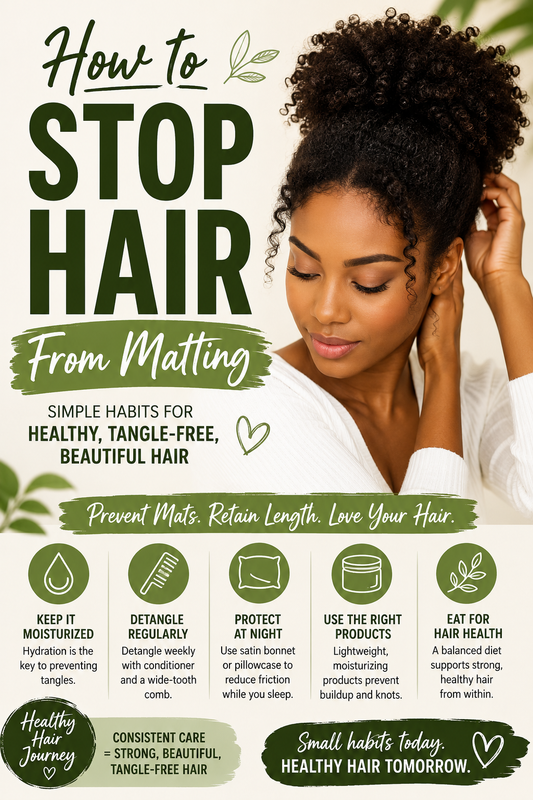
Hair matting is one of the most frustrating problems anyone can experience. Whether you have natural hair, curly hair, coils, locs, relaxed hair, or chemically treated hair, severe tangles can quickly turn into painful mats that are difficult to remove without causing breakage.
The good news is that hair matting is usually preventable with the right hair care routine. By keeping your hair moisturized, minimizing friction, and detangling correctly, you can dramatically reduce the chances of your hair becoming matted.
In this complete guide, you'll learn:
- Why hair mats
- Common causes of severe tangles
- How to prevent matting
- Best products and ingredients
- Daily and weekly routines
- Mistakes to avoid
- How to safely detangle matted hair
- Tips for natural hair, locs, braids, and curly hair
What Is Hair Matting?
Hair matting happens when multiple strands become tightly tangled together, forming thick knots that are difficult to separate.
Unlike ordinary tangles, mats often:
- Feel hard or compact
- Become painful to brush
- Trap shed hairs
- Cause breakage during detangling
- Make washing difficult
If left untreated, mats can become larger over time and sometimes require cutting.
Why Does Hair Become Matted?
Hair naturally sheds every day.
Most people lose between 50 and 100 hairs daily.
Normally, these shed hairs fall away during brushing or washing.
However, if the shed hairs remain trapped within your curls or coils, they begin wrapping around healthy strands.
Over time they create:
- Knots
- Tangles
- Small clumps
- Dense mats
The curlier your hair is, the more likely shed hairs remain trapped.
Common Causes of Hair Matting
1. Dry Hair
Dry hair is rough.
Rough strands catch onto neighboring hairs.
The result:
- Friction
- Knots
- Tangles
- Mats
Keeping hair moisturized greatly reduces friction.
2. Skipping Detangling
Waiting weeks before detangling allows thousands of shed hairs to build up.
Eventually those hairs twist together into dense mats.
Regular detangling is essential.
3. Sleeping Without Protection
Cotton pillowcases absorb moisture while creating friction.
Every night your hair rubs against the fabric.
Over time this creates:
- Tangles
- Frizz
- Breakage
- Matting
A satin bonnet or satin pillowcase greatly reduces friction.
4. Wearing Hairstyles Too Long
Protective styles are protective only when maintained.
Leaving braids, twists, or extensions installed too long increases:
- Shed hair buildup
- Dirt accumulation
- Dryness
- Matting at the roots
5. Product Build-Up
Heavy creams, gels, and waxes can glue strands together.
Without regular cleansing, buildup traps shed hairs inside the hair.
6. Wind
Loose hair blowing in the wind constantly rubs against itself.
Long hair especially becomes tangled quickly.
7. Swimming
Saltwater and chlorine strip moisture from the hair.
Dry strands tangle much faster.
8. Illness or Limited Mobility
People recovering from surgery or experiencing illness sometimes cannot brush or wash their hair regularly.
This is one of the most common causes of severe matting.
Signs Your Hair Is Beginning to Mat
Watch for early warning signs.
These include:
- Hair clumping together
- Increased tangles
- Difficulty combing
- Hair sticking together after washing
- Knots near the scalp
- Hair feeling rough
- Excessive shedding during detangling
Catching matting early makes removal much easier.
Hair Types Most Likely to Mat
Hair matting can affect anyone but is especially common with:
Natural Hair
Coils naturally wrap around neighboring strands.
This traps shed hairs.
Curly Hair
The tighter the curl pattern, the easier hair tangles.
4C Hair
4C hair experiences the greatest shrinkage, making shed hairs harder to remove.
Long Hair
Long strands easily wrap around themselves.
Color-Treated Hair
Chemical processing weakens the cuticle.
Damaged hair tangles more often.
Heat-Damaged Hair
Split ends catch onto neighboring strands.
Daily Routine to Prevent Hair Matting
Morning
Lightly mist your hair.
Apply a moisturizing leave-in conditioner if needed.
Finger separate any small tangles.
Protect ends before leaving the house.
Throughout the Day
Avoid constantly touching your hair.
If it's windy, wear protective styles.
Keep hair hydrated.
Evening
Finger detangle gently.
Cover hair with:
- Satin bonnet
- Satin scarf
Or sleep on a satin pillowcase.
Weekly Routine
Every week:
Shampoo
Clean the scalp thoroughly.
Remove dirt and buildup.
Deep Condition
Restore moisture.
Soft hair tangles less.
Detangle
Always detangle while conditioner is in the hair.
Start from the ends.
Move upward slowly.
Seal Moisture
Apply a lightweight oil after moisturizing.
Healthy strands glide past one another more easily.
Best Detangling Method
Never start at the roots.
Instead:
Step 1
Separate hair into sections.
Step 2
Apply conditioner.
Step 3
Finger detangle first.
Step 4
Use a wide-tooth comb.
Step 5
Work upward gradually.
Step 6
Twist each completed section.
This reduces re-tangling.
Ingredients That Help Prevent Matting
Hydration is essential for reducing tangles. Ingredients that support softer, smoother hair include:
- Aloe vera
- Coconut oil
- Jamaican black castor oil
- Argan oil
- Avocado oil
- Olive oil
- Glycerin
- Shea butter
- Jojoba oil
- Vitamin E
These ingredients help improve slip, reduce friction, and make detangling easier when used as part of a balanced routine.
How Hair Oils Help
Natural oils can:
- Reduce friction
- Add shine
- Seal moisture
- Improve softness
- Reduce breakage
- Make detangling easier
Many people find that applying a lightweight scalp and hair oil after moisturizing helps keep strands smooth between wash days.
Protective Hairstyles That Reduce Matting
Some excellent choices include:
- Flat twists
- Two-strand twists
- Loose braids
- Buns
- Braid-outs
- Twist-outs
- Pineapple styles
- Loose ponytails
These styles reduce friction while allowing access to the scalp for cleansing and moisturizing.
Hairstyles That May Increase Matting
If not maintained properly:
- Tight buns
- Neglected extensions
- Old braids
- Matted ponytails
- Loose hair during sleep
These styles can encourage tangles.
How Often Should You Detangle?
| Hair Type | Recommended Frequency |
|---|---|
| Straight | Every 1–2 days |
| Wavy | Every 2–3 days |
| Curly | Weekly |
| Coily | Weekly or during wash day |
| Protective Styles | As needed around exposed hair and thoroughly after removal |
Choose a schedule that fits your hair's condition, styling routine, and level of shedding.
How to Remove Light Matting
If the mat isn't severe:
Apply conditioner generously.
Allow it to sit for 15–30 minutes.
Add a little oil.
Finger separate strands.
Use a wide-tooth comb.
Work slowly.
Patience prevents unnecessary breakage.
What Not to Do
Avoid:
- Pulling hard
- Dry brushing
- Using tiny combs first
- Skipping conditioner
- Cutting immediately
- Rushing
Gentle detangling almost always preserves more hair.
Nutrition Also Matters
Healthy hair begins inside the body.
Support strong strands with:
- Protein
- Iron
- Zinc
- Omega-3 fats
- Vitamin D
- Vitamin C
- Plenty of water
Well-nourished hair is generally stronger and less prone to breakage, which can contribute to tangling.
Myths About Hair Matting
Myth: Only Dirty Hair Mats
False.
Even clean hair can mat if it's dry or not detangled.
Myth: Oils Alone Prevent Matting
False.
Oils help reduce friction, but cleansing, conditioning, and regular detangling are also essential.
Myth: You Must Cut Matted Hair
False.
Many mats can be loosened with patience, conditioner, and careful sectioning. Extremely severe or compacted mats may require professional assistance.
Myth: Protective Styles Never Cause Matting
False.
Protective styles require maintenance. Leaving them in too long can increase shed hair buildup and tangling.
Frequently Asked Questions
Can matted hair be saved?
Often, yes. Many mats can be gently detangled using conditioner, finger detangling, and time. Extremely severe matting may require help from a professional stylist.
Does conditioner help remove mats?
Yes. Conditioners provide slip, making it easier for strands to glide apart.
Why does my hair mat after washing?
Hair is more fragile when wet. If it isn't detangled before or during conditioning, shed hairs can wrap around healthy strands and create tangles as the hair dries.
Does sleeping with wet hair cause matting?
It can. Wet hair rubbing against bedding creates friction and can dry into tangled sections. Allow hair to dry fully or protect it with a satin bonnet if sleeping before it's completely dry.
Does trimming help?
Yes. Removing split ends reduces snagging and helps prevent future tangles.
Final Thoughts
Stopping hair from matting starts with consistency rather than complicated routines. Regular cleansing, moisturizing, gentle detangling, and protecting your hair while you sleep all work together to prevent severe tangles before they develop.
If you have natural, curly, coily, or textured hair, make detangling part of every wash day and avoid leaving protective styles in longer than recommended. Healthy, hydrated strands are less likely to cling together, making your hair easier to manage and less prone to breakage.
With a simple routine and the right care, you can keep your hair soft, manageable, and free from stubborn mats—allowing it to thrive and making every styling session easier.