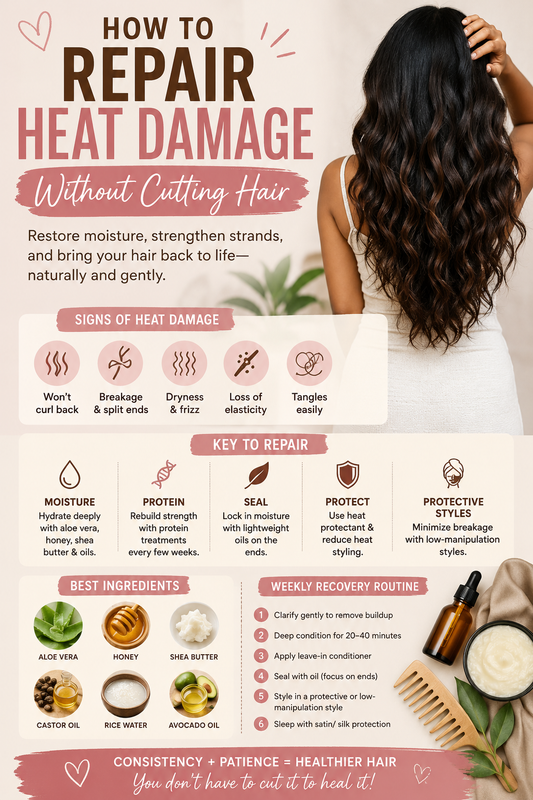
Heat styling can completely transform your look — silky straight hair, defined curls, sleek edges, or voluminous blowouts. But over time, excessive heat can slowly weaken the hair shaft, strip moisture, and leave hair dry, brittle, thin, frizzy, and lifeless. The good news is that heat damage does not always mean you must cut all your hair off.
Many people with natural hair, curly hair, relaxed hair, braids, silk presses, wigs, locs, and color-treated hair successfully repair heat-damaged hair without doing a major chop. With the right routine, moisture balance, protein support, scalp care, and protective styling, you can improve your hair’s appearance, strengthen weakened strands, reduce breakage, and slowly restore healthier hair over time.
In this complete guide, you will learn:
- What heat damage really is
- Signs your hair is heat damaged
- Whether heat damage can truly be reversed
- The best oils and ingredients for repair
- How to rebuild moisture and elasticity
- The biggest mistakes preventing recovery
- The best routines for natural hair recovery
- How to prevent future damage while still styling your hair
If your hair feels weak, limp, overly dry, or refuses to curl back properly, this guide will help you start restoring your hair naturally.
What Is Heat Damage?
Heat damage happens when excessive heat weakens or permanently alters the hair’s protein structure. Hair is made mostly of keratin protein, and high temperatures can break down these proteins over time.
Common causes include:
- Flat irons
- Blow dryers
- Curling irons
- Hot combs
- Heated brushes
- Frequent silk presses
- Excessive diffuser heat
- High-temperature bonnet dryers
- Repeated heat styling without protection
When hair experiences too much heat repeatedly, the cuticle layer becomes damaged. Once the cuticle is weakened, moisture escapes faster, causing dryness and breakage.
In severe cases, the inner protein structure becomes permanently altered, causing curls or coils to loosen permanently.
Signs Your Hair Is Heat Damaged
Many people mistake heat damage for dryness or lack of moisture. While dryness is part of it, heat damage usually has multiple symptoms.
1. Hair Won’t Curl Back
One of the most obvious signs is when natural curls no longer return after washing.
Curly and coily hair may appear:
- Straight on the ends
- Limp
- Loose
- Uneven
- Stringy
2. Increased Breakage
Heat weakens protein bonds, making hair snap easily during:
- Detangling
- Washing
- Styling
- Brushing
3. Split Ends
Heat-damaged hair often develops:
- White dots
- Frayed ends
- Splits traveling upward
- Thin ends
4. Extreme Dryness
Damaged cuticles cannot retain moisture effectively. Hair may feel:
- Crispy
- Rough
- Hard
- Straw-like
5. Loss of Elasticity
Healthy hair stretches slightly before returning to normal. Heat-damaged hair snaps immediately.
6. Excessive Frizz
When the cuticle is damaged, strands become rough and unable to lay smoothly.
7. Tangling and Matting
Damaged cuticles catch onto neighboring strands, causing knots and tangles.
Can Heat Damage Be Repaired Without Cutting Hair?
This depends on the severity.
Mild Heat Damage
Mild damage can often improve significantly with:
- Moisture restoration
- Protein treatments
- Reduced heat use
- Protective styling
- Scalp nourishment
Hair may regain softness, elasticity, and even partial curl pattern recovery.
Moderate Heat Damage
Moderate damage can often be managed and improved enough to avoid a major haircut.
You may need:
- Gradual trims
- Intensive conditioning
- Protein/moisture balancing
- Consistent low-manipulation styling
Severe Heat Damage
Severe heat damage is usually permanent.
Hair that is:
- Permanently straight
- Extremely thin
- Mushy when wet
- Breaking excessively
may eventually require trimming over time.
However, you do NOT always need a full big chop.
Many people slowly trim damaged ends while preserving overall length.
The Biggest Mistakes That Make Heat Damage Worse
Before repairing your hair, you must stop the habits causing further damage.
1. Continuing Daily Heat Styling
Using flat irons daily prevents recovery.
Even “touch-ups” can worsen damage.
2. Using Heat Above 400°F
Many styling tools reach dangerous temperatures.
Fine hair can become damaged at temperatures as low as 300°F.
3. Skipping Heat Protectant
Heat protectants help reduce moisture loss and surface damage.
4. Overwashing
Harsh shampoos can strip already fragile hair.
5. Too Much Protein
Excessive protein treatments can make hair stiff and brittle.
6. Ignoring Moisture
Dry hair breaks faster and struggles to recover.
7. Tight Protective Styles
Tension combined with weakened hair can cause thinning.
Step-by-Step Routine to Repair Heat-Damaged Hair
Step 1: Stop Heat for Several Weeks
The first step is giving your hair a break.
Avoid:
- Flat irons
- Curling irons
- Hot combs
- Frequent blow-drying
Air drying or low-heat styling allows recovery.
Even reducing heat dramatically helps.
Step 2: Clarify the Hair
Product buildup blocks moisture absorption.
Use a gentle clarifying shampoo once to reset the hair.
Look for ingredients like:
- Apple cider vinegar
- Aloe vera
- Peppermint
- Tea tree oil
Do not over-clarify.
Once every 3–4 weeks is enough for most people.
Step 3: Deep Condition Weekly
Deep conditioning is one of the most important steps.
A quality deep conditioner helps:
- Restore softness
- Improve elasticity
- Reduce breakage
- Increase manageability
Look for ingredients like:
- Shea butter
- Honey
- Aloe vera
- Avocado oil
- Coconut oil
- Castor oil
- Argan oil
Use steam or a warm towel for better penetration.
Leave deep conditioner on for 20–40 minutes.
Step 4: Rebuild Protein Carefully
Protein helps strengthen weakened strands.
Signs you may need protein:
- Mushy wet hair
- Excessive breakage
- Weak strands
- Limp hair
Protein-rich ingredients include:
- Keratin
- Rice protein
- Hydrolyzed wheat protein
- Silk amino acids
Use protein treatments every 3–6 weeks depending on damage level.
Too much protein can cause stiffness.
Step 5: Moisturize Consistently
Heat-damaged hair loses moisture rapidly.
Hydration is critical.
Best Moisturizing Ingredients
- Aloe vera
- Glycerin
- Honey
- Marshmallow root
- Slippery elm
- Castor oil
- Jojoba oil
A leave-in treatment followed by oil helps seal moisture.
Step 6: Seal the Ends
Your ends are the oldest part of your hair.
Use lightweight oils to reduce breakage:
- Jamaican black castor oil
- Argan oil
- Avocado oil
- Grapeseed oil
Focus heavily on the ends.
Step 7: Use Protective Styles
Protective styles reduce manipulation and friction.
Good options include:
- Twists
- Loose braids
- Buns
- Wigs
- Roller sets
- Satin wrap styles
Avoid overly tight styles.
Best Oils for Repairing Heat-Damaged Hair
Natural oils can help improve softness, elasticity, shine, and moisture retention.
Jamaican Black Castor Oil
Popular for:
- Thickening appearance
- Sealing moisture
- Supporting scalp health
- Reducing dryness
Excellent for:
- Thin ends
- Breakage-prone hair
Argan Oil
Rich in vitamin E and fatty acids.
Benefits include:
- Shine enhancement
- Frizz reduction
- Softness
Great before blow drying.
Coconut Oil
Can reduce protein loss in hair.
Best used:
- Pre-poo treatment
- Overnight oil treatment
Some low-porosity hair may dislike heavy coconut oil use.
Avocado Oil
Rich in nutrients and penetrates well into hair strands.
Helps improve:
- Elasticity
- Softness
- Manageability
Rosemary Oil
Often used to support scalp circulation and healthier growth environments.
Always dilute essential oils properly.
Best Ingredients for Heat-Damaged Hair
Aloe Vera
Hydrates and soothes dry hair.
Honey
A natural humectant that attracts moisture.
Shea Butter
Excellent for sealing hydration.
Rice Water
Contains amino acids that may support strengthening.
Silk Amino Acids
Help improve softness and elasticity.
Ceramides
Help strengthen the cuticle barrier.
Protein vs Moisture: Finding Balance
Many people overdo one side.
Healthy hair needs BOTH.
Signs of Too Much Moisture
Hair feels:
- Mushy
- Weak
- Limp
- Overly stretchy
Signs of Too Much Protein
Hair feels:
- Hard
- Brittle
- Dry
- Straw-like
The goal is balance.
Most heat-damaged hair benefits from:
- Weekly moisture
- Occasional protein
How Long Does Heat Damage Take to Repair?
Recovery varies.
Mild Damage
4–8 weeks
Moderate Damage
2–6 months
Severe Damage
6–12+ months
Consistency matters more than quick fixes.
Can Heat-Damaged Curls Come Back?
Sometimes.
If the protein structure was not permanently altered, curls may gradually return.
However:
- Severely straightened sections may never fully recover
- Curl recovery often happens slowly
- New healthy growth is usually strongest
Best Hairstyles While Recovering
Twist Outs
Low heat and low manipulation.
Braid Outs
Helps stretch hair naturally.
Flexi Rod Sets
Adds curl without direct heat.
Protective Buns
Reduces friction and breakage.
Wigs
Allow hair to rest underneath.
Sleeping Tips for Heat-Damaged Hair
Nighttime protection matters.
Use:
- Satin bonnet
- Silk scarf
- Satin pillowcase
Cotton pillowcases absorb moisture and increase friction.
How to Wash Heat-Damaged Hair Properly
Before Washing
Detangle gently with:
- Fingers
- Wide-tooth comb
Apply oil or conditioner before shampooing.
During Washing
Avoid rough scrubbing.
Focus shampoo mainly on the scalp.
After Washing
Blot gently with microfiber towels or cotton T-shirts.
Avoid rough towel drying.
Best Detangling Tips
Heat-damaged hair tangles easily.
To reduce breakage:
- Detangle in sections
- Use slippery conditioner
- Start from ends upward
- Be patient
Never rip through knots aggressively.
The Truth About Split Ends
Unfortunately, split ends cannot truly be repaired permanently.
Products may temporarily smooth them, but trimming is the only permanent solution.
However, you can:
- Slow splitting
- Reduce further damage
- Maintain length longer
Should You Trim Heat-Damaged Hair?
Small trims often help recovery.
You do NOT necessarily need:
- A big chop
- Dramatic haircut
Dusting thin or split ends every few months can improve appearance and reduce breakage.
Foods That Support Hair Recovery
Healthy hair recovery also depends on nutrition.
Protein-Rich Foods
Hair is protein-based.
Eat:
- Eggs
- Fish
- Chicken
- Beans
- Greek yogurt
Omega-3 Fatty Acids
Support scalp health.
Found in:
- Salmon
- Walnuts
- Flaxseeds
Iron
Low iron can worsen shedding.
Zinc
Supports follicle function.
Biotin
Supports keratin production.
Does Scalp Health Matter?
Absolutely.
Healthy growth starts at the scalp.
Focus on:
- Clean scalp
- Reduced buildup
- Moisture balance
- Gentle massage
Scalp oils containing:
- Peppermint
- Rosemary
- Tea tree
may support a healthier scalp environment.
DIY Heat Damage Repair Mask
Ingredients
- 2 tablespoons aloe vera gel
- 1 tablespoon honey
- 1 tablespoon avocado oil
- 1 tablespoon conditioner
Instructions
- Mix thoroughly
- Apply to damp hair
- Cover with cap
- Leave on 30 minutes
- Rinse thoroughly
Use weekly.
Can You Ever Use Heat Again?
Yes — carefully.
The goal is healthier heat use.
Safer Heat Styling Tips
1. Always Use Heat Protectant
Never skip this step.
2. Lower the Temperature
Fine hair:
250–300°F
Medium hair:
300–350°F
Coarse hair:
350–380°F
3. Limit Passes
Avoid repeatedly passing flat irons over the same section.
4. Use Quality Tools
Cheap tools often heat unevenly.
5. Avoid Daily Heat
Save heat styling for occasional use.
Heat Damage Prevention Routine
Weekly
- Moisturize
- Deep condition
- Protect ends
Monthly
- Clarify gently
- Protein treatment if needed
Daily
- Satin protection
- Moisture maintenance
- Gentle handling
Myths About Heat Damage
Myth 1: Oils Completely Protect Hair from Heat
Oils alone are not enough.
You still need proper heat protectants and temperature control.
Myth 2: Natural Hair Is Heat-Proof
All hair types can experience heat damage.
Myth 3: Heat Damage Can Always Be Fully Reversed
Some damage is permanent.
The goal is improvement and healthier new growth.
Myth 4: You Must Big Chop Immediately
Many people recover hair gradually without drastic cutting.
Best Products for Heat-Damaged Hair
Look for products focused on:
- Moisture restoration
- Protein repair
- Scalp nourishment
- Reduced breakage
Helpful categories:
- Leave-in conditioners
- Hair oils
- Deep conditioners
- Protein masks
- Scalp oils
- Moisturizing sprays
How Protective Styling Helps Recovery
Protective styles help by reducing:
- Daily manipulation
- Friction
- Tangling
- Breakage
However, styles should never:
- Pull tightly
- Cause scalp pain
- Be left in too long
Healthy protective styling supports retention.
Emotional Side of Heat Damage
Many people feel discouraged after seeing:
- Broken curls
- Thin ends
- Excessive shedding
- Slow growth
Remember:
Hair recovery takes time.
Consistency matters more than perfection.
Even severely damaged hair can often look dramatically healthier with patience and proper care.
Signs Your Hair Is Improving
Positive signs include:
- Reduced breakage
- Better moisture retention
- Softer texture
- Increased shine
- Improved elasticity
- Fuller-looking ends
- Curl pattern returning gradually
Take photos monthly to track progress.
Sample Weekly Heat Damage Recovery Routine
Wash Day
- Pre-poo with oil
- Gentle shampoo
- Deep condition
- Apply leave-in
- Seal with oil
- Protective style
Midweek
- Light moisturizing spray
- Seal ends
- Scalp massage
Nightly
- Satin bonnet or scarf
- Loose protective style
Best Practices for Natural Hair Recovery
Natural hair often thrives with:
- Moisture retention
- Low manipulation
- Protective styling
- Reduced heat
- Consistent scalp care
Patience is key.
Hair health improves gradually.
Final Thoughts: Repairing Heat Damage Without Cutting Hair
Heat damage can feel frustrating, especially after spending years growing your hair. But in many cases, you can improve your hair significantly without doing a major chop.
The keys to recovery are:
- Moisture balance
- Protein support
- Reduced heat use
- Protective styling
- Scalp care
- Gentle handling
- Consistency
Some damage may eventually need trimming, but healthy routines can preserve length while improving your hair’s strength, softness, and appearance over time.
With patience and proper care, healthier hair is absolutely possible.