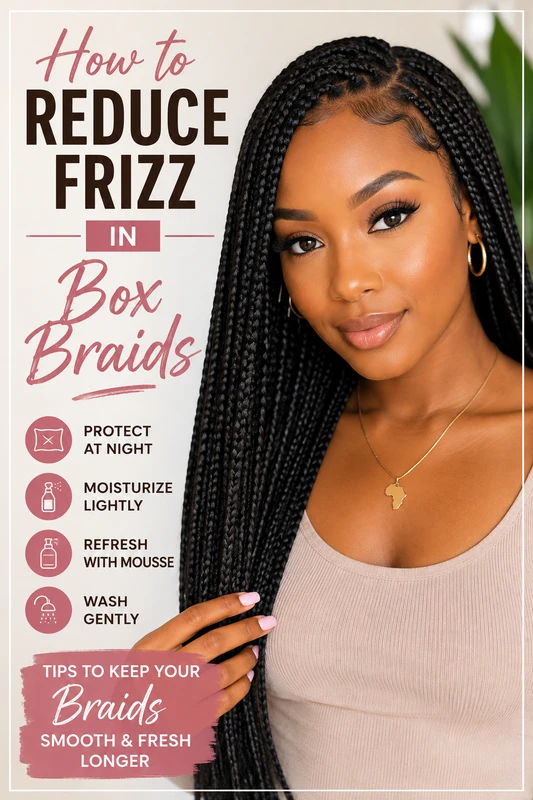
Box braids are one of the most popular protective hairstyles for Black hair—and for good reason. They are versatile, beautiful, relatively low maintenance, and can give your natural hair a break from daily styling. But even the best-installed box braids can eventually develop one frustrating problem: frizz.
You may leave the salon with perfectly smooth, neat braids only to notice fuzzy roots, flyaways, and frizzy strands a week or two later. In some cases, box braids can begin looking older much sooner than expected.
The good news is that you don't necessarily have to take your braids down just because a little frizz appears.
Learning how to reduce frizz in box braids can help you keep your protective style looking fresh while still properly caring for the natural hair underneath.
In this complete guide, we'll explain why box braids become frizzy, how to prevent excessive frizz, how to refresh older braids, what to do after washing your braids, and the everyday habits that can help your style last longer.
Why Do Box Braids Get Frizzy?
Before trying to eliminate frizz, it helps to understand where it comes from.
A box braid contains your natural hair intertwined with braiding hair. Your natural strands do not stop behaving like natural hair simply because they are inside a braid.
As your hair is exposed to moisture, humidity, movement, friction, and everyday activities, individual strands can begin escaping from the braid.
These tiny loose hairs create the fuzzy appearance we call frizz.
Some frizz is completely normal.
In fact, expecting box braids to remain as perfect as they looked on installation day for several weeks isn't realistic. Hair grows, strands move, and your scalp naturally produces oils and sheds skin cells.
The goal should therefore be to control excessive frizz rather than trying to prevent every single flyaway.
1. Start With Properly Prepared Hair
Frizz prevention actually begins before your braider installs the first braid.
How you prepare your natural hair can have a major effect on how smooth your finished box braids look.
Your hair should generally be:
- Clean
- Conditioned
- Detangled
- Properly moisturized
- Completely dry before installation
- Free from excessive product buildup
Starting with tangled or poorly detangled hair can make it harder for your natural strands to blend smoothly into the braids.
A good wash and conditioning routine before your appointment can create a much better foundation.
However, avoid coating your hair with extremely heavy amounts of oils, creams, butters, or styling products before braiding.
Too much product can cause buildup and make the hair difficult to grip.
Your braider may also have specific recommendations for how they want your hair prepared.
2. Make Sure Your Hair Is Thoroughly Detangled
Detangling deserves special attention.
When sections contain knots and tangles, individual hairs are more likely to stick out once the braid is created.
Work through your hair carefully before installation.
Depending on your hair, you might use your fingers, a wide-tooth comb, or a detangling brush.
Start at the ends and gradually work toward the roots instead of aggressively pulling a comb through the entire section.
The smoother the section is before braiding, the easier it becomes to create a clean braid.
3. Don't Install Braids on Soaking-Wet Hair
Installing box braids over extremely wet natural hair isn't usually ideal.
Wet hair can shrink as it dries.
If the hair is tightly incorporated into a braid while very wet, shrinkage and movement during drying can contribute to hairs pushing out of the braid.
You also don't want moisture trapped inside thick braids for unnecessarily long periods.
Before installation, make sure your hair has been dried according to your styling method and your braider's recommendations.
Some people stretch their natural hair before box braids because stretched hair may blend more smoothly into the braid.
Others prefer less heat.
The best preparation depends on your hair and the desired style.
4. Choose the Right Size Box Braids
The size of your box braids can influence how noticeable frizz becomes.
Very small braids may contain smaller sections of natural hair, while jumbo braids contain much larger sections.
Neither is automatically better.
However, the braid size should make sense for your hair's:
- Density
- Length
- Texture
- Condition
- Strength
If your natural hair is much shorter than the braid itself, your ends may eventually begin sticking out.
An experienced braider can help determine an appropriate braid size and installation technique.
Most importantly, don't sacrifice your scalp and edges simply to get extremely tight, perfectly smooth braids.
5. Avoid Excessively Tight Box Braids
There is a difference between neat braids and painfully tight braids.
Your box braids do not need to pull excessively on your scalp to look good.
Braids that are extremely tight can cause discomfort and place unnecessary tension on the natural hair.
If your braids are so tight that you have severe pain, bumps, or significant scalp irritation, don't ignore those warning signs simply because the hairstyle looks neat.
Protective styling should protect your hair—not make your scalp miserable.
6. Wear a Satin or Silk Scarf at Night
If you want your box braids to stay fresh longer, your nighttime routine is one of the most important things to change.
Sleeping directly on cotton bedding can create friction as you move throughout the night.
That friction can encourage individual hairs to work their way out of the braids.
Instead, cover your braids before going to sleep.
Popular options include:
- Satin scarves
- Satin bonnets
- Silk scarves
- Extra-large braid bonnets
- Satin-lined sleep caps
Long box braids may require an oversized bonnet.
You can also use a satin or silk pillowcase as additional protection.
For maximum protection, some people use both a bonnet and satin pillowcase.
7. Don't Rub Your Braids Against Your Pillow
Even with a bonnet, how you handle long box braids at night matters.
Avoid leaving very long braids loose underneath you.
Instead, gently gather them so they aren't constantly rubbing against your shoulders, sheets, and pillow.
Do not pull them into an extremely tight ponytail.
The goal is simply to keep the braids contained while reducing unnecessary friction.
8. Protect Your Box Braids While Showering
You want moisture in your natural hair, but that doesn't mean your braids need to become completely soaked every time you take a shower.
Repeatedly exposing the entire hairstyle to steam and water may cause the natural hair inside the braid to swell and contract.
That movement can make frizz more noticeable.
Wear a large shower cap that completely covers your braids whenever you are showering but not washing your hair.
If your braids are very long, gently fold them into the cap instead of forcing them into a small shower cap.
9. Be Careful With Humidity
Humidity can make frizz more noticeable, particularly when your natural hair readily absorbs moisture from the air.
You can't control the weather, but you can reduce unnecessary exposure.
If you're going to be outside in extremely humid weather for a long period, consider protecting your hairstyle when practical.
A satin-lined hat, scarf, or other hair-friendly covering can sometimes help.
Don't become obsessed with avoiding humidity, though.
Box braids are meant to be worn and enjoyed.
A little frizz after living your life is normal.
10. Keep Your Braids Moisturized
One of the biggest mistakes people make with protective styles is assuming their natural hair doesn't need moisture because they can't see it.
Your hair is still underneath those braids.
A lightweight moisturizing spray can make braid maintenance much easier than trying to coat the style with thick creams.
Focus primarily on your natural hair and scalp rather than saturating synthetic braiding hair with product.
A light mist can help maintain moisture without leaving the braids excessively wet.
The key word is light.
More product does not automatically mean more moisture.
11. Avoid Product Overload
Trying to fix every little flyaway with more product can backfire.
Applying layer after layer of:
- Gel
- Edge control
- Oil
- Mousse
- Cream
- Leave-in conditioner
- Braid spray
can eventually leave your braids coated in residue.
Buildup may attract lint and dirt, particularly around the roots.
Instead of piling products on top of one another every day, use small amounts when needed.
Your box braid routine should be relatively simple.
12. Use a Lightweight Braid Spray
A braid spray can be particularly convenient because it allows you to target your scalp and natural hair without heavily coating the style.
Look for products designed to provide lightweight moisture.
Apply enough to refresh the hair without soaking the braids.
You can concentrate on areas where your natural hair is located, especially near the roots.
After spraying, allow your braids to dry completely before covering them for an extended period.
13. Use Mousse to Refresh Frizzy Box Braids
Hair mousse or styling foam is one of the most popular ways to refresh box braids.
It can temporarily smooth down flyaways and make older braids appear neater.
Start with a small amount.
Distribute it over the frizzy sections of your braids rather than completely saturating your hairstyle.
Smooth the product downward in the direction of the braid.
Then allow your braids to dry.
Some people tie a satin scarf around their roots while the mousse sets.
Once the hair is dry, remove the scarf.
The roots may look considerably smoother.
Remember that mousse doesn't permanently eliminate frizz. It is primarily a styling technique for improving the appearance of the hairstyle.
14. Tie Your Hair Down After Refreshing It
A satin scarf can do more than protect your hair while sleeping.
It can also help set freshly refreshed braids.
After applying an appropriate amount of styling foam, place your scarf around the top portion of your hair.
Don't tie it painfully tight.
Leave it in place while the product dries.
This can encourage fuzzy strands around the roots to lie flatter.
15. Avoid Constantly Touching Your Braids
Box braids can be fun to play with.
You may find yourself twisting them, pulling them, running your fingers through them, or constantly changing your hairstyle throughout the day.
Unfortunately, constant manipulation creates friction.
The more the braids are handled, the more opportunities there are for individual natural hairs to escape.
Try to leave your braids alone whenever possible.
Protective styles tend to work best when they actually reduce daily manipulation.
16. Don't Rest Your Braids Against Rough Clothing All Day
Friction doesn't only happen at night.
Long box braids constantly rub against your clothes.
Certain fabrics may create more friction than others.
If your braids extend down your back, you'll probably notice that the lower portions become fuzzier over time.
This is difficult to eliminate completely, but you can occasionally wear your braids up when appropriate.
Just avoid creating tight buns or ponytails that place excessive tension on your scalp.
17. Be Careful When Styling Box Braids
One reason people love box braids is their versatility.
You can wear them in:
- Ponytails
- Buns
- Half-up styles
- Side parts
- Center parts
- Braided buns
- Loose styles
But constantly changing hairstyles can make braids frizz faster.
Every time you bend, pull, twist, and rearrange your braids, you create movement.
That movement can encourage your natural hair to work its way out.
Enjoy different styles, but don't manipulate your braids unnecessarily several times every day.
18. Protect Your Edges
The hairline deserves special care during box braid maintenance.
The hairs around your edges are often finer and more fragile than hair in other areas.
Avoid repeatedly pulling the front braids into tight styles.
You should also avoid using large amounts of strong-hold edge control every single day simply to make the hairstyle appear freshly installed.
Give your hairline a break.
A little fuzziness around your edges is better than constantly placing unnecessary tension on them.
19. Wash Box Braids Gently
Yes, box braids can be washed.
Your scalp still needs appropriate cleansing while wearing a protective style.
The problem is that aggressive washing can create substantial frizz.
Avoid scrubbing the braids as though you were washing loose hair.
Instead, focus primarily on your scalp.
Apply shampoo according to the product directions and gently work it around the scalp.
Use your fingertips rather than aggressively scratching with your nails.
Rinse thoroughly.
Allow the water and cleanser to move down the length of the braids rather than repeatedly rubbing the braids together.
20. How to Reduce Frizz After Washing Box Braids
Your box braids may look noticeably fuzzier immediately after washing.
Don't panic.
Water causes natural hair to respond according to its texture, and some strands may become more visible.
After washing:
- Gently remove excess water.
- Avoid aggressively rubbing the braids with a towel.
- Apply your chosen lightweight moisturizing products if needed.
- Use a small amount of styling mousse if appropriate.
- Smooth the braids downward.
- Tie a satin scarf around the roots.
- Allow the braids to dry thoroughly.
Never cover soaking-wet braids for a prolonged period.
Thick braids can take a surprisingly long time to dry.
21. Don't Rub Box Braids With a Regular Bath Towel
Traditional towels can create considerable friction.
Instead of vigorously rubbing your braids after washing, gently squeeze out excess water.
A microfiber towel or soft cotton T-shirt may be gentler.
Work downward rather than roughing up the braid.
This simple change can help reduce unnecessary fuzziness after wash day.
22. Let Box Braids Dry Completely
Keeping your braids damp for too long isn't a good maintenance strategy.
If you wash or heavily mist your braids, give them adequate time to dry.
This is particularly important before:
- Going to bed
- Putting on a bonnet
- Wearing a hat
- Creating a tight bun
Whenever possible, wash your braids earlier in the day rather than immediately before bedtime.
That gives the hairstyle more time to dry.
23. Refresh the Perimeter Instead of Redoing Everything
Sometimes your box braids aren't actually old—the visible front and perimeter just look frizzy.
Those sections receive more manipulation and are more noticeable.
If the rest of the style still looks good, you may be able to have a few braids around the hairline professionally redone.
This can dramatically refresh the appearance without reinstalling the entire hairstyle.
However, don't repeatedly rebraid fragile edges just for cosmetic reasons.
Hair health should remain the priority.
24. Trim Obvious Flyaways Carefully
Some people carefully trim obvious strands sticking out from synthetic braiding hair.
However, this requires caution because your natural hair may also be sticking out.
You don't want to accidentally cut your own hair.
If you aren't sure whether a strand belongs to your natural hair or the extension, leave it alone.
A slightly frizzy braid is preferable to accidentally cutting healthy natural hair.
25. Should You Use Gel on Frizzy Box Braids?
Gel can sometimes smooth flyaways temporarily, especially around the roots.
But heavy gel use isn't always necessary.
Too much gel can cause:
- Flaking
- Stickiness
- Product buildup
- Residue
If you use gel, use a small amount and pay attention to how it interacts with other products already on your hair.
Styling foam may be a lighter option for refreshing the overall style.
26. Can Oil Reduce Frizz in Box Braids?
Oil can add shine and reduce the appearance of dryness, but oil alone isn't necessarily a frizz solution.
Oil and water-based moisture serve different purposes.
Applying huge amounts of oil to fuzzy braids will not magically put escaped strands back into the braid.
Instead, use oil strategically when it fits your scalp and hair routine.
Avoid saturating the scalp every day.
27. Stop Trying to Make Your Braids Look Brand-New Forever
One of the most important box braid lessons is accepting that some frizz is normal.
Freshly installed braids look different from three-week-old braids.
That's okay.
Your natural hair is alive and constantly changing.
You may have new growth.
Your hair may shrink.
Tiny hairs may escape.
Your roots may become less defined.
A protective hairstyle does not need to look like day one throughout its entire lifespan to be beautiful.
How to Refresh Frizzy Box Braids Step by Step
If your box braids are looking older but aren't ready to be removed, try this simple refresh routine.
Step 1: Examine Your Braids
Determine where most of the frizz is located.
Is it primarily:
- At the roots?
- Around the hairline?
- Throughout the length?
- Near your natural ends?
- At the bottom of the braids?
This helps determine what type of refresh is actually needed.
Step 2: Clean the Scalp if Necessary
If your scalp has significant buildup, don't simply apply mousse over it.
Cleanse when needed.
Fresh-looking braids aren't worth neglecting scalp hygiene.
Step 3: Apply Lightweight Moisture
Lightly mist your natural hair and scalp with an appropriate moisturizing product.
Avoid drenching the style.
Step 4: Apply Styling Foam
Use a modest amount of foam over the frizzy areas.
Smooth downward.
Step 5: Tie Down the Roots
Place a satin scarf over your roots.
Keep it snug enough to hold the hair in place without creating uncomfortable pressure.
Step 6: Allow Everything to Dry
Give the style enough time to dry completely.
Step 7: Remove the Scarf and Style
Once dry, remove the scarf and gently arrange your braids.
Avoid immediately manipulating them into an extremely tight style.
How to Keep Box Braids From Frizzing Overnight
Nighttime protection can make one of the biggest differences in braid longevity.
Create a simple routine:
Every night:
Lightly moisturize only when needed, gather your braids gently, cover them with a satin or silk scarf or bonnet, and sleep on a smooth pillowcase if possible.
You do not necessarily need to apply product every night.
The main goal is reducing friction.
How to Reduce Frizz at the Roots of Box Braids
Roots are usually the first area to become fuzzy because that's where new growth appears.
To refresh frizzy roots:
- Clean your scalp if necessary.
- Apply a small amount of styling foam.
- Smooth the roots gently.
- Tie them down with a satin scarf.
- Let them dry.
- Avoid picking at the roots afterward.
Remember that new growth is normal.
Trying to force weeks of new growth to look like a fresh installation may encourage excessive manipulation.
How to Reduce Frizz Along the Length of Box Braids
Frizz throughout the braid may come from your natural hair escaping or from wear on the extension hair itself.
For mild frizz, mousse and gentle smoothing may improve the appearance.
For significant frizz, it may simply mean the hairstyle is aging.
Don't repeatedly load the braids with styling products trying to make an old style look completely new.
How Long Should Box Braids Last Before Getting Frizzy?
There is no exact number.
How quickly your braids develop frizz depends on:
- Hair texture
- Braid size
- Installation technique
- Natural hair length
- Weather
- Humidity
- Exercise
- Washing frequency
- Nighttime protection
- Styling habits
- Hair growth
- Product use
One person's braids may remain relatively smooth for weeks, while another person's natural texture begins escaping much sooner.
Neither necessarily means something is wrong.
Why Are My Box Braids Frizzy After Only One Week?
If your box braids become frizzy quickly, several factors may be involved.
You may have:
- Naturally frizz-prone hair
- Shorter layers escaping from the braids
- High humidity exposure
- Frequent sweating
- Excessive manipulation
- No nighttime protection
- Frequent water exposure
- Braids that weren't installed smoothly
Look at your entire routine rather than assuming the installation was automatically bad.
Can You Completely Prevent Box Braid Frizz?
Probably not—and you don't need to.
Your natural hair isn't plastic.
It reacts to water, weather, friction, movement, and time.
The realistic goal is to minimize excessive frizz and maintain the style, not eliminate every flyaway.
Trying too hard to maintain perfectly smooth braids can sometimes lead to excessive product use and manipulation.
Common Mistakes That Make Box Braids Frizz Faster
If your box braids always seem to become fuzzy quickly, check whether you're making any of these common mistakes:
- Sleeping without satin protection
- Going to bed with wet braids
- Constantly touching the hairstyle
- Taking steamy showers without covering your hair
- Roughly washing the braids
- Rubbing them with a towel
- Applying excessive product
- Constantly changing hairstyles
- Pulling braids into tight ponytails
- Leaving very long braids loose while sleeping
- Ignoring scalp buildup
- Overusing heavy gels and edge control
Fixing two or three of these habits may noticeably improve how long your style looks fresh.
A Simple Weekly Box Braid Maintenance Routine
You don't need a complicated routine.
Daily
Leave your braids alone as much as possible.
Lightly moisturize your natural hair when needed.
Avoid excessive styling.
Nightly
Cover your braids with satin or silk.
Keep long braids contained to reduce friction.
Weekly
Evaluate your scalp.
Cleanse when necessary rather than following an arbitrary schedule that doesn't work for you.
Check for buildup, dryness, or irritation.
Refresh mild frizz with styling foam when necessary.
After Exercise
If you sweat heavily, allow your scalp and braids to dry.
Don't immediately cover a very damp scalp with a hat or bonnet for hours.
When Is Frizz a Sign That It's Time to Remove Your Braids?
Frizz alone doesn't necessarily mean box braids need to come down.
But eventually every protective style reaches the end of its useful life.
Consider removing your braids when you notice significant new growth, excessive matting around the roots, persistent buildup that is difficult to manage, or a general decline in the condition of the hairstyle.
Don't keep braids installed indefinitely just because the extension hair still looks good.
Your natural hair and scalp should determine your maintenance decisions.
Frequently Asked Questions About Frizzy Box Braids
How do you make frizzy box braids look new again?
Styling mousse, gentle smoothing, and tying the roots down with a satin scarf can temporarily make fuzzy box braids look neater. If only the perimeter looks old, having a few front braids professionally redone may also refresh the style.
Why are my braids getting fuzzy so fast?
Humidity, friction, sweating, washing, your natural hair texture, short strands, manipulation, and lack of nighttime protection can all contribute to early frizz.
Does mousse help frizzy box braids?
Mousse can temporarily smooth flyaways and improve the appearance of fuzzy braids. Use it moderately to avoid unnecessary product buildup.
Should I mousse my box braids every day?
Usually, daily mousse isn't necessary. Excessive product use may lead to buildup. Refresh your style when it actually needs it.
How do I stop my braids from frizzing while sleeping?
Cover your braids with a satin or silk scarf or bonnet and avoid leaving long braids loose underneath your body. A satin pillowcase can provide additional protection.
Can I wash box braids without making them frizzy?
Some frizz after washing is normal. You can minimize it by focusing shampoo on the scalp, avoiding rough scrubbing, gently removing excess water, and smoothing the braids afterward.
Does water make box braids frizzy?
Water can cause natural hair inside the braid to swell, shrink, or become more visible. That doesn't mean you should avoid cleansing your scalp or moisturizing your hair. The key is avoiding unnecessary soaking and rough handling.
How do you fix frizzy roots without rebraiding?
Try a small amount of styling foam followed by a satin scarf while the hair dries. This may temporarily flatten flyaways and improve the appearance of the roots.
Is frizz bad for box braids?
No. Frizz is mostly an appearance issue and a normal part of wearing braids. Excessive matting, buildup, breakage, or scalp problems are more important concerns.
Should I cut hairs sticking out of box braids?
Be extremely careful. Some of those hairs may be your natural hair. If you can't clearly distinguish your natural strands from extension hair, don't cut them.
The Best Way to Reduce Frizz in Box Braids
Keeping box braids smooth doesn't require covering them in products every day.
The most effective strategy is usually prevention.
Start with properly prepared and detangled natural hair. Make sure your braids are installed neatly without excessive tension. Protect your hair with satin or silk at night, minimize unnecessary manipulation, keep your scalp clean, moisturize your natural hair appropriately, and refresh mild frizz with styling foam when needed.
Most importantly, don't treat every fuzzy strand as a problem.
Box braids are a protective hairstyle, and the health of your natural hair underneath should always matter more than keeping the hairstyle perfectly smooth.
A good box braid routine should help you enjoy your hairstyle while minimizing manipulation and maintaining a comfortable, healthy scalp.
With consistent nighttime protection, gentle cleansing, lightweight moisture, and occasional refreshing, you can reduce unnecessary frizz and keep your box braids looking beautiful for longer.