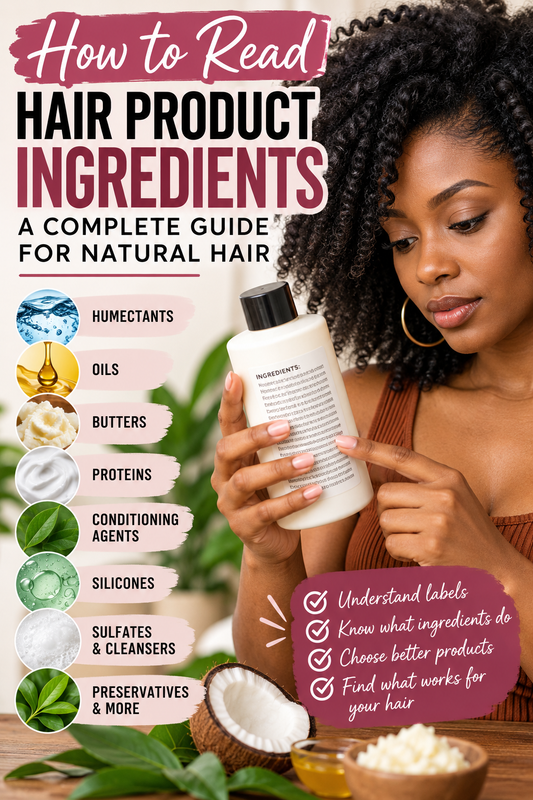
Walking down the hair-care aisle can be overwhelming. One shampoo promises moisture. Another claims to strengthen damaged hair. A conditioner says it can repair breakage, while a styling cream promises definition, softness, shine, and frizz control.
But how do you know what a hair product will actually do?
One of the best places to start is the ingredient list.
Learning how to read hair product ingredients can help you understand what you are putting on your hair and scalp, compare similar products, recognize ingredients that work well for your hair, and avoid buying products simply because the front of the bottle makes impressive claims.
This can be especially helpful for people with natural Black hair, curls, coils, locs, braids, and other textured hairstyles, because textured hair can have very different moisture, detangling, styling, and scalp-care needs.
The good news is that you don't need to become a cosmetic chemist to understand your products.
Once you learn a few basic rules, ingredient labels become much easier to interpret.
This guide explains how ingredient lists work, which ingredients are commonly found in natural hair products, what ingredients such as water, oils, butters, humectants, proteins, silicones, preservatives, and alcohols actually do, and how to decide whether a product makes sense for your hair.
Why You Should Learn How to Read Hair Product Ingredients
Many people choose hair products based primarily on packaging.
You might see phrases such as:
- Moisture repair
- Strengthening
- Hydrating
- Natural
- Nourishing
- Anti-breakage
- Growth support
- Curl defining
- Sulfate-free
- Silicone-free
These descriptions can be useful, but they don't tell you the entire story.
The ingredient list provides additional information about how a product is formulated.
Learning to understand that list can help you answer questions such as:
Is this product primarily water-based?
Does it contain ingredients that provide slip?
Does it contain protein?
Are there oils or butters in the formula?
Does it contain cleansing ingredients?
Does it contain silicones?
What type of alcohol does it contain?
Does it include humectants such as glycerin?
Instead of assuming an ingredient is automatically "good" or "bad," you can start thinking about what role that ingredient plays in the overall formula.
That distinction is extremely important.
How Hair Product Ingredient Lists Work
Before looking at individual ingredients, you should understand how ingredient labels are organized.
In the United States, cosmetic ingredients generally must be listed according to applicable labeling requirements, with ingredients present at higher concentrations generally appearing before those present at lower concentrations. Ingredients at concentrations of 1% or less may be listed in any order after ingredients present above 1%.
That means the first several ingredients can often give you useful clues about the basic structure of a product.
For example, imagine a leave-in conditioner starts with:
Water, Aloe Vera Juice, Cetearyl Alcohol, Glycerin, Behentrimonium Chloride...
You can immediately learn quite a bit.
Water is a major part of the formula.
Aloe is included relatively high on the list.
Cetearyl alcohol is a fatty alcohol commonly used for conditioning and texture.
Glycerin is a humectant.
Behentrimonium chloride is commonly used as a conditioning and detangling ingredient.
Even without understanding every ingredient on the label, you already have a basic picture of what the product is designed to do.
Pay Attention to the First Five Ingredients
You've probably heard the advice:
"Only the first five ingredients matter."
That's an oversimplification.
However, paying close attention to the beginning of the ingredient list is useful because those ingredients frequently make up a significant portion of the formula.
If you're shopping for a moisturizing leave-in conditioner, for example, seeing water near the beginning of the ingredient list would make sense.
But don't automatically dismiss ingredients near the bottom.
Some ingredients are effective at relatively low concentrations.
Preservatives, fragrances, certain conditioning agents, extracts, and other functional ingredients may not need to appear near the beginning of a formula to serve their intended purpose.
So use the first several ingredients as clues—not as the entire story.
1. Water: The Foundation of Many Moisturizing Hair Products
Look at your conditioners, leave-in treatments, moisturizing sprays, curl creams, and styling lotions.
You'll frequently see:
Water
or
Aqua
near the beginning of the ingredient list.
Water is one of the most important components of many moisturizing hair products.
This is particularly relevant for natural hair.
Curly and coily hair can become dry because natural scalp oils have a more difficult path traveling down bends and curves in the hair shaft compared with straighter hair.
A water-based product can help introduce moisture to the hair, while conditioning ingredients and emollients can help improve softness and manageability.
This is also why simply applying more oil isn't always the solution when natural hair feels dry.
Oil and water serve different purposes.
Oil can provide lubrication, reduce friction, improve shine, and help reduce moisture loss depending on the formula and application.
But oil itself isn't the same thing as water.
If your hair feels extremely dry, consider whether your routine includes enough water-based moisture rather than simply adding additional layers of oil.
2. Humectants
Humectants are ingredients that attract and interact with water.
They're commonly used in:
- Leave-in conditioners
- Deep conditioners
- Moisturizers
- Curl creams
- Styling gels
- Shampoos
- Hair masks
Common humectants include:
Glycerin
Glycerin is one of the most recognizable humectants in hair care. It can help support hydration and is used in many moisturizing formulas.
Propylene Glycol
Propylene glycol can function as a humectant and solvent.
Sorbitol
Sorbitol is another ingredient that can help attract moisture.
Honey
Honey naturally contains sugars and has humectant properties, although the way it functions in a finished cosmetic product depends on the overall formulation.
Panthenol
Panthenol, also known as provitamin B5, is frequently included in hair-care products for conditioning and moisture-related benefits.
Humectants aren't automatically good or bad.
Your results can depend on the formula, your hair, your styling routine, and environmental conditions.
3. Oils
Natural oils are extremely popular in textured-hair care.
You may see ingredients such as:
- Coconut oil
- Jojoba oil
- Castor oil
- Avocado oil
- Olive oil
- Grapeseed oil
- Sweet almond oil
- Argan oil
- Sunflower oil
Each oil has somewhat different properties.
Coconut Oil
Coconut oil is particularly interesting because research has shown that it can penetrate the hair shaft and help reduce protein loss under certain conditions.
However, that doesn't mean coconut oil works perfectly for everyone.
Some people love it.
Others report that products containing a lot of coconut oil leave their hair feeling stiff, coated, or dry.
Jojoba Oil
Jojoba oil is technically a liquid wax ester rather than a conventional triglyceride oil.
It is lightweight compared with many heavier oils and is commonly used in scalp and hair products.
Castor Oil
Castor oil is much thicker.
Because of its viscosity, it can be useful in products intended to provide lubrication, shine, and a heavier coating.
People with thick or coarse natural hair may enjoy heavier products, while someone with very fine hair may find them excessive.
Grapeseed Oil
Grapeseed oil is relatively lightweight and is commonly used in conditioners, moisturizers, and styling products.
Avocado Oil
Avocado oil is another popular ingredient in natural hair formulas and contains a high proportion of monounsaturated fatty acids.
4. Butters
If you have natural hair, you've probably encountered shea butter.
Butters are often used in rich moisturizers, styling creams, pomades, hair masks, and sealants.
Common examples include:
- Shea butter
- Mango butter
- Cocoa butter
- Kokum butter
Shea butter may appear as:
Butyrospermum Parkii Butter
Don't be intimidated by the botanical name.
Ingredient labels frequently use standardized ingredient names rather than the everyday names consumers recognize.
Butters can add richness, lubrication, softness, and occlusivity to a formula.
However, more butter doesn't automatically mean more moisture.
Very heavy formulas may weigh down fine or low-density hair.
The best product depends on your hair.
5. Fatty Alcohols
Here's one of the biggest mistakes people make when reading hair-product labels:
They see the word alcohol and immediately put the bottle back.
Not all alcohols behave the same way.
Fatty alcohols are commonly used in conditioners and moisturizing products.
Examples include:
Cetyl Alcohol
Cetearyl Alcohol
Stearyl Alcohol
Behenyl Alcohol
These ingredients can help provide softness, improve the texture of a product, stabilize emulsions, and contribute to conditioning.
If you see cetearyl alcohol near the beginning of a conditioner ingredient list, that's not automatically a warning sign.
In fact, it is extremely common in conditioners.
6. Drying or Volatile Alcohols
Other alcohols have different properties.
You might encounter ingredients such as:
- Alcohol denat.
- Ethanol
- Isopropyl alcohol
These ingredients can be used for various formulation purposes and may evaporate relatively quickly.
That doesn't automatically mean a product containing one of these ingredients is terrible.
Concentration and formulation matter.
A product can't always be judged accurately from one ingredient alone.
However, if you have extremely dry or fragile hair and notice that a particular alcohol-heavy styling product repeatedly leaves your hair feeling dry, that information may help you choose something different next time.
Your actual results matter.
7. Proteins
Protein is another major category in hair care.
Common protein-related ingredients include:
- Hydrolyzed keratin
- Hydrolyzed wheat protein
- Hydrolyzed rice protein
- Hydrolyzed soy protein
- Hydrolyzed vegetable protein
- Hydrolyzed collagen
- Amino acids
Hydrolyzed proteins have been broken into smaller components, allowing them to be incorporated into cosmetic formulations.
Protein-containing products are often marketed toward damaged, chemically treated, colored, or weakened hair.
They may help improve the temporary feel and appearance of damaged hair.
But protein doesn't literally rebuild a damaged hair strand into brand-new hair.
Hair outside the scalp is primarily composed of dead keratinized cells.
Cosmetic treatments can improve properties such as feel, strength, manageability, lubrication, and appearance, but severely damaged hair can't biologically heal itself like living skin.
Does Natural Hair Need Protein?
Sometimes.
But the answer depends on your hair and routine.
Hair exposed to:
- Bleaching
- Permanent color
- Relaxers
- Frequent heat styling
- Mechanical damage
- Excessive manipulation
may benefit from appropriately formulated strengthening treatments.
But that doesn't mean everyone needs a strong protein treatment every week.
If your hair feels unusually stiff or brittle after using a particular protein-rich product, reduce the frequency and evaluate how your hair responds.
Balance matters.
8. Conditioning Agents
Some of the hardest-looking names on ingredient labels are actually common conditioning ingredients.
Examples include:
Behentrimonium Chloride
Behentrimonium Methosulfate
Cetrimonium Chloride
Don't let the names scare you.
These ingredients are commonly used to improve conditioning, softness, slip, detangling, and manageability.
And here's another important lesson:
Don't judge an ingredient by how "chemical" its name sounds.
Everything is made of chemicals, including water.
Long scientific names don't automatically indicate that something is harmful.
Similarly, a familiar or "natural-sounding" name doesn't automatically mean an ingredient will work well for everyone.
Evaluate the ingredient based on its function, concentration, formulation, and evidence—not how easy its name is to pronounce.
9. Silicones
Few hair-care ingredients create as much debate as silicones.
Common silicones include:
- Dimethicone
- Amodimethicone
- Cyclopentasiloxane
- Cyclomethicone
Silicones can provide benefits such as:
- Slip
- Shine
- Reduced friction
- Easier detangling
- Smoother-feeling hair
- Frizz reduction
- Heat-protection support in appropriately formulated products
Some natural-hair routines avoid silicones because of concerns about buildup.
Others use silicone-containing products successfully.
You don't have to follow a universal rule.
If your hair performs well with a silicone-containing conditioner and you cleanse your hair appropriately, there isn't necessarily a reason to stop using it simply because someone online says all silicones are bad.
Pay attention to your results.
10. Sulfates
Sulfates are another controversial category.
Common examples include:
Sodium Lauryl Sulfate
and
Sodium Laureth Sulfate
These are surfactants, meaning they help remove oils, dirt, product residue, and other material from hair and scalp.
Some people with dry natural hair prefer sulfate-free shampoos because certain sulfate-containing formulas may feel too cleansing for them.
But again:
Sulfate does not automatically equal bad shampoo.
The performance of a shampoo depends on the complete surfactant system and the overall formulation.
There are gentle sulfate-containing shampoos and sulfate-free shampoos that may still feel too cleansing for some hair types.
Choose based on your scalp, buildup level, washing frequency, styling routine, and how your hair responds.
11. Sulfate-Free Cleansers
Sulfate-free shampoos may use cleansing ingredients such as:
- Cocamidopropyl betaine
- Sodium cocoyl isethionate
- Sodium lauroyl methyl isethionate
- Decyl glucoside
- Coco glucoside
These ingredients can be used to create effective cleansing systems without traditional sulfates.
But "sulfate-free" doesn't automatically mean "better."
The entire formulation matters.
Someone who uses heavy butters, oils, gels, edge controls, and styling creams may occasionally need stronger cleansing than someone who uses very little product.
Your shampoo should clean your scalp and hair effectively without leaving your hair consistently feeling unmanageable.
12. Preservatives
Preservatives sometimes get an unfair reputation.
But preservation is extremely important, particularly in products containing water.
Without an effective preservation system, microorganisms such as bacteria, yeast, and mold may grow in cosmetic products.
Common preservative ingredients can include:
- Phenoxyethanol
- Sodium benzoate
- Potassium sorbate
- Benzyl alcohol
Different preservation systems work under different formulation conditions.
You shouldn't automatically assume that a "preservative-free" water-based product is safer.
In many situations, proper preservation is part of what makes a cosmetic product safe to use throughout its intended shelf life.
13. Fragrance
Fragrance may appear as:
Fragrance
or
Parfum
Many people enjoy scented hair products.
However, fragrance can be an issue for people with certain sensitivities or allergies.
If you consistently experience itching, irritation, redness, or discomfort after using fragranced products, consider trying fragrance-free options and speaking with a dermatologist if symptoms persist.
Don't assume every scalp reaction is caused by fragrance, though.
There are many possible causes of scalp irritation.
14. Essential Oils
Natural hair products frequently contain essential oils such as:
- Peppermint oil
- Rosemary oil
- Tea tree oil
- Lavender oil
Consumers sometimes assume essential oils are automatically gentler because they come from plants.
That's not necessarily true.
Essential oils contain concentrated aromatic compounds and can cause irritation or allergic reactions in some people.
More isn't necessarily better.
A properly formulated cosmetic product should use ingredients at appropriate concentrations.
Be especially cautious about applying undiluted essential oils directly to your scalp.
15. Botanical Extracts
You'll often find plant extracts in natural hair products.
Examples include:
- Aloe vera
- Nettle extract
- Horsetail extract
- Chamomile extract
- Green tea extract
- Hibiscus extract
- Rosemary extract
Botanical extracts can contribute various properties to cosmetic formulas.
But pay attention to their position on the ingredient list.
A shampoo can display a giant picture of aloe vera on the front while containing only a relatively small amount of aloe extract.
Marketing highlights and formulation concentration aren't necessarily the same thing.
16. Ingredients That Provide Slip
Slip is especially valuable for natural hair.
Good slip can make detangling easier and reduce the amount of force needed to separate tangled strands.
Ingredients that may contribute to conditioning and slip include:
- Behentrimonium chloride
- Behentrimonium methosulfate
- Cetrimonium chloride
- Fatty alcohols
- Certain silicones
- Oils and emollients
For tightly coiled hair, slip can be more important than having a long list of exotic botanical extracts.
If a conditioner allows your fingers or detangling tool to move through your hair with less resistance, that's a practical benefit.
17. Ingredients for Hold and Styling
Styling products require a completely different set of ingredients.
If you're buying gel, mousse, edge control, or styling custard, you may encounter film-forming polymers.
These ingredients help create hold and maintain a hairstyle.
Examples may include:
- PVP
- VP/VA Copolymer
- Acrylates copolymers
- Polyquaterniums
You shouldn't automatically avoid these ingredients because their names sound synthetic.
If you're buying a styling product, you need ingredients capable of performing styling functions.
The important question is:
Does the formula accomplish what you need without creating unwanted dryness, flaking, stiffness, or buildup?
18. What Does "Natural" Actually Mean?
The word natural appears everywhere in the beauty industry.
But don't assume that "natural" automatically means:
- Safer
- Healthier
- Non-irritating
- More effective
- Better for natural hair
Natural ingredients can cause allergic reactions.
Synthetic ingredients can be safe and useful.
A better approach is to ask:
What does this ingredient do?
Why is it in the product?
Is it appropriate for my hair and scalp?
That's far more useful than dividing every ingredient into "natural = good" and "synthetic = bad."
19. Don't Fall for the "If You Can't Pronounce It, Don't Use It" Rule
You've probably seen this advice online:
"If you can't pronounce an ingredient, don't put it on your body."
That's not a scientifically useful way to evaluate cosmetics.
For example:
Butyrospermum Parkii sounds complicated.
It's shea butter.
Tocopherol may sound unfamiliar.
It's vitamin E.
Ascorbic acid sounds chemical.
It's vitamin C.
Ingredient safety isn't determined by pronunciation.
Focus on what the ingredient is, what it does, how much is used, and how the complete product is formulated.
20. Understanding Ingredient Concentration
One of the biggest limitations of reading ingredient labels is that you usually don't know the exact percentage of every ingredient.
Suppose two conditioners both contain shea butter.
Conditioner A might contain significantly more than Conditioner B.
Yet both can advertise shea butter on the front.
This is why ingredient lists are useful—but they aren't formulas.
You can't completely reverse-engineer a cosmetic product simply by reading the label.
Two products with similar ingredient lists can perform very differently because of differences in concentration, processing, raw materials, pH, ingredient interactions, and manufacturing methods.
21. Hair Porosity and Ingredients
Hair porosity describes how readily hair interacts with and retains moisture, although porosity is influenced by several structural factors and can change with damage.
People often categorize hair as:
- Low porosity
- Medium porosity
- High porosity
These categories can be useful as general descriptions, but they shouldn't become rigid rules.
Low-Porosity Hair
People who describe their hair as low porosity often prefer lighter products because heavy oils and butters may leave their hair feeling coated.
Possible options include lightweight leave-ins, sprays, and lighter oils.
High-Porosity Hair
Hair with significant cuticle damage may lose moisture more readily.
Richer conditioners, film-forming ingredients, conditioning agents, and certain oils may help improve feel and manageability.
But porosity isn't the only factor.
Hair thickness, density, damage, styling habits, climate, and personal preference also matter.
22. Fine Hair vs. Coarse Hair
Your strand thickness can dramatically affect which products you enjoy.
Fine Hair
Fine strands can become weighed down easily.
Someone with fine natural hair may prefer:
- Lightweight leave-ins
- Sprays
- Light conditioners
- Smaller amounts of oils
- Less heavy butter
Coarse Hair
Coarse strands may tolerate or prefer richer products.
These can include:
- Creams
- Butters
- Rich conditioners
- Heavier oils
- Pomades
However, these are starting points—not strict rules.
23. How to Read a Shampoo Ingredient List
When evaluating shampoo, start by asking:
What is doing the cleansing?
Water will often be first.
After that, look for surfactants.
Then consider conditioning ingredients, humectants, botanical extracts, fragrance, preservatives, and other supporting ingredients.
Most importantly, evaluate the actual results.
After shampooing:
Does your scalp feel clean?
Does your hair feel excessively stripped?
Is there still heavy buildup?
Does your hair detangle reasonably well afterward?
Your experience gives you information that an ingredient list alone can't provide.
24. How to Read a Conditioner Ingredient List
For conditioners, look for combinations of:
- Water
- Fatty alcohols
- Conditioning agents
- Humectants
- Emollients
- Oils
- Butters
- Proteins
- Silicones
- Preservatives
One example might look something like:
Water → Cetearyl Alcohol → Behentrimonium Methosulfate → Glycerin → Oil → Additional Conditioning Ingredients
That type of ingredient structure is common in conditioning products.
The exact formula matters much more than any one ingredient.
25. How to Read a Leave-In Conditioner
A good leave-in should complement the needs of your hair.
You might look for:
- Water
- Conditioning agents
- Humectants
- Lightweight emollients
- Oils
- Film-forming ingredients
- Proteins, depending on your needs
If you have fine hair, you might prefer a lighter leave-in.
If you have thick, coarse, or extremely dry-feeling hair, you may prefer a richer cream.
Experiment systematically rather than constantly switching products.
26. How to Read Hair Oil Ingredients
Here's something consumers frequently miss:
A bottle labeled "Argan Hair Oil" isn't necessarily pure argan oil.
Read the ingredient list.
It may contain:
- Silicones
- Mineral oil
- Sunflower oil
- Soybean oil
- Fragrance
- Argan oil
There's nothing inherently wrong with a blended product.
But you should know what you're buying.
If you specifically want 100% argan oil, check whether the ingredient list contains only argan oil.
27. How to Read Hair Growth Product Labels
Be especially careful when products make dramatic hair-growth claims.
Hair growth is influenced by factors including:
- Genetics
- Age
- Nutrition
- Hormones
- Health conditions
- Medications
- Scalp conditions
- Hair-care practices
Cosmetic products can help keep the scalp and existing hair conditioned and may help reduce breakage, which can support length retention.
But reducing breakage and increasing the biological growth rate of hair follicles are not the same thing.
Be skeptical of products promising several inches of growth in an extremely short period.
28. Scalp Oils and Ingredient Lists
Scalp oils often contain combinations of:
- Castor oil
- Jojoba oil
- Grapeseed oil
- Sunflower oil
- Coconut oil
- Essential oils
- Botanical extracts
- Fragrance
If you're prone to scalp irritation, introducing one product at a time can make it easier to identify potential triggers.
And remember:
An itchy or flaky scalp doesn't always mean your scalp simply needs more oil.
Conditions such as dandruff, seborrheic dermatitis, eczema, psoriasis, allergic contact dermatitis, and product buildup can produce similar symptoms.
Persistent or severe scalp problems should be evaluated by a qualified healthcare professional or dermatologist.
29. Ingredient Lists for Locs
People with locs often have a different concern:
Buildup.
Heavy products can accumulate inside or on locs, particularly when they're difficult to rinse completely.
Many people with locs therefore prefer lightweight products such as:
- Water-based sprays
- Lightweight oils
- Light leave-ins
- Residue-conscious cleansers
That doesn't mean everyone with locs must avoid creams or oils.
But pay attention to whether your products leave visible residue or make your locs feel coated.
30. Ingredient Lists for Braids and Protective Styles
When wearing braids, twists, or other protective styles, your scalp is more exposed and may be easier to access.
Lightweight scalp products can be useful.
Look for products that provide the function you actually need rather than applying multiple heavy products simply because they're marketed for braids.
A basic routine may include cleansing when needed, maintaining comfortable scalp hydration, and avoiding excessive product buildup.
If a product makes your scalp itch, burn, or become unusually irritated, discontinue it and investigate the cause.
31. Watch for Ingredient Overload
More ingredients don't necessarily mean a better product.
A bottle with 50 botanical extracts isn't automatically superior to one with 15 well-selected ingredients.
Cosmetic formulation is about how ingredients work together.
Sometimes a relatively simple formula can perform extremely well.
Don't judge value based on ingredient count.
32. Learn Your Hair's Ingredient Patterns
This is one of the most useful things you can do.
Instead of endlessly asking:
"What is the best product for natural hair?"
start asking:
"What types of formulas consistently work for MY hair?"
Suppose your favorite three conditioners all contain:
- Water
- Cetearyl alcohol
- Behentrimonium methosulfate
- Glycerin
- A lightweight oil
That's valuable information.
Now suppose three products you disliked were extremely heavy in shea butter and castor oil.
That's another clue.
Over time, you can identify patterns.
33. Keep a Hair Product Journal
You don't need anything complicated.
Create a note on your phone with:
Product name
Product type
Top ingredients
How much you used
How your hair felt immediately
How your hair felt the next day
How long moisture or style lasted
Whether there was buildup
Whether your scalp became irritated
After several months, you may discover clear patterns.
Maybe your hair loves glycerin.
Maybe it performs better with lighter oils.
Maybe heavy butters weigh it down.
Maybe a certain conditioner consistently gives you incredible slip.
This information is more valuable than blindly following hair-care trends.
34. Common Hair Ingredient Myths
Let's clear up several popular misconceptions.
Myth: All alcohol is bad.
False.
Fatty alcohols such as cetearyl alcohol and cetyl alcohol are commonly used in conditioners.
Myth: All sulfates destroy natural hair.
Not necessarily.
Different cleansing systems have different strengths, and formulation matters.
Myth: Silicones are automatically bad for natural hair.
No.
Many people successfully use silicones for slip, shine, detangling, and frizz control.
Myth: Natural ingredients are always safer.
No.
Natural substances can cause irritation and allergic reactions too.
Myth: Oils moisturize hair exactly like water.
No.
Oils and water perform different functions.
Myth: The longer the ingredient list, the better the product.
No.
Formula quality isn't determined by the number of ingredients.
Myth: You must understand every ingredient before using a product.
No.
Learning the major ingredient categories is enough to make much more informed choices.
35. A Simple 60-Second Ingredient Check
You don't need to stand in the store researching a label for 30 minutes.
Try this quick system.
Step 1: Identify the Product's Purpose
What are you buying?
Shampoo?
Conditioner?
Leave-in?
Styler?
Scalp oil?
Pomade?
The "right" ingredients depend on what the product is supposed to accomplish.
Step 2: Read the First Several Ingredients
These give you an idea of the product's foundation.
Step 3: Identify the Main Functional Ingredients
Look for:
- Cleansers
- Conditioners
- Humectants
- Oils
- Butters
- Proteins
- Silicones
- Styling polymers
Step 4: Consider Your Hair
Ask yourself:
Is my hair fine or coarse?
Do heavy products weigh it down?
Do I have significant chemical or heat damage?
Do I struggle with buildup?
Do I wear locs?
Do I frequently use protective styles?
Step 5: Look Beyond Marketing
Turn the bottle around.
The front is marketing.
The back gives you more information about the formula.
36. Build a Routine Instead of Chasing Ingredients
It's easy to become obsessed with individual ingredients.
But healthy hair care isn't about finding one magical ingredient.
A solid natural-hair routine generally focuses on fundamentals such as:
Cleansing
Remove dirt, sweat, oil, and excessive product buildup.
Conditioning
Improve softness, slip, and manageability.
Detangling
Reduce unnecessary mechanical damage.
Moisture management
Use appropriately formulated products that help your hair remain manageable.
Styling
Choose products suited to your desired hairstyle.
Protection
Reduce unnecessary heat, friction, tension, and manipulation.
Consistency
Stick with practices that work instead of changing your entire routine every week.
Ingredients are tools within that system.
37. When Ingredients Matter More Than Hair Type
Many people shop entirely according to curl pattern:
4A.
4B.
4C.
But curl pattern alone doesn't tell you everything you need to know about product selection.
Two women with 4C hair can need completely different products.
One might have:
- Fine strands
- Low density
- Minimal damage
- An oily scalp
Another might have:
- Coarse strands
- High density
- Bleached ends
- A dry-feeling scalp
They shouldn't necessarily use identical products.
When choosing products, consider multiple characteristics:
- Strand thickness
- Density
- Damage
- Porosity
- Scalp condition
- Styling habits
- Climate
- Product buildup
- Personal preference
Curl pattern is only one part of the picture.
38. When Should You Stop Using a Hair Product?
An ingredient list can help you choose a product, but your hair and scalp ultimately tell you whether it works for you.
Consider discontinuing a product if you repeatedly experience:
- Burning
- Significant itching
- Rash
- Swelling
- Persistent scalp irritation
- Unusual flaking
- Severe dryness
- Excessive buildup
If you experience swelling, difficulty breathing, or another potentially serious allergic reaction, seek immediate medical attention.
For persistent scalp or hair-loss concerns, consult a dermatologist or appropriate healthcare professional.
39. The Best Ingredient List Isn't Always the Most Impressive One
People sometimes search for the "perfect" ingredient list.
It doesn't exist.
A lightweight leave-in might be perfect for one person and far too light for someone else.
A heavy shea-butter cream may transform someone's coarse hair while making another person's fine curls limp and greasy.
A silicone conditioner might provide incredible detangling for one person while another prefers a silicone-free formula.
The goal isn't to find a universally perfect ingredient list.
The goal is to understand what you're buying and determine whether it fits your needs.
40. Frequently Asked Questions About Hair Product Ingredients
What ingredients should I look for in natural hair products?
It depends on the product and your needs. Moisturizing and conditioning formulas commonly contain water, humectants, fatty alcohols, conditioning agents, emollients, oils, butters, silicones, or combinations of these ingredients.
Is water the best first ingredient for natural hair?
For many conditioners, leave-ins, sprays, and moisturizers, water appearing first is completely normal and often desirable. Oil-based products and pomades are different and don't necessarily need water.
Are sulfates bad for Black hair?
Not automatically. Some people find certain sulfate shampoos too cleansing, while others use them successfully. The overall formulation and your cleansing needs matter.
Are silicones bad for natural hair?
Not inherently. Silicones can improve slip, shine, detangling, and smoothness. Some people choose to avoid them because of personal preferences or concerns about buildup.
Are parabens dangerous?
Cosmetic ingredient safety should be evaluated based on the specific ingredient, concentration, exposure, and available scientific evidence rather than broad social-media claims. If you're concerned about a particular ingredient, consult authoritative regulatory and scientific sources rather than relying solely on viral ingredient lists.
Is shea butter good for natural hair?
It can be. Shea butter is a rich emollient used in many natural-hair products. Some people with thick or coarse hair enjoy it, while people with fine hair may find very rich shea-butter products too heavy.
Is castor oil good for natural hair?
Castor oil can provide lubrication and shine and is frequently used in textured-hair products. However, claims that ordinary cosmetic castor oil dramatically accelerates hair growth shouldn't be confused with evidence-based treatments for hair loss.
What does glycerin do for natural hair?
Glycerin is a humectant that interacts with water and is frequently included in moisturizing hair products.
Should I avoid products with alcohol?
Not all alcohols are the same. Fatty alcohols such as cetyl alcohol, stearyl alcohol, and cetearyl alcohol are common conditioning ingredients and shouldn't be confused with more volatile alcohols.
How do I know if a hair product contains protein?
Look for terms such as hydrolyzed keratin, hydrolyzed wheat protein, hydrolyzed rice protein, hydrolyzed soy protein, collagen, or certain amino acids.
Final Thoughts: Learn the Label, Then Listen to Your Hair
Learning how to read hair product ingredients can completely change the way you shop for natural hair products.
Instead of being persuaded only by packaging, viral trends, influencer recommendations, or claims on the front of a bottle, you can look at the formula and understand what you're actually purchasing.
Start with the basics.
Look at the first several ingredients.
Learn to recognize water, humectants, oils, butters, fatty alcohols, conditioning agents, proteins, silicones, surfactants, preservatives, and styling polymers.
Most importantly, stop thinking about ingredients as simply good versus bad.
Cosmetic formulation is much more complicated than that.
Cetearyl alcohol isn't bad simply because it contains the word alcohol.
Silicones aren't automatically bad because some natural-hair routines avoid them.
Natural oils aren't automatically perfect simply because they come from plants.
And an ingredient isn't dangerous simply because you can't pronounce its scientific name.
The better question is:
What does this ingredient do in this particular formula, and does this product work for my hair?
Your hair can give you valuable feedback.
Notice which products leave your curls soft.
Notice which conditioners give you excellent slip.
Notice which creams weigh your hair down.
Notice which oils feel too heavy.
Notice which shampoos remove buildup without leaving your hair difficult to manage.
Over time, you'll start recognizing ingredient patterns.
And once you understand those patterns, shopping for natural hair products becomes much easier.
Instead of chasing every new product that hits the shelf, you can make more informed decisions based on your hair's actual needs.
That's the real benefit of learning how to read hair product ingredients.