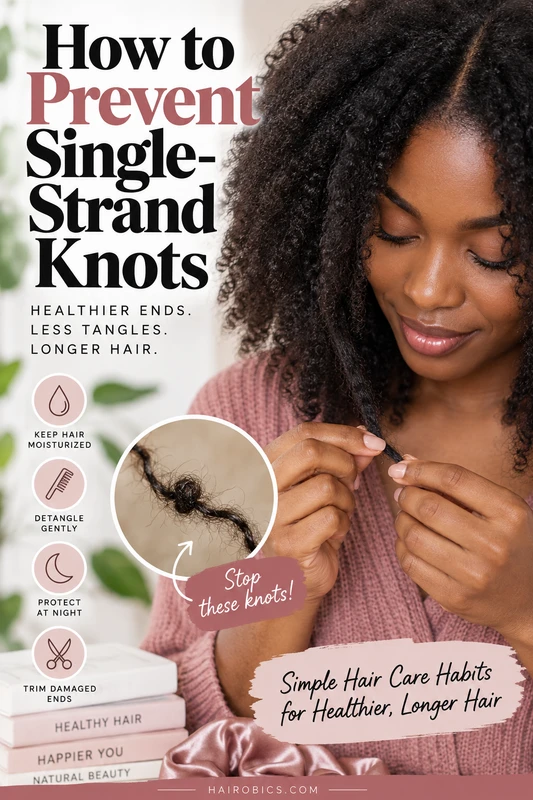
Single-strand knots can be one of the most frustrating parts of caring for natural, curly, coily, and kinky hair. You may be running your fingers through your hair when suddenly you feel a tiny knot near the end of a strand. Sometimes the knot slides out with a little patience. Other times, it seems practically impossible to remove without cutting the strand.
These tiny knots are commonly called single-strand knots or fairy knots, and they are especially common among people with tightly curled and coily hair.
While an occasional knot may be unavoidable, constantly finding them throughout your hair can contribute to tangling, rough ends, breakage, and difficulty retaining length.
Fortunately, the right hair-care routine can dramatically reduce how frequently single-strand knots develop.
In this complete guide, we'll explain how to prevent single-strand knots, why natural hair is particularly susceptible to them, how to safely deal with knots that have already formed, and which daily habits can help you maintain smoother, healthier-looking ends.
What Are Single-Strand Knots?
A single-strand knot occurs when an individual strand of hair loops around itself and forms a tiny knot.
Unlike a traditional tangle involving several strands, a single-strand knot may involve only one hair strand.
The knot often appears toward the end of the hair, although it can sometimes develop farther up the strand.
You might notice one while:
- Finger detangling
- Applying moisturizer
- Styling your hair
- Braiding or twisting
- Running your fingers through your ends
- Washing or conditioning your hair
Single-strand knots are especially common in curly and coily hair because the natural bends and curves of the hair make it easier for individual strands to loop around themselves.
The tighter your curl pattern, the more opportunities a strand has to interact with itself and neighboring strands.
Why Does Natural Hair Get Single-Strand Knots?
Natural hair does not necessarily develop knots because you're doing something wrong.
The structure of curly and coily hair naturally increases the likelihood of tangling.
A straight strand tends to fall downward relatively consistently. A tightly coiled strand bends, twists, contracts, and moves in several directions.
When the hair is loose, the end of a strand can curl backward and create a loop. If the end passes through that loop, a tiny knot can form.
Several factors can increase this tendency.
1. Tight Curl Patterns
Tightly curled and coily hair naturally folds back onto itself.
That makes single-strand knots especially common among people with Type 3 and Type 4 textures.
Type 4 hair may be particularly susceptible because of its numerous bends and coils.
2. Shrinkage
Shrinkage is another major factor.
When wet natural hair dries, curls contract toward the scalp. During this process, individual strands may wrap around themselves or neighboring strands.
Shrinkage is a normal characteristic of healthy curly hair, but allowing the hair to shrink completely without keeping it organized can sometimes increase tangling.
3. Dry Hair
Dry strands usually have more friction than properly conditioned strands.
When hair feels rough, strands may catch against each other instead of sliding past one another.
This can encourage both regular tangles and single-strand knots.
4. Split or Weathered Ends
Hair ends are the oldest portion of your hair.
Over time, they experience:
- Washing
- Detangling
- Heat
- Styling
- Sun exposure
- Friction
- Manipulation
- Clothing contact
As ends become weathered, their rougher surfaces can catch against other strands.
5. Wearing Hair Loose Frequently
Afros, wash-and-gos, twist-outs, braid-outs, and other loose hairstyles can look beautiful.
However, constantly wearing highly textured hair completely loose gives individual strands more freedom to curl around themselves.
This doesn't mean you have to stop wearing your favorite styles. It simply means you may need to balance loose hairstyles with stretched or low-manipulation styles.
How to Prevent Single-Strand Knots
Preventing every knot probably isn't realistic for highly textured hair.
The better goal is to reduce how frequently knots develop while protecting your ends from unnecessary breakage.
Here are some of the most effective strategies.
1. Keep Your Hair Moisturized
Moisture should be one of your first priorities when trying to reduce knots.
Dry hair tends to create more friction.
Properly conditioned hair generally feels softer and has better slip, allowing strands to move past one another more easily.
Your moisturizing routine might include:
- Water or a water-based moisturizer
- Leave-in conditioner
- Cream or moisturizer
- A small amount of oil or butter when appropriate
The exact combination depends on your hair.
Fine hair may become weighed down by heavy products, while thick or highly porous hair may respond well to richer formulas.
The goal isn't to coat your hair in as many products as possible.
Instead, focus on maintaining hair that feels soft, flexible, conditioned, and manageable.
Pay Extra Attention to Your Ends
Your ends need special attention because they are both the oldest and most knot-prone portion of your hair.
When applying moisturizer, don't stop halfway down the strand.
Gently work the product through your ends.
If your ends repeatedly feel rough shortly after moisturizing, you may need to adjust your routine, increase conditioning, or evaluate whether it's time for a trim.
2. Detangle Regularly
Allowing shed hairs and tangles to accumulate can create the perfect environment for knots.
Regular detangling helps separate strands before small tangles become larger ones.
However, aggressive detangling can create an entirely different problem: breakage.
A Better Detangling Method
Divide your hair into manageable sections.
Apply water, conditioner, or a detangling product with plenty of slip.
Begin at the ends.
Gradually work toward the roots.
Use your fingers or an appropriate wide-tooth comb or detangling brush.
If you encounter resistance, stop instead of forcing the tool through.
The goal is not to finish as quickly as possible.
It's to detangle while preserving as many healthy strands as possible.
3. Don't Detangle Extremely Dry Hair
Trying to pull apart severely dry curls can increase friction and snapping.
Instead, add lubrication before detangling.
Depending on your routine, you could use:
- Water
- Leave-in conditioner
- Rinse-out conditioner
- Detangling spray
- Moisturizing mist
Hair doesn't necessarily need to be soaking wet, but some textures are easier to manipulate when damp and conditioned.
Experiment to determine whether your hair responds best to wet or damp detangling.
4. Work in Sections
Sectioning is one of the simplest ways to prevent natural hair from becoming tangled during wash day.
Instead of washing your entire head as one large mass of hair, divide it into approximately four to eight sections.
People with very thick or long hair may prefer even more sections.
Loosely twist or braid each section.
Then wash, condition, detangle, and moisturize systematically.
Sectioning keeps already-detangled hair separated from hair that still needs attention.
It can also reduce the amount of uncontrolled shrinkage that occurs during the process.
5. Stretch Your Hair
One of the most effective ways to reduce single-strand knots is keeping curly hair somewhat stretched.
Stretching elongates the curls, reducing opportunities for individual strands to curl back onto themselves.
You don't necessarily need heat to stretch natural hair.
Heat-free stretching methods include:
- African threading
- Banding
- Braids
- Twists
- Bantu knots
- Roller sets
You can also stretch a wash-and-go after it dries by gently banding the hair or using another low-tension stretching technique.
The objective isn't to eliminate your curl pattern.
You're simply reducing extreme shrinkage and helping strands remain more separated.
6. Try Braids or Twists After Wash Day
If your hair becomes severely tangled every time it dries loose, try putting each freshly moisturized section into a braid or twist.
Allowing hair to dry in sections can significantly reduce tangling.
Once the hair is dry, you can:
- Leave the twists in
- Create a twist-out
- Create a braid-out
- Put your hair into an updo
- Create another low-manipulation style
This strategy is particularly useful for people whose hair shrinks dramatically after washing.
7. Protect Your Hair at Night
Eight hours of tossing and turning against cotton bedding can create substantial friction.
That friction can contribute to:
- Frizz
- Dryness
- Tangling
- Breakage
- Rough ends
Protect your hair before going to bed.
A satin or silk bonnet is one of the simplest options.
You can also use a satin or silk scarf.
For additional protection, consider a satin or silk pillowcase.
Don't Just Throw Loose Hair Into a Bonnet
If your hair tangles easily, putting completely loose hair into a bonnet may not be enough.
Instead, loosely:
- Braid it
- Twist it
- Band it
- Pineapple it
- Section it
The ideal nighttime routine depends on your hairstyle and texture.
The important part is minimizing unnecessary friction and preventing strands from becoming excessively intertwined overnight.
8. Trim Damaged Ends
Sometimes the problem isn't your moisturizing routine.
It's your ends.
Old, split, frayed, or severely weathered ends can repeatedly snag against neighboring strands.
If you're constantly finding knots concentrated in the last inch or two of your hair, inspect your ends carefully.
Signs you may need a trim include:
- Numerous split ends
- Transparent-looking ends
- Rough ends
- Excessive tangling
- Ends that repeatedly knot together
- Difficulty detangling
- Uneven or thin-looking ends
Trimming damaged ends does not make hair grow faster from the scalp.
However, maintaining healthier ends can reduce breakage and help you retain more of the length you grow.
9. Don't Hold Onto Damaged Ends Just for Length
Length retention is important for many people growing natural hair.
However, keeping severely damaged ends simply because you don't want shorter hair can sometimes make your routine more difficult.
Damaged ends may repeatedly tangle with healthier strands.
That can make detangling more time-consuming and potentially increase mechanical breakage.
Healthy-looking ends usually create a fuller, more polished appearance than longer but severely thinned ends.
10. Reduce Excessive Manipulation
Every time you manipulate your hair, strands rub against each other.
This includes:
- Combing
- Brushing
- Finger styling
- Restyling
- Twisting
- Braiding
- Separating curls
Some manipulation is unavoidable.
The issue is excessive manipulation.
If you completely restyle your hair every morning, you may be creating more friction than necessary.
Consider hairstyles that can last several days without major manipulation.
11. Use Low-Manipulation Hairstyles
Low-manipulation styles help keep hair organized while reducing daily combing and styling.
Examples include:
- Two-strand twists
- Flat twists
- Braids
- Buns
- Updos
- Roller sets
- Tucked styles
Protective hairstyles such as braids can also reduce daily manipulation when installed and maintained properly.
However, don't assume that every protective hairstyle automatically protects your hair.
Extremely tight braids, excessive extension weight, poor scalp care, and leaving styles installed too long can cause other problems.
Protective styling should actually protect your hair—not create additional tension or damage.
12. Keep Your Ends Tucked Away Occasionally
The ends are the oldest and most vulnerable part of your hair.
They also experience constant contact with:
- Shirts
- Sweaters
- Jackets
- Scarves
- Car seats
- Bedding
- Furniture
If your hair is shoulder length or longer, this friction can become significant.
Occasionally wearing hairstyles where the ends are tucked away can help reduce exposure.
Examples include buns, tucked twists, and certain updos.
You don't have to hide your ends every day.
Balance is key.
13. Be Careful With Wash-and-Gos
Wash-and-gos can beautifully showcase your natural curl pattern.
But for some tightly coiled textures, frequent wash-and-gos may increase single-strand knots.
Why?
The hair is allowed to shrink into its natural pattern.
As the curls contract, individual strands may wrap around themselves.
If you love wash-and-gos, you don't necessarily need to eliminate them.
Instead:
- Detangle thoroughly beforehand.
- Use products with good slip.
- Define sections carefully.
- Avoid constantly touching your curls.
- Protect the style overnight.
- Stretch the hair slightly when appropriate.
- Detangle carefully when removing the style.
Pay attention to your hair.
If every wash-and-go ends with dozens of new knots, consider alternating with stretched hairstyles.
14. Avoid Constantly Touching Your Hair
Natural hair can be tempting to touch.
You might twirl individual curls while working, watching television, or scrolling through your phone.
Repeatedly manipulating the ends can encourage strands to wrap around themselves.
Try to leave your hair alone once you've styled it.
Less touching means less friction and unnecessary manipulation.
15. Use Conditioner With Good Slip
Slip refers to how easily your fingers or detangling tools glide through your hair.
A conditioner with good slip can make detangling significantly easier.
This is especially important for:
- Thick natural hair
- Long natural hair
- Type 4 hair
- High-density hair
- Hair that tangles easily
Apply enough conditioner to coat your strands, then carefully detangle in sections.
If your fingers constantly snag while using a particular conditioner, the product may not provide enough lubrication for your hair.
16. Deep Condition When Needed
Deep conditioning can help improve softness and manageability, particularly when your hair feels dry or rough.
Depending on your hair's needs, you may deep condition periodically rather than after every shampoo.
After shampooing:
- Apply deep conditioner throughout your hair.
- Focus especially on dry areas and ends.
- Follow the product's instructions.
- Rinse thoroughly.
- Apply your normal styling products.
Avoid assuming that leaving conditioner on for hours automatically provides better results. Follow the manufacturer's directions unless you have a specific reason not to.
17. Avoid Product Buildup
Moisture is important, but more product isn't always better.
Layering excessive amounts of creams, gels, butters, and oils can eventually leave buildup on the hair.
Hair with significant buildup may become:
- Dull
- Sticky
- Heavy
- Difficult to moisturize
- Harder to detangle
Use a cleansing routine appropriate for the products you use.
If your normal shampoo no longer leaves your hair feeling clean, occasional clarifying may help remove stubborn buildup.
Follow clarifying with conditioning because stronger cleansers can sometimes leave hair feeling dry.
18. Shampoo Your Scalp and Hair Properly
Trying to avoid shampoo entirely because you're worried about dryness can sometimes backfire.
Cleansing removes sweat, dirt, oils, and styling-product residue.
The key is choosing a shampoo and washing schedule appropriate for your hair and scalp.
During shampooing, avoid aggressively piling all of your hair on top of your head.
Instead, work primarily at the scalp and allow the cleanser to move down the lengths as you rinse.
For long or highly tangled hair, shampooing in sections may help keep the hair organized.
19. Avoid Rough Towel Drying
Traditional bath towels can create unnecessary friction when aggressively rubbed against curly hair.
Instead of vigorously rubbing your hair dry, gently squeeze or blot away excess water.
Some people prefer microfiber towels or soft cotton T-shirts for this purpose.
Whatever material you choose, technique matters.
Avoid rough rubbing and twisting.
20. Protect Your Hair From Clothing
Your nighttime pillowcase isn't the only fabric touching your hair.
During the day, your ends may rub against clothing.
Wool coats, rough sweaters, scarves, and other textured materials can create friction.
This is particularly important during winter when people wear multiple layers.
If your hair constantly rests against rough clothing, consider wearing it up occasionally or placing a smoother barrier between your hair and the fabric.
How to Remove a Single-Strand Knot
What should you do when a knot has already formed?
First, resist the temptation to aggressively pull it apart.
If the knot is loose, you may be able to carefully unravel it.
Apply a small amount of conditioner, detangler, or another product with good slip.
Hold the strand above the knot.
Use your fingers to gently loosen the loop.
Sometimes a fine tool can help with a stubborn knot, but be extremely careful to avoid damaging the strand or your scalp.
If the knot is extremely tight and cannot be safely removed, trimming the affected portion with sharp hair-cutting shears may be the better option.
Avoid ripping the knot out.
Should You Cut Single-Strand Knots?
Sometimes.
If you can gently unravel a knot without damaging the hair, you may be able to preserve the strand.
But extremely tight knots can weaken the strand and catch neighboring hairs.
In those situations, cutting slightly above the knot with proper hair shears may be preferable to ripping through it.
Don't use dull household scissors.
Hair-cutting shears provide a cleaner cut.
If you're finding hundreds of knots rather than an occasional one, don't simply cut each knot individually without examining the underlying cause.
Review your:
- Moisturizing routine
- Detangling technique
- Trim schedule
- Nighttime routine
- Hairstyle choices
- Wash-day routine
Frequent knotting may indicate that your routine needs adjustment.
Are Single-Strand Knots Split Ends?
No.
Single-strand knots and split ends are different.
A single-strand knot occurs when one strand loops and ties around itself.
A split end occurs when the end of the hair shaft separates into multiple pieces.
However, they can be related.
A knot can create a weak point in the strand, while rough or damaged ends can be more prone to snagging and tangling.
That's another reason maintaining healthy ends is important.
Do Single-Strand Knots Stop Hair Growth?
Single-strand knots do not stop your follicles from producing hair.
Hair growth occurs at the scalp.
However, knots can affect length retention.
Suppose your hair grows approximately half an inch in a month, but your ends continually break because of tangles, dryness, and knots.
Your hair is still growing from the scalp, but you may not see much change in overall length.
This is why hair growth and length retention are different concepts.
Growing longer natural hair requires both:
Healthy scalp growth + protecting existing length.
Can Oil Prevent Single-Strand Knots?
Oil alone cannot guarantee knot-free hair.
However, certain oils can help reduce friction and improve lubrication when incorporated appropriately into a complete hair-care routine.
Popular oils used in natural hair routines include:
- Jojoba oil
- Avocado oil
- Coconut oil
- Olive oil
- Grapeseed oil
- Sweet almond oil
- Castor oil
Different oils behave differently, and not every oil works equally well for every hair type.
Remember that oil is not a substitute for water.
If your hair is dehydrated, repeatedly coating it with heavy oil may leave it greasy without addressing the underlying need for conditioning and hydration.
Use oils strategically rather than excessively.
Best Routine to Prevent Single-Strand Knots
Consistency matters more than complicated routines.
Here's an example of a simple routine.
Wash Day
Divide hair into sections.
Cleanse the scalp and hair gently.
Apply conditioner.
Detangle from ends to roots.
Rinse carefully while keeping sections organized.
After Washing
Apply leave-in conditioner or your preferred moisturizer.
Pay extra attention to the ends.
Apply styling products as needed.
Put hair into twists, braids, or another organized style if you experience severe shrinkage-related tangling.
During the Week
Refresh moisture when necessary.
Avoid constantly restyling your hair.
Keep ends protected from excessive friction.
Before Bed
Separate the hair into a few sections if necessary.
Loosely twist, braid, band, or pineapple it.
Cover with satin or silk.
Periodically
Inspect your ends.
Trim damaged portions when necessary.
Clarify buildup when needed.
Evaluate whether your current hairstyles are contributing to excessive tangling.
This routine doesn't have to be followed exactly.
Adjust it according to your hair density, length, porosity, curl pattern, lifestyle, and styling preferences.
Single-Strand Knots on Type 4 Hair
Single-strand knots can be particularly noticeable on Type 4 hair because tightly coiled strands naturally bend and contract.
For Type 4 hair, focus heavily on three strategies:
Moisture, stretching, and sectioning.
Keeping hair moisturized reduces friction.
Keeping it slightly stretched reduces opportunities for strands to loop around themselves.
Working in sections prevents the hair from becoming one large tangled mass.
For example, instead of washing a full Afro loose, divide the hair into six twists.
Cleanse and condition section by section.
Detangle carefully.
Re-twist each completed section.
This small change can make wash day significantly easier for some people.
Single-Strand Knots on Fine Natural Hair
Fine strands require slightly different care.
Heavy butters and oils may weigh fine hair down, so focus on lightweight moisture and gentle handling.
Fine strands can also break more easily when knots are aggressively manipulated.
Avoid repeatedly pulling at a tight knot.
If it cannot be safely loosened, trimming the affected end may prevent additional damage.
Single-Strand Knots on Long Natural Hair
As natural hair becomes longer, the ends have experienced years of manipulation and environmental exposure.
Long hair also has more opportunities to:
- Rub against clothing
- Tangle during sleep
- Wrap around itself
- Shrink into neighboring strands
People with long natural hair may benefit especially from:
- Washing in sections
- Keeping ends conditioned
- Stretching after wash day
- Protective nighttime routines
- Regular end maintenance
- Low-manipulation hairstyles
The longer your hair becomes, the more important preserving your oldest ends becomes.
Common Mistakes That Can Cause More Knots
Sometimes reducing knots isn't about adding something to your routine.
It's about stopping certain habits.
Mistake #1: Going Too Long Between Detangling Sessions
Allowing shed hair to remain trapped among your curls can contribute to tangling.
Mistake #2: Detangling Aggressively
Pulling a comb through resistant sections can turn small tangles into broken strands.
Mistake #3: Ignoring Dry Ends
Your ends deserve as much attention as your roots.
Mistake #4: Sleeping With Loose, Unprotected Hair
Nighttime friction can contribute to dryness and tangling.
Mistake #5: Avoiding Trims Indefinitely
Holding onto severely damaged ends may make detangling increasingly difficult.
Mistake #6: Wearing Only Highly Shrunken Styles
If your hair is extremely prone to knots, occasionally stretching it can help.
Mistake #7: Using Too Much Product
Heavy buildup isn't the same thing as healthy moisture.
Frequently Asked Questions About Single-Strand Knots
Why do I have so many single-strand knots?
Frequent knots can be associated with tight curl patterns, shrinkage, dry or weathered ends, friction, infrequent detangling, loose hairstyles, or a combination of these factors.
Some knotting is normal for highly textured hair.
The goal should be reducing excessive knotting rather than expecting every strand to remain perfectly knot-free.
Are fairy knots bad for natural hair?
An occasional fairy knot isn't necessarily a major problem.
However, excessive knots may snag other hairs and contribute to breakage or difficult detangling.
Can you untie a fairy knot?
Sometimes.
Loose knots may be carefully unraveled with your fingers and a product that provides slip.
Very tight knots may need to be trimmed.
Why are my ends always knotting?
Your ends are the oldest and most weathered portion of your hair.
They also experience more friction and may curl around themselves.
If your ends are constantly knotting despite proper moisture and detangling, inspect them for splitting, thinning, or other damage.
Does trimming prevent fairy knots?
Trimming won't permanently prevent single-strand knots because new ones can still form.
However, removing severely damaged or rough ends may reduce snagging and improve manageability.
Should I cut every single-strand knot?
Not necessarily.
If a knot can be safely unraveled, cutting isn't required.
If it is extremely tight, trimming slightly above it with hair shears may be safer than aggressively pulling at it.
Do protective styles prevent single-strand knots?
They can help because they reduce manipulation and keep strands organized.
However, protective styles must be installed, maintained, and removed properly.
Hair can still become tangled underneath a protective style if it becomes excessively dry or shed hairs accumulate.
Can single-strand knots happen on straight hair?
Yes, but they tend to be especially common in curly and coily textures because those strands naturally bend and loop around themselves.
Does sleeping with a bonnet prevent knots?
A satin or silk bonnet can reduce friction, but organizing your hair before putting the bonnet on may provide even better protection.
Try loosely twisting, braiding, banding, or otherwise securing hair before bed.
How often should you trim natural hair to prevent knots?
There is no universal trimming schedule.
Your hair's condition should guide you.
Someone who uses frequent heat or manipulation may require trims more often than someone whose ends remain healthy.
Instead of automatically trimming according to a strict calendar, regularly inspect your ends for splitting, roughness, thinning, and excessive tangling.
How to Prevent Single-Strand Knots Without Losing Length
If you're growing your natural hair, it can feel discouraging to cut any length.
But length retention isn't about avoiding scissors forever.
It's about keeping as much healthy hair as possible.
Focus on preventing damage before it develops.
That means:
- Moisturizing consistently
- Detangling carefully
- Protecting hair at night
- Reducing friction
- Keeping hair organized
- Limiting unnecessary manipulation
- Maintaining healthy ends
When these habits become part of your normal routine, you may find that fewer strands require trimming because fewer ends become severely damaged.
The Bottom Line: Preventing Single-Strand Knots Starts With Your Routine
Single-strand knots are a normal challenge for many people with natural, curly, coily, and kinky hair.
Because textured strands naturally bend, shrink, and curl around themselves, completely eliminating every fairy knot may not be realistic.
But you can significantly reduce excessive knotting.
The most effective strategy is to focus on moisture, gentle detangling, stretching, sectioning, nighttime protection, low manipulation, and healthy ends.
Pay particular attention to the oldest portion of your hair—your ends.
Keep them moisturized and conditioned. Protect them from unnecessary friction. Detangle patiently. Trim damaged ends when necessary.
Most importantly, observe how your own hair responds.
If wash-and-gos consistently leave your hair covered in knots, incorporate more stretched styles. If your ends become rough between wash days, adjust your moisturizing routine. If your hair tangles overnight, improve your nighttime protection.
Small changes can make a major difference over time.
The goal isn't perfectly knot-free hair.
The goal is healthier strands, easier detangling, less unnecessary breakage, and better length retention.
With consistent care, you can spend less time fighting tiny knots and more time enjoying your natural hair.