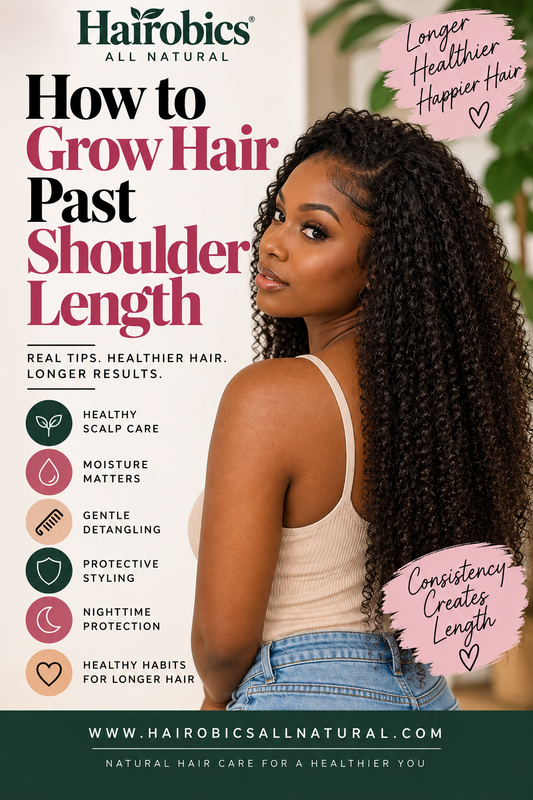
Growing your hair past shoulder length can feel surprisingly difficult. You may notice that your hair grows steadily for a while, reaches your shoulders, and then seems to stay at almost exactly the same length year after year.
The good news is that your hair may actually be growing normally.
For many people—especially those with natural, curly, coily, or textured hair—the biggest challenge isn't necessarily increasing the speed of hair growth. The challenge is keeping the hair that has already grown.
This is known as length retention.
If your hair grows approximately half an inch per month but you're constantly losing length from split ends, knots, dryness, excessive manipulation, or breakage, your hair can appear to have stopped growing.
Learning how to grow hair past shoulder length therefore requires two strategies:
- Supporting healthy hair growth from the scalp.
- Protecting your existing strands so they can become progressively longer.
In this complete guide, we'll explain why hair often seems to get stuck around shoulder length, what causes breakage, how to build a length-retention routine, and what you can do every day, week, and month to help your hair reach new lengths.
Why Does Hair Seem to Stop Growing at Shoulder Length?
One of the most frustrating experiences is watching your hair reach shoulder length and then seemingly stop.
There are several reasons this happens.
Your hair follicles continue producing hair according to their natural growth cycle, but the ends of your hair are the oldest and usually the most fragile portion of each strand.
Once your hair reaches shoulder length, it also begins experiencing more friction.
Your ends constantly rub against:
- Shirts
- Jackets
- Sweaters
- Scarves
- Cotton pillowcases
- Car seats
- Furniture
- Towels
This friction can slowly weaken your ends.
The result?
Your hair grows from the scalp while simultaneously breaking from the ends.
If you gain six inches of new growth during the year but lose four or five inches through breakage, trimming, knots, and split ends, you'll see very little improvement in overall length.
This creates the illusion that your hair has reached its "maximum length."
In reality, improving your hair-care habits may allow you to retain considerably more of your growth.
Hair Growth vs. Length Retention
Understanding this difference can completely change the way you approach growing longer hair.
Hair growth happens inside the follicle.
Length retention happens after the hair emerges from your scalp.
Your genetics, age, hormones, nutritional status, health, and hair-growth cycle can influence how quickly and how long your hair grows.
However, your hair-care routine has a major influence on what happens to the strand after it grows.
Imagine that your hair grows six inches during a year.
Scenario A
Hair growth: 6 inches
Breakage/trimming: 5 inches
Length retained: 1 inch
Scenario B
Hair growth: 6 inches
Breakage/trimming: 2 inches
Length retained: 4 inches
Both people experienced the same amount of growth.
The second person simply kept more of it.
That's why a successful long-hair routine should focus heavily on preventing unnecessary breakage.
How Long Does It Take to Grow Hair Past Your Shoulders?
There isn't one universal timeline.
Scalp hair commonly grows around half an inch per month on average, although individual growth rates vary considerably.
That could equal roughly six inches in one year.
But your visible progress depends on several factors, including:
- Starting length
- Hair-growth rate
- Shrinkage
- Breakage
- Trimming frequency
- Hair-care practices
- Genetics
- Health
- Styling habits
Curly and coily hair can also appear significantly shorter than its actual stretched length because of shrinkage.
For example, tightly coiled hair might look shoulder length when dry but stretch several inches beyond the shoulders.
Rather than obsessing over monthly measurements, focus on maintaining a routine that allows your hair to remain healthy over long periods.
Long hair is usually the result of consistency.
1. Focus on Your Scalp
Healthy-looking hair starts with proper scalp care.
Your scalp contains the follicles responsible for producing your strands. Keeping your scalp clean and comfortable creates a better environment for normal hair growth.
This doesn't mean you need an elaborate scalp routine.
Simple consistency can be more useful than constantly experimenting with different treatments.
Your scalp routine might include:
- Regular cleansing
- Gentle scalp massage
- Avoiding excessive buildup
- Limiting scratching
- Avoiding excessively tight hairstyles
- Using scalp products appropriately
If you regularly experience severe itching, inflammation, sores, unusual scaling, or sudden hair loss, consider talking with a dermatologist rather than simply adding more oils or products.
2. Keep Your Scalp Clean
There is a common misconception that dirty hair grows faster.
It doesn't.
Your scalp naturally produces sebum while styling products, sweat, environmental debris, and dead skin can accumulate between washes.
A consistent cleansing routine removes this buildup.
How often you wash depends on your scalp, lifestyle, hairstyle, and product use.
Some people with natural hair prefer washing weekly. Others may wash every 7–14 days.
People who exercise frequently or experience significant scalp buildup may need to cleanse more often.
The goal isn't to follow an arbitrary number of days.
The goal is to keep your scalp clean without leaving your hair excessively dry.
3. Make Moisture a Priority
Dryness is one of the biggest enemies of length retention.
Hair that remains excessively dry can become less flexible and more vulnerable to breakage during styling and manipulation.
Textured hair can be especially prone to dryness because natural scalp oils have a more difficult journey traveling down curved and coiled strands.
That means your ends may receive very little natural sebum.
A basic moisturizing routine can include:
Step 1: Apply a water-based moisturizer or leave-in conditioner.
Step 2: Distribute the product gently throughout your hair.
Step 3: Concentrate additional attention on your ends.
Step 4: If your hair responds well to it, follow with an oil, cream, or butter to help reduce moisture loss.
Your hair should feel moisturized and flexible—not permanently coated in heavy products.
4. Pay Special Attention to Your Ends
If your goal is growing hair past shoulder length, your ends deserve VIP treatment.
Why?
Because they're the oldest part of your hair.
If your hair is several years old at the ends, those strands have survived hundreds of wash days, styling sessions, nights of sleep, weather changes, and encounters with clothing.
Protect them accordingly.
When applying conditioner, moisturizer, or leave-in treatment, don't concentrate everything near your scalp.
Move the product through your lengths and ends.
Your ends are usually where you need protection the most.
5. Deep Condition Regularly
Deep conditioning can be a valuable part of a length-retention routine, particularly for dry, curly, coily, or chemically treated hair.
After shampooing, apply your conditioner according to its instructions.
Focus on your lengths and ends.
Use this opportunity to carefully detangle your hair if the product provides enough slip.
The goal is to maintain hair that feels:
- Soft
- Flexible
- Manageable
- Hydrated
- Easier to detangle
You don't necessarily need to leave a conditioner on for hours.
Follow the manufacturer's directions rather than assuming longer always means better.
6. Detangle Your Hair Carefully
Detangling is one of the easiest times to accidentally destroy months of progress.
Aggressive detangling can snap strands and damage your ends.
Avoid ripping a brush or comb from your roots straight through tangled hair.
Instead:
Divide your hair into sections.
Working in smaller sections gives you better control.
Add moisture and slip.
Depending on your routine, use water, conditioner, leave-in conditioner, or a detangling product.
Start near the ends.
Remove tangles from the ends before gradually moving upward.
Hold the section.
Supporting the hair with your hand can reduce pulling on the scalp.
Be patient with knots.
If you encounter a difficult knot, don't automatically rip through it.
Use your fingers and additional product to gently loosen the tangled strands.
A few extra minutes during detangling can potentially save a surprising amount of hair.
7. Reduce Manipulation
Sometimes growing longer hair requires doing less.
Constant styling means constant manipulation.
Think about everything your hair experiences when you repeatedly:
- Comb it
- Brush it
- Twist it
- Untwist it
- Braid it
- Unbraid it
- Slick it down
- Pull it into ponytails
- Restyle your edges
Every interaction creates some degree of mechanical stress.
This doesn't mean you should never style your hair.
Instead, find hairstyles that look good without requiring complete manipulation every morning.
Low-manipulation styles can be extremely helpful when trying to grow hair past shoulder length.
8. Try Protective and Low-Manipulation Hairstyles
Protective styling can help reduce daily handling and protect vulnerable ends.
Options include:
- Two-strand twists
- Flat twists
- Braids
- Buns
- Cornrows
- Mini twists
- Updos
But there's an important distinction:
A hairstyle isn't automatically protective just because it's called a protective style.
Extremely tight braids, heavy extensions, constant edge control, or excessive tension can create additional problems.
Your protective style should actually protect your hair.
You shouldn't need to sacrifice your edges to retain your ends.
9. Stop Wearing Extremely Tight Hairstyles
Tighter does not mean better.
Repeated tension around the hairline can contribute to breakage and, in some cases, traction alopecia.
Pay attention to warning signs such as:
- Pain
- Headaches
- Tenderness
- Bumps
- Excessive pulling
- Thinning edges
If a hairstyle hurts, that's a warning—not proof that the style will last longer.
Long-term length retention includes protecting your scalp and hairline.
10. Protect Your Hair While Sleeping
You might spend six to eight hours sleeping every night.
That's thousands of hours every year.
If your hair repeatedly rubs against absorbent or rough fabrics throughout that time, friction can contribute to tangling and breakage.
Consider sleeping with:
- A satin bonnet
- A satin scarf
- A satin pillowcase
People with long natural hair may also benefit from loosely sectioning, braiding, or twisting their hair before bed.
The goal is to prevent your hair from becoming tangled and matted overnight.
11. Be Careful With Cotton Clothing
Once your hair reaches shoulder length, your clothing can become part of your hair-care routine.
Loose hair may constantly rub against cotton shirts, sweaters, coats, and scarves.
Over time, this friction can affect fragile ends.
You don't have to stop wearing cotton.
Instead, consider wearing your hair up more frequently when you're trying to retain length.
Styles that keep your ends off your shoulders can be especially useful once your hair reaches this stage.
12. Limit Excessive Heat
Heat isn't automatically bad for hair.
But excessive temperatures and repeated heat styling can weaken the hair shaft and increase the risk of damage.
If you're using a blow dryer, flat iron, or curling iron:
- Use an appropriate heat protectant.
- Avoid unnecessarily high temperatures.
- Don't repeatedly pass the tool over the same section.
- Avoid heat styling extremely frequently.
- Make sure your technique is gentle.
For natural hair, excessive heat can also affect the curl pattern.
If growing long, healthy hair is your priority, treat heat as a styling tool rather than something your hair must experience constantly.
13. Avoid Constantly Trimming Your Hair
Trimming is important, but trimming does not make hair grow faster from the scalp.
Hair grows from follicles—not from the ends.
Trimming removes damaged or split ends and can improve the appearance and manageability of your hair.
However, trimming too much too frequently can make length retention difficult.
Suppose your hair grows approximately half an inch in a month.
If you're regularly cutting away most of your new length, visible progress will naturally be slower.
Trim when your hair needs it rather than automatically cutting large amounts simply because a certain number of weeks have passed.
14. Don't Ignore Split Ends
The opposite extreme isn't ideal either.
Some people refuse to trim anything because they're afraid of losing length.
But severely damaged ends can become difficult to detangle and may continue splitting.
Watch for:
- Frayed ends
- Excessive tangling
- See-through ends
- Numerous split ends
- Rough ends
- Ends that constantly snap
A small, strategic trim can sometimes make it easier to retain healthy-looking length over time.
15. Reduce Single-Strand Knots
Single-strand knots are particularly common with tightly curled and coily hair.
A strand curls around itself and forms a tiny knot.
These knots can snag other strands, complicate detangling, and sometimes lead to breakage.
To help reduce them:
- Keep hair moisturized.
- Detangle regularly but gently.
- Keep ends stretched when appropriate.
- Wear twists or braids periodically.
- Protect hair at night.
- Avoid letting loose hair remain tangled for extended periods.
You may never eliminate every single-strand knot from tightly coiled hair, but reducing them can make length retention easier.
16. Use Shampoo Correctly
Shampoo is primarily intended to cleanse your scalp and hair.
You don't necessarily need to aggressively pile all of your hair on top of your head and scrub it together.
That can create unnecessary tangling.
Instead:
- Divide your hair if necessary.
- Wet your hair thoroughly.
- Apply shampoo primarily to the scalp.
- Massage gently with your fingertips.
- Allow the cleanser and water to move through your lengths.
- Rinse thoroughly.
Your exact technique will depend on your hair density, length, and style.
17. Don't Scratch Your Scalp With Your Fingernails
When your scalp itches, digging your fingernails into it can feel satisfying.
But aggressive scratching can irritate the scalp.
When shampooing, massage with the pads of your fingertips rather than scratching forcefully with your nails.
Persistent scalp itching deserves attention.
Possible causes range from product buildup and irritation to dandruff and other scalp conditions.
If itching is severe, recurrent, or accompanied by sores or hair loss, consult a qualified healthcare professional.
18. Consider Scalp Massage
Scalp massage can be a relaxing addition to your hair routine.
Using the pads of your fingers, gently massage different areas of your scalp for several minutes.
You can massage your scalp with or without a scalp product.
The key word is gently.
You don't need to aggressively rub your scalp or pull your strands.
If you use oils, remember that more isn't necessarily better.
A scalp soaked in oil isn't automatically healthier than one receiving a small amount.
19. Don't Overload Your Hair With Products
It's easy to assume that growing longer hair requires ten different products.
It doesn't.
Too many layers of heavy oils, creams, gels, butters, and stylers can create buildup.
You might then need stronger or more frequent cleansing to remove everything.
A simple routine may work better:
Cleanse → Condition → Moisturize → Protect → Style
You can customize those steps based on your hair.
The products should support your routine rather than make it unnecessarily complicated.
20. Learn Your Hair's Moisture Needs
There isn't one moisturizing schedule that works for everyone.
Some people need to refresh their hair every few days.
Others can go longer.
Instead of moisturizing according to an arbitrary internet schedule, learn how your hair behaves.
Ask:
Does my hair feel dry?
Are my ends becoming rough?
Is my hair flexible?
Is it becoming difficult to manipulate?
Does it snap easily?
The answers can help determine whether your hair needs additional moisture.
21. Be Careful With Protein Treatments
Protein-containing hair products can be helpful for some damaged or weakened hair, but more protein isn't always better.
Hair requires an appropriate balance between strength and flexibility.
If your routine is overloaded with protein treatments even though your hair doesn't need them, your strands may feel stiff or brittle.
Pay attention to how your hair responds.
You don't need to use a treatment simply because someone else's hair loves it.
22. Stretch Your Hair Safely
Keeping natural hair somewhat stretched can reduce tangling and make longer hair easier to manage.
Heat isn't the only way to stretch hair.
Heat-free or low-heat methods include:
- Banding
- Braiding
- Twisting
- African threading
- Roller sets
Stretched hair may also make it easier to monitor your actual length because shrinkage can hide progress.
23. Avoid Comparing Your Hair Growth to Someone Else's
Social media makes comparison extremely easy.
Someone may appear to grow waist-length hair in an incredibly short period, but you often don't know:
- Their genetics
- Their starting length
- Their shrinkage
- Their routine
- Their growth rate
- Whether extensions are involved
- How old the photos actually are
Your hair has its own growth cycle and characteristics.
Track your progress against yourself.
24. Take Length-Check Photos
One of the best ways to monitor your progress is photography.
Take a photo every two or three months.
Try to keep the variables consistent:
- Same shirt
- Same location
- Same camera angle
- Same hairstyle
- Same degree of stretching
You may see very little difference from week to week.
But comparing photos six months apart can reveal progress that was difficult to notice day-to-day.
25. Eat a Balanced Diet
Hair is part of your body.
Nutrition therefore matters.
A balanced diet that provides sufficient calories, protein, vitamins, minerals, and essential fats supports normal body functions, including hair production.
Foods that can be part of a nutritious diet include:
- Eggs
- Fish
- Beans
- Lentils
- Lean meats
- Nuts
- Seeds
- Fruits
- Vegetables
- Whole grains
- Dairy or suitable alternatives
You don't need a "miracle hair food."
Consistency and overall nutritional adequacy matter more than a single ingredient.
26. Don't Automatically Take Hair Supplements
Hair-growth supplements are heavily marketed, but they aren't automatically necessary.
Taking excessive amounts of certain nutrients can potentially cause problems, and supplementation won't necessarily make healthy hair grow dramatically faster if you're not deficient.
If you're concerned about a nutritional deficiency, unexplained hair loss, or major changes in your hair, speak with a healthcare professional.
27. Drink Enough Fluids
Hydration supports normal bodily functions, but drinking extreme amounts of water won't magically make hair grow several inches overnight.
Drink enough fluids to support your overall health.
Think of hydration as one part of a healthy lifestyle—not a miracle hair-growth hack.
28. Manage Stress
Long-term or severe stress can affect many aspects of health and may influence the hair-growth cycle in some people.
Stress management looks different for everyone.
Helpful habits can include:
- Regular exercise
- Adequate sleep
- Meditation
- Relaxation
- Spending time outdoors
- Hobbies
- Social connection
Hair care is important, but overall wellness matters too.
29. Protect Your Hair During Exercise
Exercise is excellent for overall health, but sweat and friction can complicate hair maintenance.
If you exercise frequently:
- Avoid extremely tight ponytails.
- Use gentle hair ties.
- Keep hair secured without excessive tension.
- Cleanse your scalp according to your needs.
- Allow sweaty hair and scalp to dry appropriately.
- Refresh moisture when necessary.
Don't avoid exercise because you're afraid of ruining your hairstyle.
Instead, create a hair routine that works with your lifestyle.
30. Protect Your Hair From Weather
Your environment can affect how your hair behaves.
Cold air, dry indoor heating, intense sun, wind, and humidity can all influence moisture, tangling, and styling.
During cold or dry weather, you may need:
- More frequent moisturizing
- Protective styles
- Additional nighttime protection
During hot weather, you may need:
- More frequent scalp cleansing
- Lighter products
- Styles that keep hair manageable
Adjust your routine throughout the year instead of expecting one routine to work perfectly in every season.
A Simple Weekly Routine for Growing Hair Past Shoulder Length
A routine doesn't need to be complicated.
Here's an example.
Wash Day
Step 1: Section your hair.
Divide your hair into manageable sections.
Step 2: Shampoo.
Focus on cleansing your scalp and removing buildup.
Step 3: Condition.
Apply conditioner generously to your lengths and ends.
Step 4: Detangle.
Carefully work from the ends upward.
Step 5: Rinse.
Rinse thoroughly according to the product directions.
Step 6: Apply leave-in moisture.
Concentrate on dry areas and ends.
Step 7: Seal or style as desired.
Use an oil, cream, or styling product if it works well for your hair.
Step 8: Choose a low-manipulation style.
Twists, braids, buns, or other gentle styles can help reduce daily handling.
Daily Hair Routine for Length Retention
You shouldn't have to completely restyle your hair every morning.
Your daily routine might be as simple as:
Morning
Remove your bonnet or scarf.
Check your hair's moisture level.
Refresh only if needed.
Arrange your existing style.
Avoid unnecessary brushing and combing.
Night
Check your ends.
Loosely secure or section your hair.
Put on your satin bonnet or scarf.
Sleep on a satin pillowcase as an additional layer of protection if desired.
That's it.
Long hair doesn't necessarily require hours of daily work.
Monthly Hair Routine
Once a month, evaluate the condition of your hair.
Ask yourself:
- Are my ends healthy?
- Am I experiencing excessive breakage?
- Is my scalp comfortable?
- Is my hair staying moisturized?
- Are my styles creating tension?
- Am I experiencing more knots?
- Does my routine need adjusting?
Take progress photos every few months instead of constantly measuring.
Hair growth is a long-term process.
Biggest Mistakes That Can Keep Hair at Shoulder Length
If your hair has been the same length for years, look closely at your habits.
Common length-retention mistakes include:
Rough detangling
Ripping through knots can remove significant length over time.
Excessive heat
Repeated high-temperature styling can weaken strands.
Tight hairstyles
Constant tension can damage the hairline and increase breakage.
Ignoring your ends
Dry, damaged ends are more likely to snap.
Sleeping without protection
Nightly friction can accumulate over hundreds of nights.
Too much manipulation
Restyling every day creates repeated mechanical stress.
Never trimming damaged ends
Severely split or damaged ends can become increasingly difficult to maintain.
Trimming too frequently
Removing healthy length too often makes progress difficult to see.
Product overload
Using excessive amounts of products can create unnecessary buildup.
Constantly changing routines
Trying a new viral routine every week makes it difficult to determine what actually works for your hair.
How to Grow Natural Hair Past Shoulder Length
Natural hair often requires a strong emphasis on length retention because curls and coils can create points along the strand that are vulnerable to mechanical stress.
Shrinkage also hides length.
Your natural hair may be significantly longer than it looks.
For natural hair, focus on:
- Consistent moisture
- Gentle detangling
- Low-manipulation styling
- Protecting ends
- Satin nighttime protection
- Reducing excessive heat
- Avoiding overly tight styles
- Maintaining a clean scalp
Don't try to completely eliminate shrinkage.
Shrinkage is a normal characteristic of many healthy curl patterns.
Instead, use safe stretching techniques when you want easier detangling or a more accurate length check.
How to Grow 4C Hair Past Shoulder Length
People with 4C hair sometimes believe their hair simply can't grow long.
It can.
However, tightly coiled strands may experience considerable shrinkage, tangling, and single-strand knots, making length retention especially important.
For 4C hair:
Keep hair moisturized but avoid excessive product buildup.
Work in sections during wash day.
Detangle patiently.
Use styles such as twists and braids to reduce tangling.
Protect your ends.
Sleep with satin.
Avoid constantly manipulating your hair.
Consider keeping hair moderately stretched through heat-free methods.
Most importantly, don't judge growth solely by how long your hair looks in its shrunken state.
Shoulder Length to Bra-Strap Length
Once your hair passes your shoulders, the next popular milestone is often armpit length or bra-strap length.
This stage requires patience.
The longer your hair becomes, the older your ends become.
That means protecting them becomes increasingly important.
You may notice that routines you could get away with when your hair was short don't work as well once it becomes longer.
Detangling may take longer.
You may need larger bonnets.
You may need to divide your hair into more sections.
Your protective styles may need adjusting.
Your routine should evolve as your hair grows.
How Long Can Your Hair Actually Grow?
Maximum hair length varies between individuals because of the hair-growth cycle, growth rate, genetics, breakage, health, and hair-care habits.
Hair goes through several phases, including an active growth phase known as anagen.
The length of that growth phase influences how long an individual strand can potentially become before it eventually sheds.
That's why everyone's theoretical maximum length isn't identical.
But many people never discover their true length potential because their ends break long before the strand reaches the end of its natural growth phase.
Improving length retention gives your hair a better opportunity to demonstrate what it can actually do.
Do Hair Oils Make Hair Grow Past Shoulder Length?
Hair oils can be useful components of a hair-care routine, but they shouldn't be treated as magical growth potions.
Depending on the oil and how it's used, oils may help:
- Lubricate strands
- Reduce friction
- Improve manageability
- Seal in moisture
- Support scalp-care routines
- Improve the appearance of dry hair
But oil doesn't replace shampoo, conditioner, proper nutrition, gentle handling, or medical care when needed.
Think of oil as one tool within a complete routine.
Does Protective Styling Make Hair Grow Faster?
Protective styling doesn't necessarily change the biological speed at which your follicles produce hair.
Its main benefit is potentially helping you retain more length by reducing manipulation, tangling, and friction.
That's an important difference.
If your hair grows at the same speed but breaks less frequently, you'll see greater progress.
That's why someone may feel as though their hair "grew faster" while wearing twists or braids.
They may simply have retained more of their growth.
Can Hair Grow Past Shoulder Length Without Protective Styles?
Absolutely.
You don't have to wear extensions or braids to grow long hair.
Protective styling is a strategy—not a requirement.
You can retain length while wearing your natural hair loose if you're careful about:
- Moisture
- Detangling
- Nighttime protection
- Friction
- Heat
- Manipulation
- Split ends
The best routine is one you can maintain consistently.
When Hair Isn't Growing Normally
Sometimes the issue isn't breakage.
If you're experiencing unusual symptoms such as:
- Sudden hair loss
- Bald patches
- Significant thinning
- Scalp pain
- Persistent inflammation
- Severe itching
- Excessive shedding
- Rapid changes in hair density
consider consulting a dermatologist or healthcare professional.
Hair changes can sometimes be associated with medical conditions, medications, hormonal changes, nutritional deficiencies, or scalp disorders.
A hair-care product shouldn't be used as a substitute for appropriate medical evaluation.
12-Month Hair Growth Plan
If your goal is longer hair, think in years rather than days.
Months 1–3: Build Your Foundation
Establish a consistent wash schedule.
Improve your detangling technique.
Start protecting your hair every night.
Reduce excessive heat and tension.
Take your starting photos.
Months 4–6: Improve Length Retention
Evaluate your ends.
Pay attention to breakage.
Reduce unnecessary manipulation.
Experiment with low-manipulation styles.
Compare your six-month progress with your starting photos.
Months 7–9: Stay Consistent
This is where many people get impatient.
Don't abandon a healthy routine simply because you're bored.
Continue protecting your ends.
Adjust your routine for seasonal changes.
Months 10–12: Evaluate
Compare your hair with your original photos.
Look at:
- Length
- Density
- Breakage
- Ends
- Moisture
- Scalp health
- Manageability
Then determine what worked best and carry those habits into the next year.
Frequently Asked Questions About Growing Hair Past Shoulder Length
Why won't my hair grow past my shoulders?
Your hair may be growing from the scalp but breaking near the ends. Friction, dryness, excessive heat, tight hairstyles, rough detangling, split ends, and frequent manipulation can all interfere with length retention.
How can I grow my hair past shoulder length faster?
You can't safely force hair to grow dramatically faster than its natural biological rate. Instead, focus on supporting normal growth and minimizing breakage so you retain more of the hair you're already growing.
How long does it take to grow hair past your shoulders?
The timeline depends on your starting length, individual growth rate, shrinkage, trimming, and breakage. Hair commonly grows around half an inch per month on average, but individual rates vary.
Why has my hair been shoulder length for years?
If your hair remains around the same length for years, breakage may be occurring at roughly the same rate as growth. Examine your ends, detangling technique, heat use, hairstyles, nighttime routine, and moisture habits.
Should I trim my hair if I'm trying to grow it?
Yes, when necessary. Trimming removes damaged and split ends, but excessive trimming can reduce visible length retention. Trim according to the condition of your hair rather than assuming frequent cutting makes the follicles grow faster.
Can 4C hair grow past shoulder length?
Yes. 4C hair can grow well beyond shoulder length. Because tightly coiled hair experiences shrinkage and can be vulnerable to tangling and knots, gentle handling and length retention are especially important.
How often should I moisturize my natural hair?
There isn't one perfect schedule. Moisturize according to your hair's needs. Some people refresh every few days, while others need less frequent moisturizing.
Should I oil my scalp every day?
Not necessarily. Daily scalp oiling isn't required for healthy hair growth and may cause excessive buildup for some people. Use scalp products according to your individual needs and wash regularly.
Do braids grow your hair?
Braids don't directly make follicles produce hair faster. However, a properly installed braid style may reduce manipulation and help some people retain more length.
What is the most important thing for growing long natural hair?
Consistency.
There isn't one shampoo, oil, supplement, or hairstyle that determines whether you'll have long hair.
Your overall routine matters.
Final Thoughts: Growing Hair Past Shoulder Length Is About Keeping Your Growth
If your hair has been sitting at shoulder length for what feels like forever, don't automatically assume it has stopped growing.
Your biggest obstacle may be length retention.
Hair grows from your scalp, but your routine determines how well you preserve those strands over time.
Focus on the fundamentals:
Keep your scalp clean.
Keep your hair appropriately moisturized.
Handle your strands gently.
Protect your ends.
Reduce excessive manipulation.
Avoid unnecessary tension.
Use heat carefully.
Protect your hair while sleeping.
Trim damaged ends when necessary.
Eat a balanced diet.
And most importantly, stay consistent.
Growing hair past shoulder length rarely happens because someone discovers one miracle product. It usually happens because they develop a routine that minimizes breakage and follow it month after month.
Your goal shouldn't simply be to grow longer hair.
Your goal should be to grow it, retain it, protect it, and keep it healthy as it gets longer.
Once you make that shift, shoulder length doesn't have to be your stopping point.