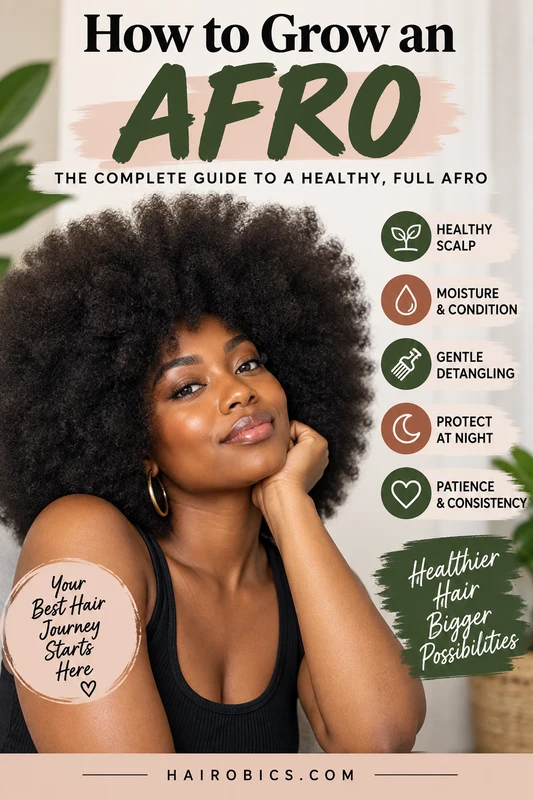
Growing a big, healthy afro is about much more than simply letting your hair get longer. A great afro depends on healthy hair growth, length retention, moisture, scalp care, gentle handling, and a routine that helps reduce unnecessary breakage.
For people with naturally curly, coily, kinky, and textured hair, growing an afro can sometimes feel slow because shrinkage hides much of the hair's true length. Your hair may actually be growing consistently even when it doesn't look dramatically longer from month to month.
The goal, therefore, isn't just to make your hair grow. It's to keep the hair you've already grown.
Whether you're starting with a low haircut, growing out a fade, transitioning from chemically treated hair, or simply trying to make your existing afro bigger and healthier, this guide explains how to grow an afro while keeping your strands strong, moisturized, and manageable.
Quick Answer: How Do You Grow an Afro?
To grow a healthy afro:
- Keep your scalp clean and healthy.
- Moisturize your hair consistently.
- Condition after shampooing.
- Deep condition when your hair needs additional moisture.
- Minimize excessive heat.
- Avoid hairstyles that create unnecessary tension.
- Detangle carefully.
- Protect your hair while sleeping.
- Trim damaged ends when necessary.
- Eat a balanced diet and support your overall health.
- Be patient and focus on length retention.
Your genetics influence your natural hair growth rate, density, texture, and maximum achievable length. You can't completely change those factors.
What you can control is how you treat the hair after it grows from your scalp.
That's where an effective afro hair care routine becomes extremely important.
Understanding How Afro Hair Grows
Before learning how to grow an afro faster, it helps to understand what is happening underneath the hairstyle.
Hair grows from follicles located within the skin. The visible strand is made primarily of keratin.
Each follicle moves through different stages of a hair growth cycle, including periods of active growth, transition, rest, and shedding.
Because genetics, age, hormones, nutrition, health, and other biological factors affect this cycle, there isn't one universal growth rate for everyone.
However, one of the biggest challenges with growing an afro isn't necessarily growth itself.
It's length retention.
Imagine your hair grows at the roots, but the ends repeatedly break.
Your scalp is producing new hair, yet the overall length barely changes.
This creates the impression that your afro isn't growing.
Reducing breakage allows more of that new length to remain on your head.
Why Afro Hair Can Appear to Grow Slowly
Afro-textured hair has several characteristics that can make growth less noticeable.
Shrinkage
Shrinkage is one of the biggest reasons people underestimate the length of their natural hair.
Tightly curled and coiled strands contract significantly as they dry.
You might have several inches of hair when stretched even though your afro appears considerably shorter.
Shrinkage isn't automatically a bad sign.
In many cases, the ability of curls and coils to contract is simply a normal characteristic of textured hair.
Instead of constantly stretching your hair to measure progress, take monthly or quarterly photographs under similar conditions.
This provides a much better picture of your progress.
Breakage
Breakage is different from normal shedding.
A shed hair generally separates from the follicle as part of the hair cycle. Breakage occurs somewhere along the strand.
Frequent breakage can result from:
- Excessive manipulation
- Rough detangling
- Chronic dryness
- Tight hairstyles
- Repeated chemical processing
- Excessive heat
- Friction
- Damaged ends
- Poor hair-care practices
Controlling these factors can make a tremendous difference in how quickly your afro appears to get bigger.
How to Grow an Afro: Step-by-Step
1. Start With a Healthy Scalp
Healthy-looking hair begins with proper scalp care.
Your scalp naturally produces oils, sweat, and dead skin cells. Styling products can also accumulate over time.
Allowing heavy buildup to remain indefinitely isn't necessary for hair growth.
Clean your scalp according to your individual needs.
Some people prefer weekly cleansing, while others find a somewhat longer or shorter interval works better.
Pay attention to your scalp.
If it becomes extremely oily, itchy, flaky, uncomfortable, or coated with product, it may be time to wash.
When shampooing, focus primarily on your scalp rather than aggressively scrubbing the ends.
Use your fingertips to gently massage shampoo around the scalp.
Avoid scratching aggressively with your fingernails.
Then rinse thoroughly.
2. Don't Be Afraid of Shampoo
One persistent natural-hair myth is that washing your hair prevents growth.
It doesn't.
Hair doesn't need months of dirt and product buildup to grow.
Regular cleansing can help remove:
- Sweat
- Excess oil
- Dirt
- Styling-product residue
- Dead skin
- Environmental debris
The key is finding a cleansing schedule and shampoo that work for your particular scalp and hair.
If your hair feels extremely stripped after every wash, you may need to reconsider the product, frequency, technique, or conditioning routine.
The goal is a clean scalp without leaving your hair unnecessarily dry.
3. Condition Your Afro After Washing
Conditioner is extremely useful for textured hair because it can improve softness, lubrication, and manageability.
After shampooing, apply conditioner throughout your hair, concentrating particularly on areas that feel dry.
Allow it to sit according to the product instructions.
This is also an excellent time to begin gently separating tangles.
Hair that has adequate slip is usually easier to detangle than dry, tangled hair.
Afterward, rinse thoroughly.
4. Deep Condition When Your Hair Needs It
Deep conditioning can be useful when your afro feels particularly dry, rough, or difficult to manage.
You don't necessarily need to deep condition constantly.
Instead, pay attention to your hair.
A richer conditioning treatment may be helpful after periods involving:
- Excessive dryness
- Protective styles
- Significant manipulation
- Heat styling
- Environmental exposure
Follow the instructions provided with your chosen deep conditioner.
Leaving a treatment on dramatically longer than recommended doesn't automatically produce better results.
Consistency is usually more important than extreme treatments.
5. Make Moisture a Priority
If you're trying to figure out how to grow a big afro, moisture management deserves serious attention.
Dry strands can become more vulnerable to tangling and breakage.
Water is the foundation of hydration.
Many people find success applying a water-based leave-in conditioner or moisturizer before using other styling products.
Depending on your hair, your routine might look like:
Water or water-based moisturizer → leave-in product → styling product → oil or butter if desired
You don't have to follow a complicated acronym or use five different products.
Your routine should be based on how your hair responds.
If your afro remains soft and manageable with two products, there is no reason to use seven.
6. Pay Special Attention to Your Ends
The ends are the oldest part of your hair.
If your hair is several years old, the ends have experienced years of washing, detangling, weather, friction, styling, and manipulation.
That makes them particularly important when trying to retain length.
When moisturizing your afro, don't forget your ends.
Handle them carefully when detangling.
Avoid constantly pulling or brushing them.
And don't ignore severely split or damaged ends simply because you're trying to preserve every millimeter of length.
Sometimes removing damaged ends can make the rest of your hair easier to maintain.
7. Detangle Your Afro Carefully
Aggressive detangling can sabotage months of growth.
One of the worst approaches is grabbing a fine-tooth comb and forcing it through dry, tangled coils from roots to ends.
Instead, divide your hair into manageable sections.
Apply water, conditioner, leave-in conditioner, or another product that provides enough slip for your hair.
Begin detangling near the ends.
Gradually work upward toward the roots.
You can use your fingers, a wide-tooth comb, or a detangling brush designed for textured hair.
The exact tool matters less than your technique.
If you're hearing constant snapping, slow down.
Detangling shouldn't feel like a battle between you and your hair.
8. Keep Manipulation Under Control
Styling your afro every few hours creates repeated stress.
Constantly combing, brushing, pulling, stretching, twisting, and restyling the hair can eventually contribute to breakage.
This doesn't mean you can't style your hair.
It means you should avoid unnecessary manipulation.
Try styling your hair and allowing it to remain relatively undisturbed for a reasonable period.
Styles such as twists can help keep strands organized between wash days.
The best low-manipulation style is one that doesn't pull excessively on your scalp or damage your hair.
9. Be Careful With Tight Hairstyles
Tighter does not mean better.
Extremely tight braids, ponytails, cornrows, loc retwists, extensions, or other hairstyles can create unnecessary tension on your hair and scalp.
Pay particular attention to the hairline and temples.
These areas can be vulnerable because the strands are often finer.
Your hairstyle should not require days of pain.
Signs a style may be excessively tight include:
- Persistent scalp pain
- Bumps
- Redness
- Severe tenderness
- Headaches
- Excessive pulling around the edges
If a style feels wrong, don't assume discomfort is simply part of the process.
Protective styling should actually protect your hair.
10. Protect Your Afro at Night
Your nighttime routine can have a major influence on length retention.
Traditional cotton pillowcases can create friction as your hair moves throughout the night.
Consider sleeping with:
- A satin bonnet
- A satin scarf
- A satin pillowcase
Some people use more than one.
For example, you might wear a bonnet and also use a satin pillowcase as backup in case the bonnet comes off.
If your afro is longer, loosely sectioning or twisting it before bed can also help reduce tangling.
11. Limit Excessive Heat
Heat isn't automatically forbidden for natural hair.
The problem is excessive temperature, repeated passes, poor technique, or frequent heat styling that damages the strand.
If your primary goal is growing a healthy afro, you don't need to straighten your hair constantly.
When using heat:
- Use an appropriate heat protectant.
- Avoid unnecessarily high temperatures.
- Minimize repeated passes.
- Don't straighten simply to check your length every week.
If you notice your curls no longer returning to their normal pattern after washing, your hair may have experienced heat damage.
12. Trim When Necessary
A common question is:
“If I'm trying to grow my afro, why would I cut it?”
Because trimming and growth aren't opposites.
Your hair grows from your scalp, not from your ends.
A trim removes older portions of the strand.
Not everyone needs trimming on exactly the same schedule.
Instead of following a rigid rule, watch for signs such as:
- Persistent split ends
- Excessive knots
- Thin, uneven ends
- Ends that constantly snag
- Increasing difficulty detangling
You don't need to remove healthy hair unnecessarily.
The objective is maintaining ends that aren't continually causing additional breakage and tangling.
13. Eat a Balanced Diet
Hair products can support the condition and manageability of your hair, but your follicles also depend on your overall health.
Hair is made from protein, so adequate nutrition matters.
A balanced diet can provide nutrients involved in normal hair production and general health.
Focus on a varied diet containing foods such as:
- Eggs
- Fish
- Lean meats
- Beans
- Lentils
- Nuts
- Seeds
- Fruits
- Vegetables
- Whole grains
- Leafy greens
Nutritional deficiencies can affect hair, but taking excessive amounts of supplements isn't a shortcut to growing a huge afro.
More isn't automatically better.
If you're concerned that a nutritional deficiency is affecting your hair, discuss it with a qualified healthcare professional.
14. Drink Enough Fluids
Proper hydration supports your overall health, but drinking huge amounts of water isn't a magical hair-growth treatment.
Drink enough fluids for your body's needs.
Think of hydration as part of a healthy lifestyle rather than a standalone afro-growth hack.
15. Avoid Chasing Miracle Hair-Growth Products
Natural hair communities are full of dramatic claims:
“Grow 3 inches overnight.”
“Double your hair length in seven days.”
“Use this oil and your hair will never break again.”
Be skeptical.
No topical product can override your genetics and biological hair-growth cycle to produce impossible growth rates.
Hair oils, moisturizers, conditioners, and scalp products can still play valuable roles in a routine.
They may help with lubrication, softness, styling, moisture retention, or scalp comfort depending on the product.
But healthy hair growth requires a complete routine.
There is no single miracle ingredient.
Best Oils for Growing an Afro
Oils are popular in afro hair care because they can help lubricate strands and reduce moisture loss when used appropriately.
Different oils have different properties.
Popular options include:
Coconut Oil
Coconut oil is widely used in natural hair routines.
Some people use it before shampooing, while others apply a small amount during styling.
However, not everyone likes how coconut oil makes their hair feel.
If your hair becomes stiff or unpleasant after using it, try something else.
Jojoba Oil
Jojoba oil is technically a liquid wax and is commonly included in hair and scalp products.
Its lightweight texture makes it appealing to people who dislike extremely heavy oils.
Avocado Oil
Avocado oil is another popular option for textured-hair routines.
It can be incorporated into styling and conditioning routines, particularly when additional lubrication is desired.
Grapeseed Oil
Grapeseed oil tends to feel relatively lightweight compared with heavier oils and butters.
It can work well for people who want some lubrication without making their afro feel excessively coated.
Jamaican Black Castor Oil
Jamaican black castor oil is extremely popular in Black hair care.
Because it is thick, many people prefer using small amounts or combining it with lighter products.
Remember: an oil doesn't replace water.
If your hair is dehydrated, coating extremely dry hair with more and more oil may simply leave it greasy while it still feels dry.
How to Grow an Afro From a Low Haircut
Starting from a low cut can actually simplify the process because you're beginning with relatively uniform hair.
During the first few months, concentrate on scalp health and establishing good habits.
You don't need an elaborate routine.
A basic routine might include:
- Shampoo regularly.
- Condition.
- Apply a leave-in moisturizer.
- Use a small amount of styling product if necessary.
- Protect your hair at night.
As your hair gets longer, you'll gradually need to spend more time detangling and sectioning.
You may also notice your curl pattern becoming more visible.
Be patient during the awkward stages.
Almost everyone growing a large afro experiences periods where the hair doesn't sit exactly how they want.
Keep going.
How to Grow an Afro for Black Men
Men growing their hair from a fade or low haircut often make one major mistake:
They continue treating longer textured hair exactly like extremely short hair.
Once your hair becomes longer, it requires more attention.
You may need to begin:
- Conditioning more carefully
- Detangling in sections
- Moisturizing more consistently
- Protecting your hair at night
- Avoiding aggressive brushing
- Paying closer attention to your ends
If you regularly visit a barber, clearly explain that you're growing your afro.
Otherwise, a barber may continue cutting more length than you intended.
You can still keep your neckline and overall shape clean without significantly reducing the length of the afro.
How to Grow a Bigger Afro
If your afro is already established but doesn't seem to get bigger, focus heavily on retention.
Ask yourself:
Where am I losing length?
Check your habits.
Are you seeing broken pieces of hair every time you comb?
Are your ends constantly tangled?
Do you straighten your hair frequently?
Are you picking your afro aggressively every morning?
Do you sleep without protecting your hair?
Are you leaving tight hairstyles installed too long?
Are you allowing your hair to become extremely dry?
Small sources of damage can accumulate.
Correcting several of them simultaneously can dramatically improve retention over time.
How to Pick an Afro Without Causing Excessive Breakage
The afro pick is iconic, but it needs to be used carefully.
You don't necessarily need to drag the pick completely through your hair repeatedly.
Instead, use it primarily to lift and shape the roots.
Start with hair that isn't extremely dry or tangled.
Work in sections if necessary.
Insert the pick carefully near the roots and lift outward to create volume.
Avoid repeatedly ripping through the ends.
Your goal is shape—not maximum tension.
How Often Should You Wash an Afro?
There isn't one perfect washing schedule for every person.
Your ideal frequency depends on:
- Scalp oil production
- Exercise
- Product use
- Hair density
- Hair length
- Styling routine
- Environmental conditions
- Scalp condition
Weekly cleansing is a practical starting point for many people, but your individual needs may differ.
If you exercise heavily and sweat frequently, you may prefer more frequent scalp cleansing.
If your hair becomes dry quickly, pay attention to your shampoo choice and post-wash conditioning rather than assuming washing itself is the problem.
A Simple Weekly Afro Growth Routine
Consistency beats complexity.
Here's an example routine.
Wash Day
Step 1: Section your hair
Separate longer hair into manageable sections.
Step 2: Shampoo
Clean your scalp thoroughly but gently.
Step 3: Condition
Apply conditioner throughout your hair.
Step 4: Detangle
Carefully remove tangles, working from the ends upward.
Step 5: Rinse
Rinse according to the product directions.
Step 6: Apply leave-in conditioner
Add moisture while your hair is still damp.
Step 7: Style
Choose a low-manipulation style or shape your afro.
During the Week
Monitor your hair's moisture level.
Refresh it when necessary rather than automatically piling on products every day.
At Night
Protect your hair with satin.
Longer afros may benefit from loose twists or sections before sleeping.
How Long Does It Take to Grow an Afro?
It depends on where you're starting and what you consider an afro.
Someone starting with a shaved head may begin seeing a small afro within a few months, while developing a large, dramatic afro can take years.
Genetics, shrinkage, hair density, curl pattern, breakage, hair-care practices, health, and desired size all influence the timeline.
Instead of asking:
“Why isn't my afro huge yet?”
Ask:
“Is my hair healthier and longer than it was six months ago?”
That's a much more useful measurement.
Take photographs every month.
Use the same lighting, angle, hairstyle, and preferably the same shirt.
You might be surprised by your progress.
How to Make Your Afro Look Fuller
Hair density is largely determined by genetics, so products cannot create unlimited new follicles.
However, proper styling can make an existing afro appear fuller.
Try:
- Gently lifting the roots
- Separating compressed sections
- Avoiding extremely heavy product buildup
- Keeping the afro appropriately shaped
- Stretching the hair gently
- Maintaining healthy-looking ends
A professional shape-up can also transform how full an afro appears.
A skilled barber or stylist can create a balanced silhouette while preserving much of your length.
Be very specific about your growth goals before any cutting begins.
Common Mistakes That Can Slow Afro Length Retention
Constantly Picking Your Hair
Daily aggressive picking can gradually damage the strands.
Shape your afro gently.
Letting Your Hair Stay Extremely Dry
Persistent dryness can make textured hair harder to manipulate without breakage.
Using Too Much Product
More product isn't always more moisture.
Heavy buildup can leave your afro coated, dull, or difficult to manage.
Never Washing Your Scalp
A clean scalp is compatible with healthy hair growth.
Don't treat dirt as a growth treatment.
Ignoring Your Ends
Your ends determine how much visible length you retain.
Wearing Extremely Tight Styles
Protective styles should reduce manipulation, not create damaging tension.
Comparing Your Hair With Someone Else's
Two people can follow nearly identical routines and still have very different afros because of genetics, density, strand thickness, shrinkage, and curl pattern.
Focus on maximizing the health of your hair.
Can Protective Styles Help Grow an Afro?
Protective and low-manipulation styles can help some people retain length because the hair doesn't require constant daily styling.
Options can include:
- Two-strand twists
- Loose braids
- Cornrows
- Flat twists
- Other low-tension styles
But a protective style isn't automatically protective.
It can become counterproductive if:
- It's installed too tightly.
- Your edges are under constant tension.
- You neglect your scalp.
- Your hair becomes severely tangled.
- You leave the style installed beyond what your hair can comfortably tolerate.
- Removal is rushed and causes major breakage.
Installation and removal matter just as much as the style itself.
Does Massaging Your Scalp Help Grow an Afro?
Scalp massage can be a relaxing part of your hair-care routine.
Use your fingertips and apply gentle pressure in small circular motions.
You can massage your scalp without oil, or use a small amount of an appropriate scalp product if desired.
Don't scratch aggressively.
Scalp massage shouldn't be treated as a guaranteed method of dramatically accelerating hair growth.
Think of it as one supportive scalp-care practice within a broader healthy routine.
Why Your Afro Isn't Getting Longer
If you've been growing your hair for months but aren't seeing progress, investigate four major areas.
1. Shrinkage
Your hair may be considerably longer than it appears.
2. Breakage
You may be gaining length at the roots and losing it at the ends.
3. Styling habits
Excessive manipulation may be interfering with retention.
4. Hair or scalp concerns
If you're experiencing sudden, unusual, patchy, or severe hair loss, don't automatically assume you simply need another oil.
Consider consulting a dermatologist or other qualified healthcare professional.
Hair loss can have many potential causes, and identifying the cause is more important than randomly experimenting with products.
How to Track Your Afro Growth
Don't rely exclusively on the mirror.
Create a simple growth-tracking system.
Every four to eight weeks:
- Take a front photo.
- Take a side photo.
- Take a back photo.
- Photograph your afro unstretched.
- Occasionally measure a stretched section.
- Record any major routine changes.
Avoid measuring every day.
Hair growth happens gradually, and daily checking can make progress difficult to notice.
Comparing photos taken six months apart provides a much clearer picture.
12-Month Afro Growth Mindset
Think long term.
Months 1–3
Establish your routine.
Learn how frequently your scalp needs cleansing and how much moisture your hair prefers.
Months 4–6
Focus on reducing breakage.
By this point, you should have a better understanding of your curl pattern, product preferences, and problem areas.
Months 7–9
Continue prioritizing retention.
Your afro may begin looking noticeably larger, depending on your starting point.
Months 10–12
Compare photographs from the beginning of your journey.
Evaluate your progress based on length, fullness, manageability, breakage, and overall hair condition.
Then adjust your routine for the next year.
Growing an afro is a marathon, not a seven-day challenge.
Frequently Asked Questions About Growing an Afro
How can I grow my afro faster?
You generally can't force your follicles to grow hair dramatically faster than their natural biological rate. Instead, focus on supporting normal growth and retaining the hair you produce through good scalp care, moisture, gentle detangling, reduced manipulation, balanced nutrition, and protection from unnecessary damage.
How long does it take to grow a big afro?
A small afro can develop within months after a short haircut, while a large afro can require several years of growth and length retention. Your curl pattern and shrinkage also strongly influence how large the hair appears.
Should I comb my afro every day?
Not necessarily. Constant combing can increase manipulation. Detangle when needed and shape your afro gently rather than repeatedly combing through every strand.
Should I wet my afro every day?
Some people benefit from frequent moisture, while others don't need to wet their hair daily. Monitor how your hair responds and develop a schedule accordingly.
Does oil make an afro grow?
Oil isn't a magical growth accelerator. Certain oils can be useful for lubrication, styling, and reducing moisture loss, which may indirectly support length retention by making the hair easier to manage.
Can I grow an afro with 4C hair?
Absolutely. Tightly coiled hair can form a beautiful afro. Because 4C hair can experience substantial shrinkage, its true length may be much greater than it appears.
How do I prevent my afro from breaking?
Prioritize moisture, gentle detangling, nighttime protection, low-manipulation styling, appropriate conditioning, limited heat, and careful handling of your ends.
Should I use a bonnet with an afro?
A satin bonnet can help reduce nighttime friction and keep your hair more manageable. A satin scarf or pillowcase can also be useful.
Why is my afro growing unevenly?
Different areas can appear to grow differently because of shrinkage, breakage, styling habits, friction, natural growth patterns, or previous haircuts. A professional shaping trim can help create a more balanced appearance.
Should I cut my afro while growing it?
You don't need frequent major haircuts if your objective is gaining length. However, occasional trimming or shaping may be useful when you have damaged ends or want to maintain a particular silhouette.
Final Thoughts: Growing a Healthy Afro Takes Consistency
Learning how to grow an afro isn't about discovering one secret oil, supplement, or overnight hair-growth trick.
It's about developing habits that allow your natural hair to thrive.
Keep your scalp clean.
Keep your strands properly conditioned.
Moisturize when needed.
Detangle gently.
Protect your hair at night.
Avoid excessive tension and heat.
Take care of your ends.
And most importantly, give your hair time.
Your afro may shrink. It may go through awkward stages. Some months may seem like nothing is happening.
But don't confuse shrinkage with a lack of growth.
When you combine healthy scalp care with a consistent natural-hair routine and focus heavily on length retention, you're giving your afro the opportunity to become longer, fuller, and healthier over time.
The objective isn't simply to grow the biggest afro possible.
It's to grow the healthiest version of your afro.