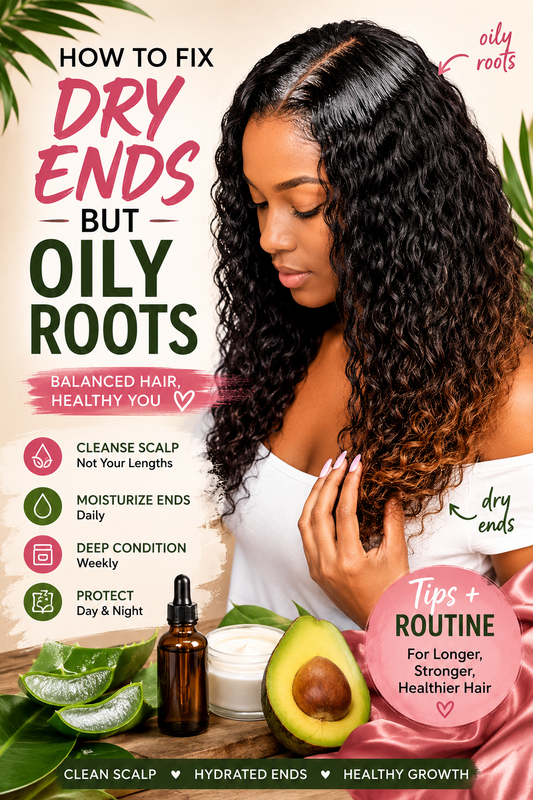
Do your hair roots feel greasy just a day or two after washing, while your ends remain dry, brittle, and prone to breakage? If so, you're dealing with one of the most common hair care challenges: oily roots and dry ends.
This frustrating combination can make hair difficult to manage. The scalp appears greasy, flat, and weighed down, while the ends feel rough, tangled, and lifeless. Many people try to solve the problem by washing more often, but this often makes the issue worse.
The good news is that oily roots and dry ends can be fixed naturally. Once you understand why it happens and how to create the right hair care routine, you can restore balance to your scalp and strands.
In this guide, you'll learn:
- Why oily roots and dry ends happen
- The biggest mistakes that make the problem worse
- How to properly wash your hair
- The best ingredients for balanced moisture
- Hair care routines for natural hair, curly hair, locs, and braids
- Long-term solutions for healthier hair growth
Let's dive in.
Why Do You Have Oily Roots But Dry Ends?
To understand the solution, you first need to understand the cause.
Your scalp naturally produces sebum, an oil designed to lubricate and protect your hair.
When your scalp produces too much oil, your roots become greasy. However, that oil often never reaches your ends, especially if you have:
- Curly hair
- Coily hair
- Kinky hair
- Long hair
- Thick hair
- Locs
- Protective styles
The result is a scalp that feels oily while your ends remain dehydrated.
Think of it this way:
Your scalp is producing enough oil, but the oil isn't traveling down the hair shaft effectively.
The farther away your ends are from the scalp, the less moisture they receive.
Signs You Have Oily Roots and Dry Ends
You may notice:
- Greasy scalp within 24–48 hours after washing
- Dry, crunchy ends
- Split ends
- Hair breakage
- Tangling
- Flat roots with frizzy ends
- Itchy scalp
- Dull-looking hair
- Excessive shedding from breakage
Many people mistake dry ends for a lack of oil when the real problem is uneven moisture distribution.
What Causes Oily Roots and Dry Ends?
1. Overwashing
One of the biggest causes is washing too frequently.
When you wash your scalp every day with harsh shampoos, your scalp responds by producing even more oil.
Meanwhile, the shampoo strips moisture from your ends.
This creates the perfect recipe for oily roots and dry ends.
2. Heat Damage
Flat irons, curling irons, and blow dryers can damage the protective outer layer of your hair.
When this layer becomes damaged:
- Moisture escapes easily
- Ends become dry
- Breakage increases
Your scalp continues producing oil, but damaged ends cannot retain moisture.
3. Product Buildup
Heavy products can accumulate near the scalp.
This buildup traps oil and dirt around the roots while preventing moisture from properly reaching the hair shaft.
Common culprits include:
- Heavy pomades
- Thick waxes
- Excessive dry shampoo
- Silicone-heavy products
4. Curly and Coily Hair
Natural hair often experiences this problem more than straight hair.
The tighter the curl pattern, the harder it is for scalp oils to travel down the strand.
This means:
- Roots stay oily
- Ends stay dry
This is completely normal but requires proper moisture management.
5. Hard Water
Minerals in hard water coat the hair shaft.
This mineral buildup prevents moisture from penetrating your strands effectively.
Over time:
- Ends become increasingly dry
- Hair becomes dull
- Scalp can become irritated
6. Environmental Damage
Sun exposure, wind, pollution, and low humidity can strip moisture from your hair.
The scalp compensates by producing more oil while your ends continue losing hydration.
The Biggest Mistakes That Make It Worse
Applying Oil to an Already Oily Scalp
Many people think adding more oil will solve the problem.
In reality, excessive oiling often:
- Clogs follicles
- Increases buildup
- Makes roots greasier
Instead, focus on moisturizing the hair shaft rather than saturating the scalp.
Skipping Conditioner
Some people avoid conditioner because they think it causes oily hair.
This is a mistake.
Conditioner should be applied mainly to:
- Mid-lengths
- Ends
Not directly on the scalp.
Conditioning helps restore moisture where it's needed most.
Using Harsh Sulfates
Strong shampoos can strip the scalp.
This often triggers:
- Increased oil production
- Scalp irritation
- Dryer ends
Choose gentle cleansers whenever possible.
Ignoring Trims
Damaged ends cannot repair themselves.
Regular trims help prevent:
- Split ends
- Tangling
- Excessive breakage
Healthy ends hold moisture better.
How to Fix Oily Roots and Dry Ends
Step 1: Use the Right Shampoo
Choose a shampoo that cleanses the scalp without stripping the hair.
Look for ingredients such as:
- Aloe vera
- Tea tree oil
- Peppermint oil
- Jamaican black castor oil
- Rosemary
A balanced cleanser removes excess oil while maintaining hydration.
Step 2: Focus Conditioner on the Ends
Apply conditioner only from the middle of the hair down.
Concentrate on:
- Dry areas
- Fragile ends
- Sections prone to breakage
Leave it on for several minutes before rinsing.
Step 3: Deep Condition Weekly
Weekly deep conditioning is one of the fastest ways to restore dry ends.
Benefits include:
- Improved elasticity
- Less breakage
- Increased softness
- Better moisture retention
Deep conditioners containing natural oils and botanical extracts work especially well.
Step 4: Moisturize Your Ends Daily
Your ends are the oldest part of your hair.
They need extra attention.
Use a lightweight moisturizer or leave-in treatment to keep them hydrated.
Focus primarily on:
- Last 3–4 inches of hair
- Fragile sections
- Areas with visible dryness
Step 5: Protect Hair While Sleeping
Cotton pillowcases absorb moisture.
Switch to:
- Satin bonnet
- Satin scarf
- Satin pillowcase
This simple change can dramatically reduce dryness.
The Best Ingredients for Dry Ends
Aloe Vera
Aloe vera hydrates without leaving buildup.
Benefits include:
- Lightweight moisture
- Scalp soothing
- Reduced irritation
Jamaican Black Castor Oil
JBCO helps seal moisture into the hair shaft.
Benefits:
- Stronger strands
- Reduced breakage
- Improved softness
Jojoba Oil
Jojoba closely resembles natural scalp oil.
It helps:
- Balance oil production
- Improve hydration
- Reduce scalp irritation
Avocado Oil
Rich in vitamins and fatty acids.
Helps:
- Improve elasticity
- Reduce dryness
- Strengthen ends
Rosemary Oil
Supports a healthy scalp environment.
Benefits include:
- Improved circulation
- Balanced scalp health
- Healthier hair growth conditions
How to Wash Hair Properly
Many people wash incorrectly.
Follow this method:
Step 1
Wet hair thoroughly.
Step 2
Apply shampoo mainly to the scalp.
Step 3
Massage gently with fingertips.
Step 4
Allow shampoo suds to cleanse the lengths as you rinse.
Step 5
Apply conditioner from mid-length to ends.
Step 6
Rinse with cool water.
This technique keeps roots clean while protecting ends.
Best Routine for Natural Hair
Natural hair requires additional moisture because scalp oils struggle to travel through curls.
Weekly
- Shampoo once
- Deep condition once
Daily
- Moisturize ends
- Seal moisture lightly
Nightly
- Satin bonnet
- Protective style
Consistency is key.
Best Routine for Curly Hair
Curly hair benefits from moisture-focused care.
Wash Day
- Gentle shampoo
- Rich conditioner
- Leave-in treatment
Midweek
- Refresh curls
- Apply lightweight moisturizer
Avoid heavy oils near the scalp.
Best Routine for Locs
Locs often develop dry ends while roots remain oily.
Tips
- Keep scalp clean
- Use lightweight moisturizing sprays
- Avoid heavy waxes
- Focus hydration on the length of locs
Consistent moisture prevents brittle locs.
Best Routine for Braids
Braids can worsen dry ends if neglected.
Moisturize
Use braid sprays several times weekly.
Focus On
- Scalp hydration
- End protection
- Preventing tension
Healthy braids begin with healthy hair underneath.
Foods That Help Balance Hair
Healthy hair starts internally.
Focus on:
Protein
Sources include:
- Eggs
- Fish
- Chicken
- Beans
Healthy Fats
Sources include:
- Avocados
- Nuts
- Seeds
Water
Hydration affects hair moisture levels.
Drink water consistently throughout the day.
How Long Does It Take to Fix Dry Ends?
Results vary.
Most people notice:
1 Week
- Less roughness
- Improved softness
2–4 Weeks
- Reduced breakage
- Better moisture retention
2–3 Months
- Noticeably healthier ends
- More balanced scalp
6 Months
- Significant improvement in overall hair health
Consistency matters more than quick fixes.
Can Oily Roots Cause Hair Loss?
Excess oil alone does not usually cause hair loss.
However:
- Buildup
- Inflammation
- Poor scalp hygiene
can contribute to scalp issues that affect healthy growth.
Maintaining a clean scalp supports optimal hair growth.
Natural Remedies for Oily Roots and Dry Ends
Apple Cider Vinegar Rinse
Can help remove buildup.
Use occasionally to clarify hair.
Aloe Vera Mask
Provides lightweight hydration.
Excellent for balancing moisture.
Rosemary Scalp Treatment
Supports scalp health without excessive heaviness.
Hot Oil Treatments
Applied mainly to lengths and ends, not the scalp.
Can improve moisture retention significantly.
How to Prevent the Problem From Returning
Once your hair improves, maintain balance by:
- Avoiding overwashing
- Using gentle products
- Deep conditioning weekly
- Protecting hair at night
- Trimming damaged ends
- Drinking plenty of water
- Limiting heat styling
These habits create long-term results.
The Ultimate Hair Growth Connection
Many people focus only on growing hair longer.
However, growth and retention are different.
Hair may be growing from the scalp every month.
But if your dry ends break at the same rate, you'll never see length retention.
Fixing dry ends helps:
- Retain growth
- Reduce breakage
- Improve thickness
- Increase overall hair health
Healthy ends are essential for achieving longer hair.
Conclusion
Dry ends and oily roots can feel impossible to manage, but they're actually one of the easiest hair problems to improve once you understand the cause.
The key is balance.
Instead of stripping the scalp or overloading your hair with oils, focus on:
- Gentle cleansing
- Consistent moisturizing
- Weekly deep conditioning
- Protecting your ends
- Maintaining a healthy scalp
With patience and consistency, you can enjoy hair that feels clean at the roots, soft at the ends, and healthier from scalp to tip.
Whether you wear natural hair, curls, locs, braids, or protective styles, creating a balanced moisture routine is one of the most effective steps you can take toward stronger, longer, and healthier hair growth.