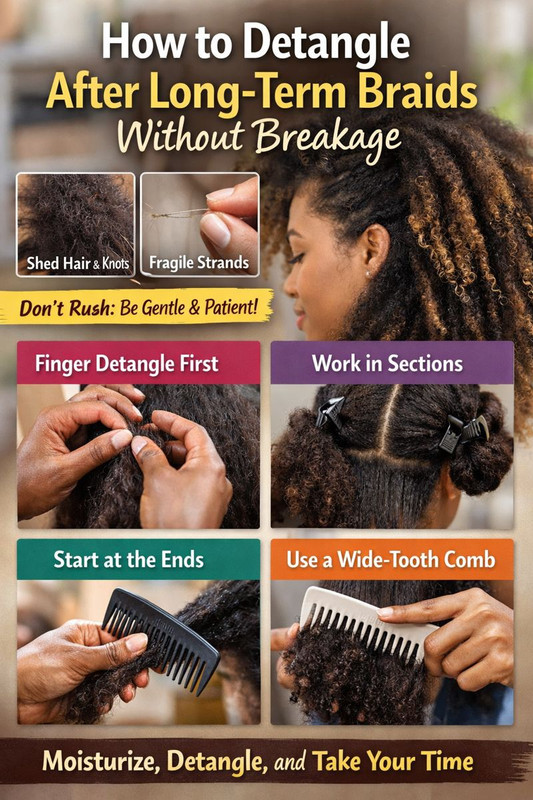
Taking down long-term braids should feel like a fresh start—but for many people, it turns into a nightmare of knots, breakage, shedding panic, and hair that feels thinner than before. If you’ve ever finished detangling after weeks (or months) of braids and thought, “Where did my hair go?”—you’re not alone.
The truth is, most breakage after braids doesn’t happen while the hair is braided—it happens during takedown and detangling.
In this guide, you’ll learn:
-
Why hair is extremely fragile after long-term braids
-
The biggest detangling mistakes that cause breakage
-
A step-by-step, low-breakage detangling routine
-
How to tell shedding from breakage
-
How to restore moisture, elasticity, and strength afterward
If you want to keep the length you grew instead of watching it snap off, this article is for you.
Why Hair Is Extra Fragile After Long-Term Braids
Before we get into detangling techniques, it’s important to understand what braids do to hair over time.
1. Shed Hair Is Trapped for Weeks
Hair naturally sheds 50–100 strands per day. When your hair is braided, that shed hair has nowhere to go—it stays wrapped around your strands.
After 6–10 weeks, you’re detangling thousands of shed hairs at once, which can easily form knots if handled incorrectly.
2. Hair Is Drier Than You Think
Even if you moisturized while braided, hair still loses water over time. Long-term braids often lead to:
-
Dehydrated strands
-
Stiff, less flexible hair
-
Reduced elasticity
Dry hair breaks faster under tension, especially during detangling.
3. Braids Create Tangling Patterns
Braids encourage hair to:
-
Wrap around itself
-
Coil tightly at the roots
-
Interlock near the ends
When you rush through detangling, you’re forcing those patterns apart—often snapping strands instead.
The Biggest Detangling Mistakes That Cause Breakage
If you’re losing length after braid takedown, one (or more) of these is usually the reason.
❌ Detangling on Dry Hair
Dry hair has zero slip and low elasticity. Detangling dry strands causes immediate snapping.
❌ Starting at the Roots
Pulling from the roots pushes knots downward, tightening them and increasing breakage.
❌ Using the Wrong Tools
Fine-tooth combs, hard brushes, or cheap plastic tools shred fragile post-braid hair.
❌ Rushing the Process
Detangling after long-term braids is not a 20-minute job. Speed equals damage.
❌ Skipping Sectioning
Trying to detangle all your hair at once guarantees tangles, frustration, and breakage.
What You Need Before You Start Detangling
Set yourself up for success before you touch a single knot.
Essential Tools
-
Wide-tooth comb
-
Detangling brush (optional, used gently)
-
Spray bottle with water
-
Moisturizing leave-in or detangler
-
Natural oil or scalp treatment
-
Hair clips (at least 4–6)
Best Detangling Environment
-
Hair slightly damp (never dripping wet or bone dry)
-
Good lighting
-
Enough time (1–2 hours minimum for long hair)
Step-by-Step: How to Detangle After Long-Term Braids Without Breakage
Step 1: Take Braids Down Slowly and Strategically
Never cut close to your natural hair. Once the braid is removed:
-
Separate shed hair gently with your fingers
-
Do not pile loose hair together
Pro tip: Detangle each braid section immediately after takedown instead of waiting until all braids are out.
Step 2: Finger Detangle First (This Is Non-Negotiable)
Finger detangling removes the bulk of shed hair without tension.
How to do it:
-
Apply a generous amount of detangler or leave-in
-
Gently pull shed hairs apart using your fingers
-
Focus on ends first, then move upward
If you skip this step, combs will do unnecessary damage.
Step 3: Detangle in Small, Controlled Sections
Divide hair into at least 4–8 sections, depending on thickness.
Working in sections:
-
Prevents re-tangling
-
Allows you to be gentle
-
Keeps shed hair contained
Always clip away completed sections.
Step 4: Start at the Ends—Always
This rule never changes.
-
Hold hair firmly above the section you’re detangling
-
Begin at the very tips
-
Work upward inch by inch
If you hit resistance:
-
Stop
-
Add more product
-
Use fingers to loosen the knot
Forcing through tangles is the fastest way to lose length.
Step 5: Use a Wide-Tooth Comb Sparingly
Combs are secondary tools, not the first line of defense.
Best practice:
-
Use after finger detangling
-
Move slowly
-
Never yank
If a comb gets stuck, pull it out downward—don’t rip through.
Step 6: Twist or Braid Each Section After Detangling
Once a section is smooth:
-
Lightly twist or braid it
-
Apply a bit of oil or leave-in
-
Clip it away
This prevents re-tangling while you work on the rest of your hair.
How Long Detangling Should Take
There’s no prize for speed.
General guidelines:
-
Shoulder-length hair: 45–60 minutes
-
Mid-back length: 1–1.5 hours
-
Thick or coily hair: 2+ hours
If detangling feels exhausting—that’s normal. What’s not normal is snapping sounds.
Shedding vs Breakage: How to Tell the Difference
Normal Shedding Looks Like:
-
Long strands
-
White bulb at the end
-
Similar length to your hair
Breakage Looks Like:
-
Short, uneven pieces
-
No bulb
-
Occurs mostly at ends or crown
After long-term braids, shedding will look dramatic—but it’s expected. Breakage is what we want to avoid.
What to Do Immediately After Detangling
Detangling is only half the recovery process.
1. Cleanse Gently
Use a moisturizing shampoo to remove:
-
Product buildup
-
Dirt
-
Sweat
Avoid harsh clarifying shampoos immediately after braids unless buildup is severe.
2. Deep Condition for Elasticity
Long-term braids reduce flexibility. Look for:
-
Moisture-rich formulas
-
Light protein (optional)
-
Slip for easy rinsing
Leave on for at least 20–30 minutes.
3. Seal Moisture Properly
After rinsing:
-
Apply leave-in conditioner
-
Seal with oil or cream
-
Focus on ends
This restores softness and reduces post-braid dryness.
How to Prevent Breakage Next Time You Take Braids Down
✔ Moisturize While Braided
Dry hair tangles more. Light hydration weekly helps.
✔ Don’t Exceed 8 Weeks
The longer braids stay in, the more shed hair accumulates.
✔ Trim Before Braids (If Needed)
Weak ends tangle faster and break during takedown.
✔ Avoid Tight Installations
Tight roots increase matting and shedding near the scalp.
Why Hair Feels Thinner After Braids (Even When It’s Not)
Many people panic after detangling because hair looks:
-
Less full
-
Shorter
-
Less dense
This is often due to:
-
Release of trapped shed hair
-
Temporary dryness
-
Shrinkage returning
With proper moisture and gentle care, fullness usually returns within 1–2 weeks.
Final Thoughts: Detangling Is Where Length Is Won or Lost
Braids don’t ruin hair—rushed detangling does.
If you remember nothing else, remember this:
-
Moisture first
-
Fingers before tools
-
Ends before roots
-
Time over speed
Detangling after long-term braids is a process, not a chore. When done correctly, you’ll keep your length, protect your ends, and actually enjoy your post-braid hair instead of fearing it.