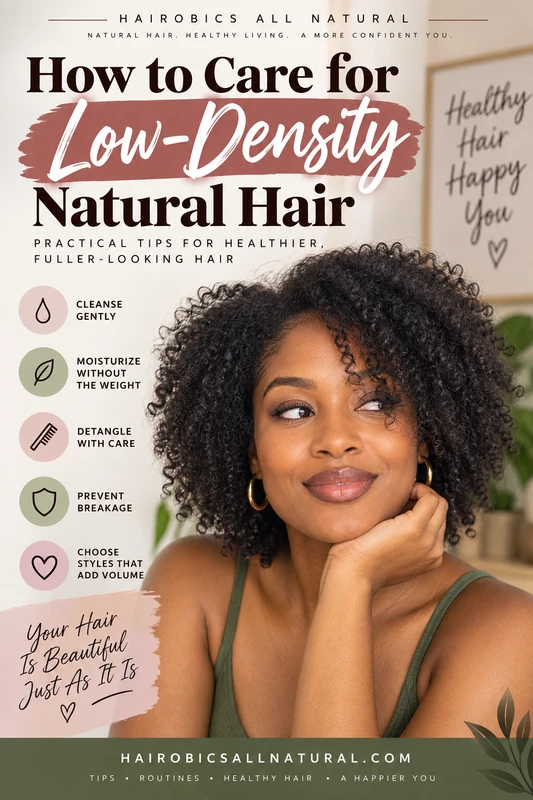
Low-density natural hair can be beautiful, soft, versatile, and healthy, but it often requires a slightly different approach than high-density hair. If you can easily see your scalp, your ponytail feels relatively small, or your twists and braids do not look as full as you would like, you may simply have low-density hair.
Hair density refers to the number of individual hair strands growing on your scalp. It is different from hair thickness, curl pattern, and porosity. You can have thick individual strands but low-density hair, or extremely fine strands with a surprisingly high density.
Understanding this difference is important because many natural hair routines are designed around creating definition, controlling large amounts of hair, or using several layers of products. Those techniques may not always work well for someone with fewer strands.
For low-density natural hair, the goal is usually to maintain a healthy scalp, protect the strands you have, minimize unnecessary breakage, keep the hair moisturized without weighing it down, and choose hairstyles that make your natural hair look its best.
In this complete guide, we'll discuss how to care for low-density natural hair, including washing, conditioning, moisturizing, detangling, styling, nighttime care, breakage prevention, and techniques for creating the appearance of fuller hair.
What Is Low-Density Natural Hair?
Hair density describes approximately how many individual strands of hair are growing within a particular area of your scalp.
People generally describe hair density as:
- Low density
- Medium density
- High density
Someone with high-density natural hair has a large number of strands growing close together. Someone with low-density natural hair has fewer strands growing across the scalp.
Because there are fewer strands, portions of the scalp may be easier to see, particularly when the hair is wet or separated into sections.
That does not automatically mean your hair is thinning or unhealthy.
Some people naturally have lower-density hair because of genetics.
The important distinction is whether your hair has always been relatively low density or whether you are experiencing a noticeable decrease in density.
Sudden or progressive hair loss should not simply be assumed to be your natural density. If you notice significant shedding, bald patches, widening parts, a rapidly shrinking ponytail, scalp symptoms, or another major change in your hair, consider speaking with a dermatologist or qualified healthcare professional.
Low Density vs. Fine Hair: What's the Difference?
These terms are often confused.
Density refers to how many strands you have.
Strand thickness refers to the diameter of each individual strand.
Imagine two women.
One woman might have thousands of extremely fine strands packed closely together. Her individual hairs are thin, but her overall density is high.
Another woman might have relatively thick individual strands but fewer of them growing across her scalp. Her strands are thick, but her density is low.
This distinction matters when developing your hair-care routine.
Low-density hair often benefits from strategies that preserve volume, while fine hair frequently requires additional attention to avoiding heavy products and excessive manipulation.
If your hair is both fine and low density, you may need to be particularly careful about breakage, tension, and product buildup.
How Do You Know If You Have Low-Density Hair?
There are several ways to get a general idea of your density at home.
One of the easiest methods is simply observing your scalp when your hair is clean and dry.
Part your hair naturally without stretching the part excessively.
If your scalp is easily visible in multiple areas without having to separate the hair very much, you may have lower-density hair.
You can also look at the size of your ponytail.
People with lower-density hair frequently have smaller ponytail circumferences than people with similar hair lengths and higher densities.
However, neither method is a medical test.
Curl pattern, shrinkage, strand thickness, hairstyle, hair length, and even lighting can dramatically affect how full your hair appears.
Instead of becoming overly focused on a label, pay attention to your hair's normal baseline.
Knowing what is normal for you makes it easier to recognize genuine changes.
How to Care for Low-Density Natural Hair
A good low-density natural hair routine does not need to contain 10 different products.
In many cases, simplicity works better.
Your basic routine can revolve around five goals:
- Keep the scalp clean.
- Maintain adequate moisture.
- Minimize breakage.
- Avoid excessive product buildup.
- Protect your hair without creating unnecessary tension.
Let's look at each part of your routine more closely.
1. Keep Your Scalp Clean
Healthy-looking natural hair begins with a clean scalp.
Low-density hair can sometimes make buildup especially noticeable because there are fewer strands available to disguise greasy roots or heavy product residue.
Do not be afraid of shampoo.
A properly chosen shampoo removes excess oil, sweat, environmental debris, dead skin, and styling-product residue.
How frequently you should wash depends on your scalp, lifestyle, products, exercise habits, and hairstyle.
Many people with natural hair do well with washing roughly every 7 to 14 days, but there is no universal schedule.
Your scalp should ultimately help determine your wash frequency.
If your scalp feels extremely oily, itchy, dirty, or coated well before your scheduled wash day, it may be time to cleanse.
Likewise, someone who exercises frequently may need to shampoo more often than someone with a relatively sedentary lifestyle.
When shampooing, focus primarily on your scalp.
Use your fingertips to gently massage the shampoo through your scalp rather than aggressively scratching with your fingernails.
Allow the shampoo to rinse through the rest of your hair.
2. Avoid Excessive Product Buildup
One of the most common mistakes with low-density natural hair is using too much product.
Natural hair advice often emphasizes moisture—and correctly so—but more product does not necessarily mean more moisture.
Heavy creams, butters, pomades, gels, oils, and leave-in products can accumulate on the strands.
The result may be hair that appears:
- Flat
- Greasy
- Dull
- Limp
- Sticky
- Less defined
- Smaller than usual
This can be especially frustrating when your goal is to make low-density hair look fuller.
Start with a small amount of product.
You can always add more.
Pay attention to how your hair responds rather than automatically following the amount demonstrated by someone with much higher-density hair.
Their head of hair may simply require substantially more product than yours.
3. Clarify When Necessary
Even with regular shampooing, styling products can gradually accumulate.
A clarifying shampoo provides a deeper cleanse and can help remove stubborn residue.
How frequently you clarify depends largely on the products you use.
If you regularly apply heavy oils, butters, gels, edge products, or styling creams, you may need to clarify more frequently than someone who uses lightweight products.
Signs that it may be time to clarify include:
- Hair feels coated after washing.
- Products stop working the way they normally do.
- Hair looks unusually dull.
- Your curls feel heavy.
- Water seems to sit on top of your hair.
- Your roots look flat shortly after washing.
After clarifying, follow with conditioner because stronger cleansing can leave some hair feeling dry.
4. Condition After Shampooing
Conditioner helps improve softness, manageability, and slip.
That slip is particularly valuable when detangling because it reduces the amount of force necessary to separate knots.
For low-density hair, preserving strands matters.
Every avoidable broken strand contributes to the overall appearance of lower density.
Apply enough conditioner to coat your hair without completely saturating it with unnecessary amounts of product.
Focus especially on the mid-lengths and ends.
The ends are the oldest portions of your strands and frequently require the most attention.
5. Deep Condition Based on What Your Hair Needs
Deep conditioning can be useful when your hair feels unusually dry, rough, or difficult to manage.
However, you do not necessarily need an elaborate deep-conditioning session every wash day.
Some people benefit from weekly deep conditioning. Others find that every couple of weeks works perfectly well.
Pay attention to your hair.
If your hair is consistently soft and manageable after regular conditioning, you may not need to constantly add more treatments.
The goal should be maintaining healthy, manageable hair rather than following a rigid routine.
6. Use Lightweight Moisturizers
Low-density hair can become weighed down quickly, particularly when it is also fine.
Consider starting with lightweight moisturizing products such as:
- Leave-in conditioner
- Moisturizing spray
- Lightweight hair milk
- Water-based moisturizer
These products can provide moisture while allowing the hair to retain movement and volume.
A lightweight moisturizing spray can be particularly convenient between wash days when your hair needs refreshing but does not need a complete restyle.
Products such as Hairobics All Natural Raaw Roots Moisturizing Spray can be incorporated into a natural hair routine when lightweight moisture is needed.
The important thing is moderation.
Your hair should feel moisturized—not coated.
7. Be Careful With Heavy Butters
Shea butter and similar heavy ingredients are popular in natural hair routines.
They can be excellent for some hair types.
But if you have low-density or fine natural hair, applying large amounts may flatten your hairstyle.
This doesn't mean you can never use heavier products.
Instead, experiment with smaller amounts.
You may find that a tiny amount applied primarily to your ends works much better than covering every strand from roots to ends.
8. Don't Overdo Hair Oil
Hair oil can be useful for adding shine, lubricating strands, reducing friction, and complementing a moisturizing routine.
However, oil is frequently overused.
Applying large amounts of oil every day can leave low-density hair greasy and flat.
Remember that oils and water-based moisturizers perform different roles.
If your hair feels dehydrated, repeatedly coating it in oil may not address the underlying problem.
Use oils strategically.
A small amount can often go a surprisingly long way on low-density hair.
How to Detangle Low-Density Natural Hair
Detangling is one of the most important parts of caring for low-density hair because unnecessary breakage can make the hair appear even less dense over time.
The objective is not to detangle as quickly as possible.
The objective is to remove knots while preserving your strands.
Detangle in Sections
Divide your hair into manageable sections.
You may not need as many sections as someone with extremely dense hair.
Four to six sections may be enough for many people.
Apply conditioner or another product that provides adequate slip.
Then gently work through each section.
Start at the Ends
Avoid placing a comb at your roots and dragging it toward the ends.
Instead, begin near the ends.
Remove tangles gradually and move upward toward the roots.
This technique reduces the likelihood of pushing several knots together.
Finger Detangling Can Help
Your fingers allow you to feel knots before forcing a tool through them.
When you encounter a knot, stop.
Separate the strands carefully instead of ripping through them.
Finger detangling can be especially useful for delicate areas around the hairline.
However, it does not have to replace combs completely.
Some people get excellent results by finger detangling first and then finishing with a wide-tooth comb or detangling brush.
Avoid Excessive Detangling
You do not need to constantly run a comb through natural hair.
Once your hair has been thoroughly detangled and styled, leave it alone as much as reasonably possible.
Repeated manipulation increases opportunities for mechanical damage.
Protect the Ends of Low-Density Hair
If your goal is longer natural hair, retaining your ends is essential.
Your hair can be growing normally from the scalp while appearing to remain the same length because the ends are breaking.
The longer your hair becomes, the older the ends become.
Those ends have experienced countless wash days, hairstyles, nights of sleeping, clothing friction, weather changes, and manipulation.
Treat them accordingly.
Keep your ends conditioned, detangle gently, limit unnecessary heat, and trim damaged ends when needed.
How Often Should Low-Density Natural Hair Be Trimmed?
There is no universal trimming schedule.
Some people automatically trim every 8 to 12 weeks, but your hair may not require trimming on that exact schedule.
Instead, watch for signs such as:
- Persistent split ends
- Excessive single-strand knots
- Rough ends
- Ends that constantly tangle together
- Transparent or extremely uneven ends
- Breakage near the ends
Trimming does not make hair grow faster from your scalp.
However, removing badly damaged ends can prevent splitting and tangling from continuing to compromise the appearance and manageability of your hair.
Best Hairstyles for Low-Density Natural Hair
The right hairstyle can dramatically change how full low-density natural hair appears.
The objective is not to hide your natural density.
Instead, styling can take advantage of texture and volume.
Twist-Outs
Twist-outs are excellent for creating definition and fullness.
For low-density hair, avoid making dozens of extremely tiny twists unless you specifically want very small definition.
Larger twists can produce bigger sections of curls and help create a fuller appearance.
Once the twists are completely dry, separate carefully.
Then gently fluff the roots.
Avoid excessive separation if your hair frizzes easily.
Braid-Outs
Braid-outs can stretch natural hair while producing waves and texture.
They can be especially helpful if shrinkage makes your low-density hair appear much smaller than it actually is.
Use enough product to create definition without making the hair heavy.
After unraveling, gently separate and fluff.
Wash-and-Go Styles
Wash-and-go styling can work beautifully on low-density natural hair.
The biggest challenge is product weight.
Applying several thick layers of leave-in, cream, gel, and oil can cause curls to clump so heavily that large portions of the scalp become visible.
Try simplifying your combination.
Depending on your hair, you may only need a lightweight leave-in and styling product.
Experiment with different amounts until you find the balance between curl definition and volume.
Afro Styles
Afros can make excellent use of natural texture.
Stretching your hair slightly before shaping it can create more visible volume.
You can use techniques such as:
- Banding
- Braiding
- Twisting
- Gentle tension stretching
- Cool or low-heat blow-drying with appropriate heat protection
Once stretched, gently shape the hair.
Avoid constantly picking from the ends.
If you use a hair pick, focus on lifting the roots without dragging the tool completely through your strands.
High Puffs
A high puff can create the appearance of considerable volume because the hair is concentrated in one area.
However, avoid pulling the base extremely tight.
Constant tight puffs can place stress on the hairline.
Your style should feel secure, not painful.
Side Parts
Changing your part can instantly change the appearance of density.
A perfectly straight middle part can sometimes emphasize the scalp.
A side part may create more volume on one side and make the overall style appear fuller.
Experiment with:
- Deep side parts
- Zigzag parts
- No visible part
- Fluffed roots
Small styling adjustments can make a big difference.
Be Careful With Protective Styles
Protective styling can help reduce daily manipulation, but the term "protective" can be misleading.
A hairstyle is not protective if it is placing excessive tension on your scalp.
Low-density hair may not have enough strands in each section to comfortably support extremely heavy extensions.
Be particularly careful with:
- Heavy box braids
- Extremely small braids
- Tight cornrows
- Heavy faux locs
- Tight ponytails
- Tight buns
- Excessive extension hair
Your natural strands should not have to carry more weight than they can comfortably support.
Don't Make Braids Too Small
Very small braids can place a lot of stress on individual sections.
Larger sections distribute the load across more strands.
If you have low-density or fine natural hair, tell your stylist that maintaining your hairline and minimizing tension are priorities.
Beauty should never require pain.
If your braids hurt, create bumps, cause headaches, or pull excessively at your edges, the style is too tight.
Protect Your Hairline
The edges are naturally delicate.
Low-density hair can make thinning around the hairline particularly noticeable.
Reduce unnecessary stress by limiting tight hairstyles.
You may also want to rotate where you place your ponytails, buns, and parts.
Wearing the exact same tight style every day repeatedly stresses the same strands.
Be gentle when brushing your edges as well.
You do not need to aggressively brush your hairline every morning to create a polished style.
Sometimes leaving your edges alone is the best form of hair care.
How to Make Low-Density Natural Hair Look Fuller
There are several styling tricks that can make low-density hair appear more voluminous without adding excessive tension.
Fluff Your Roots
After your twist-out or braid-out is completely dry, gently lift the roots with your fingers or a pick.
Do not comb through the entire length.
Concentrate on the root area.
This creates height while preserving definition toward the ends.
Avoid Perfect Parts
Perfectly straight sections expose more scalp.
Once your hairstyle is finished, use your fingers to gently blend visible part lines.
This can instantly create a fuller appearance.
Stretch Your Hair
Shrinkage is completely normal for textured hair.
However, significant shrinkage can cause hair to cluster close to the scalp.
Lightly stretching your natural hair can reveal more of its length and create a larger silhouette.
Heat is not always necessary.
Try braids, twists, banding, or African threading.
Separate Curls Strategically
Separating curls creates additional volume.
But there is a balance.
Too little separation can leave large curl clumps and visible scalp.
Too much separation may create unwanted frizz.
Separate each curl only as much as needed to achieve the fullness you prefer.
Choose the Right Haircut
Shape can dramatically influence how full hair appears.
Very long hair can sometimes look less dense because gravity pulls the hair downward and thin ends become more noticeable.
A shaped afro, rounded cut, tapered style, layered look, or shorter natural hairstyle may create a fuller silhouette.
That does not mean everyone with low-density hair should cut their hair short.
It simply means that shape can be just as important as length.
Nighttime Routine for Low-Density Natural Hair
Your nighttime routine can help preserve moisture and reduce friction.
Cotton bedding can create friction against textured hair and absorb some moisture and oil.
Consider using:
- Satin bonnet
- Satin scarf
- Silk scarf
- Satin pillowcase
- Silk pillowcase
You don't necessarily need all of them.
Choose whichever method stays comfortable and secure throughout the night.
Try the Pineapple Method
For certain curly styles, loosely gathering the hair toward the top of your head can help preserve definition overnight.
Do not make the ponytail tight.
You want to preserve your style, not create tension.
Retwist Only When Necessary
Some people completely retwist their hair every night.
That may preserve definition, but it also creates additional manipulation.
If your hairstyle still looks good, you may not need to completely restyle it.
Try several large loose twists instead.
The fewer times you unnecessarily manipulate your strands, the fewer opportunities you create for breakage.
Heat and Low-Density Natural Hair
Heat is not automatically harmful.
Damage generally occurs when excessive temperature, repeated exposure, inadequate protection, or poor technique compromises the strand.
If you blow-dry or straighten your hair, use a heat protectant and choose the lowest effective temperature.
Avoid repeatedly passing a flat iron over the same section.
You should also avoid using high heat simply because your hair is difficult to straighten.
Natural hair does not need to become bone straight to be properly stretched.
If volume is your goal, a gentle blowout may actually be more desirable than extremely flat straight hair.
Low-Density Natural Hair and Hair Growth
One of the most important things to understand is that density and growth are not the same thing.
You can have low-density hair that grows perfectly normally.
Hair growth occurs from follicles in the scalp.
Your routine should therefore focus less on trying to magically create new follicles and more on supporting a healthy scalp environment and retaining the hair you grow.
Focus on:
- Gentle cleansing
- Adequate conditioning
- Balanced moisture
- Low-tension hairstyles
- Minimal breakage
- Proper nutrition
- Consistent hair care
Be skeptical of products promising to instantly transform naturally low-density hair into extremely high-density hair.
Cosmetic products can improve the appearance, feel, manageability, and condition of hair, but they cannot simply create unlimited new follicles.
Low-Density Hair vs. Hair Loss
This distinction is extremely important.
If your hair has always been low density, that may simply be your natural hair.
But if your density has noticeably decreased, investigate why.
Potential hair-loss triggers can range from hairstyle tension and breakage to nutritional, hormonal, medication-related, scalp, autoimmune, hereditary, or other medical factors.
Watch for changes such as:
- Your part becoming noticeably wider
- Bald patches
- Significant thinning at the temples
- Excessive shedding
- A rapidly shrinking ponytail
- Sudden texture changes accompanied by hair loss
- Scalp pain, inflammation, sores, or severe itching
- Areas that seem to stop producing hair
Do not assume that every type of hair loss can be solved with oils.
Early professional evaluation can be especially important for certain forms of alopecia.
A dermatologist can examine your scalp and help determine whether you're experiencing normal shedding, breakage, pattern hair loss, traction alopecia, or another condition.
Nutrition and Healthy Natural Hair
Your hair routine matters, but healthy hair also depends on your overall health.
Hair follicles require adequate nutrients to function normally.
A balanced diet should generally include sufficient:
- Protein
- Iron
- Zinc
- Essential fatty acids
- Vitamins and minerals
- Fruits and vegetables
- Water
Avoid randomly taking large doses of hair supplements simply because a product promises faster growth.
More is not always better.
Certain nutritional deficiencies can contribute to hair problems, but excessive supplementation can also be harmful.
If you suspect a deficiency, speak with a healthcare professional about appropriate testing.
A Simple Weekly Routine for Low-Density Natural Hair
You do not need an overly complicated routine.
Here's an example.
Wash Day
Start by dividing your hair into manageable sections if needed.
Thoroughly wet your hair.
Apply shampoo primarily to the scalp and massage gently with your fingertips.
Rinse completely.
Apply conditioner to your hair, concentrating on the mid-lengths and ends.
Detangle gently from ends to roots.
Rinse according to the product directions.
Apply a lightweight leave-in or moisturizer.
Finish with a small amount of styling product.
Style your hair in a low-manipulation hairstyle.
Between Wash Days
Monitor your hair rather than automatically applying products every morning.
If it still feels soft and moisturized, leave it alone.
If it feels slightly dry, apply a small amount of water-based moisturizing spray or leave-in.
If necessary, use a tiny amount of oil or pomade to help reduce friction and improve manageability.
At Night
Cover your hair with satin or silk.
Avoid tight nighttime ponytails.
Preserve your existing hairstyle instead of completely redoing it every night.
Every Few Weeks
Evaluate your scalp and hair.
Ask yourself:
Does my scalp feel clean?
Are my ends becoming tangled?
Does my hair feel coated?
Am I experiencing unusual breakage?
Are my hairstyles creating tension?
Adjust your routine based on the answers.
Best Products for Low-Density Natural Hair
When shopping for products, look beyond marketing labels.
Pay attention to how the product actually performs on your hair.
A basic routine may include:
Gentle shampoo: Removes dirt, sweat, excess oil, and product buildup.
Conditioner: Provides slip and makes detangling easier.
Lightweight leave-in: Adds moisture without unnecessarily weighing down the hair.
Moisturizing spray: Helps refresh dry hair between washes.
Lightweight oil: Can add lubrication and shine when used sparingly.
Styling product: Provides enough hold for your preferred hairstyle without making the strands stiff or heavy.
You don't need five moisturizers and six different oils.
Consistency with a simple routine is often more useful than constantly changing products.
Common Low-Density Hair Mistakes
Using Too Much Product
This is probably one of the easiest mistakes to fix.
If your hair looks flat immediately after styling, experiment with using less product.
You might be surprised by how much volume returns.
Constantly Manipulating Your Hair
Twisting, combing, brushing, separating, slicking, braiding, and restyling all create mechanical stress.
Your hair needs periods where you simply leave it alone.
Wearing Heavy Extensions
More extension hair does not necessarily create a better protective style.
Heavy extensions can pull on your natural strands.
Choose lightweight styles whenever possible.
Ignoring Your Scalp
Healthy-looking hair and scalp care go together.
Do not continuously layer oils and products onto a scalp that needs cleansing.
Comparing Your Hair to High-Density Influencers
This is an easy trap.
Someone with three times your density may require completely different amounts of product, different section sizes, and different styling techniques.
Their twist-out may naturally appear larger because they simply have more strands.
Use tutorials for inspiration—not as rigid instructions.
Chasing Length While Ignoring Breakage
Hair growth means little if your ends continuously break.
Retention is what allows your growth to become visible over time.
Treat your ends gently.
How to Build a Low-Density Hair Routine That Actually Works
The best natural hair routine is not necessarily the longest routine.
It is the routine you can consistently maintain.
Start simple.
Use a cleanser, conditioner, moisturizer, and styling product.
Observe your hair for several weeks.
Then make adjustments.
If your hair constantly feels dry, improve your moisturizing and conditioning strategy.
If it feels greasy and flat, reduce the amount of product.
If your scalp develops buildup quickly, wash more frequently.
If your ends constantly break, examine your detangling habits and hairstyles.
If your edges are thinning, reduce tension immediately.
Natural hair care becomes much easier when you stop trying to follow universal rules and begin responding to what your own hair is showing you.
Can Low-Density Natural Hair Become Thicker?
This depends on what you mean by "thicker."
If your naturally low density is primarily genetic, a cosmetic routine cannot magically create thousands of brand-new follicles.
However, your hair can sometimes look significantly fuller when you improve length retention, reduce breakage, remove heavy buildup, use lighter products, and choose volume-enhancing hairstyles.
If your lower density is caused or worsened by breakage, traction, or another treatable problem, addressing the underlying issue may improve the appearance of your hair over time.
The key is identifying what you're actually dealing with.
Frequently Asked Questions About Low-Density Natural Hair
Should low-density hair be washed more often?
Not necessarily.
Wash frequency should be based on your scalp, lifestyle, products, and hair needs.
However, low-density hair can become visibly weighed down by buildup, so regular cleansing is important.
Is oil good for low-density hair?
It can be.
The key is quantity.
Use small amounts and monitor how your hair responds.
If your hair becomes greasy and flat, reduce the amount or frequency.
Are braids good for low-density natural hair?
They can be, provided they are not too tight or heavy.
Choose lightweight extension styles and make sure individual sections contain enough natural hair to safely support the added weight.
How can I make my low-density natural hair look thicker?
Try twist-outs, braid-outs, root fluffing, strategic curl separation, stretched afros, side parts, layered cuts, and lightweight products.
Avoid coating the hair in heavy products that collapse volume.
Is low-density hair unhealthy?
No.
Low density can simply be a natural characteristic.
The important question is whether your density has always been relatively low or has recently changed.
Does low-density hair grow slower?
Not necessarily.
Density describes how many strands you have, while growth rate describes how quickly individual hairs grow.
You can have low-density hair that grows normally.
What is the best protective style for low-density natural hair?
Look for styles that minimize manipulation without creating excessive tension.
Loose twists, flat twists, lightweight braids, low-tension updos, and other simple styles can work well.
The specific hairstyle matters less than how tightly and heavily it is installed.
Should I use mousse on low-density natural hair?
Mousse can work very well because many formulas provide hold without the weight of thick creams and butters.
It can be particularly useful for twist-outs, braid-outs, rod sets, and other defined styles.
Should low-density hair use gel?
Yes, if gel works well for your hair.
Start with a small amount.
Some strong gels can create very tight curl clumps, which may make more scalp visible. Experiment with the amount and application technique.
Final Thoughts: Caring for Low-Density Natural Hair
Learning how to care for low-density natural hair begins with understanding that low density is not automatically a problem that needs to be fixed.
Your hair does not need to look like someone else's hair to be healthy.
Instead, focus on maximizing the health and appearance of the strands you have.
Keep your scalp clean.
Moisturize without overloading your hair.
Condition consistently.
Detangle gently.
Protect your ends.
Avoid excessive tension.
Use lightweight products when possible.
Choose hairstyles that create volume while respecting your strands.
Most importantly, pay attention to changes.
If your hair has always been low density, embrace a routine designed around its natural characteristics. If your hair is becoming progressively less dense, particularly around your edges, crown, or part, consider seeking professional guidance rather than assuming you simply need another oil.
With consistent care and the right techniques, low-density natural hair can look soft, defined, voluminous, and beautiful at virtually any length.
For more natural hair-care tips, routines, and products created with textured hair in mind, visit Hairobics All Natural at www.hairobicsallnatural.com.