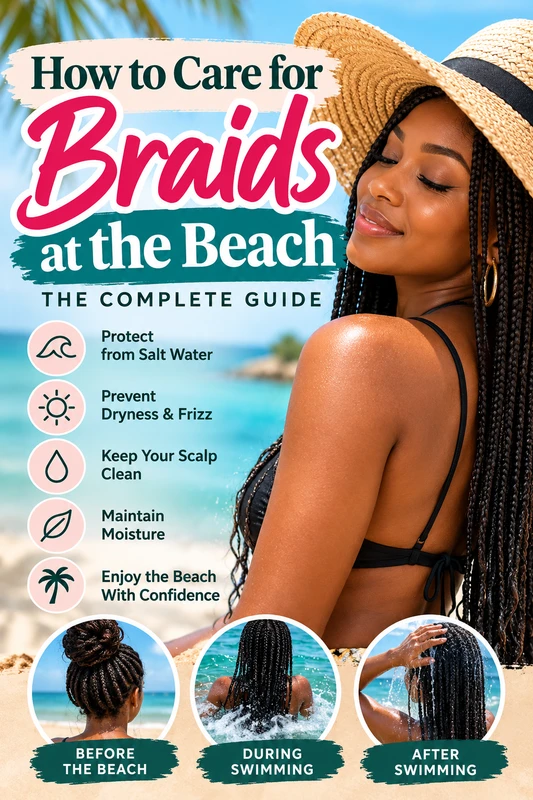
Braids and beach days are a perfect combination. Whether you're wearing knotless braids, box braids, cornrows, feed-in braids, stitch braids, boho braids, or another protective style, braids make it easier to enjoy a vacation without spending hours styling your natural hair every morning.
But the beach introduces several challenges that can affect both your braids and the natural hair underneath them.
Salt water can leave hair feeling dry or stiff. Sand can work its way between your braids and onto your scalp. Wind can create friction and frizz. Sun exposure can leave your hair feeling dry. Swimming can saturate long braids with water, making them extremely heavy and slow to dry.
The good news is that you don't have to avoid the ocean just because you're wearing braids.
With a few simple precautions before you reach the beach, proper care after swimming, and a consistent moisture routine, you can enjoy the water while keeping your braids looking fresh.
In this complete Hairobics All Natural guide, we'll explain how to care for braids at the beach, including what to do before swimming, how to protect braids from salt water, what to do when sand gets into your scalp, how to wash and dry your braids afterward, and how to prevent excessive dryness and frizz.
Can You Go to the Beach With Braids?
Absolutely.
Braids can actually be one of the most convenient hairstyles for a beach vacation because your natural hair is already organized into a protective style.
You don't have to straighten your hair before going out.
You don't have to worry about humidity immediately changing a freshly styled look.
And you can usually pull your braids into a ponytail, bun, or other simple style within minutes.
However, "protective style" does not mean your hair is completely protected from the environment.
Your natural hair is still inside those braids.
Your scalp is still exposed.
And depending on your braid style, portions of your natural hair may come into direct contact with salt water, sand, wind, sweat, and sunlight.
The goal isn't to keep your braids perfectly untouched.
The goal is to reduce unnecessary dryness, buildup, tangling, and friction while still enjoying your day.
What Happens to Braids at the Beach?
A beach environment exposes your braids to several things at once.
Salt Water
Ocean water contains salt.
After the water evaporates, salt can remain on the hair and scalp. This can contribute to hair feeling rough, stiff, or dry, particularly when you repeatedly swim without rinsing your hair afterward.
Sand
Sand gets everywhere.
It can become trapped between your braids, around the roots, along your hairline, and even inside loose or curly sections of boho and goddess braids.
Wind
Wind causes braids to move and rub against one another.
That additional friction can make the style appear fuzzier.
Sun
Hours outdoors can contribute to dryness, especially when combined with swimming and wind.
Sweat
Hot weather naturally causes your scalp to sweat.
Sweat mixed with hair products, sunscreen, natural scalp oils, sand, and salt water can contribute to buildup.
If buildup is already an issue for you, read our guide to what causes white buildup around braids and how to prevent it.
How to Prepare Your Braids Before Going to the Beach
The best beach braid routine actually begins before you touch the water.
You don't need an elaborate routine or ten different products.
Keep things simple.
1. Check Your Scalp
Before leaving for the beach, take a quick look at your scalp.
Do you already have significant buildup?
Is your scalp excessively dry?
Are your roots still damp from a recent wash?
Are any braids pulling uncomfortably around your edges?
Address obvious problems before adding salt water, sand, sweat, and sunscreen to the situation.
If your scalp already has heavy buildup, piling additional products over it isn't the solution.
Cleansing may be necessary.
2. Give Your Natural Hair Some Lightweight Moisture
Your natural hair still needs moisture while it's inside a protective style.
Before spending hours outdoors, consider lightly moisturizing the sections of your braids containing your natural hair.
The key word is lightly.
You don't need to saturate your entire hairstyle.
For more detailed information about maintaining hydration while wearing protective styles, read our complete guide to keeping natural hair moisturized in braids.
Featured Hairobics Product: Raaw Roots Locs & Braids Moisturizer Spray
Hairobics Raaw Roots Locs & Braids Moisturizer Spray is designed for braids, locs, twists, extensions, weaves, synthetic hair, and natural hair.
The spray format makes it easy to reach your natural hair while it's inside a protective style.
Lightly apply it where your hair needs moisture rather than soaking your entire hairstyle.
Remember that moisture and buildup need to stay balanced.
Constantly layering heavy products onto your braids can eventually leave residue around your roots.
Should You Wet Your Braids Before Swimming in the Ocean?
If you plan to fully submerge your braids, rinsing them with clean fresh water before entering the ocean can be a useful step.
Hair that is already wet has absorbed some clean water before it encounters ocean water.
You don't need to completely drench extremely long or thick braids unnecessarily.
Concentrate on your natural hair and the portions of the hairstyle that will be submerged.
Afterward, you should still rinse your braids with fresh water.
Pre-wetting isn't a replacement for post-swim care.
Should You Wear a Swim Cap Over Braids?
You can wear a swim cap if you can comfortably fit your braids underneath one without creating excessive pulling or pressure.
For smaller cornrows or compact braided styles, this may be relatively easy.
For waist-length knotless braids or large box braids, fitting everything underneath a standard swim cap may be difficult.
Never force a large amount of hair into a tight cap if doing so causes uncomfortable pulling around your edges.
If you're mainly lounging on the beach rather than swimming, a hat or scarf can also help keep sand away from your hair.
How to Wear Braids at the Beach
Leaving extremely long braids hanging loose while you're running through the water, swimming, playing volleyball, or walking in strong wind may create unnecessary tangling and friction.
Instead, loosely secure them.
Good beach options include:
- A loose ponytail
- A low bun
- A loose high bun
- Two loose sections
- A comfortable braided ponytail
The emphasis should be on loose.
You don't need to pull your roots tightly to keep your hair out of the way.
Your hairline shouldn't hurt.
Avoid Tight Beach Hairstyles
It can be tempting to pull braids into an extremely tight bun so they stay completely out of your face.
But remember that your braids already place some weight on your natural hair.
Once long braids become wet, they're even heavier.
Pulling heavy, wet braids tightly upward may place unnecessary tension around your roots and edges.
Keep wet braided hairstyles comfortable.
If you feel pulling, loosen the style.
How to Protect Your Edges at the Beach
Your edges are one of the most delicate areas of your hairstyle.
Avoid repeatedly pulling your braids backward into extremely tight ponytails or buns.
Instead:
Keep your hairline comfortable.
Avoid constantly adjusting your braids.
Don't force short edge hairs into tight styles.
Don't pull wet, heavy braids tightly backward.
If several braids around your hairline already feel uncomfortable before your beach trip, don't ignore it.
Protective styling shouldn't require enduring significant pain.
Can You Swim in the Ocean With Box Braids?
Yes.
Box braids are generally secure enough for swimming, although they may become extremely heavy when wet.
The biggest challenge is usually what happens after swimming.
You need to:
Rinse away salt water.
Remove sand.
Gently squeeze out excess water.
Dry the braids thoroughly.
Restore lightweight moisture when necessary.
Avoid tying soaking-wet box braids into a tight bun and leaving them there for the rest of the day.
The interior of thick braids may stay wet much longer than the surface.
Can You Swim With Knotless Braids?
Yes.
Knotless braids can be convenient for beach vacations.
However, frequent swimming may contribute to frizz around your roots as your natural hair repeatedly gets wet and dries.
That doesn't necessarily mean anything is wrong with the hairstyle.
Some frizz is simply part of wearing a protective style through swimming, humidity, exercise, and everyday life.
If maintaining an extremely polished appearance is your top priority, consider limiting how often you completely submerge your braids.
If enjoying the ocean is your priority, swim and plan to refresh the style afterward.
Can You Swim With Cornrows?
Yes.
Cornrows can be particularly convenient for swimming because they're close to the scalp and don't carry the same weight as long individual extensions.
They're also easier to rinse.
However, because your scalp is exposed between the rows, salt, sweat, sunscreen, and sand can collect directly on the scalp.
Rinse thoroughly after swimming.
Avoid aggressively scratching between your cornrows to remove sand.
What About Boho and Goddess Braids?
Boho braids require extra attention because of their loose curly pieces.
Those loose strands can tangle more easily than fully braided extensions.
Salt water, wind, sand, and repeated swimming may make the loose curls more difficult to maintain.
Before swimming, loosely secure your hair so the curly pieces aren't whipping around excessively.
Afterward, separate tangled sections carefully rather than aggressively pulling them apart.
Boho braids may require more maintenance during a beach vacation than traditional box or knotless braids.
What Should You Do Immediately After Swimming?
This is probably the most important section of your beach braid routine.
Don't simply leave the ocean, let your braids dry with salt water in them, and repeat the process every day for a week.
Whenever practical, rinse your hair with clean fresh water.
A beach shower is ideal.
Allow fresh water to flow through your scalp and down your braids.
Pay particular attention to:
- Your roots
- Your scalp
- Your hairline
- Your nape
- The sections containing your natural hair
You don't necessarily need a full shampoo wash after every quick dip in the ocean.
But rinsing away salt and sand is a smart habit.
How to Get Sand Out of Braids
Sand can be frustrating because tiny particles can work their way between braided sections.
Start by letting loose sand fall away naturally.
Gently shake or separate your braids.
Then rinse your scalp with clean water.
Allow the water to travel between your parts.
Do not aggressively scratch your scalp with your fingernails trying to remove individual grains of sand.
If sand remains after rinsing, you may need a more thorough wash once you return to your hotel or home.
Should You Shampoo Your Braids After the Beach?
It depends.
If you only spent a few hours on the beach and barely got your hair wet, a full wash may not be necessary.
However, shampooing may make sense if you've accumulated significant:
- Salt
- Sweat
- Sand
- Sunscreen
- Scalp oil
- Styling-product buildup
- Odor
If you've been swimming repeatedly throughout a week-long vacation, your scalp may also need more thorough cleansing.
The goal isn't to shampoo automatically every time your braids encounter water.
Clean according to the condition of your hair and scalp.
For the complete technique, see our guide to washing braids without ruining them.
You can also read our dedicated Braids Washing Guide for a step-by-step cleansing routine.
How to Wash Braids After the Beach
When a full wash is necessary, concentrate primarily on your scalp.
Step 1: Rinse
Allow clean water to remove loose sand, salt, sweat, and surface residue.
Step 2: Apply Shampoo
Apply an appropriate shampoo primarily to your scalp.
Diluting shampoo can sometimes make it easier to distribute between braided sections.
Step 3: Massage Gently
Use the pads of your fingertips.
Avoid digging your fingernails into your scalp.
Step 4: Rinse Thoroughly
Allow water to travel downward through the braids.
Keep rinsing until the cleanser has been removed.
Step 5: Remove Excess Water
Gently squeeze your braids from top to bottom.
Don't twist or wring them aggressively.
Step 6: Dry Completely
This final step is extremely important.
How to Prevent Frizz When Washing Beach Braids
You may notice some additional frizz after a beach trip.
That's normal.
Water causes your natural hair to expand, while wind, swimming, towels, clothing, and repeated manipulation can create additional friction.
You can minimize unnecessary frizz by handling the hair gently.
Don't scrub braids together.
Don't rub them aggressively with a bath towel.
Don't repeatedly twist and wring them.
Instead, squeeze excess water from the hair and blot with a microfiber towel or soft cotton T-shirt.
Our guide to washing braids without frizz explains additional techniques for maintaining a neater appearance.
Drying Braids After the Beach
One of the biggest mistakes you can make after swimming is ignoring the drying process.
Long, thick braids can hold an enormous amount of water.
Even when the outside feels relatively dry, the roots and interior sections may still be damp.
Start by gently squeezing excess water from the braids.
Then use a microfiber towel or soft T-shirt to absorb additional moisture.
Allow your braids to hang freely in a well-ventilated area.
When appropriate, a hooded dryer or blow dryer on a suitable cool or low setting may help speed up the process.
Pay special attention to the roots.
For a complete routine, read How to Dry Braids After Washing.
Don't Sleep With Soaking-Wet Braids
Imagine swimming at 6:00 p.m., returning to your hotel, putting your soaking-wet braids into a bun, covering them with a bonnet, and immediately going to sleep.
Your roots may stay damp for hours.
Instead, give your braids sufficient time to dry.
If you know you're going swimming, getting into the water earlier in the day gives your hairstyle more drying time before bedtime.
This is especially important with very long or thick box braids.
Once your hair is dry, follow a protective nighttime routine.
Our guide to sleeping with long braids explains how to protect longer braided styles comfortably overnight.
Moisturize Your Natural Hair After Swimming
After you've rinsed or washed away salt water and your braids are no longer soaking wet, evaluate your hair's moisture level.
Does your natural hair feel dry?
Does your hairline feel rough?
Do the sections containing your natural hair need additional hydration?
This is where a lightweight braid moisturizer can be useful.
Lightly apply Raaw Roots Locs & Braids Moisturizer Spray to the areas that need moisture.
You don't need to drench the entire hairstyle.
More product isn't always better.
A small amount applied consistently can be preferable to layering heavy products until your scalp becomes coated.
Beach Braid Routine: Before, During and After
Here's an easy routine you can remember on vacation.
Before the Beach
Check your scalp.
Lightly moisturize your natural hair if needed.
Secure long braids loosely.
Bring a scarf or hat if desired.
Bring your braid moisturizer for later.
Before Swimming
Consider rinsing the sections that will be submerged with clean fresh water.
Secure long braids comfortably.
Avoid extremely tight buns.
After Swimming
Rinse with clean water.
Remove visible sand.
Gently squeeze out excess water.
Allow your braids to dry thoroughly.
Later That Evening
Check your scalp.
Cleanse if necessary.
Apply lightweight moisture if your hair feels dry.
Make sure your roots are dry before covering your hair.
Protect your braids overnight with satin.
How to Keep Braids Looking Fresh on a Beach Vacation
If you're going away for several days, consistency matters more than perfection.
You don't need to completely redo your braids every night.
Instead, concentrate on preventing the problems that make braided styles deteriorate quickly.
That means controlling:
Friction: Protect the hair at night and avoid excessive rubbing.
Buildup: Don't continuously layer heavy products over sweat and sunscreen.
Dryness: Give your natural hair lightweight moisture when needed.
Dampness: Allow wet braids to dry completely.
Tension: Don't repeatedly pull heavy braids into tight vacation hairstyles.
Sand: Rinse your scalp after beach exposure when necessary.
For more everyday maintenance techniques, read our guide on how to keep braids looking fresh.
How Humidity Affects Beach Braids
Beaches are often humid.
Humidity can cause your natural hair to absorb moisture from the surrounding air, potentially contributing to frizz around your roots and along the braid.
You can't completely eliminate this.
And you shouldn't spend your entire vacation worrying about a few flyaways.
Instead, minimize unnecessary friction and manipulation.
At night, protect your hair.
During the day, avoid constantly touching and re-styling it.
For a deeper explanation, read our guide on how humidity affects braided hairstyles.
Should You Apply Oil Before Going Into the Ocean?
You don't need to coat your braids with a heavy layer of oil before swimming.
Remember that oil doesn't replace water-based moisture.
Heavy product application can also combine with sweat, sand, sunscreen, and natural scalp oils, creating more buildup.
Keep your routine simple.
Moisturize appropriately.
Rinse after swimming.
Clean when necessary.
Dry thoroughly.
That's more important than coating your hairstyle in multiple products.
What About Sunscreen Getting Into Your Braids?
Sunscreen is important for exposed skin, but certain products can transfer onto your hairline and roots.
Be careful when applying sunscreen around your forehead and neck.
If residue collects around your hairline, gently clean the area rather than continuously applying more hair products over it.
Never skip sun protection simply to protect your hairstyle.
Instead, be intentional about application and clean residue when necessary.
Should You Wear a Hat at the Beach?
A comfortable sun hat can be useful for keeping some direct sunlight and blowing sand away from your hair.
Just make sure the hat isn't excessively tight around your hairline.
If you're wearing very large braids, choose something roomy enough to accommodate the hairstyle without crushing or pulling your roots.
A scarf can serve a similar purpose when you're lounging rather than swimming.
What Should You Pack for a Beach Vacation With Braids?
You don't need an entire suitcase of hair products.
A practical braid-care kit might include:
- Lightweight braid moisturizer
- Shampoo
- Satin scarf or bonnet
- Microfiber towel
- Soft hair ties or scrunchies
- Wide headband or scarf
- Comfortable sun hat
- Braid mousse if you normally use one
- Shower cap for non-swimming days
The exact products you need depend on your hairstyle and the length of your trip.
Common Beach Braid Mistakes
Mistake #1: Never Rinsing After Swimming
Repeatedly allowing ocean water to dry in your hair may leave salt and residue behind.
Rinse when practical.
Mistake #2: Leaving Braids Wet All Night
Long braids can take much longer to dry than you expect.
Give them sufficient drying time.
Mistake #3: Pulling Wet Braids Into Tight Buns
Wet extensions can become heavy.
Don't add unnecessary tension to your roots.
Mistake #4: Adding More Product Every Time Your Scalp Feels Uncomfortable
Sometimes your scalp needs cleansing rather than another layer of oil or moisturizer.
Mistake #5: Aggressively Scratching Out Sand
Use rinsing and gentle cleansing instead.
Mistake #6: Ignoring Your Natural Hair
Your extensions may look fine while the natural hair underneath is becoming dry.
Pay attention to the sections containing your real hair.
Mistake #7: Obsessing Over Every Little Bit of Frizz
You're at the beach.
Some frizz is normal.
Healthy hair and an enjoyable vacation matter more than keeping every braid perfectly untouched.
How Often Should You Wash Braids During a Beach Vacation?
There's no universal schedule.
If you're spending seven days at a resort but only swimming once, your routine will be different from someone swimming in the ocean every morning.
Use your scalp as your guide.
Consider cleansing when you notice substantial:
- Sweat
- Sand
- Salt residue
- Product buildup
- Odor
- Visible dirt
- Scalp discomfort
If you're swimming frequently, rinse with fresh water after swimming whenever practical and perform a more thorough cleanse when your scalp needs it.
What If My Braids Smell After Swimming?
First, make sure the smell isn't coming from braids that have remained damp for too long.
Thick braids can hold moisture.
If your hair repeatedly stays wet for long periods, odor can develop.
The solution isn't simply spraying fragrance over the hairstyle.
Clean the scalp and hair when necessary and, most importantly, dry the braids completely.
Pay special attention to your roots.
Should You Get Braids Right Before a Beach Vacation?
Braids can be an excellent vacation hairstyle.
However, consider giving a fresh installation a little time before exposing it to constant swimming.
Brand-new braids can sometimes feel tighter during the first few days.
If your hairstyle is already uncomfortably tight, pulling it into swim styles and adding the weight of water isn't ideal.
Your braids should feel comfortable.
If you're experiencing significant pain, bumps, excessive pulling, or irritation around the hairline, address the tension rather than assuming you simply need to "break in" the hairstyle.
How Long Should You Keep Braids After Vacation?
A beach trip doesn't automatically mean you need to remove your braids when you return home.
Evaluate the condition of your style and natural hair.
Consider:
How old are the braids?
Is there excessive buildup?
Are your roots heavily tangled?
Are your edges under stress?
Do the braids smell even after cleansing and drying?
Has the style become extremely loose?
Are your braids still comfortable?
If the hairstyle is still in good condition, you may be able to continue wearing it.
But don't extend the life of an unhealthy hairstyle simply because the braids still look acceptable.
Our guide to how long you should keep braids in explains when it may be time to take your protective style down.
Can You Go to the Beach Every Day With Braids?
Yes, but your maintenance routine becomes more important with repeated exposure.
Someone visiting the beach once doesn't need the same routine as someone spending an entire summer swimming several times per week.
Frequent beachgoers should pay particular attention to:
- Rinsing
- Scalp cleanliness
- Complete drying
- Moisture balance
- Buildup
- Frizz
- Hairline tension
The more frequently your braids get wet, the more frequently you'll need to evaluate them.
Are Braids Good for Beach Vacations?
Braids are one of the most practical hairstyles for many beach vacations.
They allow you to wake up and get moving without spending hours styling your hair.
You can swim, walk along the beach, go sightseeing, work out, go to dinner, and transition between activities with relatively little styling.
But convenience shouldn't lead to neglect.
Your natural hair still needs care underneath your extensions.
Think of braids as low manipulation, not no maintenance.
Frequently Asked Questions About Caring for Braids at the Beach
Can salt water ruin braids?
One swim in the ocean isn't automatically going to ruin your braids. However, repeated salt-water exposure without rinsing, cleansing, moisturizing, and proper drying may contribute to dryness, residue, frizz, and a rougher feel.
Should I wash my braids immediately after swimming?
You don't necessarily need a full shampoo after every quick swim, but rinsing with clean fresh water afterward is useful. Shampoo when your scalp and hair need more thorough cleansing.
Can I let my braids air-dry after swimming?
Yes, provided they have enough time and airflow to dry thoroughly. Very thick or long braids may require additional drying time.
Can I sleep with wet braids after the beach?
It's better to allow your braids and roots to dry thoroughly before covering them for the night.
Should I moisturize my braids after swimming?
If your natural hair feels dry after you've rinsed or cleansed your braids, apply an appropriate lightweight moisturizer to the sections containing your natural hair.
Can I swim with knotless braids?
Yes. Just expect that repeated swimming may contribute to some frizz around your natural hair and roots.
Can I swim with box braids?
Yes. Be prepared for them to become significantly heavier when wet and give them plenty of time to dry afterward.
How do I keep sand out of my braids?
Keeping long braids secured, wearing a comfortable hat or scarf while lounging, and avoiding lying directly in the sand can help. If sand gets into your scalp, rinse it out gently.
Should I wear my braids up or down at the beach?
Either can work. For swimming or windy conditions, loosely securing long braids is often more manageable. Avoid styles that pull tightly at the roots.
How do I keep braids from getting frizzy at the beach?
You can't completely eliminate frizz when you're combining water, humidity, wind, and activity. You can reduce it by minimizing friction, handling your braids gently, protecting them at night, and avoiding unnecessary manipulation.
Final Thoughts: Enjoy the Beach Without Neglecting Your Braids
Learning how to care for braids at the beach doesn't require an elaborate hair routine.
Focus on a few fundamentals.
Prepare your natural hair with appropriate moisture.
Keep long braids comfortably secured while swimming.
Rinse salt water and sand from your hair afterward.
Clean your scalp when necessary.
Gently remove excess water.
Dry your braids thoroughly.
Restore lightweight moisture when your natural hair needs it.
And protect your hairstyle at night.
Most importantly, don't let maintaining perfectly neat braids prevent you from enjoying your vacation.
Braids are supposed to make your routine easier.
A little frizz after swimming in the ocean is normal. What matters more is keeping your natural hair and scalp properly maintained underneath the style.
For everyday braid hydration, consider Hairobics Raaw Roots Locs & Braids Moisturizer Spray, designed for braids, locs, twists, extensions, weaves, synthetic hair, and natural hair.
With the right before-and-after beach routine, you can swim, relax, enjoy the sun, and come home with your braids—and the natural hair underneath them—in better condition.