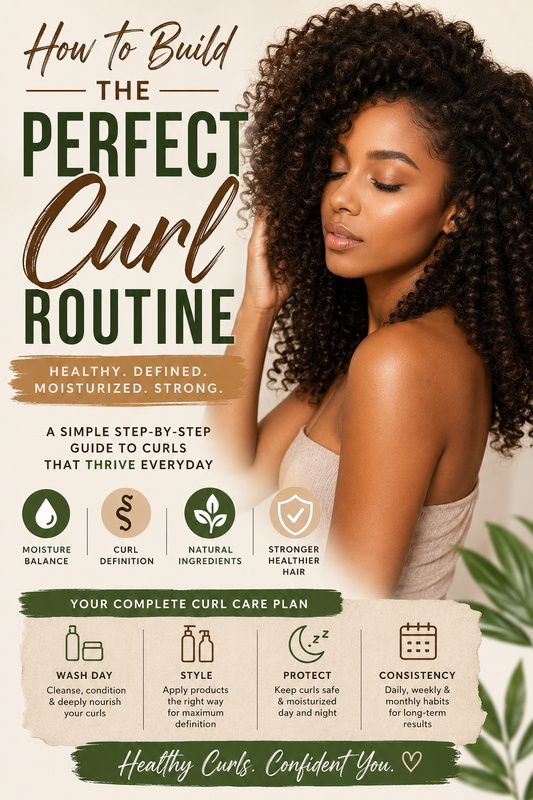
Every head of curls is unique, but one thing remains true: curls thrive on consistency. If you've ever wondered why your curls look amazing one day and dry, frizzy, or undefined the next, the answer often isn't your hair—it's your routine.
Building the perfect curl routine isn't about buying dozens of expensive products. It's about understanding your hair's needs and creating a simple system that keeps your curls hydrated, healthy, and protected.
Whether you have loose waves, springy ringlets, tight coils, or kinky curls, this guide will show you exactly how to build a curl routine that works.
Why Every Curl Needs a Routine
Unlike straight hair, curly hair naturally struggles to distribute scalp oils from roots to ends. This makes curls more likely to become:
- Dry
- Brittle
- Frizzy
- Tangled
- Prone to breakage
A consistent routine helps maintain moisture while reducing damage.
Benefits include:
- Better curl definition
- Less frizz
- More moisture
- Stronger strands
- Easier detangling
- Healthier scalp
- Improved curl elasticity
- Faster length retention
Step 1: Know Your Curl Type
Although every curl is different, knowing your pattern helps choose the right products.
Type 2 (Wavy)
Characteristics:
- Loose bends
- Lightweight
- Can become oily quickly
- Easily weighed down
Needs:
- Lightweight moisture
- Curl-enhancing products
- Minimal heavy oils
Type 3 (Curly)
Characteristics:
- Spiral curls
- More volume
- Moderate dryness
- Medium density
Needs:
- Hydration
- Leave-in conditioner
- Curl cream
- Gel for hold
Type 4 (Coily)
Characteristics:
- Tight coils
- Maximum shrinkage
- Extremely dry
- Fragile
Needs:
- Rich moisture
- Deep conditioning
- Oils
- Protective styling
Step 2: Understand Your Hair Porosity
Porosity affects how moisture enters and leaves your hair.
Low Porosity
Hair resists moisture.
Best practices:
- Warm water
- Lightweight products
- Avoid buildup
- Clarify monthly
Medium Porosity
The easiest hair to maintain.
Needs:
- Regular conditioning
- Weekly masks
- Moisture balance
High Porosity
Hair absorbs water quickly but loses it fast.
Needs:
- Leave-ins
- Oils
- Creams
- Protein treatments
Step 3: Cleanse Properly
Healthy curls begin with a clean scalp.
Wash frequency depends on your lifestyle.
General guideline:
- Every 5–10 days
People who exercise often may wash more frequently.
Choose sulfate-free cleansers whenever possible to avoid stripping moisture.
Step 4: Deep Condition Weekly
Deep conditioning is one of the biggest differences between average curls and thriving curls.
Benefits:
- Repairs dryness
- Improves elasticity
- Softens hair
- Reduces breakage
- Makes detangling easier
Leave treatments on for 20–30 minutes for the best results.
Step 5: Detangle Correctly
Never rush detangling.
Always:
- Saturate hair with conditioner
- Divide into sections
- Start from the ends
- Work upward slowly
Using your fingers first helps reduce unnecessary breakage.
Step 6: Apply Products in the Correct Order
Layering products correctly makes a huge difference.
Typical routine:
- Leave-in conditioner
- Curl cream
- Curl gel
- Lightweight oil (optional)
Applying products to soaking wet hair usually produces better curl clumps.
Step 7: Lock In Moisture
Moisture should remain inside the hair.
Methods include:
LOC Method
- Liquid
- Oil
- Cream
LCO Method
- Liquid
- Cream
- Oil
Experiment to determine which method works best for your curls.
Step 8: Dry Hair Properly
Avoid rough cotton towels.
Instead use:
- Microfiber towels
- Cotton T-shirts
Air drying works well for many curl types.
Diffusing can reduce drying time while increasing volume.
Step 9: Protect Hair While Sleeping
Night protection prevents moisture loss.
Sleep with:
- Satin bonnet
- Satin scarf
- Satin pillowcase
Loose pineapple hairstyles help preserve curl definition.
Daily Curl Routine
Morning:
- Refresh curls with water
- Apply leave-in if needed
- Smooth frizz
- Scrunch curls
Night:
- Pineapple hair
- Satin bonnet
- Moisturize dry areas if needed
Weekly Curl Routine
Weekly checklist:
✓ Wash hair
✓ Condition
✓ Deep condition
✓ Detangle
✓ Style
✓ Massage scalp
Monthly Curl Routine
Every month:
- Clarify hair
- Trim split ends if needed
- Protein treatment (if necessary)
- Check scalp health
Ingredients Your Curls Love
Look for ingredients such as:
- Aloe vera
- Coconut oil
- Jamaican black castor oil
- Avocado oil
- Olive oil
- Argan oil
- Shea butter
- Marshmallow root
- Flaxseed
- Glycerin (depending on climate)
- Vitamin E
These ingredients help nourish curls while supporting moisture retention.
Common Curl Routine Mistakes
Washing Too Often
Overwashing removes natural oils.
Using Too Much Product
Heavy buildup reduces curl definition.
Skipping Deep Conditioning
Dry curls become weak and brittle.
Detangling Dry Hair
This often causes unnecessary breakage.
Sleeping Without Protection
Cotton fabrics absorb moisture.
Ignoring Your Scalp
Healthy curls begin with healthy roots.
Seasonal Curl Routine Adjustments
Summer
Focus on:
- UV protection
- Lightweight hydration
- Sweat management
- Extra cleansing after swimming
Winter
Increase:
- Deep conditioning
- Rich moisturizers
- Protective styles
- Scalp hydration
Sample Curl Routine
Wash Day
- Shampoo
- Conditioner
- Deep conditioner
- Detangle
- Leave-in conditioner
- Curl cream
- Gel
- Dry naturally or diffuse
Refresh Day
- Light mist of water
- Small amount of leave-in
- Scrunch curls
- Smooth frizz
- Air dry
Building a Routine Around Your Lifestyle
Not everyone has time for elaborate wash days. The best routine is one you can consistently follow.
If you're busy:
- Wash once a week
- Deep condition weekly
- Refresh curls between wash days
- Protect hair at night
Consistency matters more than complexity.
Supporting Curl Health from the Inside
Healthy curls also benefit from overall wellness. Staying hydrated, eating a balanced diet rich in vitamins and minerals, managing stress, and getting adequate sleep all contribute to stronger hair over time. While products care for the outside of the hair, your daily habits support healthy growth from within.
Curl Routine Tips for Different Hairstyles
If you wear wash-and-gos, focus on hydration and defining products. For twist-outs or braid-outs, use moisturizing creams and allow hair to dry completely before unraveling. Protective styles still require scalp care—cleanse the scalp gently, apply lightweight moisturizers, and avoid excessive tension around the edges.
How to Know Your Routine Is Working
A successful curl routine doesn't produce overnight miracles, but over several weeks you should notice:
- Softer hair
- Better curl definition
- Less breakage
- Reduced tangles
- Improved moisture retention
- Easier styling
- More consistent wash-day results
- Healthier-looking ends
Take photos every month to track progress rather than relying on memory alone.
Frequently Asked Questions
How often should I wash curly hair?
Most curly hair benefits from washing every 5–10 days, though your routine may vary depending on scalp oiliness, workouts, and product buildup.
Should I brush curly hair?
It's best to detangle curly hair while it's wet and coated with conditioner. Brushing dry curls can disrupt the curl pattern and increase frizz.
Do curls need oil every day?
Not necessarily. Oils help seal moisture but do not replace water. Apply oil only when your hair needs help locking in hydration.
Can I use heat on curly hair?
Occasional heat styling is fine when you use a heat protectant, but frequent high heat can weaken curl patterns over time.
Why are my curls still frizzy?
Frizz can result from dryness, humidity, product buildup, over-manipulation, or using products that don't suit your hair type. Adjusting your routine and maintaining moisture often makes a noticeable difference.
Final Thoughts
The perfect curl routine isn't about chasing perfection—it's about creating healthy habits that keep your curls moisturized, defined, and resilient. By understanding your curl type, porosity, and moisture needs, you can build a routine that fits your lifestyle and supports long-term hair health.
Consistency is the key. Cleanse regularly, deep condition weekly, moisturize thoughtfully, protect your curls at night, and adjust your routine as the seasons change. Over time, these simple practices can lead to softer, stronger, more manageable curls that look and feel their best every day.