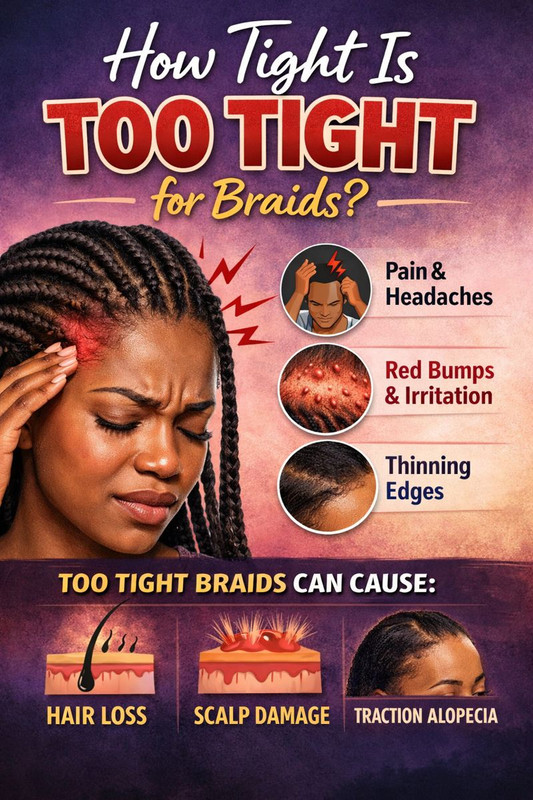
Braids are one of the most popular protective styles for natural hair. They’re low-maintenance, stylish, and versatile. But there’s a line — and many people cross it without realizing — between secure braids and dangerously tight braids.
If you’ve ever left the braiding chair with:
-
A throbbing scalp
-
Red bumps around your hairline
-
A headache that lasts days
-
Or the urge to cut your braids out that same night
…your braids were too tight.
This article breaks down exactly how tight is too tight, what your scalp is trying to tell you, the long-term damage tight braids cause, and what to do immediately if you’re already dealing with pain or thinning edges.
Why Braids Are Often Installed Too Tight
Most braids are installed tight for one main reason: longevity.
Braiders are often taught that tighter braids:
-
Look neater
-
Last longer
-
Don’t frizz as quickly
-
Satisfy clients who say, “Make it last”
Unfortunately, hair health doesn’t work that way.
Hair grows from living follicles embedded in the scalp. When braids are pulled too tight, you’re not just stressing the hair strand — you’re stressing the follicle itself, which can permanently shut down over time.
The Difference Between “Snug” and “Too Tight”
Let’s clear this up because many people confuse the two.
Snug Braids Feel Like:
-
Light tension
-
Slight tenderness for 24 hours or less
-
No bumps, redness, or pain when touching the scalp
-
No pulling sensation when you move your face or eyebrows
Too-Tight Braids Feel Like:
-
Sharp or burning pain
-
Headaches or pressure behind the eyes
-
Pain when lifting your eyebrows or smiling
-
Scalp soreness lasting more than 48 hours
-
Redness, bumps, or swelling
-
A “pulled” feeling even when resting
Pain is not normal. Ever.
If your scalp hurts, your follicles are under attack.
Immediate Warning Signs Your Braids Are Too Tight
Your scalp speaks fast — you just have to listen.
1. Persistent Pain Beyond 24–48 Hours
Mild soreness is common the first day. Pain that lasts longer than two days means inflammation is setting in, which can restrict blood flow to the follicle.
No blood flow = no growth.
2. Small Bumps Along the Hairline or Parts
Those little bumps (sometimes mistaken for pimples) are actually inflamed follicles. This is an early stage of traction alopecia.
Ignore them long enough and the follicle can scar over.
3. Shiny or Red Scalp
A shiny scalp around braids means the skin is stretched too tightly. Redness means irritation and inflammation.
Healthy scalp skin should look calm, not stressed.
4. Thinning Edges or Part Lines
If your edges look thinner after removing braids — especially repeatedly — this is not coincidence.
That’s tension damage.
5. Hair Coming Out From the Root When You Take Braids Down
Shed hair is normal. But if you notice bulbs attached to short broken hairs, tension likely forced the hair out before it completed its growth cycle.
Why Tight Braids Are So Damaging
1. They Restrict Blood Flow
Hair follicles need oxygen and nutrients delivered through blood. Tight braids compress the scalp, cutting off circulation.
No circulation = stalled growth.
2. They Cause Chronic Inflammation
Repeated tight styles cause low-grade inflammation, which slowly weakens follicles over time. This is why damage often shows up months or years later.
3. They Lead to Traction Alopecia
Traction alopecia is hair loss caused by repeated tension. It commonly affects:
-
Edges
-
Temples
-
Nape
-
Crown
Once follicles scar, regrowth becomes difficult or impossible.
4. They Break Hair at the Root
Tension doesn’t just pull hair out — it weakens the root, making strands more likely to snap under stress.
How Tight Braids Affect Different Hair Types
Fine or Low-Density Hair
-
Higher risk of traction alopecia
-
Follicles are more fragile
-
Tight braids cause faster thinning
Thick or Coarse Hair
-
May tolerate tension slightly better
-
Still vulnerable over time
-
Damage often shows later
Relaxed or Color-Treated Hair
-
Extremely high risk
-
Hair is already weakened
-
Tight braids accelerate breakage
How Long Is Too Long to Keep Tight Braids In?
If braids are tight, even one week is too long.
General guidelines:
-
Tight braids causing pain → remove or loosen within 48 hours
-
Mild tension but no pain → no longer than 3–4 weeks
-
Comfortable, tension-free braids → up to 6–8 weeks max
The longer tight braids stay in, the greater the risk of permanent damage.
What to Do Immediately If Your Braids Are Too Tight
1. Loosen Them — Don’t “Push Through”
Pain is not something to “get used to.” Ask the braider to loosen them or carefully loosen them yourself.
2. Apply a Lightweight Scalp Oil
A nourishing oil can reduce inflammation and restore flexibility to the scalp.
Look for oils that:
-
Calm irritation
-
Improve circulation
-
Reduce tightness
Avoid heavy grease that suffocates the scalp.
3. Use Cold Compresses
Cold reduces inflammation. Apply a cold pack (wrapped in cloth) to tender areas for 10–15 minutes.
4. Massage Gently (Not Aggressively)
Use light circular motions to increase blood flow. Do not rub harshly — inflamed follicles are fragile.
5. Remove the Braids If Necessary
If pain doesn’t improve after 48 hours, removal is the healthiest option. Hair grows back — damaged follicles don’t always.
Can Hair Grow Back After Tight Braids?
It depends on how long and how often the tension occurred.
Hair Can Grow Back If:
-
Damage was recent
-
Follicles are not scarred
-
Inflammation is reduced quickly
-
You avoid tight styles moving forward
Hair May Not Fully Grow Back If:
-
Traction alopecia is advanced
-
Hairline has been tight for years
-
Follicles are scarred
Early action makes all the difference.
How to Ask for Braids Without Tension (Script You Can Use)
If you’ve ever been afraid to speak up at the braiding chair, you’re not alone. Try this:
“I have a sensitive scalp and can’t do tight braids. I’m okay with a looser install if it means healthier hair.”
If a braider insists tightness is “normal,” that’s a red flag.
A professional stylist prioritizes scalp health, not just aesthetics.
Protective Styles That Are Gentler Than Tight Braids
If you love braids but want healthier hair, consider:
-
Knotless braids
-
Crochet styles
-
Loose twists
-
Halo braids
-
Sew-ins with minimal tension
-
Wigs with proper scalp care underneath
Protective should never mean painful.
How to Prep Your Hair Before Braids to Reduce Tension
Healthy hair tolerates styles better.
Before braiding:
-
Deep condition
-
Detangle thoroughly
-
Moisturize hair and scalp
-
Avoid braiding on freshly washed, dry hair
Dry, brittle hair + tight braids = breakage.
Long-Term Scalp Care After Tight Braids
If you’ve had tight styles in the past:
-
Give your hair breaks between installs
-
Focus on scalp nourishment
-
Massage regularly to stimulate follicles
-
Avoid repeating tension in the same areas
Consistency heals damage.
The Bottom Line: How Tight Is Too Tight?
If it hurts, it’s too tight.
If you’re sore days later, it’s too tight.
If your edges are thinning, it’s too tight.
Braids should protect your hair — not punish it.
Healthy hair grows from a calm, well-nourished scalp. No style is worth sacrificing that.