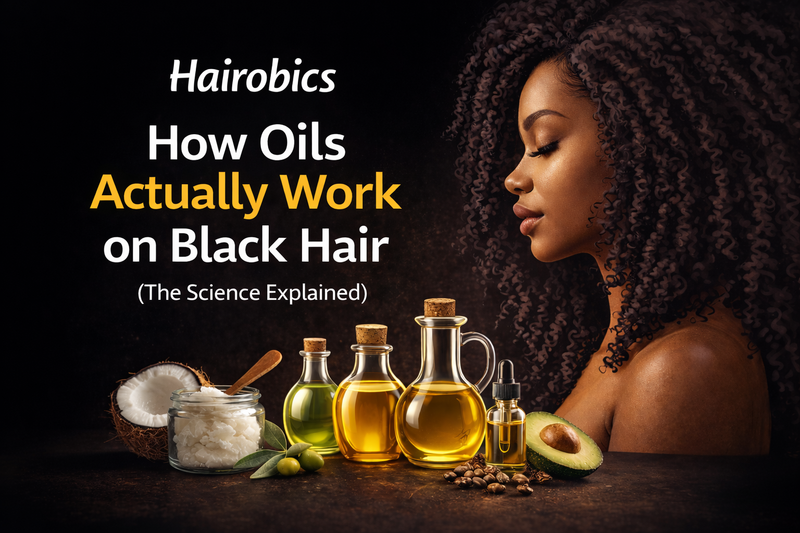
Understanding how oils actually work on Black hair is one of the most important steps toward achieving consistent growth, moisture retention, and long-term hair health. Oils are widely used in natural hair care routines, but many people misunderstand what oils actually do — and what they do not do.
Some people believe oils “moisturize” hair. Others believe oils alone can make hair grow faster. The truth is more scientific and much more useful.
In this in-depth guide, you'll learn:
-
How oils interact with Black hair structure
-
The science of moisture retention
-
Why oils sometimes stop working
-
The difference between sealing vs moisturizing
-
How to use oils for maximum growth
-
Common mistakes that prevent results
-
The best oil strategies for long-term hair health
This guide will help you use oils correctly so your hair can grow longer, stronger, and healthier.
Understanding the Structure of Black Hair
To understand oils, you first need to understand how Black hair is structured.
Black hair typically has:
-
Curves and coils
-
Raised cuticles
-
Lower natural oil distribution
-
Higher dryness risk
-
Greater breakage risk
Because hair strands curve, scalp oils have difficulty traveling down the hair shaft.
This is why Black hair often feels dry even when the scalp produces natural oils.
Oils are used to replace the lubrication that naturally straight hair receives.
But lubrication is not the same as moisture.
What Oils Actually Do
Oils serve four major functions in Black hair care.
1. Oils Seal Moisture
Oils do not hydrate hair.
Water hydrates hair.
Oils lock hydration inside the strand.
When water enters the hair shaft, oils create a protective barrier that slows evaporation.
Without sealing, moisture escapes quickly.
This leads to:
-
Dryness
-
Frizz
-
Breakage
-
Tangling
Sealing moisture is oils’ most important role.
2. Oils Reduce Friction
Black hair is vulnerable to mechanical damage.
Friction happens when:
-
Hair rubs against clothing
-
Hair rubs against other strands
-
Combs pull strands
-
Styles create tension
Oils reduce surface friction.
This helps prevent:
-
Split ends
-
Snapping
-
Mid-shaft breakage
Well-lubricated hair moves instead of snapping.
This is critical for length retention.
3. Oils Protect the Cuticle
The hair cuticle protects the inner cortex.
When the cuticle lifts:
-
Moisture escapes
-
Weakness increases
-
Breakage rises
Oils help smooth cuticles.
This creates:
-
Shine
-
Smoothness
-
Reduced tangling
Smooth cuticles are stronger cuticles.
4. Oils Support Scalp Health
Healthy hair grows from a healthy scalp.
Certain oils help:
-
Reduce scalp dryness
-
Support barrier function
-
Improve flexibility
-
Reduce irritation
A healthy scalp produces stronger hair strands.
Why Oils Feel Like Moisture
Many people say oils "moisturize" hair.
Here's why it feels that way:
Oils:
-
Make hair softer
-
Add slip
-
Add shine
-
Reduce roughness
These effects feel like moisture but are actually lubrication effects.
Hair that is oily but dry underneath will still break.
This is one of the biggest misconceptions in natural hair care.
The Science of Oil Penetration
Not all oils behave the same way.
Some oils sit on the surface.
Some penetrate inside the strand.
Penetrating Oils
Penetrating oils enter the cortex.
Examples include:
-
Coconut oil
-
Olive oil
-
Avocado oil
These oils can:
-
Reduce protein loss
-
Improve elasticity
-
Strengthen strands
Penetrating oils work best before washing.
This is called pre-pooing.
Sealing Oils
Sealing oils stay on the outside.
Examples include:
-
Castor oil
-
Jojoba oil
-
Grapeseed oil
These oils:
-
Lock moisture inside
-
Reduce evaporation
-
Add shine
These are best used after moisturizing.
Why Oils Alone Don't Grow Hair
Hair growth happens inside follicles under the scalp.
Growth is controlled by:
-
Genetics
-
Hormones
-
Nutrition
-
Blood flow
-
Scalp health
Oils help hair growth indirectly by reducing breakage.
Less breakage = longer hair.
Oils support retention, not growth speed.
How Oils Prevent Breakage
Breakage is the biggest reason natural hair seems not to grow.
Hair growth average:
About 1/2 inch per month
But breakage cancels growth.
Oils help by:
-
Keeping hair flexible
-
Reducing dryness
-
Preventing snapping
-
Improving detangling
Healthy lubrication allows strands to bend without breaking.
The Biggest Oil Mistakes
Mistake 1: Applying Oils to Dry Hair
This is extremely common.
Oil on dry hair seals dryness inside.
Hair must be moisturized first.
Correct order:
-
Water or leave-in
-
Cream (optional)
-
Oil
Mistake 2: Using Too Much Oil
Heavy oiling causes:
-
Buildup
-
Blocked moisture
-
Dull hair
-
Sticky strands
Hair needs light coating, not saturation.
Mistake 3: Using Only Oil
Oil-only routines eventually fail.
Hair needs:
-
Water
-
Conditioners
-
Protein
-
Gentle cleansing
Oil alone cannot maintain healthy hair.
Mistake 4: Not Washing Oils Out
Old oils oxidize and attract dirt.
Buildup causes:
-
Dryness
-
Itching
-
Slow growth
-
Weak strands
Regular cleansing resets the hair.
How to Use Oils Correctly
Step 1 — Start With Water
Hair moisture begins with water.
Best methods:
-
Spray bottle
-
Leave-in conditioner
-
Damp hair application
Water enters the cortex.
Step 2 — Apply Leave-In
Leave-in conditioners:
-
Improve moisture retention
-
Add slip
-
Strengthen strands
This creates the moisture base.
Step 3 — Seal With Oil
Apply a small amount.
Focus on:
-
Ends
-
Dry areas
-
Protective styles
Avoid soaking the hair.
The Best Oil Routine for Black Hair
A simple oil routine works best.
2–3 Times Per Week
-
Light mist of water
-
Leave-in conditioner
-
Small amount of oil
Weekly
Pre-poo with penetrating oil before shampoo.
Leave on 30–60 minutes.
Wash and condition.
Seal afterwards.
How Oils Help Protective Styles
Protective styles increase oil importance.
Braids, twists, and locs:
-
Prevent natural oil movement
-
Increase dryness risk
Oils help maintain flexibility.
Focus on:
-
Ends
-
Part lines
-
Scalp areas
Light application is best.
Signs Oils Are Working
You know oils are working when:
-
Breakage decreases
-
Hair feels flexible
-
Ends stay smooth
-
Shine improves
-
Detangling becomes easier
Growth becomes noticeable after several months.
Signs Oils Are Not Working
Signs include:
-
Hair still feels brittle
-
Greasy but dry strands
-
Flaking scalp
-
Sticky buildup
-
Increased shedding
These signs usually mean:
-
Too much oil
-
Not enough moisture
-
Poor cleansing
Choosing the Right Oil for Your Hair
Fine Natural Hair
Best oils:
-
Grapeseed oil
-
Argan oil
-
Sweet almond oil
Light oils prevent weighing hair down.
Thick Natural Hair
Best oils:
-
Castor oil
-
Olive oil
-
Avocado oil
Heavier oils improve sealing.
Low Porosity Hair
Best oils:
-
Jojoba oil
-
Argan oil
-
Sweet almond oil
Light oils absorb better.
High Porosity Hair
Best oils:
-
Castor oil
-
Olive oil
-
Jamaican Black Castor Oil
Heavy oils slow moisture loss.
Oils vs Butters
Oils and butters are different.
Oils:
-
Liquid lipids
-
Spread easily
-
Light sealing
Butters:
-
Solid lipids
-
Thick coating
-
Heavy sealing
Butters work best on:
-
Ends
-
Protective styles
-
Winter routines
Oils work best for daily care.
Long-Term Oil Strategy for Growth
The best oil strategy is consistent and simple.
Key Principles
-
Always moisturize first
-
Use small amounts
-
Wash regularly
-
Protect ends
-
Focus on retention
Consistency beats heavy oiling.
The Truth About "Hot Oil Treatments"
Hot oil treatments improve:
-
Elasticity
-
Softness
-
Slip
Heat helps oils penetrate better.
Use warm — not hot — oil.
Apply for 20–30 minutes before washing.
Why Oils Stop Working
Many people say:
"My oils stopped working."
Usually this means:
-
Buildup accumulated
-
Hair needs protein
-
Moisture balance changed
-
Routine became inconsistent
Hair needs periodic resets.
Clarifying shampoos help restore performance.
The Best Oil Mindset
Healthy hair is not about the perfect oil.
It is about:
-
Moisture balance
-
Gentle handling
-
Consistent routines
-
Scalp health
-
Breakage prevention
Oils are tools — not miracles.
Final Thoughts: Oils Are Powerful When Used Correctly
Oils play a major role in Black hair care — but only when used properly.
The truth is:
-
Oils seal moisture
-
Oils reduce breakage
-
Oils protect strands
-
Oils support scalp health
But oils must be paired with water, conditioning, and gentle care.
When used correctly, oils help Black hair:
-
Retain length
-
Stay flexible
-
Resist breakage
-
Maintain shine
-
Grow longer over time
Understanding how oils actually work can completely transform your hair routine — and finally unlock consistent, visible growth.