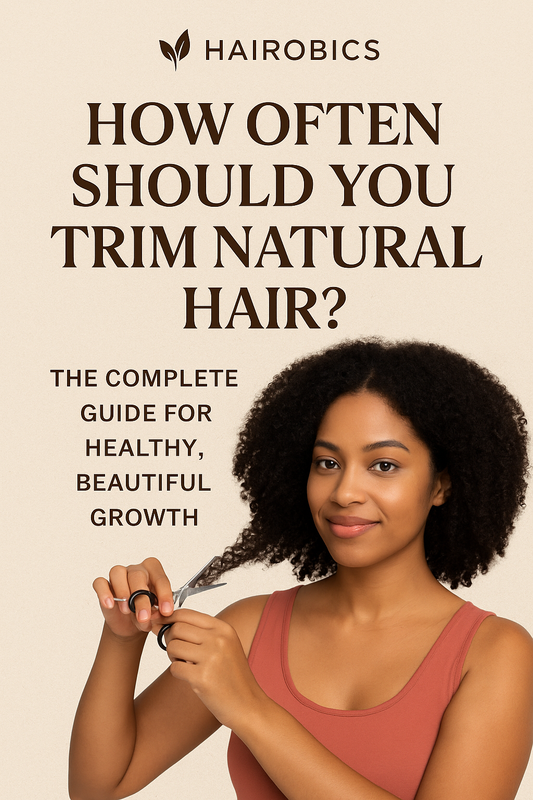
One of the biggest debates in the natural hair community is this: How often should you trim natural hair?
Some people go months—sometimes years—without touching their ends… while others swear by trimming every 6–8 weeks.
The truth?
Natural hair thrives when the ends are maintained regularly, but the ideal trimming schedule depends on your hair’s texture, lifestyle, styling habits, and overall goals.
In this ultimate guide, we’ll break down exactly how often you should trim natural hair, how to identify damaged ends, how trims affect growth, and how to trim at home without causing breakage. We’ll also look at how the right moisturizing and strengthening products—like Hairobics All Natural’s hair oils, boosters, and leave-ins—help you stretch the time between trims.
Let’s get into it.
What Does Trimming Actually Do for Natural Hair?
Contrary to popular belief, trimming doesn’t make hair grow faster—but it does something equally important:
⭐ Trimming prevents breakage so you can finally retain the length you’re growing.
Natural hair, especially Type 3 and Type 4 textures, tends to be:
-
Dry
-
Prone to tangles
-
Vulnerable at the ends
-
More likely to develop single-strand knots (SSKs)
A proper trim eliminates:
-
Split ends
-
Frazzled, dry ends
-
Knots
-
Roughness
-
Thinning at the tips
When your ends are healthy:
-
They don’t break as easily
-
Your curls look fuller
-
Your wash days become easier
-
You retain more length over time
Simply put: healthy ends = healthy natural hair.
How Often Should You Trim Natural Hair? (The Official Guide)
The most accurate trimming schedule varies from person to person. But here’s a general rule:
Most natural hair types should be trimmed every 8–16 weeks.
Below is a breakdown by hair type, lifestyle, and styling habits so you can choose the schedule that fits YOU best.
1. By Hair Type
Type 2 (Wavy) & Type 3 (Curly): Every 12–16 Weeks
Wavy and curly hair need trims but not as frequently as coily hair.
Signs you’re due:
-
Frizz won’t smooth out
-
Curls lose definition
-
Ends feel rough or stringy
If you heat style often, cut the time to 8–12 weeks.
Type 4 (Coily / Kinky): Every 8–12 Weeks
Type 4 hair is the most fragile because each curl bend is a potential break point. Coily textures also develop knots much more easily.
Most people with 4C or 4B hair will benefit from trimming at least quarterly (every 3 months).
If you stretch your hair often, blow-dry regularly, or wear protective styles, your ends may need more frequent care.
2. By Hair Length Goals
Your motivation determines your trim schedule too:
If you want to grow your hair long:
Trim every 10–16 weeks, focusing ONLY on the damaged ends.
If you want thicker, fuller curls:
Trim every 8–12 weeks to maintain a round, healthy shape.
If you heat style or color your hair:
Trim every 6–10 weeks—your ends take more damage and need closer attention.
3. By Styling Routine
If you frequently wear wash-and-gos:
Curl definition usually reveals when the ends are rough or frayed.
Recommended: every 10–12 weeks
If you mostly wear twist-outs or braid-outs:
Your ends may hide damage longer, but knots can build up.
Recommended: every 12 weeks
If you wear protective styles (braids, locs, sew-ins, etc.):
Trim after every 2–3 installs, or about every 8–12 weeks.
If you blow-dry or flat-iron regularly:
Heat lifts the cuticle and weakens ends.
Recommended: every 6–8 weeks
How to Tell When It’s Time for a Trim
Even with general guidelines, the best indicator will always be your hair’s behavior.
Here are the signs that natural hair needs a trim—ASAP:
✔ 1. Your ends are rough or dry no matter what you apply
If deep conditioning doesn’t help, they need to be cut.
✔ 2. You feel tiny knots at the ends
Single-strand knots won’t go away. They multiply and cause tangles.
✔ 3. Your hair keeps tangling on itself
This is a major sign that split ends are spreading upward.
✔ 4. Your twist-outs or braid-outs don’t look as defined
Even with perfect technique.
✔ 5. You see thinning at the bottom
This creates a V-shape or wispy look.
✔ 6. Your hair is shedding more
Sometimes what looks like shedding is actually breakage from damaged ends.
✔ 7. Your curls won’t “clump” anymore
Ends that are frayed cannot curl properly.
If you’re seeing 2 or more of these signs, it’s trimming time.
Do Trims Make Natural Hair Grow Faster?
This is one of the biggest myths in hair care.
? No, trimming does NOT make the hair itself grow faster.
Growth happens at the scalp, not the ends.
BUT—trimming helps you retain the length you’re growing by preventing split ends from traveling up the hair shaft.
Meaning:
➤ Trimming your natural hair consistently = longer, healthier hair over time
Combine trimming with:
-
Proper moisture
-
Regular scalp care
-
Low manipulation styling
-
Strengthening products
…and you’ll see faster growth results, even though trimming doesn’t literally stimulate growth.
How to Trim Natural Hair (Without Causing Damage)
You can do trims professionally OR at home.
If you trim at home, follow these rules.
1. Use Proper Hair Shears (NOT kitchen scissors!)
Kitchen scissors tear the ends and create more damage.
Look for:
-
Hair-cutting shears
-
Sharp blades
-
Stainless steel
2. Decide Whether You Want a “Shape Trim” or a “Dusting”
Dusting
Removes only the damaged tips (⅛–¼ inch). Perfect for growth retention.
Trim
Removes more length (½–1 inch or more) for shape and health.
3. Should You Trim on Wet or Stretched Hair?
Wet curly trims
Great for shape but not ideal if your hair shrinks differently in sections.
Stretched trims (blow-dried or banded)
Ideal for evenness and accuracy.
Most naturals trim on stretched hair.
4. Section Your Hair
Always work in 4–8 sections.
Use:
-
Clips
-
Butterfly clamps
-
Hair ties
This keeps the trim even and prevents cutting too much.
5. How to Trim Each Section
-
Stretch the section smoothly
-
Comb or brush through the ends
-
Identify the split or thin area
-
Cut just above the damage
Always cut across, not at an angle (which creates thinner ends).
How to Trim Natural Hair With Locs, Braids, or Protective Styles
Locs:
Trim every 4–6 months or when the ends feel damaged or thin.
You can also “dust” the tips to prevent unraveling.
Box braids and twists:
Trim before installing AND after removing protective styles.
Sew-ins:
Trim your leave-out every 6–8 weeks, and your full hair 2–3 times a year.
Wigs:
Trim your natural hair every 10–12 weeks to maintain health under the wig.
How to Reduce How Often You Need Trims
If you keep your ends healthy, you can lengthen the time between trims.
Here’s how:
1. Keep Your Hair Moisturized (Especially the Ends)
Dry ends break faster—simple as that.
Using moisture-rich products like Hairobics All Natural Leave-In Treatment or hydrating mists on the ends keeps them soft and flexible.
2. Seal Your Ends With Oils or Butters
Oils help lock in moisture and reduce knotting.
Great options include:
-
Hairobics Hair & Scalp Booster
-
Hairobics Scalp Rejuvenator Oil
-
Hairobics Raaw Roots Soft Pomade
Sealing helps reduce dryness and prolong the life of your ends.
3. Avoid Constant Manipulation
Daily combing, tight styles, or pulling leads to breakage.
Choose:
-
Twist-outs
-
Loose buns
-
Pineapple styles
-
Rod sets
Low-manipulation routines = fewer trims.
4. Protect Your Hair at Night
Use:
-
Satin bonnet
-
Satin pillowcase
-
Silk scarf
Cotton steals moisture and roughens the ends.
5. Minimize Heat Use
Excessive blow-drying or flat ironing weakens the cuticle.
If you use heat, always apply heat protectant and trim more frequently.
Seasonal Trimming Recommendations
Winter
Cold weather = dryness
Trim every 8–10 weeks
Spring
Growth season
Trim every 10–12 weeks
Summer
Humidity + tangles
Trim every 8–12 weeks
Fall
Ideal time for a dusting
Trim every 12–14 weeks
Does Cutting More Hair Lead to Faster Growth?
No—but cutting off damaged hair allows healthy hair to thrive.
If you have severe breakage, fairy knots, or split ends midway up the strand, removing enough damage helps prevent future breakage.
Healthy hair retains length.
Damaged hair breaks off.
What Happens If You Never Trim Natural Hair?
Going too long without trimming leads to:
❌ More single-strand knots
❌ Chronic tangling
❌ Increased breakage
❌ See-through ends
❌ Stunted length retention
❌ Splits traveling up the hair shaft
❌ Thinning of the overall shape
Many naturals who avoid trimming wonder why their hair “isn’t growing.”
But in reality—it is growing.
It’s just breaking at the same rate or faster, so you don’t see length.
Best Products to Use Between Trims (For Maximum Growth & Healthy Ends)
To stretch your trims and maintain healthy ends, use moisture and strengthening products regularly. These ingredients work especially well for natural hair.
1. Hairobics Hair & Scalp Booster
Packed with herbs and natural oils that strengthen roots and nourish the scalp—ideal for encouraging healthy new growth.
2. Hairobics Leave-In Treatment
A lightweight hydrator that softens curls, prevents dryness, and protects the ends between washes.
3. Hairobics Raaw Roots Moisturizing Spray
Perfect for daily moisture—reduces knotting and dryness on protective styles or loose hair.
4. Hairobics Raaw Roots Soft Pomade
Seals moisture into the ends and protects them from breakage.
5. Hairobics Scalp Rejuvenator Oil
Great for repairing dry scalps and preventing breakage from the root downward.
Using the right products consistently means fewer trims, longer hair, and stronger curls.
Final Answer: How Often Should You Trim Natural Hair?
Here’s the quick guide:
? Type 2 & Type 3 Hair:
Trim every 12–16 weeks
? Type 4 Hair:
Trim every 8–12 weeks
? If you heat style:
Trim every 6–8 weeks
? If you wear protective styles:
Trim every 8–12 weeks
? If you are growing out your natural hair:
Trim every 10–16 weeks
? If your ends look damaged:
Trim immediately
Conclusion
Trimming natural hair isn’t about cutting off your growth—it’s about protecting your progress. Healthy ends hold moisture better, tangle less, and give your curls a fuller, more defined look.
By trimming consistently, moisturizing your ends, protecting your hair at night, and using high-quality natural products like Hairobics All Natural, you’ll notice:
✨ Longer retention
✨ Thicker curls
✨ Shinier hair
✨ Healthier ends
✨ Easier styling
✨ More growth over time