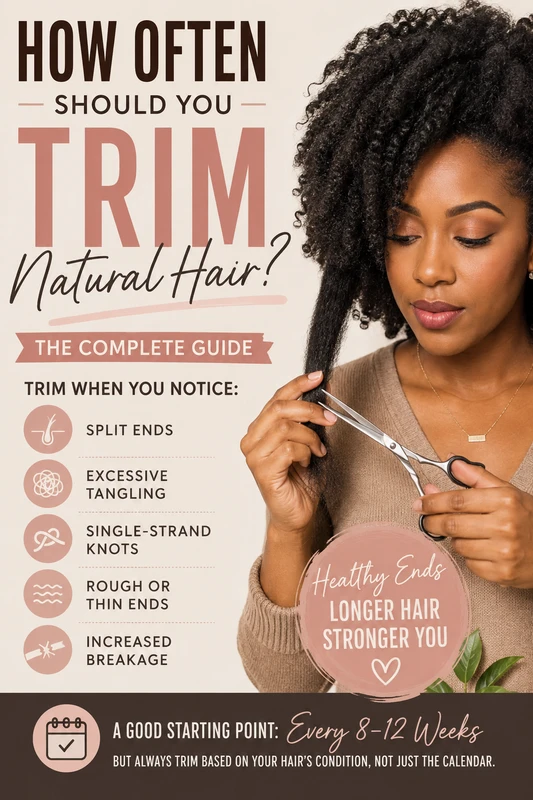
If you're trying to grow long, healthy natural hair, trimming can feel like losing progress. But strategic trims can help with length retention and overall hair health by removing damaged ends before they contribute to tangling and breakage.
So, how often should you trim natural hair?
For many people, every 8–12 weeks is a useful starting point, but there is no universal schedule. Some may need trims every 6–8 weeks, while people with healthy, protected ends may go 12–16 weeks or longer.
The condition of your ends matters more than the calendar.
Your texture, heat use, chemical treatments, protective styles, detangling habits, and level of breakage can all affect how frequently you need a trim.
Quick Answer: How Often Should You Trim Natural Hair?
Check your ends approximately every 8–12 weeks for:
- Split ends
- Excessive tangling
- Single-strand knots
- Thin or see-through ends
- Roughness
- Unevenness
- Increased breakage
- Ends that no longer curl normally
If your ends still look and feel healthy, you may be able to wait longer.
A practical guideline is:
Healthy natural hair with minimal heat: Every 12–16 weeks as needed
Natural hair regularly worn loose: Approximately every 8–12 weeks
Hair frequently straightened or heat styled: Approximately every 6–10 weeks depending on damage
Color-treated or chemically processed hair: Approximately every 6–8 weeks or according to the condition of the ends
Protective-style-focused routine: Inspect after taking down the style and trim only when necessary
These are guidelines, not strict rules. Your hair should ultimately tell you when it's time for a trim.
Why Does Natural Hair Need Trimming?
Hair grows from the scalp, but your ends are the oldest part of your hair. Over time, they may go through hundreds of wash days, detangling sessions, hairstyles, nights of sleeping, weather changes, and protective styles.
Natural curls and coils can also wrap around one another, develop knots, experience friction, and require careful detangling.
Trimming damaged ends can make natural hair:
- Easier to detangle
- Easier to style
- Fuller looking
- More uniform
- Less prone to knotting
- Less prone to unnecessary breakage
The goal isn't to cut your hair because a certain number of weeks have passed. It's to remove damaged hair when necessary.
Does Trimming Natural Hair Make It Grow Faster?
No. Trimming does not directly make hair grow faster.
Hair growth begins inside follicles in your scalp. Cutting your ends cannot change your biological growth rate.
However, trimming may help you retain more of the hair you grow.
If your roots are growing but your ends are severely damaged, tangled, splitting, and breaking, you can lose length through breakage. That's why someone can feel like:
“My hair grows, but it never gets longer.”
Sometimes the problem isn't growth. It's length retention.
Removing damaged ends and protecting healthy hair may help you retain more length over time.
8 Signs Natural Hair Needs a Trim
1. Your Ends Feel Rough
Coily and curly hair naturally has texture, but your ends shouldn't suddenly feel significantly rougher, brittle, or ragged compared with the rest of your strands.
2. You See Split Ends
Split ends occur when the end of the hair shaft begins separating. Some are obvious; others are tiny.
Products may temporarily improve how damaged ends look or feel, but they cannot permanently fuse a physically split strand back together.
3. Your Ends Constantly Tangle
If you detangle your hair only for the ends to immediately start catching on one another again, inspect them carefully.
Damaged and weathered ends can create additional friction and tangling.
4. Your Ends Look Thin
Stretch a section of your hair.
If it's thick near the roots and middle but dramatically thinner or see-through toward the bottom, accumulated breakage may be responsible.
Some tapering is normal because every strand isn't at exactly the same stage of the growth cycle.
5. You're Finding More Single-Strand Knots
Single-strand knots, sometimes called fairy knots, are common in tightly curled and coily hair.
You may never eliminate them completely, but if your ends suddenly seem covered with knots, trimming may help.
6. Your Hair Doesn't Style the Same
Your twist-out may look defined except for frizzy ends, or your ends may stop curling properly around rollers.
Changes in styling performance can indicate weathered ends.
7. You're Seeing More Breakage
Shedding and breakage are different. Shed hairs generally come from the root, while broken hairs snap somewhere along the shaft.
Possible contributors include rough detangling, excessive dryness, heat damage, chemical damage, tight hairstyles, excessive manipulation, and damaged ends.
8. Your Ends Look Uneven
Natural hair doesn't have to be perfectly even. But if certain sections are dramatically shorter because of repeated breakage, a shaping trim may create a healthier-looking foundation.
Should You Trim Natural Hair Every 6–8 Weeks?
Not necessarily.
Someone who rarely uses heat, wears low-manipulation hairstyles, sleeps with satin protection, detangles carefully, and protects their ends may not have significant damage after eight weeks.
Cutting healthy hair simply because eight weeks have passed could make length retention more difficult.
Someone who frequently flat-irons, colors their hair, wears it loose daily, or experiences substantial friction may need more frequent trims.
Trim according to your hair's condition—not someone else's calendar.
How Often Should You Trim Natural Hair When Growing It Out?
If you're growing your hair, check your ends approximately every 8–12 weeks.
If they're healthy, continue your routine.
If you notice minor damage, remove only what's necessary.
Avoiding trims completely isn't always the best strategy because long natural hair requires both growth and length retention.
How Often Should You Trim 4C Hair?
There isn't one specific schedule for 4C hair.
Because tightly coiled hair can experience significant shrinkage, knots, tangling, and friction, checking the ends every 8–12 weeks is a reasonable starting point.
You may go longer if your ends remain healthy.
Watch for:
- Single-strand knots
- Tangled ends
- Excessive breakage
- Roughness
- Thin ends
Stretching your hair before inspecting it can make damage easier to identify.
How Often Should You Trim 3C Hair?
An approximately 8–12 week inspection schedule can also be a useful starting point for 3C hair.
Styling habits matter. Someone frequently wearing wash-and-go styles may experience more end tangling than someone regularly wearing low-manipulation stretched styles.
How Often Should You Trim Hair in Protective Styles?
Protective styling can reduce manipulation, but it doesn't make your ends immune to damage.
If you regularly wear box braids, twists, cornrows, crochet styles, wigs, or flat twists, inspect your hair between installations.
After removing the style, cleanse, condition, detangle, and examine your ends.
If they're healthy, you don't necessarily need a trim. If they're knotting, splitting, or thinning, remove the damaged portion.
Should You Trim Before or After Braids?
Either can work.
Trimming before braids gives your stylist cleaner, healthier ends. Trimming after braids allows you to evaluate your hair after takedown.
If your ends are already clearly damaged, consider trimming before installing the protective style.
How Often Should You Trim Natural Hair If You Use Heat?
Frequent flat-ironing, high-temperature blow-drying, pressing, and curling can increase dryness and structural damage.
You may need trims approximately every 6–10 weeks, depending on your hair's condition.
Use heat protectant, choose the lowest effective temperature, and avoid repeatedly passing hot tools over the same section.
How Often Should You Trim Color-Treated Natural Hair?
Bleached, highlighted, permanently colored, or frequently recolored hair may require additional attention.
Some people may benefit from trimming approximately every 6–8 weeks, while others can go longer.
Damage—not the calendar—should determine your schedule.
How Much Natural Hair Should You Trim?
Remove enough to eliminate the damaged portion.
You might remove:
¼ inch: Very minor weathering
½ inch: Moderate damage
1 inch or more: Damage extending farther up the strands
If two inches are severely damaged, removing only one-quarter inch won't solve the problem. Likewise, don't cut two healthy inches simply because you think a trim must be substantial.
What Is Dusting Natural Hair?
Dusting is a tiny trim that removes very small amounts from the ends.
It may work well for people who:
- Are focused on length retention
- Trim frequently
- Have relatively healthy ends
- Want to remove small knots or splits
Dusting isn't enough when several inches are severely damaged.
Should Natural Hair Be Trimmed Wet or Dry?
Both approaches can work.
Dry trimming can make it easier to see the hair's shape, uneven areas, thin ends, and how curls naturally fall.
Stretched trimming using twists, braids, banding, or gentle blow-drying can make individual ends easier to examine.
Wet trimming can make hair easier to section and control, although shrinkage may make the finished dry shape harder to predict.
There isn't one universally correct method. Choose the method that lets you clearly identify damage without unnecessary manipulation.
How to Trim Natural Hair at Home
Use professional hair-cutting shears rather than dull household scissors.
Start with clean, conditioned hair and carefully detangle in sections. Stretch the hair using twists, braids, banding, or low/moderate-heat tension blow-drying if desired.
Divide your hair into manageable sections and inspect for:
- Thinness
- Knots
- Splits
- Rough areas
- Transparency
Cut cleanly above the damaged area.
If maintaining an even shape matters, compare neighboring sections as you work, but don't continue cutting healthy hair simply to chase perfect symmetry.
What Is Search-and-Destroy Trimming?
With search and destroy, you inspect individual strands and cut visible split ends or knots instead of trimming every strand to the same length.
It can preserve length because you're only cutting damaged strands.
However, it is time-consuming and shouldn't replace a full trim when your ends are generally thin or damaged.
How to Make Natural Hair Trims Last Longer
Protecting your ends may reduce how frequently you need significant trims.
Keep your ends moisturized. Pay special attention to the oldest parts of your hair when applying leave-in products or moisturizers.
Reduce mechanical damage. Rough combing, aggressive brushing, clothing friction, tight ponytails, and repeated styling can wear down your ends.
Detangle from the ends upward. Don't place your comb at the roots and drag it through tangled hair.
Sleep with satin or silk protection. Satin bonnets, scarves, or pillowcases can reduce nighttime friction.
Protect your ends. Twists, buns, braids, flat twists, and updos can reduce daily manipulation.
Avoid excessive tension. A hairstyle isn't protective if it's pulling your hair extremely tight, particularly around the hairline.
Limit excessive heat. Use heat protectant and the lowest effective temperature.
Handle knots carefully. Add conditioner or another product with slip and gently separate tangled strands rather than ripping through them.
Don't leave protective styles in excessively long. Shed hairs and new growth can accumulate, increasing tangling during takedown.
Can You Go a Year Without Trimming Natural Hair?
Technically, yes.
Some people with exceptionally healthy ends may go many months without needing a significant trim. Others develop knots, splits, and thinning much sooner.
Instead of deciding:
“I'm not cutting my hair for one year.”
Try:
“I'm going to inspect my ends every few months and trim only when necessary.”
What Happens If You Never Trim Natural Hair?
Not trimming doesn't automatically make hair unhealthy.
If your ends remain healthy, there's no biological rule requiring you to cut them.
But repeatedly ignoring damaged ends can contribute to:
- Increased tangling
- More knots
- Uneven ends
- Breakage
- Thin-looking length
- Difficult detangling
- Less predictable hairstyles
Eventually, you may need a larger haircut than you would have needed with occasional small trims.
Trim vs. Big Chop
A trim removes a relatively small amount of hair to maintain healthy ends or shape.
A big chop removes a substantial amount of hair and is commonly used when transitioning from relaxed to natural hair, removing severe heat or chemical damage, starting over after significant breakage, or choosing a dramatically shorter hairstyle.
Routine maintenance usually doesn't require a big chop.
Why Can Natural Hair Look Better After a Trim?
Damaged ends can make hair appear thin and uneven.
After trimming, the perimeter may look:
- Fuller
- Thicker
- More defined
- More uniform
Your hair hasn't become longer. Its healthier shape simply creates a stronger appearance.
A Simple Natural Hair Trimming Schedule
Weeks 1–4: Maintain moisture, detangle gently, and protect your hair at night.
Weeks 6–8: Pay closer attention to knots, roughness, and detangling difficulty.
Weeks 8–12: Perform a thorough inspection. Stretch several sections and examine your ends. Trim if they're damaged; continue your routine if they're healthy.
Weeks 12–16: Inspect again. If your ends remain healthy after four months, your routine may be doing a good job protecting your length.
Think of this as an inspection schedule rather than an automatic cutting schedule.
Trimming Natural Hair for Maximum Length Retention
If long natural hair is your goal, focus on:
Growth + Moisture + Low Breakage + Healthy Ends
Avoid two extremes:
Never trimming damaged hair: This can leave you with tangled, thin, weathered ends.
Constantly cutting healthy hair: This can remove length unnecessarily.
The better approach is to trim enough to maintain healthy ends without unnecessarily removing healthy length.
Frequently Asked Questions
How often should Black women trim natural hair?
Checking the ends every 8–12 weeks is a practical starting point. Actual trimming frequency should depend on splitting, knots, thinning, breakage, heat use, chemical processing, and overall end health.
Is trimming every three months good for natural hair?
For many people, yes. Checking your ends every three months is practical, but you only need to cut them if you notice damage or want to maintain a particular shape.
Does trimming natural hair help it grow?
Trimming doesn't increase growth from the scalp. It may help with length retention by removing damaged ends that could contribute to breakage.
How much should I trim?
Remove enough to eliminate the damaged section. That could be one-quarter inch, half an inch, an inch, or more.
Should I trim 4C hair every three months?
Three months is a useful inspection interval for many people with 4C hair, but healthy ends don't automatically need cutting.
How do I know if I need a trim?
Common signs include split ends, thin ends, excessive single-strand knots, roughness, constant tangling, unevenness, and increased breakage.
Can damaged ends repair themselves?
Products can temporarily smooth, coat, lubricate, and improve the appearance of damaged hair, but a physically split shaft cannot permanently fuse itself back together. Severely damaged ends generally need removal.
Can I trim natural hair myself?
Yes. Use sharp professional hair shears, work slowly in sections, and avoid removing more than necessary.
Should I straighten natural hair before trimming?
No. You can stretch natural hair with twists, braids, banding, or gentle tension to make the ends easier to examine without flat-ironing.
Final Thoughts: How Often Should You Trim Natural Hair?
For many people, checking natural hair every 8–12 weeks is an excellent starting point. The most important rule is:
Trim based on the condition of your hair—not just the calendar.
If your ends are relatively full, easy to detangle, and free from significant splitting or knotting, you may not need a trim yet.
If they're rough, thin, constantly tangled, covered in knots, or visibly splitting, holding onto damaged length may work against your length-retention goals.
Trimming doesn't make your follicles produce hair faster. It's about maintaining the hair you've already grown.
Combine strategic trims with gentle detangling, adequate moisture, nighttime protection, low-manipulation styling, careful heat use, and consistent end protection.
The objective isn't to trim as frequently as possible.
It's to keep your ends healthy enough that you don't need to.