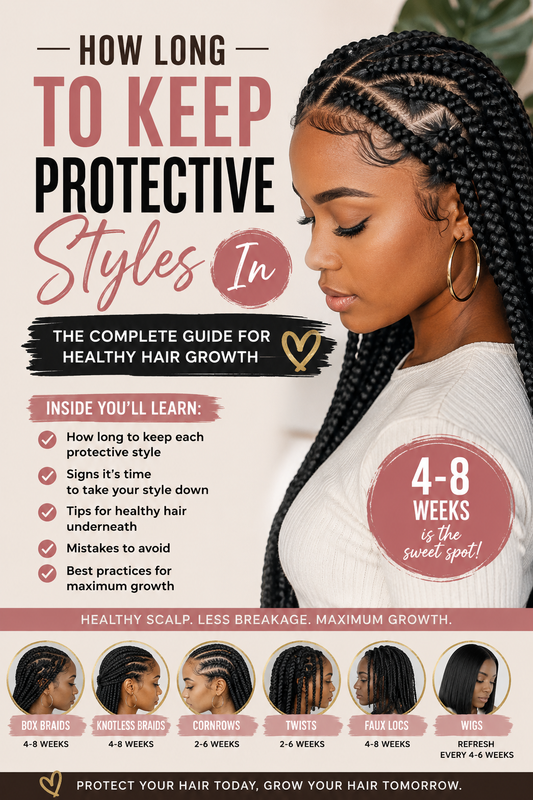
Protective styles are one of the most effective tools for retaining length, reducing breakage, and helping natural hair thrive. Whether you wear box braids, knotless braids, twists, cornrows, faux locs, wigs, or crochet styles, protective styling can make managing your hair easier while supporting your growth goals.
However, one of the biggest mistakes people make is keeping protective styles in for too long.
Many believe that the longer a style stays in, the more hair growth they will achieve. Unfortunately, that isn't always true. Leaving a style installed beyond its ideal lifespan can lead to matting, thinning edges, breakage, buildup, scalp irritation, and even hair loss.
So how long should you actually keep a protective style in?
The answer depends on several factors including your hair type, scalp health, maintenance routine, and the specific style you're wearing.
In this complete guide, we'll explain:
- How long to keep each protective style
- Signs it's time to remove your style
- Common mistakes to avoid
- How protective styles affect hair growth
- Best practices for maintaining healthy hair underneath
By the end of this article, you'll know exactly when to take your style down and how to maximize hair growth while minimizing damage.
What Is a Protective Style?
A protective style is any hairstyle designed to reduce daily manipulation of your hair.
The purpose is to:
- Protect hair ends
- Reduce breakage
- Minimize tangles
- Preserve moisture
- Encourage length retention
Common protective styles include:
- Box braids
- Knotless braids
- Cornrows
- Twists
- Faux locs
- Wigs
- Sew-ins
- Crochet styles
- Bantu knots
- Flat twists
Protective styles do not make hair grow faster directly.
Instead, they help you retain the hair that naturally grows from your scalp by reducing breakage.
The Biggest Myth About Protective Styles
Many people believe:
"If I keep my braids in for three months, my hair will grow more."
Hair growth happens from the scalp.
Your hair grows whether it is braided or not.
The average person grows approximately:
- ½ inch per month
- 6 inches per year
Keeping a style longer does not increase this growth rate.
What matters is protecting the new growth without allowing excessive buildup, tangling, or stress on the hair.
How Long Should You Keep Protective Styles In?
The general rule is:
Most protective styles should stay in for 4 to 8 weeks.
Some styles can safely remain longer with proper maintenance, while others should come out sooner.
Let's examine each style individually.
Box Braids
Recommended Time:
4–8 weeks
Box braids are among the most popular protective styles because they are versatile and low maintenance.
However, keeping them longer than 8 weeks can cause:
- Tangling at the roots
- Product buildup
- Excessive shedding
- Matted new growth
Ideal Timeline
Week 1–4:
Excellent condition.
Week 5–6:
Still healthy with maintenance.
Week 7–8:
Time to begin planning removal.
Beyond 8 weeks:
Higher risk of breakage and matting.
Knotless Braids
Recommended Time:
4–8 weeks
Knotless braids place less tension on the scalp than traditional box braids.
Benefits include:
- Reduced edge stress
- Less scalp irritation
- More natural movement
Even though they're gentler, they still shouldn't remain installed indefinitely.
After about 8 weeks, new growth can begin tangling around the braid base.
Cornrows
Recommended Time:
2–6 weeks
Cornrows are excellent for:
- Wigs
- Weaves
- Athletic lifestyles
- Low maintenance routines
Because cornrows sit directly against the scalp, buildup accumulates more quickly.
Most stylists recommend removing them after:
- 2–4 weeks for tight cornrows
- Up to 6 weeks for larger designs
Two-Strand Twists
Recommended Time:
2–6 weeks
Twists are one of the gentlest protective styles available.
Benefits include:
- Minimal tension
- Easy scalp access
- Less breakage
Most people find twists remain neat for:
- 2–4 weeks naturally
- Up to 6 weeks with maintenance
Once excessive frizz develops, it may be time to refresh or remove them.
Faux Locs
Recommended Time:
4–8 weeks
Faux locs can be heavier than braids, depending on installation.
Keeping them too long may cause:
- Scalp tension
- Hair thinning
- Product buildup
Many professionals recommend staying within the 6–8 week range.
Crochet Styles
Recommended Time:
4–8 weeks
Crochet styles are generally lightweight and versatile.
Benefits include:
- Quick installation
- Minimal manipulation
- Easy maintenance
Most crochet styles should be removed after 6–8 weeks.
Sew-Ins
Recommended Time:
6–8 weeks
Sew-ins offer excellent protection when installed correctly.
However, extended wear can cause:
- Track buildup
- Matting underneath
- Difficulty cleansing scalp
Most stylists suggest:
6 to 8 weeks maximum.
Wigs
Recommended Time:
Varies
Wigs are unique because the hair underneath remains accessible.
With proper care, wig wearers can maintain healthy hair continuously.
However:
- Cornrows underneath should be refreshed every 4–6 weeks.
- Hair should still be washed regularly.
How Long Should Children Keep Protective Styles?
Children's hair is often more delicate than adult hair.
Recommended timelines:
- Braids: 3–5 weeks
- Twists: 2–4 weeks
- Cornrows: 2–4 weeks
Avoid excessive tension around the edges.
Signs It's Time to Remove Your Protective Style
1. Excessive New Growth
Large amounts of new growth can begin tangling with shed hair.
This increases:
- Breakage
- Knotting
- Matting
2. Itchy Scalp
Persistent itching may indicate:
- Buildup
- Dry scalp
- Product accumulation
3. Bad Odor
An unpleasant smell often signals:
- Sweat accumulation
- Product buildup
- Scalp imbalance
4. Visible Buildup
White residue around the roots indicates your style has likely reached its limit.
5. Thinning Edges
Protective styles should protect your hairline.
If you notice:
- Thinning edges
- Small bumps
- Tenderness
Remove the style immediately.
6. Excessive Frizz
Frizz alone isn't necessarily damaging.
However, extreme frizz often indicates the style has run its course.
What Happens If You Leave Protective Styles In Too Long?
Matting
One of the most common issues.
Shed hairs become trapped inside the style.
Eventually they tangle together.
Removing matted hair often results in significant breakage.
Excessive Shedding
Normal shedding ranges from:
50–100 hairs daily.
Over 8 weeks, this can amount to thousands of shed hairs trapped inside your style.
Breakage
Dry hair becomes fragile.
Extended wear can increase snapping during takedown.
Scalp Issues
Including:
- Itching
- Inflammation
- Fungal growth
- Follicle irritation
Traction Alopecia
Constant tension may lead to permanent hair loss.
This most commonly affects:
- Edges
- Temples
- Nape area
How Often Should You Wash Hair in Protective Styles?
A common mistake is avoiding washing entirely.
Healthy frequency:
Every 1–2 weeks.
Benefits include:
- Cleaner scalp
- Reduced buildup
- Better follicle health
How to Moisturize Hair While Wearing Protective Styles
Protective styles work best when hair remains hydrated.
Focus on:
Water-Based Moisture
Hydration begins with water.
Use moisturizing sprays regularly.
Scalp Care
Keep the scalp nourished with lightweight oils.
Seal Moisture
Follow moisture with natural oils when necessary.
Best Protective Styles for Hair Growth
The best styles are:
1. Knotless Braids
Less tension and greater comfort.
2. Two-Strand Twists
Low manipulation and easy maintenance.
3. Flat Twists
Protective without excessive weight.
4. Wigs
Allow maximum access to natural hair.
5. Crochet Styles
Gentle and versatile.
How to Remove Protective Styles Safely
Step 1
Apply oil to roots.
Step 2
Work slowly.
Never rush.
Step 3
Detangle section by section.
Step 4
Remove shed hair gently.
Step 5
Wash thoroughly afterward.
What to Do Between Protective Styles
Many people reinstall immediately.
Instead:
Clarify
Remove buildup.
Deep Condition
Restore moisture.
Trim if Needed
Eliminate split ends.
Let Hair Rest
Allow the scalp to breathe for at least a few days.
The Ideal Protective Styling Schedule
Example:
Weeks 1–6:
Protective style.
Week 7:
Wash, deep condition, rest.
Weeks 8–13:
Protective style.
Week 14:
Recovery period.
This rotation helps maintain healthy hair and scalp function year-round.
Common Protective Style Mistakes
Too Tight
Tension damages follicles.
Too Long
Increases matting and breakage.
No Moisture
Dry hair breaks easily.
Ignoring Scalp Health
Healthy growth starts at the scalp.
Skipping Cleansing
Dirty scalps can become irritated.
Frequently Asked Questions
Can I Keep Braids In for 12 Weeks?
It's generally not recommended.
Most experts suggest removing them by 8 weeks.
Will Hair Grow Faster in Protective Styles?
No.
Protective styles help retain length by reducing breakage.
How Long Should Knotless Braids Stay In?
Typically 4–8 weeks.
Can I Wash Braids?
Yes.
Every 1–2 weeks is ideal.
Should I Let My Hair Rest Between Styles?
Yes.
Giving your scalp a break helps reduce stress and maintain hair health.
Final Thoughts
Protective styles can be a powerful tool for growing longer, stronger hair when used correctly. The key is understanding that protective styles are not meant to stay in forever. Most styles perform best when worn for 4 to 8 weeks before removal and proper hair care.
Pay attention to your scalp, monitor buildup, keep your hair moisturized, and avoid excessive tension. By following these guidelines, you'll maximize length retention, reduce breakage, and create the ideal environment for healthy hair growth.
Remember: the healthiest protective style is the one that protects your hair without overstaying its welcome. Consistent maintenance, proper timing, and healthy scalp care will always outperform keeping a style in for months at a time.
For best results, pair your protective styling routine with nourishing natural hair products that support moisture retention, scalp health, and stronger hair from root to tip.