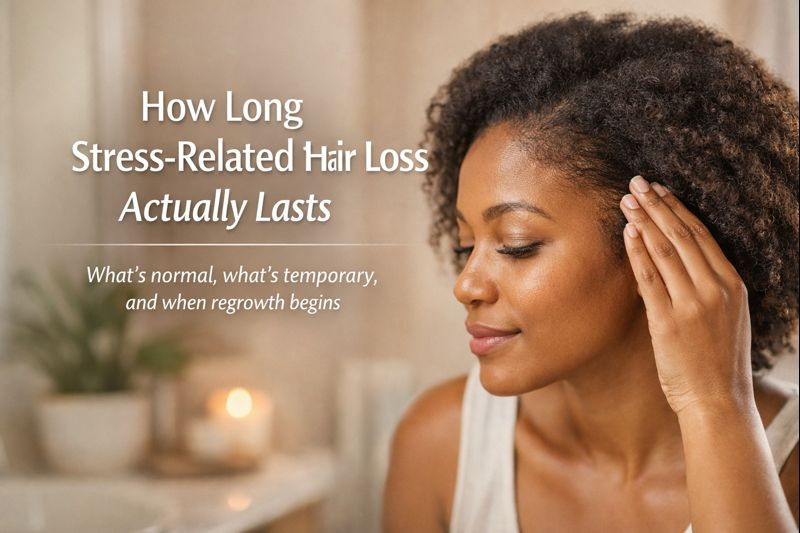
If you’ve ever gone through a stressful season and suddenly noticed more hair in your shower drain, on your pillow, or wrapped around your fingers on wash day, you’re not imagining it.
Stress-related hair loss is real.
It’s common.
And for many people, it’s terrifying—because it feels sudden, uncontrollable, and never-ending.
But here’s the truth most articles don’t explain clearly enough:
Stress-related hair loss is usually temporary—but the timeline is longer and more complex than most people expect.
This article explains:
-
What stress-related hair loss really is
-
Why it starts after the stress (not during it)
-
How long shedding actually lasts
-
When regrowth begins
-
Why some people feel “stuck” in shedding for months
-
How to shorten the recovery window naturally
If you’re wondering “Is this ever going to stop?”—this article is for you.
What Is Stress-Related Hair Loss?
Stress-related hair loss most commonly shows up as a condition called telogen effluvium.
In simple terms, telogen effluvium happens when stress forces a large number of hairs to exit the growth phase early and enter the resting (shedding) phase all at once.
The Hair Growth Cycle (Simplified)
Your hair grows in cycles:
-
Anagen (Growth Phase)
-
Lasts 2–7 years
-
Hair actively grows
-
-
Catagen (Transition Phase)
-
Lasts ~2–3 weeks
-
Hair detaches from blood supply
-
-
Telogen (Resting Phase)
-
Lasts ~3 months
-
Hair eventually sheds
-
Normally, only 10–15% of your hair is in telogen at any time.
Stress changes that balance.
Why Stress Triggers Hair Loss (Even If Your Hair Looks “Healthy”)
When your body experiences significant stress, it shifts into survival mode.
Stress can be:
-
Emotional (grief, anxiety, trauma, burnout)
-
Physical (illness, surgery, childbirth, COVID)
-
Hormonal (postpartum changes, thyroid imbalance)
-
Nutritional (rapid weight loss, restrictive dieting)
-
Chronic (long-term work stress, poor sleep, inflammation)
During stress, your body prioritizes:
-
The brain
-
The heart
-
Essential organs
Hair? Not a priority.
Stress hormones like cortisol signal hair follicles to stop growing and prepare to shed.
Why Stress-Related Hair Loss Starts After the Stress
This is the part that confuses people the most.
You might feel calmer now—but suddenly your hair is falling out.
That’s because telogen effluvium is delayed.
The Timeline Looks Like This:
-
Stressful event occurs
-
Hair follicles are pushed into telogen
-
Hair stays in resting phase for ~3 months
-
Shedding begins 2–4 months later
This delay makes people think:
-
“It came out of nowhere”
-
“My hair loss makes no sense”
-
“I must have a serious condition”
In reality, your hair is reacting to something that already happened.
How Long Does Stress-Related Hair Loss Actually Last?
Here’s the honest answer:
⏳ Typical Duration: 3 to 6 months
For most people:
-
Shedding lasts 3–6 months
-
Hair fall gradually slows
-
Regrowth begins afterward
But—and this is important—not everyone follows the same timeline.
Why Some People Shed Longer Than 6 Months
If stress-related hair loss lasts longer than expected, it’s usually because the stress never fully resolved or new stress replaced the old stress.
Common reasons shedding continues:
1. Chronic Stress Never Stopped
Even if the original crisis ended, your nervous system may still be in survival mode.
Signs include:
-
Poor sleep
-
Anxiety
-
Digestive issues
-
Scalp tension
-
Inflammation
Your body doesn’t know the danger is over.
2. Nutrient Depletion After Stress
Stress drains key nutrients like:
-
Iron
-
Zinc
-
B vitamins
-
Magnesium
-
Protein
Without replenishment, hair struggles to restart growth.
3. Scalp Inflammation
Stress increases inflammation in the scalp, tightening blood vessels and reducing oxygen to follicles.
A stressed scalp often feels:
-
Tight
-
Tender
-
Itchy
-
Oily but dry underneath
Hair won’t grow well in an inflamed environment.
4. Stress Becomes a Cycle
Hair loss itself becomes stressful.
This creates:
Stress → hair loss → anxiety → more stress → continued shedding
Breaking this loop is critical.
When Does Hair Start Growing Back?
? Regrowth Typically Starts 3–6 Months After Shedding Slows
But regrowth is subtle at first.
You may notice:
-
Short “baby hairs” around the hairline
-
Flyaways at the crown
-
Fine regrowth near the temples
These new hairs take time to thicken and lengthen.
Why Regrowth Feels Slow (Even When It’s Working)
Hair grows about ½ inch per month.
That means:
-
3 months = ~1.5 inches
-
6 months = ~3 inches
-
12 months = ~6 inches
So even when regrowth starts, it may take 6–12 months before your hair looks like it’s fully back.
This is normal—but rarely explained.
Does Stress-Related Hair Loss Ever Become Permanent?
In most cases: No.
Telogen effluvium does not destroy follicles.
However, stress can:
-
Unmask genetic hair thinning
-
Worsen existing scalp conditions
-
Trigger hormonal imbalances
If hair loss continues beyond 9–12 months, it’s time to look deeper.
Signs Your Stress-Related Hair Loss Is Ending
Look for these encouraging signs:
-
Less hair in the shower drain
-
Fewer strands on your pillow
-
Reduced shedding when detangling
-
Short regrowth hairs appearing
-
Scalp feels calmer and less tight
Shedding rarely stops overnight—it tapers gradually.
How to Shorten the Recovery Time Naturally
You can’t rush hair growth—but you can remove the obstacles slowing it down.
1. Calm the Nervous System
Hair growth improves when your body feels safe.
Helpful practices:
-
Deep breathing
-
Gentle movement
-
Adequate sleep
-
Reducing caffeine if cortisol is high
Hair follows hormones—and hormones follow stress.
2. Support the Scalp First
Healthy hair starts with a healthy scalp.
Focus on:
-
Reducing inflammation
-
Improving blood flow
-
Keeping follicles clear
Scalp massage and lightweight botanical oils help restore circulation without clogging follicles.
3. Be Gentle With Shedding Hair
During telogen effluvium:
-
Avoid tight styles
-
Minimize tension
-
Detangle gently
-
Reduce excessive heat
Your hair is in recovery mode.
4. Rebuild From the Inside
Stress depletes building blocks hair needs to regrow.
Prioritize:
-
Protein
-
Iron-rich foods
-
Hydration
-
Whole, anti-inflammatory foods
Hair is a reflection of internal recovery.
The Biggest Myth About Stress Hair Loss
Myth: “If my hair is still shedding, it means something is wrong.”
Truth: Shedding can continue even after the trigger is gone.
Your body operates on a delay.
Understanding that delay is often the biggest relief people feel.
Final Truth: Stress Hair Loss Has an End Point
Stress-related hair loss feels endless—but it isn’t.
For most people:
-
It starts 2–4 months after stress
-
Lasts 3–6 months
-
Regrowth begins quietly
-
Density improves over time
The key is patience, scalp health, and calming the system—not panic.
Hair doesn’t just grow from products or routines.
It grows when the body feels safe enough to invest in it again.
And that does happen.