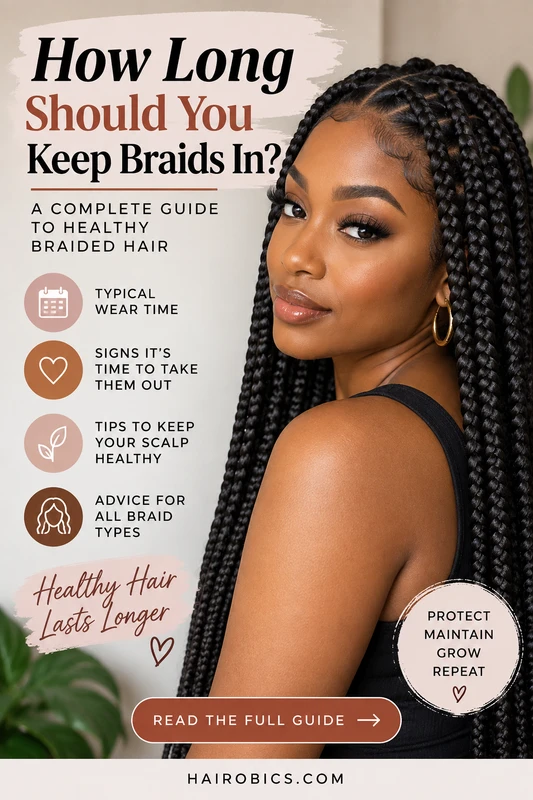
Braids are one of the most popular protective hairstyles for Black hair and natural hair. They can reduce the amount of daily styling your hair requires, make mornings easier, protect your ends, and give you countless styling options.
But protective styles only protect your hair when they're maintained properly.
One of the biggest mistakes people make with braids is leaving them installed for too long.
You might look at your braids after several weeks and think, "They still look pretty good. Why take them down?"
The appearance of your braids isn't the only thing that matters.
Underneath the extensions, your natural hair continues to grow, shed, collect product, and respond to tension. Your scalp also continues producing oil, sweat, and dead skin cells. The longer your braids stay installed, the more important scalp care and proper maintenance become.
So, how long should you keep braids in?
For many braided protective styles, about 4–8 weeks is a practical general range, depending on the type of braids, how quickly your hair grows, the condition of your scalp, how much new growth you have, and how well you're maintaining the style.
That doesn't mean everyone should automatically keep their braids for eight weeks.
Some people may need to remove them much sooner.
In this guide, we'll explain how long different types of braids can typically be worn, the warning signs that it's time to take your braids down, what happens when braids are left in too long, and how to keep your natural hair and scalp healthy while wearing a protective style.
How Long Should You Keep Braids In?
A good general guideline for many braided hairstyles is approximately:
4 to 8 weeks.
However, there isn't one perfect timeline that applies to every person or every braided hairstyle.
Your ideal wear time depends on several factors, including:
- Your braid style
- The size of your braids
- How tightly they were installed
- Your hair texture
- Your hair's condition
- How quickly your hair grows
- Your scalp condition
- Your activity level
- How often you sweat
- Product buildup
- How well you maintain your scalp
- How much new growth has developed
For example, someone with a very active lifestyle who sweats heavily several times a week may need to cleanse their scalp more frequently and potentially remove their braids sooner than someone who experiences little scalp buildup.
Similarly, someone dealing with fragile edges or excessive tension shouldn't try to reach a certain number of weeks just because the braids still look attractive.
Hair and scalp health should always come before extending the life of the hairstyle.
How Long Do Box Braids Last?
Box braids are among the most popular protective styles because they're versatile and relatively easy to maintain.
In many cases, box braids are worn for approximately:
4–8 weeks
Smaller box braids may continue looking neat longer than large braids, but that doesn't necessarily mean they should remain installed indefinitely.
After several weeks, you'll usually begin noticing:
- New growth around the roots
- Frizz
- Product buildup
- Loose braids
- Increased movement around the roots
- More visible shed hair
- Changes around the edges
Your natural hair continues growing underneath the style, causing the attachment point of the braid to move farther away from the scalp.
Eventually, the weight of the extension may begin pulling on the new growth.
That's one reason extremely long wear periods aren't necessarily better.
How Long Should You Keep Knotless Braids In?
Knotless braids have become extremely popular because the installation technique can create a flatter and more natural-looking result than traditional box braids.
Many people wear knotless braids for approximately:
4–8 weeks
Smaller knotless braids may maintain their appearance longer, while larger knotless braids often become loose or frizzy sooner.
The condition of your roots is particularly important.
As your natural hair grows, the braids become increasingly separated from the scalp.
If you're noticing excessive pulling, tangling, matting, buildup, or very loose roots, it may be time to remove them even if you haven't reached your planned takedown date.
How Long Should You Keep Cornrows In?
Cornrows generally have a shorter practical lifespan than individual box braids because the style's appearance depends heavily on the hair remaining close to the scalp.
A common range is approximately:
2–6 weeks
Some cornrow styles become fuzzy relatively quickly, especially if your hair grows quickly or you frequently exercise.
Cornrows worn underneath wigs may also require special attention.
Because the hair is covered much of the time, don't assume that it doesn't need maintenance.
Your scalp can still accumulate:
- Sweat
- Sebum
- Dead skin
- Styling products
- Environmental debris
Regularly check what's happening underneath your wig.
How Long Should You Keep Feed-In Braids In?
Feed-in braids are often worn for around:
2–5 weeks
The exact timeframe depends on the size and design of the braids.
Large feed-in cornrows may loosen relatively quickly, while smaller or more intricate styles may remain neat longer.
Pay particular attention to your edges.
Feed-in styles can sometimes place significant tension around the hairline depending on how they're installed.
If the hairstyle feels excessively tight, don't wait several weeks hoping the discomfort disappears.
How Long Should You Keep Stitch Braids In?
Stitch braids can often be maintained for approximately:
2–5 weeks
Because the clean sections and defined stitch pattern are a major part of the hairstyle, new growth can make the style appear older relatively quickly.
But appearance shouldn't determine your takedown schedule by itself.
Monitor your:
- Scalp
- Roots
- Edges
- New growth
- Buildup
- Overall comfort
If your hair is showing signs of stress, remove the style.
How Long Should You Keep Boho Braids In?
Bohemian or boho braids combine traditional braids with loose curly pieces.
They can typically be worn for approximately:
4–8 weeks
However, the loose curls may require additional maintenance because they're more susceptible to:
- Tangling
- Frizz
- Matting
- Dryness
The curly pieces may make the style appear older before the actual braids need to be removed.
Avoid using excessive amounts of heavy product simply to keep the curls looking fresh. Too much product can contribute to buildup.
How Long Should You Keep Crochet Braids In?
Crochet braids can often be worn for approximately:
4–8 weeks
Because your natural hair is usually cornrowed underneath the crochet hair, it's easy to forget about it.
Don't.
Your natural hair and scalp still require attention.
Check underneath the crochet hair regularly and make sure you're not experiencing excessive:
- Itching
- Flaking
- Odor
- Buildup
- Tenderness
- Matting
The fact that your natural hair isn't visible doesn't mean it should be ignored.
Is 8 Weeks Too Long for Braids?
Not necessarily.
Some people can comfortably wear well-maintained braids for around eight weeks without obvious problems.
However, eight weeks shouldn't automatically become everyone's goal.
Your hair may tell you that the style needs to come out sooner.
If your braids are excessively loose, your roots are beginning to tangle, or your scalp is uncomfortable, taking the style down at five or six weeks may be a better decision than trying to stretch it to eight.
Think of eight weeks as an upper-end guideline for many styles rather than a challenge you need to complete.
Can You Keep Braids In for 3 Months?
You technically may be able to leave some braided styles installed for three months, but that doesn't mean it's the best choice for your hair.
Twelve weeks is a long time for natural hair to remain confined in the same style.
During that period, you can accumulate significant amounts of:
- Shed hair
- New growth
- Product
- Oil
- Sweat
- Dead skin
- Debris
Your roots may also begin tangling together.
Once that happens, braid removal can become considerably more difficult.
You may spend hours detangling and potentially experience unnecessary breakage.
For many people, taking the braids down earlier, properly cleansing and conditioning the hair, and giving the hair some attention before the next protective style is the safer approach.
Why Leaving Braids In Too Long Can Be a Problem
Braids can reduce daily manipulation, but they don't freeze your natural hair in time.
Your hair continues going through its normal processes underneath the hairstyle.
Here's what can happen when braids remain installed for too long.
1. New Growth Can Become Tangled
As your hair grows, the braided section moves farther away from your scalp.
The loose new growth at the root can begin intertwining with neighboring strands.
Over time, this can create knots.
When you eventually remove the braids, those knots may be difficult to separate.
2. Shed Hair Accumulates
People naturally shed hair as part of the hair-growth cycle.
When your hair is loose, many shed strands fall away during:
- Washing
- Brushing
- Detangling
- Styling
When your hair is braided, many of those strands remain trapped inside the hairstyle.
That's why you may notice what appears to be a large amount of hair during braid takedown.
Some shedding is expected.
However, the longer you wear the style, the more shed strands may accumulate and intertwine with your growing hair.
3. Product Buildup Can Develop
Applying product repeatedly without sufficient cleansing can create buildup around the roots.
Common sources include:
- Edge control
- Gel
- Oil
- Leave-in products
- Sprays
- Styling foam
- Dry shampoo
- Scalp products
More product isn't automatically better.
The goal is to use enough product to support your hair without coating the scalp with layer after layer.
4. Your Roots Can Begin Matting
One of the biggest problems with excessively long braid wear is matting at the roots.
Shed hair, new growth, moisture, oil, and styling products can combine into dense tangles.
If you see significant buildup around the base of your braids, be especially patient during takedown.
Never aggressively rip through these areas.
5. Excessive Tension Can Affect the Hairline
Braids that are too tight can place unnecessary stress on the scalp and hair follicles.
Pay particular attention to your:
- Temples
- Edges
- Nape
- Front hairline
Very small braids or heavy extensions may increase the amount of tension placed on individual sections of hair.
If you notice persistent pain, bumps, significant redness, or visible pulling, don't ignore it simply because you just paid to have your hair braided.
Your hairstyle should not require sacrificing your edges.
10 Signs It's Time to Take Your Braids Out
Instead of relying only on the calendar, pay attention to what your hair and scalp are telling you.
1. Your Roots Are Extremely Loose
Some looseness is normal as your hair grows.
But when the braid is hanging significantly away from your scalp, the extension may place more leverage on your natural hair.
That can increase tangling and stress.
2. You Have Significant New Growth
New growth is a good thing—it means your hair is growing.
However, a large amount of new growth can make the style difficult to maintain.
It can also make the takedown process more complicated.
3. Your Hair Is Matting at the Roots
If neighboring sections are beginning to tangle together, don't keep postponing takedown.
Matting can become increasingly difficult to undo.
4. Your Scalp Has Heavy Buildup
A little buildup doesn't necessarily mean your braids must immediately come out.
But heavy, stubborn buildup around the roots may indicate that your scalp needs a more thorough cleansing than you can comfortably perform while the braids remain installed.
5. Your Braids Smell Unpleasant
Persistent scalp or braid odor can occur when sweat, moisture, oils, products, and microorganisms accumulate.
If cleansing doesn't solve the problem, consider removing the style so you can thoroughly wash and dry your natural hair.
6. Your Scalp Is Constantly Itchy
Occasional itching can happen.
Constant or intense itching deserves attention.
Don't spend several weeks aggressively scratching your scalp with combs, fingernails, or other sharp objects.
If the itching is severe, persistent, painful, or accompanied by sores or significant scaling, consider removing the braids and consulting a qualified healthcare professional if necessary.
7. Your Edges Look Thinner
This is an important warning sign.
If your edges appear thinner than before your braid installation, continuing to wear a tension-heavy style may worsen the situation.
Remove the source of tension and avoid immediately reinstalling another tight hairstyle.
8. You're Developing Painful Bumps
Tender bumps around braided sections can be associated with excessive tension or irritation.
Don't treat persistent pain as a normal part of wearing braids.
9. Your Braids Are Extremely Frizzy or Unraveling
Frizz itself isn't dangerous.
But widespread unraveling and very loose roots often indicate that the style has reached the end of its practical lifespan.
10. Your Hair Simply Feels Ready for a Reset
Sometimes you don't need a dramatic warning sign.
If you've been wearing your braids for several weeks and feel that your scalp and natural hair need a thorough cleanse, conditioning session, detangling session, and reset, that's a perfectly reasonable reason to remove them.
Should You Wash Your Braids?
You don't necessarily need to avoid washing your hair simply because it's braided.
Your scalp can still benefit from cleansing, particularly if you:
- Exercise frequently
- Sweat heavily
- Use several styling products
- Have an oily scalp
- Wear hats regularly
- Spend significant time outdoors
How frequently you cleanse depends on your individual scalp and hairstyle.
When cleansing braids, focus primarily on the scalp.
Avoid aggressively rubbing the braids together because this can cause unnecessary frizz and tangling.
Most importantly, allow the braids and your natural hair to dry thoroughly.
Keeping thick braids damp for prolonged periods can contribute to unpleasant odors and scalp problems.
How to Keep Your Scalp Healthy While Wearing Braids
Keeping braids for six weeks doesn't mean ignoring your hair for six weeks.
Protective styling should still involve maintenance.
Keep Your Scalp Clean
Develop a cleansing schedule appropriate for your lifestyle.
If you're exercising frequently or experiencing significant buildup, you may need more frequent scalp cleansing.
Moisturize When Needed
Natural hair can become dry while braided.
A lightweight moisturizing product can help add moisture without excessively coating the hair.
Focus on balance.
You don't need to saturate your braids with product every day.
Use Oils Sparingly
Hair oils can be useful for sealing and adding lubrication, but oil isn't a replacement for water-based moisture.
Applying large amounts of oil to a dirty scalp can also contribute to buildup.
Use only what your hair and scalp need.
Protect Your Braids at Night
A satin or silk scarf, bonnet, or pillowcase can help reduce friction while you sleep.
This may help:
- Reduce frizz
- Preserve the hairstyle
- Protect your edges
- Reduce unnecessary friction
Nighttime protection can significantly improve the appearance of braids over several weeks.
Don't Constantly Restyle Your Braids
One advantage of braids is that they offer plenty of styling options.
But repeatedly pulling your braids into tight ponytails, buns, and other tension-heavy styles can defeat some of the benefits of protective styling.
Give your hairline a break.
Loose styles are often preferable to constant tension.
How to Make Braids Last Longer Without Hurting Your Hair
Everyone wants to get good value from a braided hairstyle, particularly after spending several hours in the stylist's chair.
The solution isn't necessarily keeping the braids installed for as long as humanly possible.
Instead, focus on keeping them neat and healthy during a reasonable wear period.
Protect Them Every Night
Sleeping without covering your braids can create friction against cotton bedding.
A satin bonnet or scarf can help reduce this friction.
Avoid Excessive Product
Don't try to fix every sign of frizz by applying more gel.
Overusing styling products may temporarily improve appearance while creating significant buildup at the roots.
Keep Your Scalp Clean
A cleaner scalp generally makes wearing a protective style more comfortable.
Be Careful With Your Edges
Avoid pulling your braids tightly backward every day.
Your hairline contains some of the most delicate hairs on your head.
Refresh Strategically
If the front of your braids becomes messy before the rest of the style, some people choose to have only the perimeter refreshed.
If you do this, make sure the refreshed braids aren't installed excessively tightly.
How Long Should You Wait Between Braided Hairstyles?
Taking down one set of braids Friday and installing another set Saturday may be convenient, but your hair may benefit from some time outside of extensions—especially if you notice dryness, tangling, breakage, or scalp irritation.
There isn't a universal number of days everyone must wait.
Instead, assess your hair.
After removing your braids:
- Carefully detangle.
- Cleanse your scalp.
- Shampoo your hair.
- Condition thoroughly.
- Assess your ends.
- Check your edges.
- Look for breakage.
- Restore moisture.
- Give irritated areas time to recover.
If your hair and scalp feel healthy, your next protective style may be relatively straightforward.
If your hair feels unusually fragile or your scalp is irritated, consider extending your break before installing another tension-based style.
How to Take Braids Down Without Breaking Your Hair
Your takedown technique matters almost as much as the installation.
After several weeks, your hair contains accumulated shed strands that can easily tangle.
Take your time.
Step 1: Cut Extensions Carefully
If you're cutting the extension hair before unraveling, make absolutely sure you're cutting well below the end of your natural hair.
If you're unsure where your natural hair ends, don't cut.
Step 2: Unravel One Braid at a Time
Work slowly from the bottom upward.
Avoid aggressively pulling the braid apart.
Step 3: Remove Buildup at the Root
You'll probably notice a small area of buildup where the braid started.
Don't immediately comb through it.
Use your fingers and an appropriate detangling product to gently soften and separate the area.
Step 4: Finger-Detangle
Remove loose shed hairs with your fingers before using a comb.
This can make the remaining detangling process easier.
Step 5: Detangle in Sections
Divide your hair into manageable sections.
Use a detangling product with good slip and work patiently.
Start near the ends and gradually move upward rather than forcing a comb from the roots straight through to the ends.
Why Does So Much Hair Come Out After Braids?
This question worries many people.
You remove your braids after six weeks and suddenly see a large ball of hair.
It can look alarming.
Remember that people naturally shed strands throughout the hair-growth cycle. While your hair is braided, many of those shed strands remain trapped inside the hairstyle instead of falling away.
If your braids were installed for several weeks, you're essentially seeing accumulated shedding during one takedown session.
However, pay attention to the difference between normal shedding and obvious breakage.
Shed hairs are typically full-length strands, while breakage may appear as numerous shorter pieces of different lengths.
If you're consistently experiencing substantial breakage after every protective style, evaluate:
- Installation tension
- Braid size
- Extension weight
- Moisture routine
- Takedown technique
- Detangling technique
- Frequency of protective styling
Protective styling shouldn't repeatedly leave your natural hair in worse condition.
Are Smaller Braids Better for Long-Term Wear?
Not automatically.
Small braids can stay visually neat longer, but extremely small braids may place tension on tiny sections of natural hair.
They can also take much longer to remove.
The best braid size balances:
- Appearance
- Manageability
- Hair density
- Hair strength
- Extension weight
- Tension
- Installation time
- Takedown time
If your natural hair is fine or fragile, extremely tiny braids with long, heavy extensions may not be the best combination.
Do Braids Actually Help Your Hair Grow?
Braids don't magically increase your biological hair-growth rate.
What they can do is help reduce certain types of daily manipulation.
When you're not constantly:
- Brushing
- Combing
- Restyling
- Using heat
- Pulling
- Manipulating your ends
you may experience better length retention.
That's an important distinction.
Your hair may appear to "grow faster" because you're retaining more of the length you're already growing instead of losing as much to breakage.
The goal of protective styling should therefore be:
Protect the hair you're growing.
Can Braids Damage Your Hair?
Yes, particularly when they're:
- Too tight
- Too heavy
- Too small
- Installed on weakened hair
- Constantly restyled tightly
- Left in excessively long
- Removed aggressively
Braids themselves aren't automatically damaging.
Installation, maintenance, duration, and removal all matter.
A beautiful braid style that causes persistent pain isn't a successful protective style.
How Tight Should Braids Be?
Braids should feel secure without causing significant pain.
Be cautious if you experience:
- Persistent scalp pain
- Severe tenderness
- Headaches associated with the hairstyle
- Small tension bumps
- Redness
- Difficulty comfortably moving your forehead
- Visible pulling around the edges
Don't accept the idea that painful braids are simply the price of having a neat hairstyle.
A skilled braider should be able to create attractive braids without unnecessarily stressing your hairline.
How to Prepare Your Hair Before Getting Braids
Healthy braid maintenance starts before installation.
Cleanse Your Hair
Start with a clean scalp and clean hair.
Installing braids over heavy buildup means you're beginning a multi-week protective style with an already dirty foundation.
Condition Your Hair
Conditioning can help improve manageability before installation.
Detangle Thoroughly
Removing tangles beforehand reduces the amount of pulling required during braiding.
Stretch If Necessary
Depending on the hairstyle and your preference, gently stretching your hair can make installation easier.
Heat isn't always necessary.
Avoid Excessive Product
Don't coat your scalp and hair in layers of heavy product immediately before braiding.
Start with an appropriate amount.
Braids and Hair Growth: Focus on Length Retention
If your goal is longer natural hair, don't judge the success of your braids by how long you kept them installed.
Judge the style by the condition of your hair afterward.
Ask yourself:
Did I retain length?
Are my ends healthy?
Do my edges still look full?
Did I experience excessive breakage?
Does my scalp feel healthy?
If you keep your braids for ten weeks but lose significant hair during takedown, extending the style wasn't necessarily beneficial.
If you keep them for five weeks and your hair remains moisturized, manageable, and strong, that may be a much more successful protective-style cycle.
A Simple 6-Week Braid Maintenance Schedule
Here's an example of how someone might approach a six-week protective-style cycle.
Week 1: Protect and Observe
Your braids are fresh.
Avoid unnecessary pulling and give your scalp time to settle.
Protect the hairstyle at night.
Week 2: Monitor Your Scalp
Pay attention to dryness, itching, oiliness, and buildup.
Cleanse as appropriate for your scalp and activity level.
Week 3: Maintain Moisture
Continue using lightweight moisture as needed.
Avoid allowing products to accumulate heavily at your roots.
Week 4: Inspect Your Edges
Check the perimeter carefully.
Look for unusual thinning, excessive tension, or loose braids.
Week 5: Evaluate Your Roots
New growth will likely be increasingly noticeable.
Look for tangling between neighboring sections.
Week 6: Decide Whether to Remove
If your scalp and hair remain comfortable and the braids are still manageable, you may choose to continue wearing them.
But if you have substantial buildup, loose roots, matting, or irritation, begin your takedown.
Remember: your hair determines the schedule—not the calendar.
Frequently Asked Questions About How Long to Keep Braids In
How long should you keep braids in for hair growth?
For many braided styles, approximately 4–8 weeks is a reasonable general range, but keeping braids longer doesn't necessarily produce more hair growth.
Focus on healthy maintenance and length retention instead.
Is 6 weeks too long for braids?
For many people, six weeks can be a reasonable wear period if the scalp and hair remain healthy and the style is properly maintained.
Is 8 weeks too long for box braids?
Eight weeks can be toward the longer end of a typical wear period. Some people may comfortably reach eight weeks, while others should remove their braids sooner because of buildup, loose roots, tangling, irritation, or tension.
Can I keep braids in for 12 weeks?
It's possible, but keeping braids installed for three months may increase the amount of new growth, shed hair, buildup, and root tangling you need to manage during takedown.
For many people, removing them earlier is preferable.
How do I know when my braids need to come out?
Common signs include excessive new growth, significant root tangling, matting, persistent itching, unpleasant odor, heavy buildup, loose braids, painful bumps, or thinning edges.
Should I wash my hair while it's braided?
You can cleanse your scalp while wearing braids. How frequently you need to do so depends on your scalp, lifestyle, activity level, and product use.
Make sure your braids dry thoroughly afterward.
Can I redo my edges without taking all my braids out?
Some people refresh the perimeter of their braids to extend the appearance of the style.
Be cautious about repeatedly braiding delicate hairline areas tightly.
Should I oil my scalp every day with braids?
Daily oiling isn't necessary for everyone.
Use products according to your scalp and hair's needs rather than automatically following a daily schedule.
Remember that oil and moisture aren't the same thing.
Why are my braids itching after two weeks?
Possible causes include dryness, sweat, buildup, irritation from products or extension hair, or scalp conditions.
Persistent or severe itching deserves attention rather than being ignored.
Do braids make your hair grow faster?
Braids don't directly speed up the biological growth rate of your hair. Their main benefit for length goals is potentially reducing manipulation and breakage, which can help you retain more length.
Final Thoughts: How Long Should You Really Keep Braids In?
So, how long should you keep braids in?
For many popular protective braided hairstyles, around 4–8 weeks is a useful general guideline, although certain cornrow and feed-in styles may have shorter practical wear periods.
The most important thing is not reaching a specific number of weeks.
It's protecting the health of your natural hair.
Your braids should probably come down sooner if you're experiencing:
- Excessive new growth and root tangling
- Matting
- Heavy product buildup
- Persistent itching
- Unpleasant odor
- Scalp tenderness
- Painful bumps
- Thinning edges
- Excessive tension
- Extremely loose braids
Protective hairstyles work best when installation, maintenance, and removal are all performed with the health of your natural hair in mind.
Don't leave your braids installed simply because they still look presentable.
And don't assume keeping them longer automatically means you'll grow longer hair.
A better goal is to maintain a healthy scalp, minimize breakage, protect your edges, retain your new growth, and remove the style before your roots become excessively tangled.
When you follow that approach, braids can become a valuable part of a healthy natural-hair routine rather than simply a hairstyle you try to stretch for as many weeks as possible.
The best time to take your braids down is when your hair and scalp are telling you they're ready—not when you've reached an arbitrary deadline.